Category Archives: Crisis Mapping

The Role of Facebook in Disaster Response

I recently met up with some Facebook colleagues to discuss the role that they and their platform might play in disaster response. So I thought I’d share some thoughts that come up during the conversation seeing as I’ve been thinking about this topic with a number of other colleagues for a while. I’m also very interested to hear any ideas and suggestions that iRevolution readers may have on this.

There’s no doubt that Facebook can—and already does—play an important role in disaster response. In Haiti, a colleague used Facebook to recruit hundreds of Creole speaking volunteers to translate tens of thousands of text messages into English as part of our Ushahidi-Haiti crisis mapping efforts. When an earth-quake struck New Zealand earlier this year, thousands of students organized their response via a Facebook group and also used the platform’s check-in’s feature to alert others in their social network that they were alright.
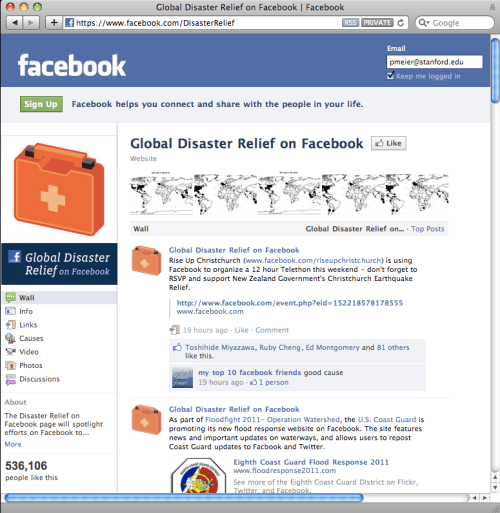
But how else might Facebook be used? The Haiti example demonstrates that the ability to rapidly recruit large numbers of volunteers is really key. So Facebook could create a dedicated landing page when a crisis unfolds, much like Google does. This landing page could then be used to recruit thousands of new volunteers for live crisis mapping operations in support of humanitarian organizations (for example). The landing page could spotlight a number of major projects that new volunteers could join, such as the Standby Volunteer Task Force (SBTF) or perhaps highlight the deployment of an Ushahidi platform for a particular crisis.

The use of Facebook to recruit volunteers presents several advantages, the most important ones being identity and scale. When we recruited hundreds of new volunteers for the Libya Crisis Map in support of the UN’s humanitarian response, we had to vet and verify each and every single one of them twice to ensure they were who they really said they were. This took hours, which wouldn’t be the case using Facebook. If we could set up a way for Facebook users to sign into an Ushahidi platform directly from their Facebook account, this too would save many hours of tedious work—a nice idea that my colleague Jaroslav Valuch suggested. See Facebook Connect, for example.

Facebook also operates at a scale of more than half-a-billion people, which has major “Cognitive Surplus” potential. We could leverage Facebook’s ad services as well—a good point made one Facebook colleague (and also Jon Gosier in an earlier conversation). That way, Facebook users would receive targeted adds on how they could volunteer based on their existing profiles.

So there’s huge potential, but like much else in the ICT-for-you-name-it space, you first have to focus on people, then process and then the technology. In other words, what we need to do first is establish a relationship with Facebook and decide on the messaging and the process by which volunteers on Facebook would join a volunteer network like the Standby Volunteer Task Force and help out on an Ushahidi map, for example.

Absorbing several hundred or thousands of new volunteers is no easy task but as long as we have a simple and efficient micro-tasking system via Facebook, we should be able to absorb this surge. Perhaps our colleagues at Facebook could take the lead on that, i.e, create a a simple interface allowing groups like the Task Force to farm out all kinds of micro-tasks, much like Crowdflower, which already embeds micro-tasks in Facebook. Indeed, we worked with Crowdflower during the floods in Pakistan to create this micro-tasking app for volunteers.

As my colleague Jaroslav also noted, this Mechanical Turk approach would allow these organizations to evaluate the performance of their volunteers on particular tasks. I would add to this some gaming dynamics to provide incentives and rewards for volunteering, as I blogged about here. Having a public score board based on the number of tasks completed by each volunteer would be just one idea. One could add badges, stickers, banners, etc., to your Facebook profile page as you complete tasks. And yes, the next question would be: how do we create the Farmville of disaster response?

On the Ushahidi end, it would also be good to create a Facebook app for Ushahidi so that users could simply map from their own Facebook page rather than open up  another browser to map critical information. As one Facebook colleague also noted, friends could then easily invite others to help map a crisis via Facebook. Indeed, this social effect could be most powerful reason to develop an Ushahidi Facebook app. As you submit a report on a map, this could be shared as a status update, for example, inviting your friends to join the cause. This could help crisis mapping go viral across your own social network—an effect that was particularly important in launching the Ushahidi-Haiti project.

As a side note, there is an Ushahidi plugin for Facebook that allows content posted on a wall to be directly pushed to the Ushahidi backend for mapping. But perhaps our colleagues at Facebook could help us add more features to this existing plugin to make it even more useful, such add integrating Facebook Connect, as noted earlier.

In sum, there are some low hanging fruits and quick wins that a few weeks of collaboration with Facebook could yield. These quick wins could make a really significant impact even if they sound (and are) rather simple. For me, the most exciting of these is the development of a Facebook app for Ushahidi.

Discussing the Recommendations of the Disaster 2.0 Report

It’s been well over a month since the Disaster 2.0 Report was publicly launched and while some conversations on the report have figured on the Crisis Mappers Network list-serve and the Standby Task Force blog, much of this discussion has largely overlooked the report’s detailed recommendations. I had hoped by now that someone would have taken the lead on catalyzing a debate around these recommendations, but since that still hasn’t happened, I might as well start.

The report’s authors clearly state that, “the development of an interface between the Volunteer and Technical Communities (V&TCs) and formal humanitarian system is a design problem that must be left to the stakeholders.” In addition, they clarify that “the purpose of this document is not to set forth the final word on how to connect new information flows into the international humanitarian system; but to initiate a conversation about the design challenges involved with this endeavor.” This conversation has yet to happen.

While the humanitarian community has proposed some design ideas, V&TCs have not responded in any detail to these proposals—although to be fair, no deadline for feedback has been suggested either. In any case, the proposed designs are meant to create an interface between humanitarian organizations and V&TCs—the two main stakeholders discussed in the Disaster 2.0 Report. It would be unfortunate and probably defeat the purpose of the report if the final interface were operationalized before any V&TCs had the chance to explain what would work best for them in terms of interface. Indeed, without an open and pro-active conversation that includes both stakeholder groups, it is unlikely that the final interface design will gain buy-in from both groups, which would result in wasted funding.

So here’s an open and editable Google Doc that includes the report’s recommen-dations. I have already added some of my comments to the Google Doc and hope others will as well. On June 1st, I will publish a new blog post that will summarize all the feedback added to the Google Doc. I hope this summary will serve to move the conversations forward so we can co-develop an interface that will prove useful and effective to all those concerned.

Video: Changing the World, One Map at a Time

Hosted in the beautiful city of Berlin, Re:publica 2011 is Germany’s largest annual conference on blogs, new media and the digital society, drawing thousands of participants from across the world for three days of exciting conversations and presentations. The conference venue was truly a spectacular one and while conference presentations are typically limited to 10-20 minutes, the organizers gave us an hour to share our stories. So I’m posting the video of my presentation below for anyone interested in learning more about new media, crowdsourcing, crisis mapping, live maps, crisis response, civil resistance, digital activism and check-in’s. I draw on my experience with Ushahidi and the Standby Volunteer Task Force (SBTF) and share examples from Kenya, Haiti, Libya, Japan, the US and Egypt to illustrate how live maps can change the world. My slides are available on Slideshare here.

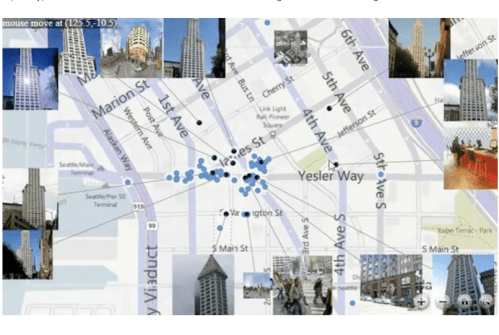
When the Network Bears Witness: From Photosynth to Allsynth?

I’ve blogged about Photosynth before and toyed around with the idea of an Allsynth platform, the convergence of multiple technologies and sensors for human rights monitoring and disaster response. The idea would be to “stitch” pictures and video footage together to reconstruct evidence in multi-media 3D type format. What if we could do this live and in networked way though?

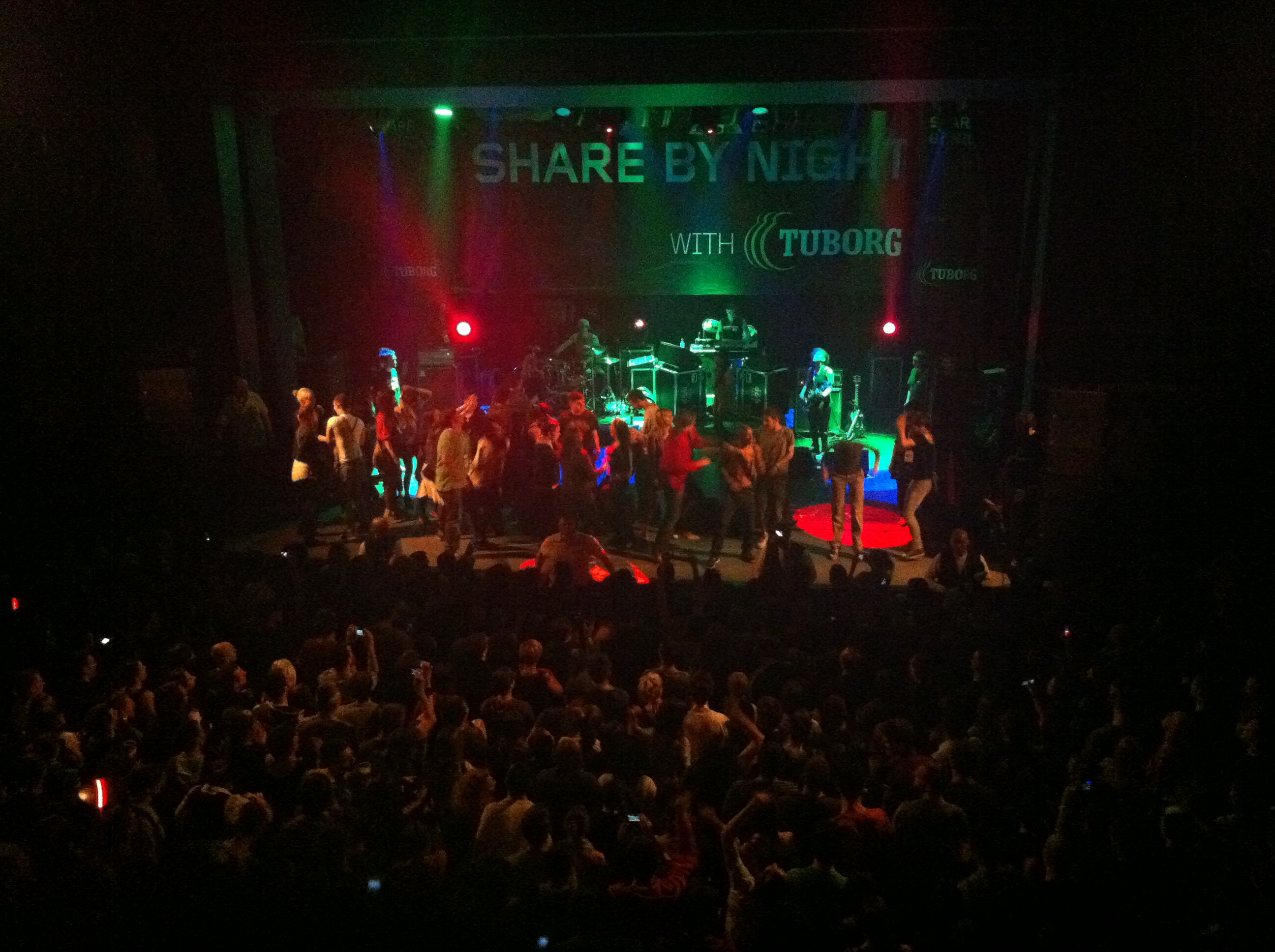
The thought popped into my head while at the Share Conference in Belgrade recently. The conference included a “Share by Night” track with concerts, live bands, etc., in the evenings. What caught my eye, one night, was not on stage but the dozens of smart phones being held up in the audience to capture the vibes, sounds, movements, etc on stage.

I then thought about that for a moment and the new start up, Color.com, that a colleague of mine co-founded. “Color creates new, dynamic social networks for your iPhone or Android wherever you go. It is meant to be used with other people right next to you who have the Color app on their smartphone. This way, you can take photos and videos together that everyone keeps.”

I was thinking about the concert and all zones bright screens. What if they were streaming live and networked? Meaning one could watch all the streaming videos from one website and pivot between different phones. Because the phones are geo-tagged, I’d be able to move closer to the stage, pivoting to phone users closer to the stage. Why need a film crew anymore? The phones in the audience become your cameras and you could even mix your own music video that way.

I’m at Where 2.0 today and Blaise Agüera y Arcas from Photosynth shared his most recent work, ReadWriteWorld, which he just announced today. “Technically it’s an index-ing, unification, and connection of the world’s geo-linked media. Informally, it’s the magic of:

  • Seeing your photos automatically connected to others;
  • Being able to simply create immersive experiences from your or your friends photos, videos, and panoramas;
  • “Fixing” the world, when the official imagery of your street is out of date;
  • Visually mapping your business, your favorite park, or your real estate for everyone to see;
  • Understanding the emergent information from the density and tagging of media.”
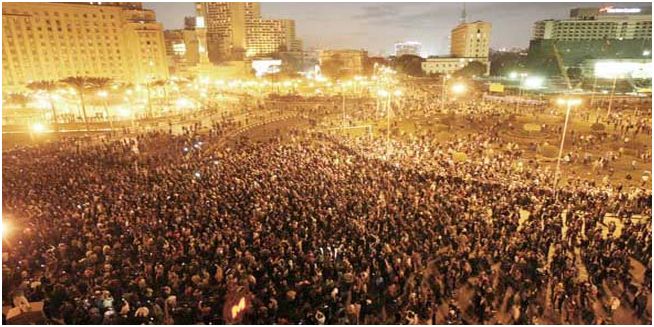
What if we applied this kind of networked, meshed technology to human rights monitoring or disaster response? Granted, most of the world does not own a smart phone. But that won’t always be the case. What if the hundreds of thousands of phones used in Tahrir Square were networked and streaming as if they were covering a concert?

 I don’t know the answer to that question, but I find the idea interesting.

Information and Communication Technology in Areas of Limited Statehood: A New Form of Governance?

I recently had the distinct pleasure of participating in a fascination workshop on “Information and Communication Technology in Areas of Limited Statehood: A New Form of Governance?” The workshop was organized by the Frei Universität’s program on Governance in Areas of Limited Statehood and co-directed by Professors Gregor Walter-Drop and Steven Livingston. Update: the result of this meeting, and a follow up meeting in 2012 is a book on the topic to be published by Oxford University Press in 2013.

Throughout the workshop, I kept thinking back to one of my all time favorite books, James Scott’s “Seeing Like a State: How Certain Schemes to Improve the Human Condition Have Failed.”  But while I’ve been fully immersed in the field of crisis mapping since the early days (2007), I haven’t really taken the time to think through the deeper implications of these new tools with respect to governance and especially statehood.

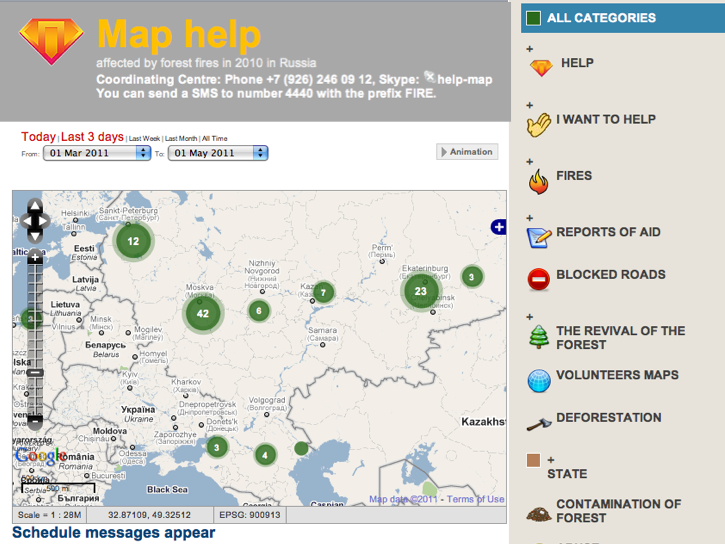
My colleague Gregory Asmolov made the link explicit during his excellent presentation on “Russian Wildfires and Alternative Modes of Governance: The Role of Crowdsourcing in Areas of Limited Statehood.” Here’s a summary:

“Because of it’s geographical size, high degree of corruption, and reliance on an extraction economy, governance by government in Russia is often weak and ineffective. Russian political expert Liliya Shevtzova goes so far as to claim that the current regime is an imitation of governance. The 2010 wildfires demonstrated the limited capacity of the state to provide effective emergency response. Information technologies, and crowdsourcing platforms in particular, fulfill the gap of the limited statehood. At the same time, however, the Russian government is also trying to use ICT to increase its claims to effective governance.”

Gregory and his colleagues in Moscow used the Ushahidi platform to create a “Help Map” during the forest fires. They also set up a call center to facilitate communication between those who needed help and those who were offering it. While I knew this had been one of the most stunning examples of citizen-based crowdsourcing initiatives in Russia, I hadn’t thought through the deeper political implications. Not only were citizens helping themselves because of Russia’s limited statehood, they were actually taking over functions of the state, which the map made very explicit. Gregory noted that some Russian citizens even went out to buy firefighting equipment with their own money to combat the fires themselves. Many official fire stations didn’t even have basic equipment needed to respond. In some ways, these efforts laid bare and indeed exposed the Russian regime as an “imitation of governance.”

The Russian government apparently responded by setting up webcams around the country to show that it was in control and still able to monitor the situation. But as this cartoon shows (from Gregory’s presentation), many in Russia were not buying the pretense. See also this article from Christian Science Monitor that Gregory shared: “Russia’s YouTube Democracy is a Sham.

As James Scott notes in his book Seeing Like a State, “the legibility of a society provides the capacity for larger-scale social engineering, high-modernist ideology provides the desire, the authoritarian state provides the determination to act on that desire, and an incapacitated civil society provides the leveled social terrain on which to build.” By legibility, Scott means the ability of the state to index, search, understand and hence manipulate society. But unlike the past, and thanks to free mapping software and crowdsourcing, society is no longer as incapacitated as it used to be. Indeed, thanks to new free and open source mapping technologies, society is able to define it’s own legibility, the contours of which necessarily reveal the limits of statehood.

Moreover, as I have noted before, the resulting map is often not as profound as the social capital generated between the dozens, often hundreds, of people collaborating on a live crisis map. In turn, this social capital facilitates mass collective action. In other words, social capital is fungible. As Scott notes, “this transformative power resides not in the map, of course, but rather in the power possessed by those who deploy the perspective of that particular map.” In many ways, therefore, the Ushahidi platform is a social-capital and collective-action generating technology.

For more on the Russia Fires projects, I recommend the following links:

The political context of the project:

Disaster Relief 2.0: Between a Signac and a Picasso

The United Nations Foundation, Vodafone Foundation, OCHA and my “alma matter” the Harvard Humanitarian Initiative just launched an important report that seeks to chart the future of disaster response based on critical lessons learned from Haiti. The report, entitled “Disaster Relief 2.0: The Future of Information Sharing in Humanitarian Emergencies,” builds on a previous UN/Vodafone Foundation Report co-authored by Diane Coyle and myself just before the Haiti earthquake: “New Technologies in Emergencies and Conflict: The Role of Information and Social Networks.”

The authors of the new study begin with a warning: “this report sounds an alarm bell. If decision makers wish to have access to (near) real-time assessments of complex emergencies, they will need to figure out how to process information flows from many more thousands of individuals than the current system can handle.” In any given crisis, “everyone has a piece of information, everyone has a piece of that picture.” And more want to share their piece of the picture. So part of the new challenge lies in how to collect and combine multiple feeds of information such that the result paints a coherent and clear picture of an evolving crisis situation. What we need is a Signac, not a Picasso.

The former, Paul Signac, is known for using “pointillism,” a technique in which “small, distinct dots of pure color are applied in patterns to form an image.” Think of these dots as data points drawn from diverse pallets but combined to depict an appealing and consistent whole. In contrast, Pablo Picasso’s paintings from his Cubism and Surrealism period often resemble unfinished collages of fragmented objects. A Picasso gives the impression of impossible puzzle pieces in contrast to the single legible harmony of a Signac.

This Picasso effect, or “information fragmentation” as the humanitarian community calls it, was one of the core information management challenges that the humanitarian community faced in Haiti: “the division of data resources and analysis into silos that are difficult to aggregate, fuse, or otherwise reintegrate into composite pictures.” This plagued information management efforts between and within UN clusters, which made absorbing new and alternative sources of information–like crowdsourced SMS reports–even less possible.

These new information sources exist in part thanks to new players in the disaster response field, the so-called Volunteer Technical Communities (VTCs). This shift towards a more multi-polar system of humanitarian response brings both new opportunities and new challenges. One way to overcome “information fragmentation” and create a Signac is for humanitarian organizations and VTCs to work more closely together. Indeed, as “volunteer and technical communities continue to engage with humanitarian crises they will increasingly add to the information overload problem. Unless they can become part of the solution.” This is in large part why we launched the Standby Volunteer Task Force at the 2010 International Conference on Crisis Mapping (ICCM 2010): to avoid information overload by creating a common canvas and style between volunteer crisis mappers and the humanitarian community.

What is perhaps most striking about this new report is the fact that it went to press the same month that two of the largest crisis mapping operations since Haiti were launched, namely the Libya and Japan Crisis Maps. One could already write an entirely new UN/Vodafone Foundation Report on just the past 3 months of crisis mapping operations. The speed with which learning and adaptation is happening in some VTCs is truly astounding. As I noted in this earlier blog post, “Crisis Mapping Libya: This is no Haiti“, we have come a long way since the Haiti response. Indeed, lessons from last year have been identified, they have been learned and operationally applied by VTCs like the Task Force. The fact that OCHA formally requested activation of the Task Force to provide a live crisis map of Libya just months after the Task Force was launched is a clear indication that we are on the right track. This is no Picasso.

Referring to lessons learned in Haiti will continue to be important, but as my colleague Nigel Snoad has noted, Haiti represents an outlier in terms of disasters. We are already learning new lessons and implementing better practices in response to crises that couldn’t be more different than Haiti, e.g., crisis mapping hostile, non-permissive environments like Egypt, Sudan and Libya. In Japan, we are also learning how a more hierarchical society with a highly developed and media rich environment presents a different set of opportunities and challenges for crisis mapping. This is why VTCs will continue to be at the forefront of Disaster 2.0 and why reports like this one are so key: they clearly show that a Signac is well within our reach if we continue working together.

Can Live Crisis Maps Help Prevent Mass Atrocities?

Live crisis maps tell stories, hopefully compelling stories the last chapters of which have yet to be written. To paraphrase my New York Times colleague Anand Giridharadas: They used to say that history is written by the victors. But today, before the victors win, if they win, there is a chance to scream out with a text message, a text message that will not vanish, a text message that will remain immortalized on a map for the world to bear witness. What would we know about what passed between Turks and Armenians, Germans and Jews, Hutus and Tutsis, if every one of them had had the chance, before the darkness, to declare for all time: “I was here, and this is what happened to me”?

Anand recently sat down with Elie Wiesel to talk about the power of bearing witness. “If one idea has animated Mr. Wiesel’s life, it is that of the power of memory: memory gives culture, he likes to say; memories spoken and shared can prevent remembered tragedies from recurring.”

This afternoon, I sat down with someone who recounted to me in graphic detail the absolute horrors he witnessed during weeks of relentless violence in Central Asia less than a year ago. Survivors uploaded their videos and pictures of the targeted violence but they did so weeks after the murders and uploaded them on several different websites, making the aggregation of evidence difficult. The international media remained unresponsive which hampered advocacy efforts. The remaining survivors were so desperate for attention that they even painted SOS in large letters on nearby roads in hopes that passing helicopters or airplanes would come to the rescue. But help from the skies above never came.

Would a live crisis map have made a difference? Would a single, public repos-itory of geo-referenced evidence mapped in real-time and multi-media format have mattered?  There are of course those who still ask, “What’s the point of putting dots on a map? How’s that supposed to change anything?” As my Ushahidi colleague Brian Herbert likes to respond, “Well then, what’s the point of having words on a page, huh? How are words going to change anything?” They say that the pen is mightier than the sword. Can the live crisis map be even mightier than the pen? If a picture is worth a 1,000 words, what is a live map worth? Will all live maps have the desired impact? Of course not, just like not every letter or book ever written has had significant impact.

But some live crisis maps may create unprecedented pressure to respond in a more timely manner. As my colleague Olga Werby recently noted,

“Mr. Moreno-Ocampo, the ICC [International Criminal Court] Prosecutor, sited Facebook and other social media as key influence in ICC taking action in Libya: ‘[Facebook and social-networking] triggered a very quick reaction. The [United Nations] Security Council reacted in a few days; the U.N. General Assembly reacted in a few days. So, now because the court is up and running we can do this immediately,’ he said. ‘I think Libya is a new world. How we manage the new challenge—that’s what we will see now.” (CNN World News article: “Gadhafi faces investigation for crimes against humanity” by Atika Shubert (watch the video at 1:40), published on March 3, 2011.) Mr. Moreno-Ocampo talks about sea-change in the world’s reaction time to crisis due to the effects of ICT!”

In his recent piece on “The Political Power of Social Media“, Clay Shirky noted that access to conversation is more important, politically, than access to information. He writes that change in behavior does not come from mass media alone. Rather, it is a two-step process where the second, social step, stems from the conversations that happen between family, friends and colleagues about new information related by the media. This is when political change becomes possible. I have witnessed first hand how crisis maps catalyze conversations and prompt questions about the patterns that materialize on the maps, the actions of a government or secret police, the reasons for the status-quo, etc.

After his conversation with Elie Wiesel, Anand wrote the following:

“The debate has tended to dwell on the question of whether all this overseas digital mirroring of a crisis, especially when the Internet is inaccessible or censored in the nation in crisis, is of any use to those on the ground. But what is often missing from the debate is the idea of bearing witness: the notion, as Mr. Wiesel, a survivor of the Auschwitz and Buchenwald concen- tration camps and a Nobel Peace Prize laureate, once put it, that an experience like the one he endured ‘cannot stay with me alone. It must be opened, it must become an offering, it must be deepened and given and shared.’ Today, at age 82, he is a trace removed from the latest technology trends, but he was more vigorous than many half his age in seeing a place for technology in tragedy. It is partly that the sufferings of others are available to much of the world in real time today, he said, and partly that the multiplication of avenues to publish and to access what others publish makes people less confined to particular sources:

‘Since they come from a variety of sources, from a variety of people, representing all ideologies and all sensitivities, we know. We cannot not know,’ Mr. Wiesel said.  ‘Whether you want it or not,’ he added a moment later, ‘we are witnesses.’ Because of technology, and because of the progress made in technology, especially in the field of communication, no one has any excuse anymore to say, ‘I don’t know; I didn’t know; I wasn’t aware’.”

After listening to the horrors that happened in Central Asia, I reached for my laptop and turned to the live Crisis Map of Libya. The person who had just recounted some of the atrocities he had witnessed had never seen a map quite like this one nor heard of Ushahidi. I explained to him the range of possible features and the different ways that people around the world have used the mapping platform over the past three years.
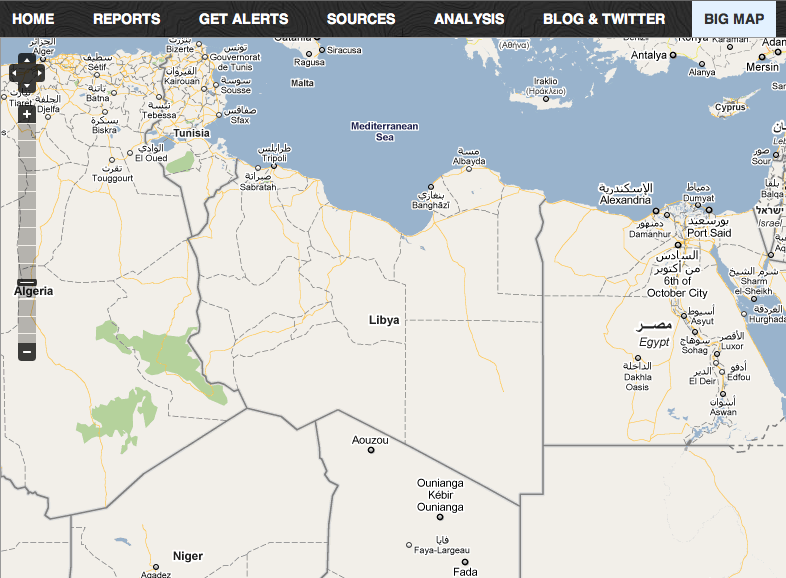
I felt some hope from my interlocutor, he was excited but I could tell that—like myself—he was also trying not to get his hopes too high. But there are definitely grounds for hope. He said something like this had never been tried in his part of the world before. Will it work? There’s only one way to find out. The last chapters of this story have yet to be written.

Live Crisis Mapping: Update on Libya and Japan

Update: The Japan Crisis Map team is now partnering with government officials. Government staff will be using iPads with the Ushahidi iPad app to report information from the field. Also, one of the Japanese cell phone operators has pledged to lend over 12,000 cell phones to volunteers.

All of us had really hoped that 2011 would be a quieter year for crisis mapping. The devastating earthquake that struck Haiti during the very first month of 2010 in many ways created a new generation of volunteer crisis mappers. This was followed rapidly by crisis mapping operations for the US, Chile, Pakistan, Russia and Colombia among other crises, which prompted the launch of the Standby Volunteer Task Force for Live Mapping in October 2010.

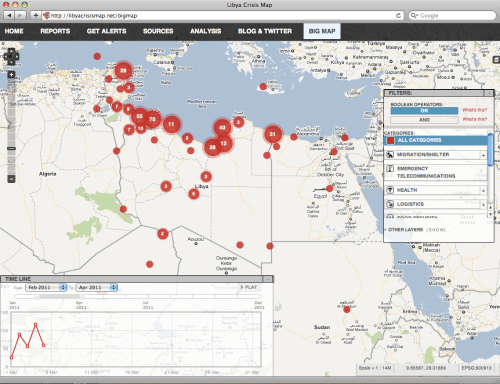
This year is unfortunately no less busy for Crisis Mappers around the world. The Standby Task Force was activated to provide mapping support to Sudan Vote Monitor for the Sudan referendum, the Christchurch Recovery Map for New Zealand earthquake and most recently the Libya Crisis Map. The latter was requested by the Information Services Section of the UN’s Office for the Coordination of Humanitarian Affairs (OCHA), an unprecedented move by the UN to engage directly with volunteer technical communities like the Task Force.

In order to provide the UN with more long term crisis mapping support in Libya, we teamed up with the UN’s Online Volunteer Service program to scale the number of Task Force volunteers considerably. We more than doubled our size in a week and now have more than 400 volunteers from over 50 different countries around the world. It was a huge challenge to train so many new crisis mappers, and that’s an understatement. But our seasoned volunteers did a formidable job and our new crisis mappers are doing an absolutely stellar job. The team has now mapped over 1,000 reports and continue to provide OCHA, UNHCR, WFP, IRC, Red Cross and others with a real time crisis map of Libya.

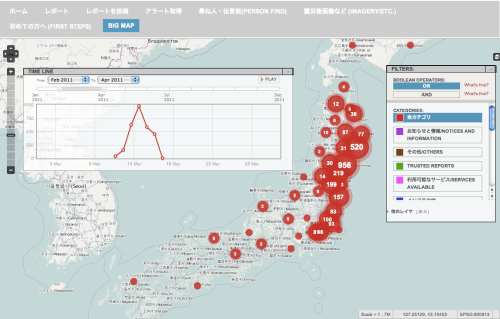
In the midst of this transition in Libya, one of the most devastating earthquakes in centuries hit northern Japan, causing one of the most destructive tsunamis in recent memory. Just hours after the earthquake, a member of Japan’s OpenStreetMap community launched a dedicated Crisis Map for the mega-disaster. A few hours later, Japanese students at The Fletcher School (which is where the Ushahidi-Haiti Crisis Map was launched) got in touch with the Tokyo-based OpenStreetMap team to provide round-the-clock crisis mapping support.

The Fletcher Team, which now includes Japanese students from Harvard and MIT, have been combing the Twittersphere for relevant updates on the situation in Japan. I have spent several hours over the past few days on the phone or Skype with members of the team to answer as many questions as I can on how to manage large scale crisis mapping efforts. They are doing a stellar job and it’s amazing that they’re able to balance these efforts while being in the middle of mid-term exams.

Over 4,000 reports have been mapped in just 6 days. That’s an astounding figure. Put differently, that’s over 600 reports per day, or one report almost every two minutes for 24 hours straight over 6 days. What’s important about the Japan Crisis Map is that the core operations are being run directly from Tokyo and the team there is continuing to scale it’s operations. It’s very telling that the Tokyo team did not require any support from the Standby Volunteer Task Force. They’re doing an excellent job in the midst of the biggest disaster they’ve ever faced. I’m just amazed.

As for who is using the map, it’s hard to get updates from our colleagues because they are completely swamped, but we have confirmed reports that several foreign Embassies in Tokyo are using the live map. One Embassy official asked that the map be kept “as up to date as possible because this picture is worth the proverbial 1,000.”

The Volunteers Behind the Libya Crisis Map: A True Story

My colleague Clay Shirky calls it “Cognitive Surplus” in his recent book. Don Tapscott and Anthony Williams refer to it as “MacroWikinomics” in theirs. What is cognitive surplus? The trillion hours of free time enjoyed by the world’s educated population every year. Don and Tony describe MacroWikinomics as mass distributed collaboration on scales we’ve never seen before thanks to technology. We’re familiar with deficits and shortages, writes, Clay, but when it comes to surplus social capital, things quickly become unpredictable—especially when this capital scales thanks to the use of social networking platforms and Web 2.0 technologies. But then again, says Clay, “Many of the unexpected uses of communication tools are surprising because our old beliefs about human nature were so lousy.”

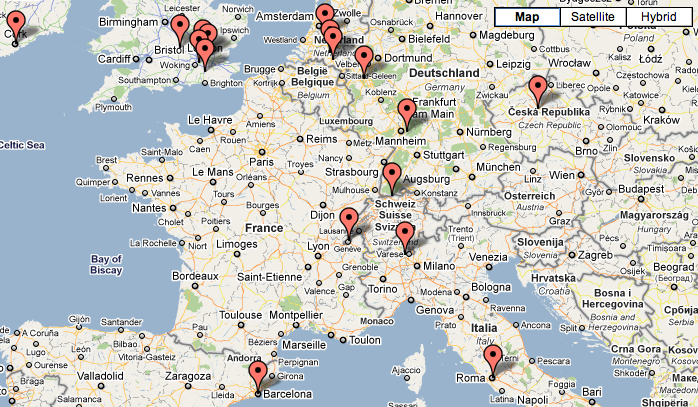
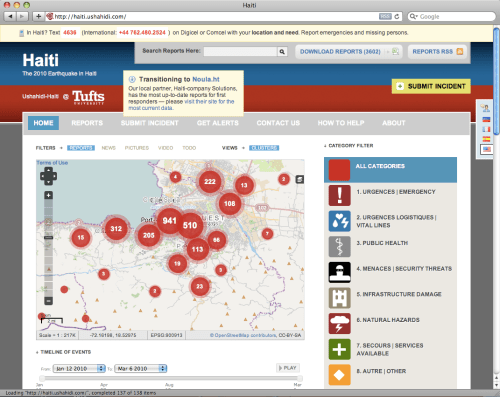
We saw cognitive surplus and macrowikinomics in action in the wake of the Haiti earthquake when more than a thousand Creole-speaking volunteers in no fewer than 49 countries around the world contributed thousands of hours of their own free time to translate tens of thousands of text messages coming from the disaster-affected population in Haiti. The map above depicts the location of each digital volunteer based on their ISP address.

As I noted in my talk at PopTech last year, it was an emotional reaction to the breaking news on CNN that prompted me to call my colleague David Kobia at Ushahidi to launch a crisis map of Haiti. But it was access to social networks, cognitive surplus, free social networking and easy mapping tools that translated that initially private, emotional reaction into public, collective action. And this was by no means a one-off, as I recently noted in my blog post on Changing the World One Map at a Time.

The Standby Task Force volunteers behind the Libya crisis map have been equally inspiring. They come from diverse backgrounds and live in some 30 countries. The map above doesn’t (yet) include all the 220+ Task Force volunteers, but it  gives you an idea of just how global this initiative is.

Just yesterday, I found out that one volunteer is an airside manager at Heathrow airport in charge of real-time crisis management and incident control. He jumps on Skype to help out on the Libya crisis map after the last aircraft have taken off around midnight. Another is 63 and was part of an initial group that put the pieces together leading to the modern tour business of rock and roll concerts back in the 1970s. He did the setup for the Simon & Garfunkle tour in the early 80s. A third volunteer brings 16 years of disaster management experience to the Task Force and has lead a number of international search & rescue teams around the world. I could go on, and on—there are more than 200 of such profiles!

It’s also great to see that the Task Force is nowhere close to just being a “Global North” initiative. We have volunteers from (or based in) Haiti, Ghana, Egypt, Sudan, United Arab Emirates, Tajikistan, Sri Lanka, Singapore, Australia, Samoa, Colombia and Brazil. And this is again just a subset.

These volunteers have accomplished so much over the past 7 days. An hour after UN/OCHA requested activation of the Task Force, the Tech Team launched the technical platform for the crisis map using Ushahidi, which they’ve been customizing (front-end and back-end) every day since. They launched a second map for the public just days later and in the first 3 days of that launch, the site received 18,000+ unique visitors and 44,000+ pageviews from 65 countries.

The Media Monitoring Team, Geolocation Team, Reports Team and Verification Team have mapped some 500 individual reports in just 7 days. They’ve been monitoring over 70 individual online sources almost around the clock for relevant content that can be added to the map. The Geolocation Team has found GPS coordinates for all the reports that end up on the map thanks to the Reports Team. The Analysis Team has produced a number of important heat maps and trends analysis reports for OCHA. The Verification Team has been providing quality control for the mapped data and triangulating reports whenever possible.

Meanwhile, the Task Team has focused on two core and urgent research projects solicited by the UN to improve the crisis map and their preparedness operations. The Humanitarian Liaison Team is composed of Task Force coordinators and representatives from the UN and other humanitarian groups. They facilitate communication between the teams listed above and our humanitarian partners. Between them, all of these teams have written over 1,200 Word document pages, font size 10, based on their exchanges on the Skype—again in just 7 days. Did I mention that these are all volunteers contributing their own “cognitive surplus” above and beyond their current jobs, classes, family lives?

It’s incredible to think that the Task Force only launched last October. And it’s only going to keep getting better, keep growing. Indeed, we’re now in touch with the coordinators of the United Nations Volunteer (UNV) program after I suggested to the UN in a phone conversation and my previous blog post that we tap into that resource to scale the Task Force’s support for Libya and beyond. It turns out the UN has an Online Volunteers Service (OVS) website!

According to our contacts at OVS,

“Many NGOs, governments and United Nations agencies already recognize the value of online volunteering, their satisfaction with the collaboration with online volunteers runs at 90%.  In 2010, our three person OVS staff team mobilized 10,000 online volunteers from 168 countries who completed 15,000 assignments, amongst them online volunteers who supported UN OCHA Colombia in the area of disaster related data gathering and management.”

To say I’m super, super excited about this potential collaboration would be an understatement. In fact, I always grin when writing the following to recruit new volunteers: “So, you want to be a Crisis Mapper?” Totally stealing Yoda’s line from StarWars when he asks young Luke Skywalker: “So, you want to be a Jedi, hmmmm?” For me, today’s Jedis are definitely the crisis mappers I work with on the Task Force. So as I’m fond of saying:

“May the Crowd be with you, always.”

Changing the World One Map at a Time

The response to last year’s crises in Haiti, Chile and Pakistan revealed an exciting potential. Volunteers from thousands of miles away could possibly play an important role in humanitarian operations by using social networking platforms and free, open source software to create live crisis maps. Today’s volunteer efforts on the Libya Crisis Map are turning that potential into reality.

When I called Ushahidi’s David Kobia to launch the Haiti Crisis Map just hours after the earthquake that struck Port-au-Prince, that was purely an emotional reaction. I had no plan. I just needed to do something because watching the first reports coming in on CNN was agonizing and unbearable. Some of my closest friends from The Fletcher School were in Haiti at the time and I had no idea whether they were still alive. Little did I know that several hundred volunteers from dozens of countries would soon join the efforts to create a live crisis map of the disaster-struck country.

I called David again a few weeks later just hours after another earthquake had struck, this time Chile. Unlike Haiti, I now had a better sense of what it would take to launch a crisis map, but I had no idea who might volunteer to keep this map alive around the clock since volunteers working on Haiti were either over-stretched or burnt out, or both (like I was). As luck would have it, I was due to give a talk at Columbia University that same day on our experience in Haiti. So I used my speaking slot to recruit volunteers for Chile. Several came up to me after the presentation and some sixty new volunteers were trained within 48 hours. This is how the Chile Crisis Map got started.

Pakistan was different. I didn’t launch a crisis map; someone else did, and from Karachi. But he needed volunteer support to create the Pakistan Crisis Map so we turned to the incredible volunteers who had helped out in Haiti and Chile and recruited new ones along the way. By now, we had a core set of volunteers with an impressive track record in live crisis mapping.

This is when I realized what the next logical step was. To give these volunteers a name and visibility. We needed to give them the opportunity to share what they had learned and train new recruits. Thus was born the Standby Volunteer Task Force: an online community for live mapping.

We got to work right away after launching in October 2010. Our first step was to create protocols and establish workflows in order to streamline crisis mapping processes and render them as efficient and effective as possible. We had the opportunity to test our first drafts thanks to the UN OCHA Colombia team who invited us to participate in an official earthquake disaster simulation exercise just weeks after we launched. This provided us with invaluable feedback which we used to revise our protocols.

In January of this year, we activated the Task Force to provide live mapping support to monitor the referendum in Southern Sudan. We also learned a lot from that experience and improved our workflows accordingly. Last month, New Zealand was struck by a powerful earthquake so we activated the Task Force at the request of local disaster response colleagues. Again, there were some important lessons gained from that deployment, and again we went back to our protocols and workflows to improve them further.

This week, the Information Services Section of OCHA in Geneva requested that the Task Force be activated for Libya. This was a first. Unlike Haiti, we had a direct channel from day one to the main coordinating body of the UN for humanitarian assistance. We also had a trained network of volunteers on standby with protocols and workflows that had already been revised and tested several times over almost half-a-year. It is also important to emphasize that many Task Force volunteers are skilled professionals, including humanitarian professionals. This is a self-selected group and while many new volunteers who join may have little experience in crisis mapping, they go through a structured training process managed by the most experienced volunteers on the team.

The result? A Crisis Map of Libya launched within hours and public institutional support expressed within days. Some of the awesome volunteers crisis mapping Libya brought their experience from the Haiti, Chile and Pakistan days. Most however, are newly trained and bring renewed energy, dedication and good cheer to the Task Force.

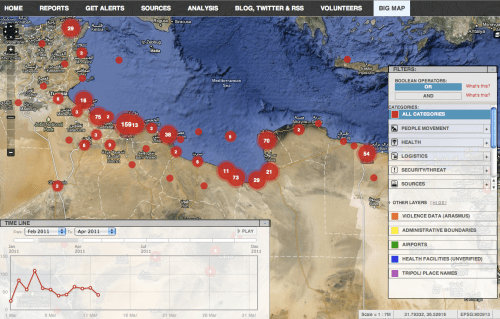
Below is a new interface option developed as a plugin for an Ushahidi project in Liberia that is being used for Libya as well. Our colleagues at OCHA are using this interface almost exclusively as it provides a number of important functionalities for data visualization and comparative analysis:

The public tweets below are amazing and unprecedented in so many ways! Thank you UN and Josette, we really appreciate your public support!

Note that Josette Sheeran is the Executive Director of WFP.

We still have a long way to go with the Task Force, but boy have we covered even more ground since Haiti. There are for me two powerful narratives in this story:

The first is a reminder that being human is about helping others in need. And thanks to today’s easy mapping platforms, volunteers can help respond to a crisis from thousands of miles away by collaborating online to create a live map that can be used to support humanitarian operations. They can use social networking platforms to connect, organize, recruit and train. There’s so much we as volunteers can do online to help, especially if we’re prepared and are ready to work hard. This is why I think it’s time for established volunteer networks like UN Volunteers (UNVs) to offer both field-based and web-based opportunities. Why not train UNVs in online crisis mapping so they can be activated to directly support UN operations via web?

The second powerful narrative for me is the collaboration between large established organizations and new decentralized volunteer networks. OCHA took a bold move when they decided to bet on the Volunteer Task Force for the Libya Crisis Map. They should be applauded. They’ve never done this before and neither have we (vis-a-vis direct collaboration with a UN office during a major crisis). I find this unprecedented move a powerful indication that learning by doing is almost always better than learning by just talking. This impromptu collaboration also shows that large organizations and small volunteer networks can work together in a way that creates more added value than flying solo does.

It’s the beginning of a new world for humanitarian response; The Prologue, if you will. I’m excited for what comes next. I know there’s a lot to figure out and many obstacles to overcome. I have no illusions of that. But I’m hopeful; as ready as I’ll ever be; and I have the honor and privilege to work with and learn from the best volunteer network of crisis mappers on the planet. They are the true heros, for without them the map would be barren. Onwards.