Category Archives: Crisis Mapping

The Crowdsourcing Detective: Crisis, Deception and Intrigue in the Twittersphere

My colleague Anahi Ayala recently started a blog called “Diary of a Crisis Mapper.” I highly recommend it. Her latest blog post on Ushahidi-Chile relates some intriguing detective work that all started with the following tweet:

The Tweet was mapped on Ushahidi-Chile. You’ll note in the discussion forum part of this report that a volunteer (Annette) updated the alert by adding that the person had been rescued. She did this after seeing a Tweet from @biodome10 saying that he had been rescued. This is when I emailed Anahi (on February 27th) to ask whether she could try and confirm this case.

It turns out the person behind the Twitter handle @biodome10 was pretending to be Gerry Fraley, a journalist with the Dallas Morning News. Biodome10 even used Gerry Fraley’s own profile picture on their Twitter profile. It also turns out that @biodome10 has a history of disseminating false information. But this first Tweet set in motion an intriguing series of events.

Someone in Chile saw the Tweet and actually called the police to report that a person was trapped under a building at that address. Anahi did some online detective work and found out that “the police decided to send 3 trucks from the fire dept, 30 cops from the rescue department, and the chief of Security in person to the address to save the person in question (see James’s blog on this, and also reported from @criverap from Twitter).”

Anahi followed this lead further:

It was Saturday night in Santiago and even if there had been one of the worst earthquake of the last 25 years, life was still going on. So it was for Dinamarca Pedro and Vargas Elba, a couple that was celebrating that night its 39 wedding anniversary. Of course, there was not much to celebrate, so at 11pm Pedro and Elba were preparing to go to bed. They lived in Lautaro 1712, Santiago, Chile.

When the door was open by force by police, carabineros and detectives, with the chief of Security in person leading the operation, the couple almost had a heart attack. No person to rescue, only an old couple which is going to remember its 39 anniversary for the rest of its life! (reported on Las Ultima Noticias Newspaper on the 1st of March 2010).

That’s not all, @biodome10 sent out a second false Tweet the following day, which was also mapped on Ushahidi-Chile:

Again the police mobilized to the location after seeing the Tweet on Twitter. When they arrived at the scene, there were no collapsed buildings in that part of the city, so they promptly left. This time though, the Tweet actually ended up on hundreds of t-shirts as part of a fund raising campaign for the Red Cross.

As Anahi writes:

Both those tweets were false. Now we know that because we know that Biodome10 was posting false information. But the Chilean police didn’t have the time and the resources to verify this information. They had priorities: go and save people as quickly as possible. They wasted time two times following both those twitter messages, while they could have been use this time to save other people in danger. Biodome10 was not only playing with social networks and Twitter, he was playing with people’s life.

At the same time, though, Anahi notes that she was able to do all her detective work right from her laptop by just accessing the web:

[…] crowd sourcing verification of information works. I have been able to find all those information just by sitting on my desk in NYC/Boston. Others have done investigations for me. I have been just collecting people’s tweets, read their blogs, and put together all the information. The fact that different people, from different parts of the world have been investigating by themselves this issue, has given me the possibility to find out that Biodome10 was a liar, independently from his identity and to be sure that the two reports we posted on our Ushahidi map were actually false.

To this end, Anahi advises groups that crowdsource crisis information to set up a verification team that can use crowdsourcing to verify information. This is precisely the principle behind Swift River, using crowdsourcing and natural language processing to crowdsource the filter. As Anahi remarks, “Crowd sourcing verification of information in this case worked. True, it was too late, especially for the police dept in Santiago, but next time we all will be ready.”

Hopefully they’ll be ready and using Swift River since the point of Swift River is to help groups validate information in near real-time. In fact, had Swift River been used during Chile, those two Tweets by @biodome10 would have received the lowest scores because there was only one “witness” reporting the incidents. Of course, Swift River is not a silver bullet as I have already elaborated on here. But we must be careful not to despair because of two false Tweets. They represent 0.0016% of all the reports mapped on Ushahidi-Chile, and they were subsequently verified.

As Dave Warner noted at a panel on USIP Mobile Phones and Afghanistan last week, “Snipers in Afghanistan use roads. Does that mean we should go and tear up all the roads?” Of course not.

I have 3 take-aways from these anecdotes:

  1. I wouldn’t be surprised if there were grounds to take legal action against @biodome10. This should send a signal to others who want to play with people’s lives during disasters.
  2. The Tweets were verifiable by anyone with an Internet connection, the main challenge was time not verifiability.
  3. Both Tweets could have been verified more quickly by others on site had they gotten wind of the information. They could easily have gone down the street and taken a picture showing that there was a wedding anniversary at the first location and intact buildings at the second. They could prove the date by including a picture of the day’s newspaper in the photographs.

In sum, I’m still of the opinion that greater connectivity can lead to greater self-correction. The detective work can be crowdsourced, my dear Watson.
Patrick Philippe Meier

Demystifying Crowdsourcing: An Introduction to Non-Probability Sampling

The use of crowdsourcing may be relatively new to the technology, business and humanitarian sectors but when it comes to statistics, crowdsourcing is a well known and established sampling method. Crowdsourcing is just non-probability sampling. The crowdsourcing of crisis information is simply an application of non-probability sampling.

Lets first review probability sampling in which every unit in the population being sampled has a known probability (greater than zero) of being selected. This approach makes it possible to “produce unbiased estimates of population totals, by weighting sampled units according to their probability selection.”

Non-probability sampling, on the other hand, describes an approach in which some units of the population have no chance of being selected or where the probability of selection cannot be accurately determined. An example is convenience sampling. The main drawback of non-probability sampling techniques is that “information about the relationship between sample and population is limited, making it difficult to extrapolate from the sample to the population.”

There are several advantages, however. First, non-probability sampling is a quick way to collect way to collect and analyze data in range of settings with diverse populations. The approach is also a “cost-efficient means of greatly increasing the sample, thus enabling more frequent measurement.” In some cases, the non-probability sampling may actually be the only approach available—a common constrain in a lot of research, including many medical studies, not to mention Ushahidi Haiti. The method is also used in exploratory research, e.g., for hypothesis generation, especially when attempting to determine whether a problem exists or not.

The point is that non-probability sampling can save lives, many lives. Much of the data used for medical research is the product of convenience sampling. When you see your doctor, or you’re hospitalized, that is not a representative sample. Should the medical field throw away all this data based on the fact that it constitutes non-probability sampling. Of course not, that would be ludicrous.

The notion of bounded crowdsourcing, which I blogged about here, is also a known sampling technique called purposive sampling. This approach involves targeting experts or key informants. Snowball sampling is another type of non-probability sampling, which may also be applied to crowdsource of crisis information.

In snowball sampling, you begin by identifying someone who meets the criteria for inclusion in your study. You then ask them to recommend others who they may know who also meet the criteria. Although this method would hardly lead to representative samples, there are times when it may be the best method available. Snowball sampling is especially useful when you are trying to reach populations that are inaccessible or hard to find.

A project like Mission 4636 and Ushahidi-Haiti could take advantage of this approach by using two-way SMS communication to ask respondents to spread the word. Individuals who sent in text messages about persons trapped under the rubble could (later) be sent an SMS asking them to share the 4636 short code with people who may know of other trapped individuals. When the humanitarian response began to scale during the search and rescue operations, purposive sampling using UN personnel could also have been implemented.

In contrast to non-probability sampling techniques, probability sampling often requires considerable time and extensive resources. Furthermore, non-response effects can easily turn any probability design into non-probability sampling if the “characteristics of non-response are not well understood” since these modify each unit’s probability of being sampled.

This is not to suggest that one approach is better than the other since this depends entirely on the context and research question.

Patrick Philippe Meier

Think You Know What Ushahidi Is? Think Again

Ushahidi is the name of both the organization (Ushahidi Inc) and the platform. This understandably leads to some confusion. So let me elaborate on both.

Ushahidi the platform is a piece of software, not a methodology. The Ushahidi platform allows users to map information of interest to them. I like to think of it as democratizing map making in the style of neogeography. How users choose to collect the information they map is where methodology comes in. Users themselves select which methodology they want to use, such as representative sampling, crowdsourcing, etc. In other words, Ushahidi is not exclusively a platform for crowdsourcing. Nor is Ushahidi restricted to mapping crisis information. A wide range of events can be mapped using the platform. Non-events can also be mapped, such as football stadiums, etc.

The platform versus methodology distinction is significant. Why? Because new users often don’t realize that they themselves need to think through which methodology they should use to collect information. Furthermore, once they’ve chosen the methodology, they need to set up the appropriate tools to collect information using that methodology, and then collect.

For example, if a user wants to collect election data using representative sampling, they will need to ensure that they select a sample of polling stations that are likely to be representative of the overall population in terms of voting behavior. They will then need to decide whether they want to use SMS, email, phone calls, etc., to relay that information. Next, they’ll want to hire trusted monitors and train them on what and how to report. But none of this has anything to do with Ushahidi the platform.

Here’s an analogy: Microsoft Word won’t tell me what methodology to use if I want to write a paper on the future of technology. That is up to me, the author, to decide. If I don’t have any training in research methods and design, then I need to get up to speed independently. MS Word won’t provide me with insights on research methods. MS Word is just the platform. Coming back to Ushahidi, if an organization does not have adequate expertise, staff, capacity, time and resources to deploy Ushahidi, that is not the fault of the platform.

In many ways, the use of Ushahidi will only be as good as the organization or persons using the tool.

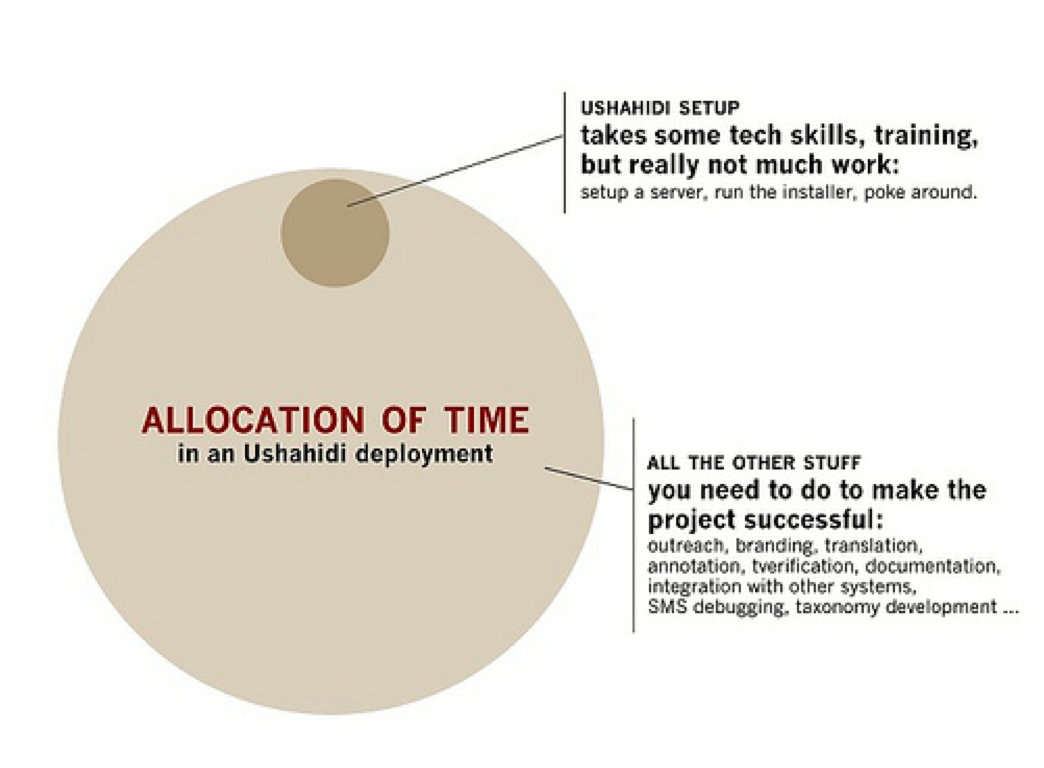
Ushahidi is only 10% of the solution (graphic by Chris Blow)

As my colleague Ory aptly cautioned: “Don’t get too jazzed up about Ushahidi. It is only 10% of the solution.” The other 90% is up to the organization using the platform. If they don’t have their act together, the Ushahidi platform won’t change that. If they do and successfully deploy the Ushahidi platform, then at least 90% of the credit goes to them.

Ushahidi the organization is a non-profit tech company. The group is not a humanitarian organization. We do not take the lead in deployments. In the case of Haiti, I launched the Ushahidi platform at The Fletcher School (where I am a PhD student) and where graduate students (not Ushahidi employees) created a “live” map of the disaster for several weeks. The Ushahidi tech team provided invaluable technical support around the clock during those weeks. It was thus a partnership led by The Fletcher Team.

We do not have a comparative advantage in deploying platforms and our core mission is to continue developing the Ushahidi platform. On occasion, we partner on select projects but do not take the lead on these projects. Why do we partner at all? Because we are required to diversify our business model as part of the grant we received from the Omidyar Network. And I think that’s a good idea.

Patrick Philippe Meier

Information Sharing During Crisis Management in Hierarchical vs. Network Teams

The month of May turned out to be ridiculously busy, so much so that I haven’t been able to blog. And when that happens, I know I’m doing too much. So my plan for June is to slow down, prioritize and do more of what I enjoy, e.g., blog.

In the meantime, the Journal of Contingencies and Crisis Management just published an interesting piece on “Information Sharing During Crisis Management in Hierarchical vs. Network Teams.” The topic and findings have implications for digital activism as well as crisis management.

Here’s the abstract:

This study examines the differences between hierarchical and network teams in emergency management. A controlled experimental environment was created in which we could study teams that differed in decision rights, availability of information, information sharing, and task division. Thirty-two teams of either two (network) or three (hierarchy) participants (N=80 in total) received messages about an incident in a tunnel with high-ranking politicians possibly being present. Based on experimentally induced knowledge, teams had to decide as quickly and as accurately as possible what the likely cause of the incident was: an attack by Al Qaeda, by anti-globalists, or an accident. The results showed that network teams were overall faster and more accurate in difficult scenarios than hierarchical teams. Network teams also shared more knowledge in the difficult scenarios, compared with the easier scenarios. The advantage of being able to share information that is inherent in network teams is thus contingent upon the type of situation encountered.

The authors define a hierarchical team as one in which members pass on information to a leader, but not to each other. In a network team, members can freely exchange information with each other. Here’s more on the conclusions derived by the study:

Our goal with the present study was to focus on a relatively simple comparison between a classic hierarchical structure and a network structure. The structures differed in terms of decision rights, availability of information, information sharing, and task division. Although previous research has not found unequivocal support in terms of speed or accuracy for one structure or the other, we expected our network structure to perform better and faster on the decision problems. We also expected the network teams to learn faster and exchange more specialist knowledge than the hierarchical teams.

Our hypotheses are partially supported. Network teams are indeed faster than hierarchical teams. Further analyses showed that network teams were, on average, as fast as the slowest working individual in the hierarchical teams. Analyses also showed that network teams very early on converged on a rapid mode of arriving at a decision, whereas hierarchical teams took more time. The extra time needed by hierarchical teams is therefore due to the time needed by the team leader to arrive at his or her decision.

We did not find an overall effect of team structure on the quality of team decision, contrary to our prediction. Interestingly, we did find that network teams were significantly better than hierarchical teams on the Al Qaeda scenarios (as compared with the anti-globalist scenarios). The Al Qaeda scenarios were the most difficult scenarios. Furthermore, scores on the Post-test showed that there was a larger transfer of knowledge on Al Qaeda from the specialist to the nonspecialist in the network condition as compared with the hierarchical condition. These results indicate that a high level of team member interaction leads to shared specialist knowledge, particularly in difficult scenarios. This in turn leads to more accurate decisions.

This study focused on the information assessment part of crisis management, not on the operative part. However, there may not be that much of a difference in terms of the actual teamwork involved. When team members have to carry out particular tasks, they may frequently also have to share specialist knowledge. Wilson, Salas, Priest, and Andrews (2007) have studied how teamwork breakdowns in the military may contribute to fratricide, the accidental shooting of one’s own troops rather than the enemy. This is obviously a very operative part of the military task. Teamwork breakdowns are subdivided into communication, coordination and cooperation, with information exchange mutual performance monitoring, and mutual trust as representative teamwork behaviours for each category (Wilson et al., 2007).

We believe that it is precisely these behaviours that are fostered by network structures rather than hierarchical structures. Network structures allow teams to exchange information quickly, monitor each other’s performance, and build up mutual trust. This is just as important in the operative part of crisis management work as it is in the information assessment part.

In conclusion, then, network teams are faster than hierarchical teams, while at the same time maintaining the same level of accuracy in relatively simple environments. In relatively complex environments, on the other hand, network teams arrive at correct decisions more frequently than hierarchical teams. This may very likely be due to a better exchange of knowledge in network teams.

Patrick Philippe Meier

From Grassroots Mapping to One Satellite Per Child

There were some amazing presentations at Where 2.0, but for me personally, Jeffrey Warren’s talk on Community-based Grassroots Mapping with Balloons and Kites in Lima was the most exciting. Jeffrey and his colleagues were inspired by two MIT undergraduate students who “launched a digital camera into near-space to take photographs of the earth from high up above.”

Jeff and colleague traveled to Lima in January 2010 to work with children and adults from several communities to bring a truly participatory (and fun!) approach to mapping.

Seeking to invert the traditional power structure of cartography, the grassroots mappers used helium balloons and kites to loft their own “community satellites” made with inexpensive digital cameras. The resulting images, which are owned by the residents, are georeferenced and stitched into maps which are 100x higher resolution that those offered by Google, at extremely low cost.

In some cases these maps may be used to support residents’ claims to land title. By creating open-source tools to include everyday people in exploring and defining their own geography, we hopes to enable a diverse set of alternative agendas and practices, and to emphasize the fundamentally narrative and subjective aspects of mapping over its use as a medium of control.

Once several pictures have been taken, they can be “stitched together” to form a map like the one below. The stitching can be done by hand or using this neat tool.

All it takes is $100 for the equipment below. In fact, you could even use $1.30 trash bags instead to reduce the cost. I highly recommend looking through this fun illustrated guide.

I also like how the communities used tracing paper to annotate the maps they produced from the balloons. This is something I had wanted to do for this community mapping project in the Sudan.

I absolutely love this project. It’s easy, cheap, participatory, empowering and fun. Jeff and company are democratizing aerial mapping. I’d love to see this approach take off all over the world and would like to find some use cases in the humanitarian context, e.g., in post-disaster reconstruction and development. Imagine if local communities in Haiti could use balloon mapping to hold the development community accountable for the way their own country is being rebuilt. This approach can democratize urban planning in post-disaster environments.

Do check out the Grassroots Mapping website. You can also sign up for the group’s mailing list. If you’re in the Boston area, you may want to join Jeffrey and friends for some balloon mapping excercises. I definitely will! In the meantime, check out Jeff’s Ignite Talk from the 2009 CrisisMappers Conference.

Patrick Philippe Meier

Why Universities are Key for the Future of Crisis Mapping

In January 2010, I launched the Ushahidi Crisis Map for Haiti. In February, I launched the Ushahidi Crisis Map of Chile. Neither initiative would have been possible without the incredible student volunteer network that formed at The Fletcher School/Tufts University, the Graduate Institute in Geneva and Columbia University’s School of International and Public Affairs (SIPA). We also had a few volunteers from the London School of Economics (LSE).

At one point, I had set up a Skype IM chat group titled “Global Situation Rooms” which included the core reps from Fletcher, Geneva and SIPA. The highlight for me was when we all got on the chat group to debrief. I moderated the session and would literally write “Geneva, you have the floor”, “New York, you have the floor”, “London, you have the floor”, etc. Talk about the first open source, global neogeography disaster response operation.

Given that The Fletcher School/Tufts group have paved the way forward in absolutely amazing ways, I  suggested back in February that we formalize this set up and launch a network of global situation rooms. I think the Fletcher team could play a leading role in this bold initiative and become the convener or Secretariat of this global network. If a disaster strikes Madagascar, for example, the Fletcher team could convene reps from other University Situation Rooms (USRs) and coordinate the near real-time crisis mapping support.

I ran with this idea and pitched it to the Clinton Global Initiative University (CGI-U), which will take place in mid-April. I’ve called the project “Universities for Ushahidi” and made this my commitment as a student participant at CGI-U. I’ve thought about this initiative further over the past two months and would like to focus  specifically on universities in the developing world and not restrict operations to emergency response, or to Ushahidi.

So here’s my dream: have the awesome team at Fletcher pave the way in training 12 universities around the world, 4 in Africa, 4 in Asia and 4 in South America. Have each of these new Situation Rooms be capable of launching near real-time crisis mapping support projects within hours after a crisis strikes in their countries/regions. In between crises, the new Situation Rooms could run other projects using Ushahidi. As I noted above, however, I would want this to include training and applications combined with other tools including OpenStreetMap, FrontlineSMS, etc.

I’m really excited by the potential. Universities have a clear comparative advantage. What other organization or institution has the ability to mobilize hundreds of student volunteers for weeks on end? I do see this as a form of activism. Students should be paving the way, revolutionizing the way we think and do things. I’m proud to be a Fletcher School student and can think of no better way to contribute to our moto: “Preparing Leaders with a Global Perspective.”

Fletcher students are exactly the type of students who will go on to work for the UN and other humanitarian/development/human rights organizations. They are the first generation of Crisis Mappers and their leadership, professionalism and camaraderie will change what is possible in this space. That is why universities are key to the future of crisis mapping.

Patrick Philippe Meier

The Rise of CrisisMapping and the CrisisMappers Group

My colleague Jennifer Leaning and I co-founded the Program on Crisis Mapping and Early (CM&EW) at the Harvard Humanitarian Initiative (HHI) back in June 2007. At the time, the term “Crisis Mapping” was virtually unheard of. In January 2008, Ushahidi demonstrated how crisis mapping could be combined with crowdsourcing and SMS.

In October 2009, my colleague Jen Ziemke and I launched the International Network of CrisisMappers with a dedicated Crisis Mappers Google Group, which currently has over 700 subscribers. Jen and I also co-organized the  first International Conference on Crisis Mapping (ICCM 2009) last year and are now preparing for ICCM 2010, which will focus on Haiti and Beyond. Over 30 online videos on Crisis Mapping have also been produced and we recently launched a dedicated monthly WebCast series on CrisisMapping as well.

On January 21, 2010, I attended a speech by Secretary of State Hillary Clinton in which she noted the pivotal role of interactive maps and SMS in the disaster response to Haiti. In her own words:

“The technology community has set up interactive maps to help us identify needs and target resources. And on Monday, a seven-year-old girl and two women were pulled from the rubble of a collapsed supermarket by an American search-and-rescue team after they sent a text message calling for help. Now, these examples are manifestations of a much broader phenomenon. The spread of information networks is forming a new nervous system for our planet.”

The CrisisMappers community played an instrumental role in the disaster response to Haiti. The interactive maps that Clinton refers to  include OpenStreetMap, Sahana, Telescience and Ushahidi. I like this idea of a new nervous system and hope the CrisisMappers community can continue growing this nervous system to ensure more rapid responses to crises. The term “crisis mapping” is at least beginning to make the rounds.

A Google search of “crisis mapping” in October 2009 returned 36,500 hits. Today, 5 months later, the search returns “123,000” hits.  During this time, Crisis Mapping initiatives have been written about and featured on CNN, ABC News, MSNBC, BBC, Reuters, UK Guardian, Al-Jazeera, NPR, the New York Times, the Washington Post, the Boston Globe, Huffington Post, Newsweek, the Globe and Mail, Wired, NewScientist, PC World, DiscoveryNews, Forbes Magazine and the TED Blog.

Several members of the CrisisMappers Group are currently preparing to present their projects at this year’s Where 2.0 Conference:

  • Haiti: Crisis Mapping the Earthquake –> link
  • Crowdsourcing the Impossible: Ushahidi-Haiti –> link
  • Community-Based Grassroots Mapping –> link
  • Mobilizing Ushahidi-Haiti  –> link
  • Crisis Mapping –> link
  • MapKibera –> link

I very much look forward to ICCM 2010 as I’m very curious to discuss what the next generation of crisis mapping technologies and applications will bring.

Patrick Philippe Meier

Using Massive Multiplayer Games to Playsource Crisis Information

This blog sequel follows this one on Netsourcing, Crowdsourcing and Turksourcing. This new round of thinking is inspired by a recent dinner conversation (that made it to the New York Times!) with Riley Crane, Omar Wasow, Anand Giridharadas, and Jen Brea. If the ideas below seem a little off the wall, the bottle of Kirsch I brought over for the Swiss fondue is to blame. Some parts of this post were were also inspired by The Polymath Project and conversations with Kuang Chen, Abraham Flaxman and Rob Munro during the Symposium on Artificial Intelligence for Development (AI-D) at Stanford University.

I wonder how many indoor cycling bikes exist in the world, or at least in the US. The number may in part be a function of the number of gyms. In any event, to borrow the language of Douglas Adams, the number must be “vastly, hugely, mind-bogglingly big,” especially the total number of hours spent on these bikes everyday in California alone. I’ve often wondered how much energy these machines generate when used; enough to recharge my iPhone? Hundreds of iPhones?  Why do I ask?

I’ve been thinking about the number of hours that gamers spend playing computer games in the US. Hundreds of thousands hours? I’m not quite sure what the correct order of magnitude is, but I do know the number is increasing. So how does the cycling analogy come in? Simple: how can we harness the millions of hours spent playing computer games every year to turksource crisis information? Could real world information be subtly fed into these games when necessary to process Human Intelligence Tasks (HITs) that would help tag and/or geolocate crisis information? Can we think of mobile games akin to FourSquare that could generate collective action around HITs?

In other words, what is the game equivalent of reCAPTCHA for turksourcing crisis information? Remember the computer game “Where in the World is Carmen Sandiego?” Could a cross between that type of learning game, a treasure hunt and “The DaVinci Code” get gamers hooked? I’m probably thinking way too old school here. Perhaps taking the most popular games today and subtly embed some HITs is the way to go. As mentioned in my previous blog post, one of the most time consuming and human resource intensive tasks that volunteers carried out during the first weeks of Ushahidi-Haiti was the manual, near real-time geo-location of unfolding events.

So how about adding a fun gaming user interface to OpenStreetMap? Like any good game, a user would be able to specify a difficulty level. Making a mobile UI would also come in handy when tourists are abroad and want to help geolocate. You’ve heard of eco-tourism, welcome to geo-tourism. Maybe Lonely Planet or Rough Guides could partner on such a project. Or, as happened in Haiti, geo-coding was also crowdsourced thanks to the pro-active Haitian volunteers of Mission 4636 who were far quicker at tagging than student volunteers. But what happens if the only volunteers around are not country experts or familiar with satellite imagery? Is there a way to use a Mechanical Turk Service approach to greatly simplify this geocoding process?

Maybe the day will come when kids whose parents tell them to get off their computer game to do their homework will turn around and say: “But Mom, I’m learning about the geography of Mozambique, which is what my quiz is on tomorrow, and I’m playsourcing crisis information to save lives at the same time!”

Patrick Philippe Meier

From Netsourcing to Crowdsourcing to Turksourcing Crisis Information

The near real-time crisis mapping of the disasters in Haiti and Chile using Ushahidi required a substantial number of student volunteers. These volunteers were not the proverbial crowd but rather members of pre-existing, highly-connected social networks: universities. How do we move from netsourcing to crowdsourcing and on to turksourcing?

Student volunteers from Fletcher/Tufts, SIPA/Columbia and the Graduate Institute in Geneva all represent established social networks and not an anonymous crowd. They contributed over ten thousand free hours over the past 3 months to monitor hundreds of sources on the web and map actionable information on an ongoing basis. The Core Team at Fletcher spent dozens of hours training volunteers on media monitoring and mapping.

Netsourcing presents some important advantages. Pre-existing social ties can help mobilize a trusted volunteer network. I  just sent one email to the Fletcher list-serve and because the Fletcher student body is a tight community, this eventually let do hundreds of volunteers being trained and contributing to the crisis mapping of Haiti.

The first call for volunteers

At the same time, however, netsourcing is bounded crowdsourcing. In other words, netsourcing is scale-constrained. Imagine if Wikipedia contributions had been limited to professors only—that too would be bounded crowdsourcing. So how do we move from netsourcing to crowdsourcing crisis information? How do we move from having 300 volunteers connected via existing social networks to 300,000 or even 3,000,000 anonymous volunteers?

This was one of the many questions that my colleague Riley Crane, a friend of his and I discussed for almost 4 hours over dinner. (Riley recently rose to fame when he and his team at MIT that won DARPA’s Red Balloon competition). The answer, we think, is to develop a Mechanical Turk Service plug-in for Ushahidi. I’m calling this turksourcing. The two most time-consuming tasks that volunteers labored on was media monitoring and geo-location. Both processes can be disaggregated into human intelligence tasks (HITs) combined with some automation, like Swift River. And none of this would require prior training.

This is a conversation I very much look forward to continuing with Riley and one that I also plan to bring up at Nathan Eagle‘s Symposium on Artificial Intelligence for Development (AI-D) at Stanford next Monday. There is another related conversation that I’m excited to continue—namely the use of distributed, mobile gaming as an incentive catalytic for collective action, an area that Riley has spent a lot of time thinking about.

In terms of Ushahidi, If turksourcing crisis information can be combined with gaming, users could compete for altruism points, e.g., for how many HITs they contributed to a disaster response. This could be a proxy for how “good” a person is; a kind of public social ranking score for those who opt in. I imagine having individuals include their score and ranking on their blog (much like the number of Twitter followers they have). Who knows, a high altruism score could even get you more dates on Match.com.

Patrick Philippe Meier

Haiti and the Tyranny of Technology

How quickly we forget what has come before us. Is it because our technologies are so new or different that recommendations in the disaster literature don’t apply to us? The technology community repeatedly emphasized the unprecedented nature of the response in Haiti, particularly with respect to communication with disaster effected populations. Was is it really a complete departure? To a large extent yes, but were there really no guidelines available?

The challenges that materialized in the response to Haiti included:

  • Raising of expectations
  • Lack of formal complaints mechanism
  • Absence of downward accountability
  • Coordination and clarity of messaging

Guidelines to address these challenges do exist. I’ll draw on two documents that are both 4 years old. The first is my colleague Imogen Wall’s study “The Right to Know: The Challenge of Public Information and Accountability in Aceh and Sri Lanka”. The second is the Final Report of the Global Symposium+5.

Here are some of the main points to take home from Imogen’s 60-page study:

  • Many organizations are still paying for mistakes made in communicating with communities in the early days of the tsunami recovery effort, resulting in what many call the ‘broken promises’ phenomenon. The inherent problems of managing expectations were exacerbated by a widespread use of translators and jargon and the extreme levels of trauma experienced by beneficiaries.
  • Confusion about policies, an inability to report misuse of aid, ignorance about where to turn for assistance, cynicism and anger stemming from broken promises about aid, and mismanaged expectations were all noted in the 2004 Tsunami. But while cases of actual broken promises undoubtedly occurred, the majority of perceived broken promises actually seem to have resulted from communications problems.
  • Managing communications with communities is key to successful community-driven development. Knowledge is power: without information, communities cannot participate, make choices, or ask questions. Good communication is also about trust and partnership, and is thus at the heart of successful community partnerships.
  • Putting communities at the center of disaster response requires that adequate provision be made for community access to information about projects, channels through which they can ask questions, and mechanisms by which they can register dissatisfaction or complaints. Such efforts both supply information and create space for dialogue between communities and aid agencies, a two way information flow tht is beneficial to both parties. No accountability and transparency system is complete without a strong complaints mechanism. Complaints mechanisms have an important role in conflict mitigation at a community level and in the prevention of violence.
  • Donors must require downward accountability and communications strategies in projects they fund and by exploring ways in which they can receive feedback on projects from beneficiaries.
  • Until information is properly shared with beneficiaries, they will never be equal partners. And until they are provided with a voice and the ability to judge a project’s viability, organizations will never be able to claim that they enabled survivors to rebuild and move on to a as bright a future as possible.
  • Primarily, beneficiaries want practical information that explains what aid is available, what assistance they can expect, how to apply for it, when aid will arrive, why what they have received might differ from their neighbor, and what to do if they are not satisfied. They are not interested in materials that simply promote a particular organization. Secondly, they are very interested in hearing how the aid effort is going, how money is being spent, what problems are being experienced elsewhere, and what solutions are being found.
  • Low-tech solutions are almost invariably better. A simple bulletin board can  do more to enhance transparency and accountability towards beneficiaries than any website. All IDP locations should be required to have a bulletin board, and aid organizations should be required to display basic project information and contact details.
  • Broadly speaking, the aim of public relations (PR) is to promote an organization; the aim of public information (PI) is to channel information to the relevant audiences. But most communications expertise within international aid organizations is geared toward public relations.
  • Aid organizations have a tendency to regard communication with beneficiaries as an optional extra rather than seeing information as a vital commodity and a humanitarian right, the key to empowerment, better relationships with beneficiaries and a more effective recovery effort. There has also been a failure to understand that information deprivation causes stress and exacerbates trauma.
  • Organizations should consider, where appropriate, incorporating some form of community-bsaed monitoring and evaluation systems into their projects.
  • Written community contracts between organizations and beneficiaries should be adopted wherever possible.
  • There will always be questions regarding how much information can or should be shared with beneficiaries. Communities should be the driver of how much information will be shared.
  • Always leave a contact name, number and address, ideally of the liaison person responsible for the community.
  • With text messaging, a simple, short message can be sent to a list of phone numbers simultaneously. And while it is easy to compile a list of phone numbers of key people in beneficiary communities, collating and managing wider lists of numbers and making them available to aid organizations could be undertaken by a body such as OCHA’s Humanitarian Information Centers.
  • SMS is a powerful medium that can be harnessed for otherwise very difficult tasks, such as providing information quickly that is available only at the last minute, such as times for aid deliveries or changes in a medical clinic’s arrival time in a certain area. The list of recipients can be easily tailored to include only those in a certain geographical area, enabling messages to be very precisely targetted.

The Final Report of the 2006 Symposium+5 event that I participated includes a review of lessons learned, best practices and recommendations on the topic of communicating with disaster affected communities. Here are the main points:

  • Programs designed to enhance two-way information-sharing and communication with affected populations are not mainstreamed into all phases of the humanitarian continuum or the UN cluster system. More needs to be done to financially support the establishment of these projects in the preparedness and early response phase.
  • Provide easily understandable information to affected communities to encourage and empower people to take action to build and strengthen their resilience. The information should be developed with affected populations, incorporate relevant traditional and indigenous knowledge and cultural heritage and be tailored to different target audiences through both media and non-media communication channels, taking into account cultural and social factors.
  • Provide funding and support to local media and journalistic organizations that have a role in providing information to affected populations in all phases, from preparedness, during response, and into recovery and reconstruction.

Yes, we have new integrated platforms that allow for 2-way communication with disaster affected populations in near real time. But do these new tools render the above lessons learned and recommendations obsolete? If not, then why did the technology community not draw on them to guide their work in Haiti?

Patrick Philippe Meier