Category Archives: Crisis Mapping

MDG Monitor: Combining GIS and Network Analysis

I had some fruitful conversations with colleagues at the UN this week and learned about an interesting initiative called the MDG Monitor. The platform is being developed in collaboration with the Parsons Institute for Information Mapping (PIIM).

Introduction

The purpose of the MDG Monitor is to provide a dynamic and interactive mapping platform to visualize complex data and systems relevant to the Millennium Development Goals (MDGs). The team is particularly interested in having the MDG Monitor facilitate the visualization of linkages, connections and relationships between the MDGs and underlying indicators: “We want to understand how complex systems work.”

G8-MDG-logosThe icons above represent the 8 development goals.

The MDG Monitor is thus designed to be a “one-stop-shop for information on progress towards the MDGs, globally and at the country level.” The platform is for “policymakers, development practitioners, journalists, students and others interested in learning about the Goals and tracking progress toward them.”

The platform is under development but I saw a series of compelling mock-ups and very much look forward to testing the user-interface when the tool becomes public. I was particularly pleased to learn about the team’s interest in visualizing both “high frequency” and “low frequency” data. The former being rapidly changing data versus the latter slow change data.

In addition, the platform will allow users to drill down below the country admin level and overlay multiple layers. As one colleague mentioned, “We want to provide policy makers with the equivalent of a magnifying glass.”

Network Analysis

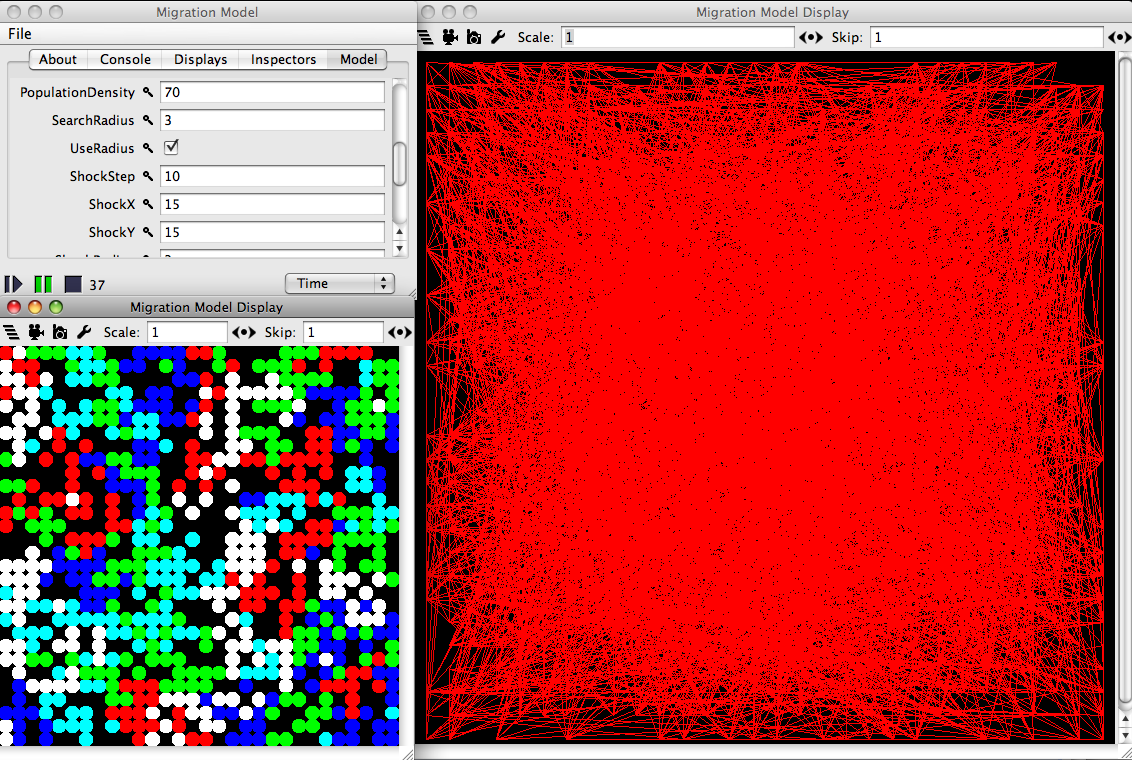
Perhaps most impressive but challenging is the team’s interest in combining spatial analysis with social networking analysis (SNA). For example, visualizing data or projects based on their geographic relationships but also on their functional relationships. I worked on a similar project at the Santa Fe Institute (SFI) back in 2006, when colleagues and I developed an Agent Based Model  (ABM) to simulate internal displacement of ethnic groups following a crisis.
abmSFI

Agent Based Model of Crisis Displacement

As the screenshot above depicts, we were interested in understanding how groups would move based on their geographical and ethnic or social ties. In any case, if the MDG Monitor team can combine the two types of dynamic maps, this will certainly be a notable advance in the field of crisis mapping.

Patrick Philippe Meier

OCHA’s Humanitarian Dashboard

I recently gave a presentation on Crisis Mapping for UN-OCHA in Nairobi and learned a new initiative called the Humanitarian Dashboard. The Dashboard is still in its development phase so the content of this post is subject to change in the near future.

I was pleasantly surprised to find out that Nick Haan, a colleague from years back, is behind the initiative. I had consulted Nick on a regular basis back in 2004-2005 when working on CEWARN. He was heading the Food Security Assessment Unit (FSAU) at the time.

Here’s a quick introduction to the Humanitarian Dashboard:

The goal of the Dashboard is to ensure evidence-based humanitarian decision making for more needs-based, effective, and timely action.  The business world is well-accustomed to dashboards for senior executives in order to provide them with a real-time overview of core business data, alert them of potential problems, and keep operations on-track for desired results.

Stephen Few, a leader in dashboard design defines a dashboard as “a single-screen display of the most important information people need to do a job, presented in a way that allows them to monitor what’s going on in an instant.”   Such a single-screen or single-page overview, updated in real time, does not currently exist in the humanitarian world.”

The added values of the Dashboard:

  1. It would allow humanitarian decision-makers to more quickly access the core and common humanitarian information that they require and to more easily compare this information across various emergencies;
  2. It would provide a common platform from which essential big picture and cross sectoral information can be discussed and debated among key stakeholders, fostering greater consensus and thus a more coordinated and effective humanitarian response;
  3. It would provide a consolidated platform of essential information with direct linkages to underlying evidence in the form of reports and data sets, thus providing a much needed organizational tool for the plethora of humanitarian information;
  4. It would provide a consistently structured core data set that would readily enable a limitless range of humanitarian analysis across countries and over-time.

I look forward to fully evaluating this new tool, which is currently being piloted in Somalia, Kenya and Pakistan.

Patrick Philippe Meier

OCHA’s Humanitarian Dashboard

I recently gave a presentation on Crisis Mapping for UN-OCHA in Nairobi and learned a new initiative called the Humanitarian Dashboard. The Dashboard is still in its development phase so the content of this post is subject to change in the near future.

I was pleasantly surprised to find out that Nick Haan, a colleague from years back, is behind the initiative. I had consulted Nick on a regular basis back in 2004-2005 when working on CEWARN. He was heading the Food Security Assessment Unit (FSAU) at the time.

Here’s a quick introduction to the Humanitarian Dashboard:

The goal of the Dashboard is to ensure evidence-based humanitarian decision making for more needs-based, effective, and timely action.  The business world is well-accustomed to dashboards for senior executives in order to provide them with a real-time overview of core business data, alert them of potential problems, and keep operations on-track for desired results.

Stephen Few, a leader in dashboard design defines a dashboard as “a single-screen display of the most important information people need to do a job, presented in a way that allows them to monitor what’s going on in an instant.”   Such a single-screen or single-page overview, updated in real time, does not currently exist in the humanitarian world.”

The added values of the Dashboard:

  1. It would allow humanitarian decision-makers to more quickly access the core and common humanitarian information that they require and to more easily compare this information across various emergencies;
  2. It would provide a common platform from which essential big picture and cross sectoral information can be discussed and debated among key stakeholders, fostering greater consensus and thus a more coordinated and effective humanitarian response;
  3. It would provide a consolidated platform of essential information with direct linkages to underlying evidence in the form of reports and data sets, thus providing a much needed organizational tool for the plethora of humanitarian information;
  4. It would provide a consistently structured core data set that would readily enable a limitless range of humanitarian analysis across countries and over-time.

I look forward to fully evaluating this new tool, which is currently being piloted in Somalia, Kenya and Pakistan.

Patrick Philippe Meier

Is Crime Mapping the Future of Crisis Mapping?

My new fascination is crime mapping.

The field of crisis mapping may still in its infancy, but crime mapping, relatively speaking, is a mature science. I have no doubt that many of the best practices, methods and software platforms developed for crime mapping are applicable to crisis mapping. This is why I plan to spend the next few months trying to get up to speed on crime mapping. If you’re interested in learning more about crime mapping, here’s how I’m getting up to speed.

First, I’m following the CrimeReports blog and Twitter feed.

Second, I got in touch with Professor Timothy Hart who is co-editor of the peer-reviewed journal Crime Mapping for some guidance. He suggested that a good place to start is with the primary criminology theory, from which many of the ideas found in the field of crime mapping grew.

To this end, Tim kindly recommended the following book:

In terms of the applied side of crime mapping, Tim recommended this book to gain a better understanding of theory in practice:

Third, I’ve registered to attend the 10th Crime Mapping Research Conference being held in New Orleans this August. And to think that I’m just co-organizing the first International Conference on Crisis Mapping, ICCM 2009. Yes, we’re 10 years behind. Just have a look at a sample of the presentations lined up:

  • The Spatial Dependency of Crime Dispersion.
  • A Time Geographic Approach to Crime Mapping.
  • Space-time Hotspots and their Prediction Accuracy.
  • Using Cluster Analysis to Identify Gang Mobility Patterns.
  • Defining Hotspots: Adding an Explanatory Power to Hotspot Mapping.
  • Application of Spatial Scan Statistic Methods to Crime Hot Spot Analysis.
  • Applying Key Spatial Theories to Understand Maps and Preventing Crime.
  • Using a Spatial Video to Capture Dynamically Changing Crime Geographies.

Fourth, I’m keeping track of news articles that refer to crime mapping, like the Wall Street Journal’s recent piece entitled “New Program Put Crime Stats on the Map.” According to the article,

Police say they use the sites to help change citizens’ behavior toward crime and encourage dialogue with communities so that more people might offer tips or leads. Some of the sites have crime-report blogs that examine activity in different locales. They also allow residents to offer tips and report crimes under way.

Is crime mapping the future of crisis mapping? Regardless of the answer, we have a lot to learn from our colleagues in the field of crime mapping as I plan to demonstrate in future blog posts. In the meantime, I hope that donors in the humanitarian and human rights communities realize that tremendous potential of crisis mapping given the value of added of maps for crime analysis.

Patrick Philippe Meier

GeoTime: Crisis Mapping Analysis in 3D

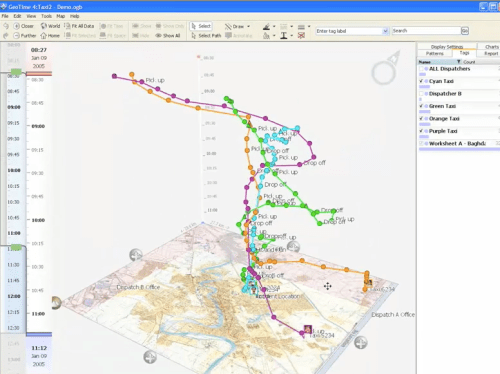
I just came across GeoTime, a very neat GIS platform for network analyis in time and space. GeoTime is developed by a company called Oculus and does a great job in presenting an appealing 3D visual interface for the temporal analysis of geo-referenced data. The platform integrates timeline comparisons, chart statistics and network analysis tools to support decision making. GeoTime also includes plug-ins for Excel and ArcGIS.

GeoTime

GeoTime includes a number of important functionalities including:

  • Movement trails: to display the history and behavior as paths in space-time;
  • Animation: to play back sequences and see how events unfold. Both the direction and speed of the animation can be adjusted.
  • Pattern recognition: to automatically identify key behaviors.
  • Annotate and Sketch: to add notes directly in the scene and save views as reports.
  • Fast Maps: to automatically adjust level of detail.
  • Interactive Chain and Network Analysis: to identify related events.

GeoTime2

Below is an excerpt of a video demo of GeoTime which is well worth watching to get a sense of how these functionalities come into play:

The demo above uses hurricane data to highlight GeoTime’s integrated functionalities. But the application can be used to analyze a wide range of data such as crime incidents to identify patterns in space and time. A demo for that is avaiable here.

GeoTime3

My interest in GeoTime stems from it’s potential application to analyzing conflict datasets. Problem is, the platform will set you back a cool $3,925. They do have a university rate of $1,675 but what’s missing is a rate for humanitarian NGOs or even a limited trial version.

Patrick Philippe Meier

How to Lie with Maps

I just finished reading Mark Monmonier‘s enjoyable book on “How to Lie with Maps” and thought I’d share some tidbits. Mark is the distinguished Professor of Geography at the Maxwell School of Syracuse University in New York.

In writing this book, Mark wanted to “make readers aware that maps, like speeches and paintings, are authored collections of information and also are also subject to distortions arising from ignorance, greed, ideological blindness, or malice.” Note that this second edition was published in 1996.

mapslie

Terminology

Mark uses some terms that made me chuckle at times. Take “cartographic priesthood,” for example, or “cartographic license.” Other terms of note include “cartopropaganda,” “cartographic disinformation and censorship,” and “cartographic security.”

Quotes

  • “The map is the perfect symbol of the state.”
  • “Maps can even make nuclear war appear survivable.”
  • “A legend might make a bad map useful, but it can’t make it efficient.”
  • “Maps are like milk: their information is perishable, and it is wise to check the date.”
  • “People trust maps, and intriguing maps attract the eye as well as connote authority.”
  • “Circles bring to the map a geometric purity easily mistaken for accuracy and authority.”
  • “Like guns and crosses, maps can be good or bad, depending on who’s holding them, who they’re aimed at, how they’re used, and why.”
  • “No other group has exploited the map as an intellectual weapon so blatantly, so intensely, so persistently, and with such variety [as the Nazis].”
  • “That maps drawn up by diplomats and generals became a political reality lends an unintended irony to the aphorism that the pen is mightier than the sword.”

Excerpts

“Even tiny maps on postage stamps can broadcast political propaganda. Useful both on domestic mail to keep aspirations alive and on international mail to suggest national unity and determination, postage stamps afford a small but numerous means for asserting territorial claims.”

“In 1668, Louis XIV of France commissioned three-dimensional scale models of eastern border towns, so that his generals in Paris and Versailles could plan realistic maneuvers. […] As late as World War II, the French government guarded them as military secrets with the highest security classification.” See picture.

louisxiv

“Government maps have for centuries been ideological statements rather than fully objective scientific representations of geographic reality. […] Governments practice two kinds of cartographic censorship—a censorship of secrecy to serve military defense and a censorship of  silence to enforce social and political values” (citing historian Brian Harley).

“Few maps symbols are as forceful and suggestive as the arrow. A bold, solid line might make the map viewer infer a well-defined, generally accepted border separating nations with homogeneous populations, but an arrow or a set of arrows can dramatize an attack across the border, exaggerate a concentration of troops, and perhaps even justify a ‘pre-emptive strike’.”

“Faulty map reading almost led to an international incident in 1988, when the Manila press reported the Malaysian annexation of the Turtle Islands.” The faulty map was “later traced to the erroneous reading of an American navigation chart by a Philippines naval officer who mistook a line representing the recommended deepwater route for ships passing the Turtle Islands for the boundary of Malaysia’s newly declared exclusive economic zone.”

Conclusion

“As display systems become more flexible, and more like video games, users must be wary that maps, however realistic, are merely representations, vulnerable to bias in both what they show and what they ignore.”

“Skepticism is especially warranted when a dynamic map supporting a simulation model pretends to describe the future.”

“Although electronic cartography may make complex simulations easier to understand, no one should trust blindly a map that acts like a crystal ball.”

Patrick Philippe Meier

Part 7: A Taxonomy for Visual Analytics

This is Part 7 of 7 of the highlights from the National Visualization Analysis Center. (NVAC). Unlike previous parts, this one focuses on a May 2009 article. Please see this post for an introduction to the study and access to the other 6 parts.

Jim Thomas, the co-author of “Illuminating the Path: A Research and Development Agenda for Visual Analytics,” and Director of the National Visualization Analysis Center (NVAC) recently called for the development of a taxonomy for visual analytics. Jim explains the importance of visual analytics as follows:

“Visual analytics are valuable because the tool helps to detect the expected, and discover the unexpected. Visual analytics combines the art of human intuition and the science of mathematical deduction to perceive patterns and derive knowledge and insight from them. With our success in developing and delivering new technologies, we are paving the way for fundamentally new tools to deal with the huge digital libraries of the future, whether for terrorist threat detection or new interactions with potentially life-saving drugs.”

In the latest edition of VAC Views, Jim expresses NVAC’s interest in helping to “define the study of visual analytics by providing an order and arrangement of topics—the taxa that are at the heart of studying visual analytics. The reason for such a “definition” is to more clearly describe the scope and intent of impact for the field of visual analytics.”

Jim and colleagues propose the following higher-order classifications:

  • Domain/Applications
  • Analytic Methods/Goals
  • Science and Technology
  • Data Types/Structures.

In his article in VAC Views, Jim requests feedback and suggestions for improving the more detailed taxonomy that he provides in the graphic below. The latter was not produced in very high resolution in VAC Views and does not reproduce well here, so I summarize below whilst giving feedback.

VacViews

1. Domain/Applications

While Security (and Health) are included in the draft NVAC proposal as domains / applications, what is missing is Humanitarian Crises, Conflict Prevention and Disaster Management.

Perhaps “domain/applications” should not be combined since “applications” tends to be a subset of associated “domains” which poses some confusion. For example, law enforcement is a domain and crime mapping analysis could be considered as an application of visual analytics.

2. Analytic Methods/Goals

Predictive, Surveillance, Watch/Warn/Alert, Relationship Mapping, Rare Event Identification are included. There are a host of other methods not referred to here such as cluster detection, a core focus of spatial analysis. See the methods table in my previous blog post for examples of spatial cluster detection.

Again I find that combining both “analytic methods” and “goals” makes the classification somewhat confusing.

3. Scientific and Technology

This classification includes the following entries (each of which are elaborated on individually later):

  • Analytic reasoning and human processes
  • Interactive visualization
  • Data representations and theory of knowledge
  • Theory of communications
  • Systems and evaluations.

4. Data Types/Structures

This includes Text, Image, Video, Graph Structures, Models/Simulations, Geospatial Coordinates, time, etc.

Returning now to the sub-classifications under “Science and Technology”:

Analytic reasoning and human processes

This sub-classification, for example, includes the following items:

  • Modes of inference
  • Knowledge creation
  • Modeling
  • Hypothesis refinement
  • Human processes (e.g., perception, decision-making).

Interactive visualization

This is comprised of:

  • The Science of Visualization
  • The Science of Interaction.

The former includes icons, positioning, motion, abstraction, etc, while the latter includes language of discourse, design and art, user-tailored interaction and simulation interaction.

Data representations and theory of knowledge

This includes (but is not limited to):

  • Data Sourcing
  • Scale and Complexity
  • Aggregation
  • Ontology
  • Predictions Representations.

Theory of communications

This sub-classification includes for example the following:

  • Story Creation
  • Theme Flow/Dynamics
  • Reasoning representation.

Systems and evaluations

This last sub-classification comprises:

  • Application Programming Interface
  • Lightweight Standards
  • Privacy.

Patrick Philippe Meier

Part 6: Mobile Technologies and Collaborative Analytics

This is Part 6 of 7 of the highlights from “Illuminating the Path: The Research and Development Agenda for Visual Analytics.” Please see this post for an introduction to the study and access to the other 6 parts.

Mobile Technologies

The National Visual Analytics Center (NVAC) study recognizes that “mobile technologies will play a role in visual analytics, especially to users at the front line of homeland security.” To this end, researchers must “devise new methods to best employ these technologies and provide a means to allow data to scale between high-resolution displays in command and control centers to field-deployable displays.”

Collaborative Analytics

While collaborative platforms from wiki’s to Google docs allow many individuals to work collaboratively, these functionalities rarely feature in crisis mapping platforms. And yet, humanitarian crises (just like homeland security challenges) are so complex that they cannot be addressed by individuals working in silos.

On the contrary, crisis analysis, civilian protection and humanitarian response efforts are “sufficiently large scale and important that they must be addressed through the coordinated action of multiple groups of people, often with different backgrounds working in disparate locations with differing information.”

In other words, “the issue of human scalability plays a critical role, as systems must support the communications needs of these groups of people working together across space and time, in high-stress and time-sensitive environments, to make critical decisions.”

Patrick Philippe Meier

Updated: Humanitarian Situation Risk Index (HSRI)

The Humanitarian Situation Risk Index (HSRI) is a tool created by UN OCHA in Colombia. The objective of HSRI is to determine the probability that a humanitarian situation occurs in each of the country’s municipalities in relation to the ongoing complex emergency. HSRI’s overall purpose is to serve as a “complementary analytical tool in decision-making allowing for humanitarian assistance prioritization in different regions as needed.”

UPDATE: I actually got in touch with the HSRI group back in February 2009 to let them know about Ushahidi and they have since “been running some beta-testing on Ushahidi, and may as of next week start up a pilot effort to organize a large number of actors in northeastern Colombia to feed data into [their] on-line information system.” In addition, they “plan to move from a logit model calculating probability of a displacement situation for each of the 1,120 Colombian municipalities, to cluster analysis, and have been running the identical model on data [they] have for confined communities.”

hsrimap

HSRI uses statistical tools (principal component analysis and the Logit model) to estimate the risk indexes. The indexes range from 0 to 1, where 0 is no risk and 1 is maximum risk. The team behind the project clearly state that the tool does not indicate the current situation in each municipality given that the data is not collected in real-time. Nor does the tool quantify the precise number of persons at risk.

The data used to estimate the Humanitarian Situation Risk Index “mostly comes from official sources, due to the fact that the vast majority of data collected and processed are from State entities, and in the remaining cases the data is from non-governmental or multilateral institutions.” The following table depicts the data collected.

hsri

I’d be interested to know whether the project will move towards doing any temporal analysis of the data over time. This would enable trends analysis which could more directly inform decision-making than a static map representing static data. One other thought might be to complement this “baseline” type data with event-data by using mobile phones and a “bounded crowdsourcing” approach a la Ushahidi.

Patrick Philippe Meier

Part 5: Data Visualization and Interactive Interface Design

This is Part 5 of 7 of the highlights from “Illuminating the Path: The Research and Development Agenda for Visual Analytics.” Please see this post for an introduction to the study and access to the other 6 parts.

Data Visualization

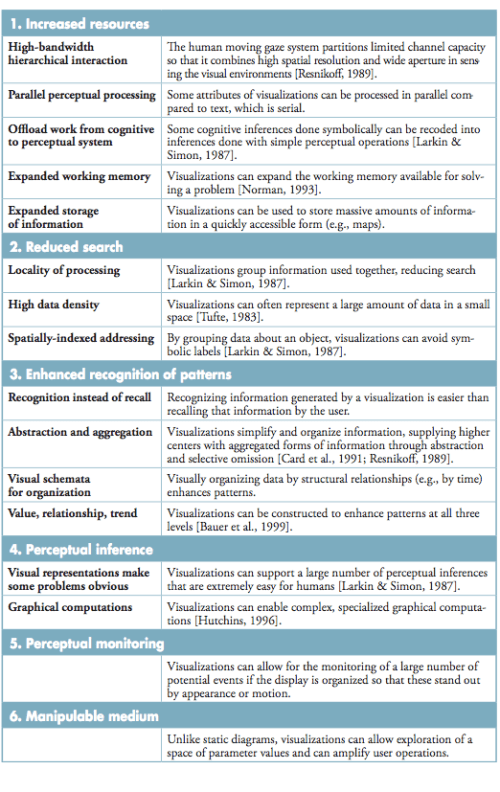
The visualization of information “amplifies human cognitive capabilities in six basic ways” by:

  • Increasing cognitive resources, such as by using a visual resource to expand human working memory;
  • Reducing search, such as by representing a large amount of data in a small place;
  • Enhancing the recognition of patterns, such as when information is organized in space by its time relationships;
  • Supporting the easy perceptual inference of relationships that are otherwise more difficult to induce;
  • Enabling perceptual monitoring of a large number of potential events;
  • Providing a manipulable medium that, unlike static diagrams, enables the exploration of a space of parameter values.

The table below provides additional information on how visualization amplifies cognition:

NAVCsTable

Clearly, “these capabilities of information visualization, combined with computational data analysis, can be applied to analytic reasoning to support the sense-making process.” The National Visualization and Analysis Center (NVAC) thus recommends developing “visually based methods to support the entire analytic reasoning process, including the analysis of data as well as structured reasoning techniques such as the construction of arguments, convergent-divergent investigation, and evaluation of alternatives.”

Since “well-crafted visual representations can play a critical role in making information clear […], the visual representations and interactions we develop must readily support users of varying backgrounds and expertise.” To be sure, “visual representations and interactions must be developed with the full range of users in mind, from the experienced user to the novice working under intense pressure […].”

As NVACs notes, “visual representations are the equivalent of power tools for analytical reasoning.” But just like real power tools, they can cause harm if used carelessly. Indeed, it is important to note that “poorly designed visualizations may lead to an incorrect decision and great harm. A famous example is the poor visualization of the O-ring data produced before the disastrous launch of the Challenger space shuttle […].”

Effective Depictions

This is why we need some basic principles for developing effective depictions, such as the following:

  • Appropriateness Principle: the visual representation should provide neither more or less information than that needed for the task at hand. Additional information may be distracting and makes the task more difficult.
  • Naturalness Principle: experiential cognition is most effective when the properties of the visual representation most closely match the information being represented. This principle supports the idea that new visual metaphors are only useful for representing information when they match the user’s cognitive model of the information. Purely artificial visual metaphors can actually hinder understanding.
  • Matching Principle: representations of information are mst effective when they match the task to be performed by the user. Effective visual representations should present affordances suggestive of the appropriate action.
  • Congruence Principle: the structure and content of a visualization should correspond to the structure and content of the desired mental representation.
  • Apprehension Principle: the structure and content of a visualization should be readily and accurately perceived and comprehended.

Further research is needed to understand “how best to combine time and space in visual representation. “For example, in the flow map, spatial information is primary” in that it defines the coordinate system, but “why is this the case, and are there visual representations where time is foregrounded that could also be used to support analytical tasks?”

In sum, we must deepen our understanding of temporal reasoning and “create task-appropriate methods for integrating spatial and temporal dimensions of data into visual representations.”

Interactive Interface Design

It is important in the visual analytics process that researchers focus on visual representations of data and interaction design in equal measure. “We need to develop a ‘science of interaction’ rooted in a deep understanding of the different forms of interaction and their respective benefits.”

For example, one promising approach for simplifying interactions is to use 3D graphical user interfaces. Another is to move beyond single modality (or human sense) interaction techniques.

Indeed, recent research suggests that “multi-modal interfaces can overcome problems that any one modality may have. For example, voice and deictic (e.g., pointing) gestures can complement each other and make it easier for the user to accomplish certain tasks.” In fact, studies suggest that “users prefer combined voice and gestural communication over either modality alone when attempting graphics manipulation.”

Patrick Philippe Meier