Category Archives: Information Forensics

Trails of Trustworthiness in Real-Time Streams

Real-time information channels like Twitter, Facebook and Google have created cascades of information that are becoming increasingly challenging to navigate. “Smart-filters” alone are not the solution since they won’t necessarily help us determine the quality and trustworthiness of the information we receive. I’ve been studying this challenge ever since the idea behind SwiftRiver first emerged several years ago now.

I was thus thrilled to come across a short paper on “Trails of Trustworthiness in Real-Time Streams” which describes a start-up project that aims to provide users with a “system that can maintain trails of trustworthiness propagated through real-time information channels,” which will “enable its educated users to evaluate its provenance, its credibility and the independence of the multiple sources that may provide this information.” The authors, Panagiotis Metaxas and Eni Mustafaraj, kindly cite my paper on “Information Forensics” and also reference SwiftRiver in their conclusion.

The paper argues that studying the tactics that propagandists employ in real life can provide insights and even predict the tricks employed by Web spammers.

“To prove the strength of this relationship between propagandistic and spamming techniques, […] we show that one can, in fact, use anti-propagandistic techniques to discover Web spamming networks. In particular, we demonstrate that when starting from an initial untrustworthy site, backwards propagation of distrust (looking at the graph defined by links pointing to to an untrustworthy site) is a successful approach to finding clusters of spamming, untrustworthy sites. This approach was inspired by the social behavior associated with distrust: in society, recognition of an untrustworthy entity (person, institution, idea, etc) is reason to question the trust- worthiness of those who recommend it. Other entities that are found to strongly support untrustworthy entities become less trustworthy themselves. As in society, distrust is also propagated backwards on the Web graph.”

The authors document that today’s Web spammers are using increasingly sophisticated tricks.

“In cases where there are high stakes, Web spammers’ influence may have important consequences for a whole country. For example, in the 2006 Congressional elections, activists using Google bombs orchestrated an effort to game search engines so that they present information in the search results that was unfavorable to 50 targeted candidates. While this was an operation conducted in the open, spammers prefer to work in secrecy so that their actions are not revealed. So,  revealed and documented the first Twitter bomb, which tried to influence the Massachusetts special elections, show- ing how an Iowa-based political group, hiding its affiliation and profile, was able to serve misinformation a day before the election to more than 60,000 Twitter users that were follow- ing the elections. Very recently we saw an increase in political cybersquatting, a phenomenon we reported in [28]. And even more recently, […] we discovered the existence of Pre-fabricated Twitter factories, an effort to provide collaborators pre-compiled tweets that will attack members of the Media while avoiding detection of automatic spam algorithms from Twitter.

The theoretical foundations for a trustworthiness system:

“Our concept of trustworthiness comes from the epistemology of knowledge. When we believe that some piece of information is trustworthy (e.g., true, or mostly true), we do so for intrinsic and/or extrinsic reasons. Intrinsic reasons are those that we acknowledge because they agree with our own prior experience or belief. Extrinsic reasons are those that we accept because we trust the conveyor of the information. If we have limited information about the conveyor of information, we look for a combination of independent sources that may support the information we receive (e.g., we employ “triangulation” of the information paths). In the design of our system we aim to automatize as much as possible the process of determining the reasons that support the information we receive.”

“We define as trustworthy, information that is deemed reliable enough (i.e., with some probability) to justify action by the receiver in the future. In other words, trustworthiness is observable through actions.”

“The overall trustworthiness of the information we receive is determined by a linear combination of (a) the reputation RZ of the original sender Z, (b) the credibility we associate with the contents of the message itself C(m), and (c) characteristics of the path that the message used to reach us.”

“To compute the trustworthiness of each message from scratch is clearly a huge task. But the research that has been done so far justifies optimism in creating a semi-automatic, personalized tool that will help its users make sense of the information they receive. Clearly, no such system exists right now, but components of our system do exist in some of the popular [real-time information channels]. For a testing and evaluation of our system we plan to use primarily Twitter, but also real-time Google results and Facebook.”

In order to provide trails of trustworthiness in real-time streams, the authors plan to address the following challenges:

•  “Establishment of new metrics that will help evaluate the trustworthiness of information people receive, especially from real-time sources, which may demand immediate attention and action. […] we show that coverage of a wider range of opinions, along with independence of results’ provenance, can enhance the quality of organic search results. We plan to extend this work in the area of real-time information so that it does not rely on post-processing procedures that evaluate quality, but on real-time algorithms that maintain a trail of trustworthiness for every piece of information the user receives.”

• “Monitor the evolving ways in which information reaches users, in particular citizens near election time.”

•  “Establish a personalizable model that captures the parameters involved in the determination of trustworthiness of in- formation in real-time information channels, such as Twitter, extending the work of measuring quality in more static information channels, and by applying machine learning and data mining algorithms. To implement this task, we will design online algorithms that support the determination of quality via the maintenance of trails of trustworthiness that each piece of information carries with it, either explicitly or implicitly. Of particular importance, is that these algorithms should help maintain privacy for the user’s trusting network.”

• “Design algorithms that can detect attacks on [real-time information channels]. For example we can automatically detect bursts of activity re- lated to a subject, source, or non-independent sources. We have already made progress in this area. Recently, we advised and provided data to a group of researchers at Indiana University to help them implement “truthy”, a site that monitors bursty activity on Twitter.  We plan to advance, fine-tune and automate this process. In particular, we will develop algorithms that calculate the trust in an information trail based on a score that is affected by the influence and trustworthiness of the informants.”

In conclusion, the authors “mention that in a month from this writing, Ushahidi […] plans to release SwiftRiver, a platform that ‘enables the filtering and verification of real-time data from channels like Twitter, SMS, Email and RSS feeds’. Several of the features of Swift River seem similar to what we propose, though a major difference appears to be that our design is personalization at the individual user level.”

Indeed, having been involved in SwiftRiver research since early 2009 and currently testing the private beta, there are important similarities and some differences. But one such difference is not personalization. Indeed, Swift allows full personalization at the individual user level.

Another is that we’re hoping to go beyond just text-based information with Swift, i.e., we hope to pull in pictures and video footage (in addition to Tweets, RSS feeds, email, SMS, etc) in order to cross-validate information across media, which we expect will make the falsification of crowdsourced information more challenging, as I argue here. In any case, I very much hope that the system being developed by the authors will be free and open source so that integration might be possible.

A copy of the paper is available here (PDF). I hope to meet the authors at the Berkman Center’s “Truth in Digital Media Symposium” and highly recommend the wiki they’ve put together with additional resources. I’ve added the majority of my research on verification of crowdsourced information to that wiki, such as my 20-page study on “Information Forensics: Five Case Studies on How to Verify Crowdsourced Information from Social Media.”

Information Forensics: Five Case Studies on How to Verify Crowdsourced Information from Social Media

My 20+ page study on verifying crowdsourced information is now publicly available here as a PDF and here as an open Google Doc for comments. I very much welcome constructive feedback from iRevolution readers so I can improve the piece before it gets published in an edited book next year.

Abstract

False information can cost lives. But no information can also cost lives, especially in a crisis zone. Indeed, information is perishable so the potential value of information must be weighed against the urgency of the situation. Correct information that arrives too late is useless. Crowdsourced information can provide rapid situational awareness, especially when added to a live crisis map. But information in the social media space may not be reliable or immediately verifiable. This may explain why humanitarian (and news) organizations are often reluctant to leverage crowdsourced crisis maps. Many believe that verifying crowdsourced information is either too challenging or impossible. The purpose of this paper is to demonstrate that concrete strategies do exist for the verification of geo-referenced crowdsourced social media information. The study first provides a brief introduction to crisis mapping and argues that crowdsourcing is simply non-probability sampling. Next, five case studies comprising various efforts to verify social media are analyzed to demonstrate how different verification strategies work. The five case studies are: Andy Carvin and Twitter; Kyrgyzstan and Skype; BBC’s User-Generated Content Hub; the Standby Volunteer Task Force (SBTF); and U-Shahid in Egypt. The final section concludes the study with specific recommendations.

Update: See also this link and my other posts on Information Forensics.

How to Verify Social Media Content: Some Tips and Tricks on Information Forensics

Update: I have authored a 20+ page paper on verifying social media content based on 5 case studies. Please see this blog post for a copy.

I get this question all the time: “How do you verify social media data?” This question drives many of the conversations on crowdsourcing and crisis mapping these days. It’s high time that we start compiling our tips and tricks into an online how-to-guide so that we don’t have to start from square one every time the question comes up. We need to build and accumulate our shared knowledge in information forensics. So here is the Google Doc version of this blog post, please feel free to add your best practices and ask others to contribute. Feel free to also add links to other studies on verifying social media content.

If every source we monitored in the social media space was known and trusted, then the need for verification would not be as pronounced. In other words, it is the plethora and virtual anonymity of sources that makes us skeptical of the content they deliver. The process of verifying  social media data thus requires a two-step process: the authentication of the source as reliable and the triangulation of the content as valid. If we can authenticate the source and find it trustworthy, this may be sufficient to trust the content and mark is a verified depending on context. If source authentication is difficult to ascertain, then we need to triangulate the content itself.

Lets unpack these two processes—authentication and triangulation—and apply them to Twitter since the most pressing challenges regarding social media verification have to do with eyewitness, user-generated content. The first step is to try and determine whether the source is trustworthy. Here are some tips on how to do this:

  • Bio on Twitter: Does the source provide a name, picture, bio and any  links to their own blog, identity, professional occupation, etc., on their page? If there’s a name, does searching for this name on Google provide any further clues to the person’s identity? Perhaps a Facebook page, a professional email address, a LinkedIn profile?
  • Number of Tweets: Is this a new Twitter handle with only a few tweets? If so, this makes authentication more difficult. Arasmus notes that “the more recent, the less reliable and the more likely it is to be an account intended to spread disinformation.” In general, the longer the Twitter handle has been around and the more Tweets linked to this handle, the better. This gives a digital trace, a history of prior evidence that can be scrutinized for evidence of political bias, misinformation, etc. Arasmus specifies: “What are the tweets like? Does the person qualify his/her reports? Are they intelligible? Is the person given to exaggeration and inconsistencies?”
  • Number of followers: Does the source have a large following? If there are only a few, are any of the followers know and credible sources? Also, how many lists has this Twitter hanlde been added to?
  • Number following: How many Twitter users does the Twitter handle follow? Are these known and credible sources?
  • Retweets: What type of content does the Twitter handle retweet? Does the Twitter handle in question get retweeted by known and credible sources?
  • Location: Can the source’s geographic location be ascertained? If so, are they nearby the unfolding events? One way to try and find out by proxy is to examine during which periods of the day/night the source tweets the most. This may provide an indication as to the person’s time zone.
  • Timing: Does the source appear to be tweeting in near real-time? Or are there considerable delays? Does anything appear unusual about the timing of the person’s tweets?
  • Social authentication: If you’re still unsure about the source’s reliability, use your own social network–Twitter, Facebook, LinkedIn–to find out if anyone in your network know about the source’s reliability.
  • Media authentication: Is the source quoted by trusted media outlines whether this be in the mainstream or social media space?
  • Engage the source: Tweet them back and ask them for further information. NPR’s Andy Carvin has employed this technique particularly well. For example, you can tweet back and ask for the source of the report and for any available pictures, videos, etc. Place the burden of proof on the source.

These are some of the tips that come to mind for source authentication. For more thoughts on this process, see my previous blog post “Passing the I’m-Not-Gaddafi-Test: Authenticating Identity During Crisis Mapping Operations.” If you some tips of your own not listed here, please do add them to the Google Doc—they don’t need to be limited to Twitter either.

Now, lets say that we’ve gone through list above and find the evidence inconclusive. We thus move to try and triangulate the content. Here are some tips on how to do this:

  • Triangulation: Are other sources on Twitter or elsewhere reporting on the event you are investigating? As Arasmus notes, “remain skeptical about the reports that you receive. Look for multiple reports from different unconnected sources.” The more independent witnesses you can get information from the better and the less critical the need for identity authentication.
  • Origins: If the user reporting an event is not necessarily the original source, can the original source be identified and authenticated? In particular, if the original source is found, does the time/date of the original report make sense given the situation?
  • Social authentication: Ask members of your own social network whether the tweet you are investigating is being reported by other sources. Ask them how unusual the event reporting is to get a sense of how likely it is to have happened in the first place. Andy Carvin’s followers, for example, “help him translate, triangulate, and track down key information. They enable remarkable acts of crowdsourced verification […] but he must always tell himself to check and challenge what he is told.”
  • Language: Andy Carvin notes that tweets that sound too official, using official language like “breaking news”, “urgent”, “confirmed” etc. need to be scrutinized. “When he sees these terms used, Carvin often replies and asks for additional details, for pictures and video. Or he will quote the tweet and add a simple one word question to the front of the message: Source?” The BBC’s UGC (user-generated content) Hub in London also verifies whether the vocabulary, slang, accents are correct for the location that a source might claim to be reporting from.
  • Pictures: If the twitter handle shares photographic “evidence”, does the photo provide any clues about the location where it was taken based on buildings, signs, cars, etc., in the background? The BBC’s UGC Hub checks weaponry against those know for the given country and also looks for shadows to determine the possible time of day that a picture was taken. In addition, they examine weather reports to “confirm that the conditions shown fit with the claimed date and time.” These same tips can be applied to Tweets that share video footage.
  • Follow up: If you have contacts in the geographic area of interest, then you could ask them to follow up directly/in-person to confirm the validity of the report. Obviously this is not always possible, particularly in conflict zones. Still, there is increasing anecdotal evidence that this strategy is being used by various media organizations and human rights groups. One particularly striking example comes from Kyrgyzstan where  a Skype group with hundreds of users across the country were able disprove and counter rumors at a breathtaking pace. See this blog post for more details. See my blog post on “How to Use Technology to Counter Rumors During Crises: Anecdotes from Kyrgyzstan.”

These are just a handful of tips and tricks come to mind. The number of bullet points above clearly shows we are not completely powerless when verifying social media data. There are several strategies available. The main challenge, as the BBC points out, is that this type of information forensics “can take anything from seconds […] to hours, as we hunt for clues and confirmation.” See for example my earlier post on “The Crowdsourcing Detective: Crisis, Deception and Intrigue in the Twitterspehere” which highlights some challenges but also new opportunities.

One of Storyful‘s comparative strengths when it comes to real-time news curation is the growing list of authenticated users it follows. This represents more of a bounded (but certainly not static) approach.  As noted in my previous blog post on “Seeking the Trustworthy Tweet,” following a bounded model presents some obvious advantages. This explains by the BBC recommends “maintaining lists of previously verified material [and sources] to act as a reference for colleagues covering the stories.” This strategy is also employed by the Verification Team of the Standby Volunteer Task Force (SBTF).

In sum, I still stand by my earlier blog post entitled “Wag the Dog: How Falsifying Crowdsourced Data can be a Pain.” I also continue to stand by my opinion that some data–even if not immediately verifiable—is better than no data. Also, it’s important to recognize that  we have in some occasions seen social media prove to be self-correcting, as I blogged about here. Finally, we know that information is often perishable in times of crises. By this I mean that crisis data often has a “use-by date” after which, it no longer matters whether said information is true or not. So speed is often vital. This is why semi-automated platforms like SwiftRiver that aim to filter and triangulate social media content can be helpful.

Seeking the Trustworthy Tweet: Can “Tweetsourcing” Ever Fit the Needs of Humanitarian Organizations?

Can microblogged data fit the information needs of humanitarian organizations? This is the question asked by a group of academics at Pennsylvania State University’s College of Information Sciences and Technology. Their study (PDF) is an important contribution to the discourse on humanitarian technology and crisis information. The applied research provides key insights based on a series of interviews with humanitarian professionals. While I largely agree with the majority of the arguments presented in this study, I do have questions regarding the framing of the problem and some of the assertions made.

The authors note that “despite the evidence of strong value to those experiencing the disaster and those seeking information concerning the disaster, there has been very little uptake of message data by large-scale, international humanitarian relief organizations.” This is because real-time message data is “deemed as unverifiable and untrustworthy, and it has not been incorporated into established mechanisms for organizational decision-making.” To this end, “committing to the mobilization of valuable and time sensitive relief supplies and personnel, based on what may turn out be illegitimate claims, has been perceived to be too great a risk.” Thus far, the authors argue, “no mechanisms have been fashioned for harvesting microblogged data from the public in a manner, which facilitates organizational decisions.”

I don’t think this latter assertion is entirely true if one looks at the use of Twitter by the private sector. Take for example the services offered by Crimson Hexagon, which I blogged about 3 years ago. This successful start-up launched by Gary King out of Harvard University provides companies with real-time sentiment analysis of brand perceptions in the Twittersphere precisely to help inform their decision making. Another example is Storyful, which harvests data from authenticated Twitter users to provide highly curated, real-time information via microblogging. Given that the humanitarian community lags behind in the use and adoption of new technologies, it behooves us to look at those sectors that are ahead of the curve to better understand the opportunities that do exist.

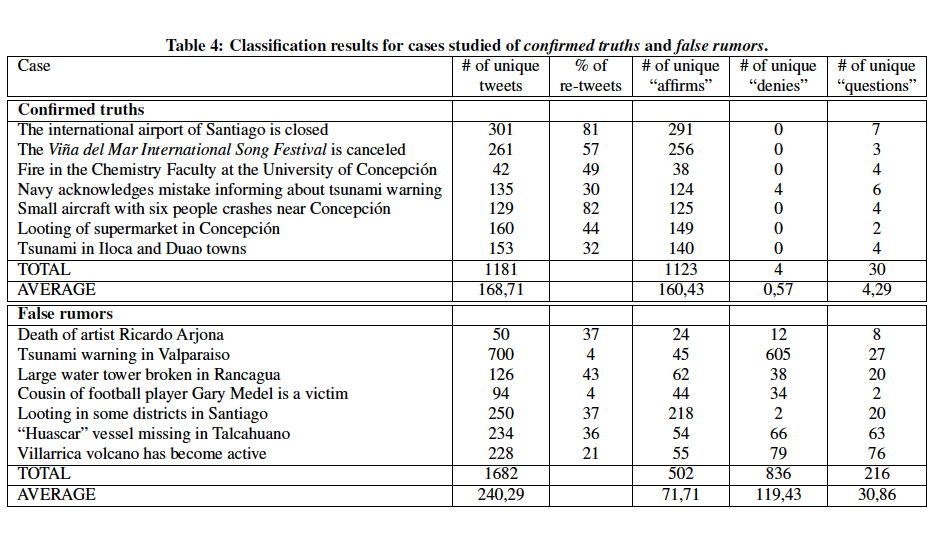
Since the study principally focused on Twitter, I’m surprised that the authors did not reference the empirical study that came out last year on the behavior of Twitter users after the 8.8 magnitude earthquake in Chile. The study shows that about 95% of tweets related to confirmed reports validated that information. In contrast only 0.03% of tweets denied the validity of these true cases. Interestingly, the results also show  that “the number of tweets that deny information becomes much larger when the information corresponds to a false rumor.” In fact, about 50% of tweets will deny the validity of false reports. This means it may very well be posible to detect rumors by using aggregate analysis on tweets.

On framing, I believe the focus on microblogging and Twitter in particular misses the bigger picture which ultimately is about the methodology of crowdsourcing rather than the technology. To be sure, the study by Penn State could just as well have been titled “Seeking the Trustworthy SMS.” I think this important research on microblogging would be stronger if this distinction were made and the resulting analysis tied more closely to the ongoing debate on crowdsourcing crisis information that began during the response to Haiti’s earthquake in 2010.

Also, as was noted during the Red Cross Summit in 2010, more than two-thirds of respondents to a survey noted that they would expect a response within an hour if they posted a need for help on a social media platform (and not just Twitter) during a crisis. So whether humanitarian organizations like it or not, crowdsourced social media information cannot be ignored.

The authors carried out a series of insightful interviews with about a dozen international humanitarian organizations to try and better understand the hesitation around the use of Twitter for humanitarian response. As noted earlier, however, it is not Twitter per se that is a concern but the underlying methodology of crowdsourcing.

As expected, interviewees noted that they prioritize the veracity of information over the speed of communication. “I don’t think speed is necessarily the number one tool that an emergency operator needs to use.” Another interviewee opined that “It might be hard to trust the data. I mean, I don’t think you can make major decisions based on a couple of tweets, on one or two tweets.” What’s interesting about this latter comment is that it implies that only one channel of information, Twitter, is to be used in decision-making, which is a false argument and one that nobody I know has ever made.

Either way, the trade-off between speed and accuracy is a well known one. As mentioned in this blog post from 2009, information is perishable and accuracy is often a luxury in the first few hours and days following a major disaster. As the authors for the study rightly note, “uncertainty is ‘always expected, if sometimes crippling’ (Benini, 1997) for NGOs involved in humanitarian relief.” Ultimately, the question posed by the authors of the Penn study can be boiled down to this: is some information better than no information if it cannot be immediately verified? In my opinion, yes. If you have some information, then at least you can investigate it’s veracity which may lead to action. I also believe that from this philosophical point of view, the answer would still be yes.

Based on the interviews, the authors found that organizations engaged in immediate emergency response were less likely to make use of Twitter (or crowdsourced information) as a channel for information. As one interviewee put it, “Lives are on the line. Every moment counts. We have it down to a science. We know what information we need and we get in and get it…” In contrast, those organizations engaged in subsequent phases of disaster response were thought more likely to make use of crowdsourced data.

I’m not entirely convinced by this: “We know what information we need and we get in and get it…”. Yes, humanitarian organizations typically know but whether they get it, and in time, is certainly not a given. Just look at the humanitarian responses to Haiti and Libya, for example. Organizations may very well be “unwilling to trade data assurance, veracity and authenticity for speed,” but sometimes this mindset will mean having absolutely no information. This is why OCHA asked the Standby Volunteer Taskforce to provide them with a live crowdsourced social media may of Libya. In Haiti, while the UN is not thought to have used crowdsourced SMS data from Mission 4636, other responders like the Marine Corps did.

Still, according to one interviewee, “fast is good, but bad information fast can kill people. It’s got to be good, and maybe fast too.” This assumes that no information doesn’t kill people. Also good information that is late, can also kill people. As one of the interviewees admitted when using traditional methods, “it can be quite slow before all that [information] trickles through all the layers to get to us.” The authors of the study also noted that, “Many [interviewees] were frustrated with how slow the traditional methods of gathering post-disaster data had remained despite the growing ubiquity of smart phones and high quality connectivity and power worldwide.”

On a side note, I found the following comment during the interviews especially revealing: “When we do needs assessments, we drive around and we look with our eyes and we talk to people and we assess what’s on the ground and that’s how we make our evaluations.” One of the common criticisms leveled against the use of crowdsourced information is that it isn’t representative. But then again, driving around, checking things out and chatting with people is hardly going to yield a representative sample either.

One of the main findings from this research has to do with a problem in attitude on the part of humanitarian organizations. “Each of the interviewees stated that their organization did not have the organizational will to try out new technolo-gies. Most expressed this as a lack of resources, support, leadership and interest to adopt new technologies.” As one interview noted, “We tried to get the president and CEO both to use Twitter. We failed abysmally, so they’re not– they almost never use it.” Interestingly, “most of the respondents admitted that many of their technological changes were motivated by the demands of their donors. At this point in time their donors have not demanded that these organizations make use of microblogged data. The subjects believed they would need to wait until this occurred for real change to begin.”

For me the lack of will has less to do with available resources and limited capacity and far more to do with a generational gap. When today’s young professionals in the humanitarian space work their way up to more executive positions, we’ll  see a significant change in attitude within these organizations. I’m thinking in particular of the many dozens of core volunteers who played a pivotal role in the crisis mapping operations in Haiti, Chile, Pakistan, Russia and most recently Libya. And when attitude changes, resources can be reallocated and new priorities can be rationalized.

What’s interesting about these interviews is that despite all the concerns and criticisms of crowdsourced Twitter data, all interviewees still see microblogged data as a “vast trove of potentially useful information concerning a disaster zone.” One of the professionals interviewed said, “Yes! Yes! Because that would – again, it would tell us what resources are already in the ground, what resources are still needed, who has the right staff, what we could provide. I mean, it would just – it would give you so much more real-time data, so that as we’re putting our plans together we can react based on what is already known as opposed to getting there and discovering, oh, they don’t really need medical supplies. What they really need is construction supplies or whatever.”

Another professional stated that, “Twitter data could potentially be used the same way… for crisis mapping. When an emergency happens there are so many things going on in the ground, and an emergency response is simply prioritization, taking care of the most important things first and knowing what those are. The difficult thing is that things change so quickly. So being able to gather information quickly…. <with Twitter> There’s enormous power.”

The authors propose three possible future directions. The first is bounded microblogging, which I have long referred to as “bounded crowdsourcing.” It doesn’t make sense to focus on the technology instead of the methodology because at the heart of the issue are the methods for information collection. In “bounded crowdsourcing,” membership is “controlled to only those vetted by a particular organization or community.” This is the approach taken by Storyful, for example. One interviewee acknowledge that “Twitter might be useful right after a disaster, but only if the person doing the Tweeting was from <NGO name removed>, you know, our own people. I guess if our own people were sending us back Tweets about the situation it could help.”

Bounded crowdsourcing overcomes the challenge of authentication and verification but obviously with a tradeoff in the volume of data collected “if an additional means were not created to enable new members through an automatic authentication system, to the bounded microblogging community.” However, the authors feel that bounded crowdsourcing environments “undermine the value of the system” since “the power of the medium lies in the fact that people, out of their own volition, make localized observations and that organizations could harness that multitude of data. The bounded environment argument neutralizes that, so in effect, at that point, when you have a group of people vetted to join a trusted circle, the data does not scale, because that pool by necessity would be small.”

That said, I believe the authors are spot on when they write that “Bounded environments might be a way of introducing Twitter into the humanitarian centric organizational discourse, as a starting point, because these organizations, as seen from the evidence presented above, are not likely to initially embrace the medium. Bounded environments could hence demonstrate the potential for Twitter to move beyond the PR and Communications departments.”

The second possible future direction is to treat crowdsourced data is ambient, “contextual information rather than instrumental information, (i.e., factual in nature).” This grassroots information could be considered as an “add-on to traditional, trusted institutional lines of information gathering.” As one interviewee noted, “Usually information exists. The question is the context doesn’t exist…. that’s really what I see as the biggest value [of crowdsourced information] and why would you use that in the future is creating the context…”.

The authors rightly suggest that “that adding contextual information through microblogged data may alleviate some of the uncertainty during the time of disaster. Since the microblogged data would not be the single data source upon which decisions would be made, the standards for authentication and security could be less stringent. This solution would offer the organization rich contextual data, while reducing the need for absolute data authentication, reducing the need for the organization to structurally change, and reducing the need for significant resources.” This is exactly how I consider and treat crowdsourced data.

The third and final forward-looking solution is computational. The authors “believe better computational models will eventually deduce informational snippets with acceptable levels of trust.” They refer to Ushahidi’s SwiftRiver project as an example.

In sum, this study is an important contribution to the discourse. The challenges around using crowdsourced crisis information are well known. If I come across as optimistic, it is for two reasons. First, I do think a lot can be done to address the challenges. Second, I do believe that attitudes in the humanitarian sector will continue to change.

How To Use Technology To Counter Rumors During Crises: Anecdotes from Kyrgyzstan

I just completed a short field mission to Kyrgyzstan with UN colleagues and I’m already looking forward to the next mission. Flipping through several dozen pages of my handwritten notes just now explains why: example after example of the astute resourcefulness and creative uses of information and communication technologies in Kyrgyzstan is inspiring. I learned heaps.

For example, one challenge that local groups faced during periods of ethnic tension and violent conflict last year was the spread of rumors, particularly via SMS. These deliberate rumors ranged from humanitarian aid being poisoned to cross border attacks carried out by a particular ethnic group. But many civil society groups were able to verify these rumors in near real-time using Skype.

When word of the conflict spread, the director of one such groups got online and invited her friends and colleagues to a dedicate Skype chat group. Within two hours, some 2,000 people across the country had joined the chat group with more knocking but the group had reached the maximum capacity allowed by Skype. (They subsequently migrated to a web-based platform to continue the real-time filtering of information from around the country).

The Skype chat was abuzz with people sharing and validating information in near real-time. When someone got wind of a rumor, they’d simply jump on Skype and ask if anyone could verify. This method proved incredibly effective. Why? Because members of this Skype group constituted a relevant, trusted and geographically distributed network. A person would only add a colleague or two to the chat if they knew who this individual was, could vouch for them and believed that they had—or could have—important information to contribute given their location and/or contacts. (This reminded me of Gmail back in the day when you only had a certain number of invites, so one tended to chose carefully how to “spend” those invites).

The degrees of separation needed to verify a rumor was close to one. In the case of the supposed border attack, one member of the chat group had a contact with the army unit guarding the border crossing in question. They called them on their cell phone and confirmed within minutes that no attack was taking place. As for the rumor about the poisoned humanitarian aid, another member of the chat found the original phone numbers from which these false SMS’s were being sent. They called a personal contact at one of the telecommunication companies and asked whether the owners of these phones were in fact texting from the place where the aid was reportedly poisoned; they weren’t. Meanwhile, another member of the chat group had himself investigated the rumor in person and confirmed that the text messages were false.

This Skype detective network proved an effective method for the early detection and response to rumors. Once a rumor was identified as such, 2,000 people could share that information with their own networks within minutes. In addition, members of this Skype group were able to ping their media contacts and have the word spread even further. In at least two cases and in two different cities, telecommunication companies also collaborated by sending out broadcast SMS to notify subscribers about the false rumors.

I wonder if this model can be further improved on and replicated. Any thoughts from iRevolution readers would be most welcome.

Analyzing the Veracity of Tweets during a Major Crisis

A research team at Yahoo recently completed an empirical study (PDF) on the behavior of Twitter users after the 8.8 magnitude earthquake in Chile. The study was based on 4,727,524 indexed tweets, about 20% of which were replies to other tweets. What is particularly interesting about this study is that the team also analyzed the spread of false rumors and confirmed news that were disseminated on Twitter.

The authors “manually selected some relevant cases of valid news items, which were confirmed at some point by reliable sources.” In addition, they “manually selected important cases of baseless rumors which emerged during the crisis (confirmed to be false at some point).” Their goal was to determine whether users interacted differently when faced with valid news vs false rumors.

The study shows that about 95% of tweets related to confirmed reports validated that information. In contrast only 0.03% of tweets denied the validity of these true cases. Interestingly, the results also show  that “the number of tweets that deny information becomes much larger when the information corresponds to a false rumor.” In fact, about 50% of tweets will deny the validity of false reports. The table below lists the full results.

The authors conclude that “the propagation of tweets that correspond to rumors differs from tweets that spread news because rumors tend to be questioned more than news by the Twitter community. Notice that this fact suggests that the Twitter community works like a collaborative filter of information. This result suggests also a very promising research line: it could posible to detect rumors by using aggregate analysis on tweets.”

I think these findings are particularly important for projects like *Swift River, which try to validate crowdsourced crisis information in real-time. I would also be interested to see a similar study on tweets around the Haitian earthquake to explore whether this “collaborative filter” dynamic is an emergent phenomena in this complex systems or simply an artifact of something else.

Interested in learning more about “information forensics”? See this link and the articles below: