Transitions 2.0: Internet, Political Culture and Autocracy in Central Asia

I recently presented my dissertation research at the American Political Science Association (APSA) convention and attended a related panel entitled: “Internet: Collective Action, Social Mobilization, and Civic Engagement.” Eric McGlinchey, one of the professors on the panel, presented his research paper (PDF) on “Transitions 2.0: Internet, Political Culture and Autocracy in Central Asia.”

Eric notes that the theories and prescriptions of the transitions literature have not borne fruit in Central Asia. Indeed, “the region today is more autocratic than it was eighteen years ago at the time of the Soviet collapse.”

Eric thus seeks to understand why “Transitions 1.0” failed and to “investigate the potential for a Transitions 2.0” by exploring three autocracies Kazakhstan, Kyrgyzstan and Uzbekistan.

As Eric notes, “new information communication technologies (ICTs) are emerging in Central Asia and, as survey research demonstrates, these new ICTs hold the potential to transform the region’s political culture from one that abides authoritarian rule to a culture that embraces political reform.”

I very much appreciate Eric’s balanced approach to technology and demographic change. As he writes,

[T]he current class of political elites is graying while the youth population of Central Asian society is growing larger.  And whereas the hierarchical Communist Party carefully controlled the political milieu in which the current political elite was acculturated, today new ICTs have broken the government’s information monopoly, laid bare the inequities of patronage politics and are in the process of changing the mental maps with which this growing younger generation views national governance.

Institutional path dependency, as Paul Pierson explains, is sustained by—learning effects‖ and—adaptive expectations. New ICTs have simultaneously transformed what youth in Central Asia learn and what they expect—and it is this transformation […] that may ultimately undermine the cost calculations that have thus far sustained autocratic patronage in the region.

Whether access to ICTs can be shown to have a successful track record in promoting liberalization and democratization is still an open debate which requires more empirical research to shed compelling insights on the question.

Eric cites the work by David Hill and Khrishna Sen (2000) who “illustrate how the Internet enabled Indonesian oppositionists not only to break Suharto’s media monopoly, but to break this monopoly using conversational, dialogic, (and) non-hierarchical” forms of communication.”

That said, Hill, Krishna and several other scholars emphasize that the “political environment within which oppositionists marshal technologies like the Internet, can dampen the transformative effects of new ICTs.” To be sure,

Just as autocracies can control printing presses, radio and television, so too can savvy authoritarian governments monitor and exert control over new telecoms and Internet service providers.  Moreover, even absent such control, new ICTs need not be liberalizing.

Peter Chroust, for example, demonstrates how illiberal groups—neo-Nazis in Germany and the Taliban in Afghanistan—can equally use new ICTs to facilitate communication and mobilization.

Benjamin Barber suggests that fears that new ICTs force people—into one commercially homogeneous global network: one McWorld tied together by technology motivate actors to fight for the opposite, for the construction of even more differentiated local identities. As such, Barber predicts, new ICTs will result in more, not less ethnic, racial, tribal, or religious violence.

Eric’s research is informative because there is still very little research on the impact of ICTs on populations in Central Asia. The results of his empirical survey suggests that “although the causal effects of new ICTs are mixed and highly dependent on structural context, the use of new ICTs nevertheless does appear to have a liberalizing effect on political culture.”

More specifically, where state filtering of the Internet is less pronounced—in Kyrgyzstan and Kazakhstan—survey results suggest that Internet users do exhibit greater inclinations toward political reform and civic engagement.  Conversely, where state filtering of the Internet is extensive, as it is in Uzbekistan, inclinations toward political reform and civic engagement differ little between Internet users non-users.

Eric concludes as follows:

Will Transitions 2.0 succeed where Transitions 1.0 failed?  To a large degree the answer to this question rests in the ability of Central Asian governments to continue effective filtering of the Internet and of global communications broadly, something that may get progressively more difficult as Internet access shifts from what now are readily controlled public areas (work, Internet cafes and libraries) to the comparative privacy of smart phones and home computers.

No less consequential is whether ICT-induced changes in political culture translate to societal changes in political engagement.  This study suggests that the retreat of Soviet institutions of political acculturation and the arrival of new ICTs will likely produce a political culture that is less trusting of autocratic rule and more open to outsiders and civic engagement.

Whether Central Asians will assume the daunting risks that undoubtedly are required to transform their governments so as to more closely reflect these changed political values, however, remains an open question.

Patrick Philippe Meier

Nonviolent Resistance in Post-Communist Countries

Introduction

I recently presented my dissertation research at the American Political Science Association (APSA) convention and had the good fortune of sharing the panel with Olena Nikolayenko from Stanford University. Nikolayenko presented an excellent paper (PDF) entitled: “Youth Movements in Post-Communist Societies: A Model for Nonviolent Resistance.”

Olena seeks to explain the variation in social movement outcomes in non-democracies by “investigating the dynamics of tactical interaction between challenger organizations and the ruling elite.” She argues that “both civic activists and autocratic incumbents engaged in processes of political learning. Hence, tactical innovation was vital to the success of youth movements, especially late risers in the protest cycle.”

I think she’s spot on with the tactical learning argument. In fact, I use the same hypothesis for my dissertation as well, referring to the cyber game of cat-and-mouse between resistance movements and repressive regimes.  By tactical innovation, Olena means “experimentation with the choice of frames, protest strategies and interaction styles with allies.”

This dynamic approach to the study of social movements to post-communist countries is particularly interesting since the notion of tactical innovation has only been applied to mature democracies.  As Olena notes, however, tactical innovation may very well be of “greater importance to the challenger organizations in the repressive political regimes.”

This is because “the stakes of the political struggle—regime change or the survival of the autocratic incumbent—have wide-ranging implications for the ruling elite and the society at large.”

Olena’s decision to focus on post-communist countries is also important because of the focus on unsuccessful cases. As she rightly notes, there is a notable bias in social movement literature on cases of success. And yet, there is much to gain from analyzing movements that are defeated by repressive regimes.

Explaining Social Movements

What is particularly neat about Olena’s dynamic approach is that she draws on Doug McAdam’s work (1983) and thus distinguishes between “tactical innovation of movement participants and tactical adaptation of the ruling elite.” McAdam’s piece is entitled: “Tactical Innovation and the Pace of Insurgency.”

Tactical innovation involves a shift from conventional forms of collective action and the application of novel confrontational tactics. Tactical adaptation refers to tactics of the incumbent government to neutralize unorthodox mobilization efforts of challenger organizations and introduce new barriers for contentious collective action.

In terms of tactical innovation, Olena explains that to gain leverage in the political arena, “a social movement needs to articulate persuasive messages, employ effective protest strategies, and forge ties with influential allies. Each of these choices can involve tactical innovation.”

I’m especially interested in the protest strategies piece given the focus of my dissertation. Olena draws on some of Charles Tilly‘s research that I had actually not come across before but which is incredibly relevant to my own doctoral research. Tilly’s relevant piece published in 1978 is entitled: “From Mobilization to Institutionalization.”

Though a range of protest tactics seems to be limitless, protesters tend to resort to a recurrent toolkit of contentious collective action. Tilly conceptualizes a repertoire of contention as “a limited set of routines that are learned, shared, acted out through a relatively deliberate process of choice.” In his influential work, Tilly (1978) demonstrates how it takes such macrohistorical factors as the rise of the nation-state and the emergence of new communication technologies to engender novel forms of protest. A central advantage of novel protest strategies is that they can catch the authorities off guard and produce a stronger political impact than familiar protest tactics.

As for tactical adaptation, Olena examines how repressive incumbent governments respond to the “rise of reform-oriented and technologically savvy youth movements by setting up state-sponsored youth organizations and intensifying the use of modern technology to subvert youth mobilization.” This an important part of the cyber game of cat-and-mouse that is all too often drowned by the media hype around new technologies.

Social movement literature has documented a toolkit of strategies that the ruling elite deploys to suppress mass mobilization. Repression is a common policy instrument used in non-democracies. In the so-called hybrid regimes, the ruling elite systematically manipulate democratic procedures to the extent the turnover of power is hardly possible, but refrain from the conspicuous use of violence.

It is critical to understand the underlying tactics employed by repressive regimes to suppress and/or manipulate political change.

Methodology

Olena focuses on nonviolent youth resistance movements in the following five countries: Azerbaijan, Belarus, Georgia, Serbia, and Ukraine. These movements share several important characteristics:

  1. The formation of youth movements during the election year, with the exception of Serbia’s Otpor;
  2. Anticipation of electoral fraud;
  3. Demand for free and fair elections;
  4. Mass mobilization in the repressive political regime,
  5. Use of nonviolent methods of resistance.

Despite these similarities, however, some of the movements were “more successful than others in expanding the base of popular support for political change in non-democracies.”

Olena carried out 46 semi-structured interviews with key informants to get an in-depth description of social movements. To estimate the the level of youth movements, Olena relied on three indicators: (1) size of movement; (2) size of post-election protests; and (3) duration of post-election protests.

Findings

While the Otpor movement in Serbia was responsible for demonstrating a series of important tactical innovations, subsequent youth resistance movements in post-communist countries were unsuccessful. This is largely due to the fact that these movements simply “copied” these tactics without adding much in terms of innovative thinking. Otpor also trained these movements and perhaps should have emphasized the importance on endogenous innovation a lot more.

In terms of political learning by elites in repressive regimes, Olena’s findings show that:

[I]n light of electoral revolutions in Serbia, Georgia, and Ukraine, the governments in Azerbaijan and Belarus have significantly raised costs of political participation. Specifically, the coercive apparatus applied violence to prevent the permanent occupation of the public space in the wake of fraudulent elections.

Moreover, the authorities deployed coercive measures against youth movements before they could develop into powerful agents of political change. In addition, the governments in Azerbaijan and Belarus have invested considerable resources into the creation of state-sponsored youth organizations.

The analysis demonstrates that both civic activists and the ruling elite are able to draw lessons from prior episodes of nonviolent resistance during a protest cycle. As a result, late risers in the protest cycle need to apply a series of innovative strategies to overcome increasing constraints on political participation and introduce an element of surprise.

Patrick Philippe Meier

Literature Review: GIS for Conflict Analysis

This interesting peer-reviewed study (PDF) was authored by researchers at the Joint Research Center (JRC) and published in the International Studies Review in September 2009.

Political and social scientists have quantitatively analyzed the drivers of conflicts in a large number of studies. Geographic components and territorial concepts have emerged as important drivers in interstate disputes. However, geographic components are rarely defined or measured with the same technique.

This study reviews geographic and territorial concepts, associated data sets and analysis methods. The study objective is to represent geographic and territorial concepts with Geographic Information Systems (GIS). The paper describes the challenges and potential opportunities for creating an integrated GIS model of security.

The literature review is a good introduction for anyone interested in the application of GIS to the spatial analysis of conflict. As a colleague mentioned, however, the authors of the study do not cite more recent work in this area, which is rather surprising and unfortunate. Perhaps this is due to the fact that the academic peer-review process can seemingly take forever.

Patrick Philippe Meier

Accurate Crowdsourcing for Human Rights

This is a short video of the presentation I will be giving at the Leir Conference on The Next Generation of Human Rights. My talk focuses on the use of digital technologies to leverage the crowdsourcing and crowdfeeding of human rights information. I draw on Ushahidi’s Swift River initiative to describe how crowdsourced information can be auto-validated.

Here’s a copy of the agenda (PDF) along with more details. This Leir Conference aims to bring together world-leading human rights practitioners, advocates, and funders for discussions in an intimate setting. Three panels will be convened, with a focus on audience discussion with the panelists. The topics will include:

  1. Trends in Combating Human Rights Abuses;
  2. Human Rights 2.0: The Next Generation of Human Rights Organizations;
  3. Challenges and Opportunities of  Technology for Human Rights.

I will be on presenting on the third panel together with colleagues from Witness.org and The Diarna Project. For more details on the larger subject of my presentation, please see this blog post on peer-producing human rights.

The desired results of this conference are to allow participants to improve advocacy, funding, or operations through collaborative efforts and shared ideas in a natural setting.

Patrick Philippe Meier

Promises and Pitfalls in the Spatial Prediction of Ethnic Violence

My colleague Nils Weidmann just published this co-authored piece with Harvard Professor Monica Toft. The paper deserves serious attention. Weidmann and Toft review this article on the spatial prediction of ethnic conflict that was authored by Lim, Metzler and Bar-Yam (LMB) and published in the prestigious journal Science.

I reviewed the article myself earlier this year and while I was highly suspicious of the findings—correlations of 0.9 (!) and above—I did not dig deeper. But Weidmann and Toft have done just this and their findings are worth reading.

The authors clearly show that the analysis by LMB “suffers from a biased selection of groups and regions, an inadequate null hypothesis and unit of analysis.” This really begs the following question: how did the LMB paper ever make it through the peer-review process?

The authors’ case selection is seriously biased as it “seems to adjust the group map as to better fit the model predictions,” for example. The isolationist policy recommendations that LMB put forward are thus founded on misleading methods and ought to be entirely dismissed.

Better yet, Science should retract the LMB paper or at least publish the commentary by Weidmann and Toft. Indeed, another question that follows from the conclusion reached by Weidmann and Toft is this: how many other below-par papers have been accepted and published by Science?

In sum, not only are the methods used by LMB questionable, but as Weidmann and Toft conclude, “the model provides little advance on prior research” in the field of crisis mapping.

On the plus side, the fact that there is push back on early articles in the field of crisis mapping is also a good sign and evidence that the field is becoming more formalized. In addition, the general approach taken by LMB still holds much promise for crisis mapping—it simply needs to be done with a lot more care and transparency. Indeed, combining agent-based models with real world empirical data and a sound understanding of ethnic conflict could become a winning strategy for crisis mapping analytics.

In closing, I look forward to following Nils Weidmann’s work at Princeton and have no doubt that he will continue to play an important role in the development of the field, and will do so with integrity and rigorous scholarship.

Patrick Philippe Meier

Repression 2.0 vs Resistance 2.0

I just presented my dissertation research at the annual American Political Science Association (APSA) conference in Toronto and thought I’d make the short presentation available online via a video-powerpoint with narration. Feedback is always welcomed!

Patrick Philippe Meier

Mapping Massacres: GIS and State Terror in Guatemala

This is the title of a paper published in Geoforum in 2006 (PDF). Note that the paper was actually submitted in 2003 but the peer-review process appears to have taken 3 years. Ridiculous. I sympathize with the authors and hope they’ve turned to blogging. But the content of their paper is actually what I want to blog about here.

The authors use GIS to visually display the locations of massacres associated with Guatemala’s civil war at the department level and include information on indigenous populations as well as physical geography. They note that “maps have become tools of empowerment in Central America and elsewhere,” and highlight how indigenous groups “have begun to use maps as tools in their fight for land and marine resources, as well as greater political economy.”

It is worth understanding that “among some sectors of Guatemalan society, there is still wholesale denial and rejection of past violent events.” To this end, the purpose of “displaying exactly where violent acts took place is to […] educate the Guatemalan public regarding the terrible violence of the recent past.” The authors suggest that “knowing the name of a specific town where a massacre took place is more concrete, potentially leading to perception of place and people, rather than simply being aware of violence in the countryside.”

Guatemala massacres

The authors produced the maps above, which clearly show that most massacres were concentrated in landscapes whose majority populations are indigenous. “Massacres were not random events in Guatemala. Instead, they took place in very specific cultural landscapes. “

The following short excerpts very much resonate with my thinking on crisis mapping:

“Even information that is easily comprehensible without maps takes on new meaning when it is portrayed spatially.”

“However, knowing in a general sense where the violence took place is not enough. If we fail to accurately display such information spatially, we fail to fully understand where and especially why these events took place. […] By using some basic geographic information systems technologies, relationships between ethnicity, location, physical environment, and violence become much clearer.”

“Mapping these tragic events is critical because these maps also serve as another type of memorial for victims and their families. Many Guatemalans have yet to come to grips with the violence of the past. Maps, more so than words can help deconstruct violent events by providing a mental image of a location and event in the onlookers mind.”

The authors have certainly contributed a better spatial understanding of the violence thanks to this study. What is perhaps missing is an equally compelling temporal resolution so that events can be incrementally analyzed over time and space. Doing so may shed more light on the tactics and strategies employed to carry out the violence. These may produce specific patterns or a library of “fingerprints” that could then be used to investigate massacres in other countries.

Patrick Philippe Meier

Doctor Snow’s Health Map Propaganda

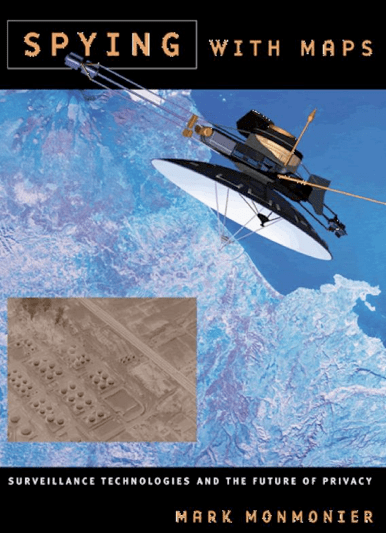
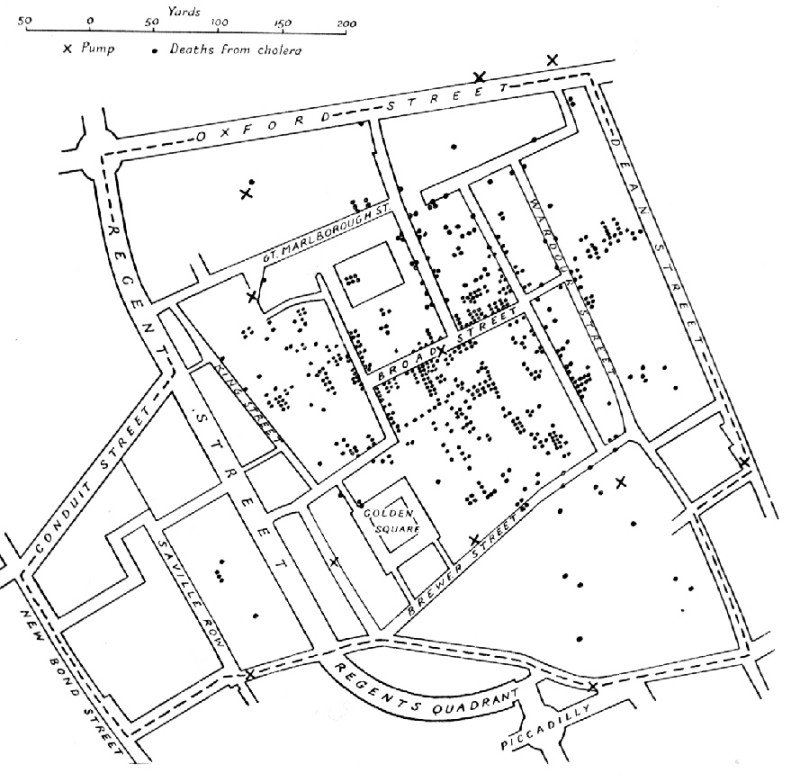
Doctor John Snow’s cholera map of 1854 is often heralded as an example of how mapping can illuminate powerful insights on otherwise hidden patterns. Not so, writes Mark Monmonier in his excellent book on “Spying with Maps” which I just reviewed here.

cholera-snow-map

Mark writes the following on John Snow’s famous map:

“If disease mapping has a poster child, it’s John Snow (1813-1858), the London anesthesiologist credited with discovering the water borne transmission of cholera. […] Snow is best known for his 1854 map showing victims’ homes clustered around Soho’s infamous Broad Street Pump, which he identified as a source of contaminated water. According to epidemiological lore, the good doctor tried unsuccessfully to convince public officials to close down the pump.”

“Undaunted, he too matters in his own hands, removed the pump’s handle, and demonstrated the correctness of his theory when new cases plummeted. Truth be told, the epidemic had already run its course. What’s more, Snow made his famous dot map several months later, for a revised edition of his book on cholera transmission. Even so, his pin map continues to embellish discussions of GIS and disease.”

“Medical geographers, GIS experts, and some epidemiologists perpetuate the Snow myth because it promotes disease mapping as a discovery tool and enhances the stature of their own disciplines. But a careful examination of Snow’s writings indicates that he understood cholera’s mode of transmission well before he made the map.”

“Although Snow was a thoughtful observer, neither his map nor those of his rivals were of any value in generating insightful hypotheses. Snow’s famous cholera map was pure propaganda—and copycat propaganda at that—but proved eminently useful later in the century, when public officials needed convincing arguments to isolate drinking water from sewage.”

Although Mark is rightfully critical of Dr. John Snow’s legendary map, the last sentence above is quite insightful. The map, while unhelpful in knowledge discovery of cholera’s source, did become “eminently useful” to influence public health policy.

Patrick Philippe Meier

Doctor Snow’s Health Map Propaganda

Doctor John Snow’s cholera map of 1854 is often heralded as an example of how mapping can illuminate powerful insights on otherwise hidden patterns. Not so, writes Mark Monmonier in his excellent book on “Spying with Maps” which I just reviewed here.

cholera-snow-map

Mark writes the following on John Snow’s famous map:

“If disease mapping has a poster child, it’s John Snow (1813-1858), the London anesthesiologist credited with discovering the water borne transmission of cholera. […] Snow is best known for his 1854 map showing victims’ homes clustered around Soho’s infamous Broad Street Pump, which he identified as a source of contaminated water. According to epidemiological lore, the good doctor tried unsuccessfully to convince public officials to close down the pump.”

“Undaunted, he too matters in his own hands, removed the pump’s handle, and demonstrated the correctness of his theory when new cases plummeted. Truth be told, the epidemic had already run its course. What’s more, Snow made his famous dot map several months later, for a revised edition of his book on cholera transmission. Even so, his pin map continues to embellish discussions of GIS and disease.”

“Medical geographers, GIS experts, and some epidemiologists perpetuate the Snow myth because it promotes disease mapping as a discovery tool and enhances the stature of their own disciplines. But a careful examination of Snow’s writings indicates that he understood cholera’s mode of transmission well before he made the map.”

“Although Snow was a thoughtful observer, neither his map nor those of his rivals were of any value in generating insightful hypotheses. Snow’s famous cholera map was pure propaganda—and copycat propaganda at that—but proved eminently useful later in the century, when public officials needed convincing arguments to isolate drinking water from sewage.”

Although Mark is rightfully critical of Dr. John Snow’s legendary map, the last sentence above is quite insightful. The map, while unhelpful in knowledge discovery of cholera’s source, did become “eminently useful” to influence public health policy.

Patrick Philippe Meier

Spying with Maps

Mark Monmonier has written yet another excellent book on maps. I relished and reviewed his earlier book on “How To Lie with Maps” and enjoyed this one even more on “Spying with Maps.” I include below some short excerpts that I found particularly neat and interesting.

Picture 1

“Mapping, it turns out, can reveal quite a bit about what we do and who we are. I say mapping, rather than maps, because cartography is not limited to static maps printed on paper or displayed on computer screens. In the new cartographies of surveillance, the maps one looks at are less important than the spatial data systems that store and integrate facts about where we live and work. Location is a powerful key for relating disparate databanks and unearthing information […].”

Big Brother is doing most of the watching, at least for now, but corporations, local governments, and other Little Brothers are quickly getting involved.”

“Much depends, of course, on who’s in charge, us or them, and on who ‘them’ is. A police state could exploit geographic technology to round up dissidents—imagine the Nazi SS with a GeoSurveillance Corps. By contrast, a capitalist marketer can exploit locational data by making a cleverly tailored pitch at a time and place when you’re most receptive. Control is control whether it’s blatant or subtle.”

Corrona Satellites

“Spy satellites became a top priority during the Cold War, and Congress generously supported remote sensing. […] analysts with security clearances pored over images from the CIA’s top-secret Corona satellites at the agency’s clandestine National Reconnaissance Office (NRO).” By 1967, “a massive research and development effort had refined the [resolution] down to an impressive 1.5 meters (5 ft.).” Today’s “intelligence satellites have even sharper eyes: various estimates suggest that pictures from Corona’s most advanced successors have a resolution of roughly 3 inches.”

“Because image intelligence focuses on detecting change, 1-meter satellite imagery is often more informative [then people realize]. A new railway spur or clearing, for instance, could signify a new missile site or weapons factory. And a suspicious accumulation of vehicles might presage an imminent attack. As John Pike observes, ‘if a picture is worth 1,000 words, two pictures are worth 10,000 words.'”

“Washington strongly discourages the sale of high-resolution satellite imagery of Israel, and during the 2001 Middle Eastern campaign, the government thwarted enemy media hopes by buying exclusive rights to Ikonos imagery of Afghanistan.”

I really appreciated Mark’s take on the panopticon. His points below are largely ignored by the mainstream literature on the subject and go a long way to explaining just why satellite imagery has not (yet?) acted a strong deterrent against genocide and crimes against humanity. For more on this, please see this post on geospatial technologies for genocide prevention.

Panopticon

Panopticon

“Although the [panopticon] metaphor seems largely appropriate, I am not convinced  that the similarity between Bentham’s model prison and video surveillance tells us anything that’s not obvious about the watcher’s power over the watched. My hunch is that the prison’s walls and bars as well as the isolation of inmates in individual cells exert far greater control over prisoners’ lives than a ready ability to spy on their actions. […] What’s relevant […] is the power of surveillance to intimidate someone already under the watcher’s control, like a prisoner (who can be beaten), an employee (who can be fired), or a motorist who runs red lights (and could be fined or lose his or her license.”

I had come across ShotSpotter a while back but rediscovered the tool in Mark’s book. What is neat is that ShotSpotter combines audio and mapping in a way that may also be applicable to crisis mapping.

Shotspotter

Shotspotter

“[…] police in several California cities rely on ShotSpotter, which its investors describe as an ‘automatic real-time gunshot locator and display system’ […] a clever marriage of seismic analysis and acoustic filtering. […] Like an earthquake, a gunshot generates a sharply defined circular pulse, which expands outward at constant speed. […] ShotSpotter’s microphones detect the wave at slightly different times depending on their distance from the shooter’s location [which the computer can use] to triangulate a location in either two or three dimension. […] The process pinpoints gunshots within 15 yards […].”

Patrick Philippe Meier