Information Visualization: Using Vision to Think

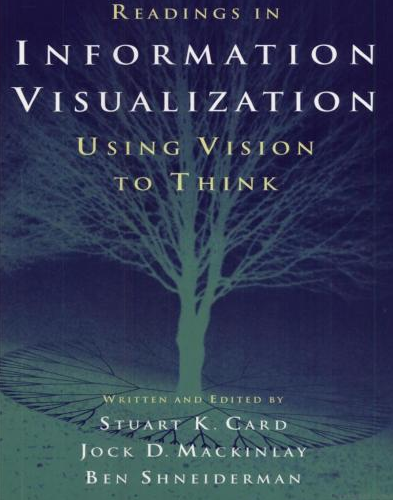
I just finished paging through “Readings in Information Visualization: Using Vision to Think” and came across some interesting tidbits. I’ve shared these below in the form of short excerpts.

Information Visualization

“To understand something is called “seeing” it. We try to make our ideas ‘clear,’ to bring them into ‘focus,’ to ‘arrange’ our thoughts. The ubiquity of visual metaphors in describing cognitive processes hints at a nexus of relationships between what we see and what we think.”

“The purpose of visualization is insight, not pictures.”

“The power of the unaided mind is highly overrated. Without external aids, memory, thought, and reasoning are all constrained. But human intelligence is highly flexible and adaptive, superb at inventing procedures and objects that overcome its own limits. The real powers come from devising external aids that enhance cognitive abilities. How have we increased memory, thought and reasoning? By the invention of external aids: It is these things that make us smart. An important class of external aids that make us smart are graphical inventions of all sorts.”

The progress of civilization can be read in the invention of visual artifacts, from writing to mathematics, to maps, to printing, to diagrams, to visual computing. […] Information visualization is about […] exploiting the dynamic, interactive, inexpensive medium of graphical computerse to devise new external aids enhancing cognitive abilities.”

“A few years ago the power of this new medium was applied to science, resulting in scientific visualization. Now it is possible to apply the medium more generally to business, to scholarship and to education.”

“It is sometimes said, ‘A picture is worth ten thousand words.’ […] This quotation was simply made up [in 1921] by ad writer Frederick R. Barnard as an invented ‘Chinese proverb’ in a streetcar advertisement for Royal Baking Power. (The company assumed that consumers would be compelled to buy a product that had the weight of Chinese philosophy behind it). The ad writer wanted to make the point that pictures can attract attention faster than other media.”

“In 1985 […] satellites were sending back large quantities of data, so visualization was useful as a method to accelerate its analysis and to enhance the identification of interesting phenomena.”

“Information visualization is particularly useful for monitoring large amounts of data in real time and under time pressure to make decision.”

Patrick Philippe Meier

Towards a “Theory” (or analogy) of Crisis Mapping?

The etymology of the word “theory” is particularly interesting. The word originates from the ancient Greek; theoros means “spectator,” from thea “a view” + horan “to see.” In 1638, theory was used to describe “an explanation based on observation and reasoning.” How fitting that the etymologies of “theory” resonate with the purpose of crisis mapping.

But is there a formal theory of crisis mapping per se?  There are little bits and pieces here and there, sprinkled across various disciplines, peer-reviewed journals and conference presentations. But I have yet to come across a “unified theory” of crisis mapping. This may be because the theory (or theories) are implicit and self-evident. Even so, there may be value in rendering the implicit—why we do crisis mapping—more visible.

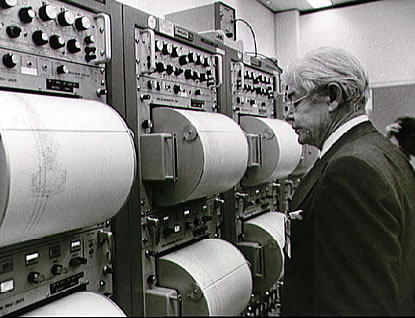
Crises occur in time and space. Yet our study of crises (and conflict in particular) has generally focused on identifying trends over time rather than over space. Why? Because unlike the field of disaster management, we do not have seismographs scattered around the planet that  precisely pint point the source of escalating social tremors. This means that the bulk of our datasets describe conflict as an event happening in countries and years, not cities and days, let alone towns and hours.

This is starting to change thanks to several factors: political scientists are now painstakingly geo-referencing conflict data (example); natural language processing algorithms are increasingly able to extract time and place data from online media and user-generated content (example);  and innovative crowdsourcing platforms are producing new geo-referenced conflict datasets (example).

In other words, we have access to more disaggregated data, which allows us to study conflict dynamics at a more appropriate scale. By the way, this stands in contrast to the “goal of the modern state [which] is to reduce the chaotic, disorderly, constantly changing social reality beneath it to something more closely resembling the administrative grid of its observations” (1). Instead of Seeing Like a State, crisis mapping corrects the myopic grid to give us The View from Below.

Crises are patterns; by this I mean that crises are not random. Military or militia tactics are not random either. There is a method to the madnes—the fog of war not withstanding. Peace is also a pattern. Crisis mapping gives us the opportunity to detect peace and conflict patterns at a finer temporal and spatial resolution than previously possible; a resolution that more closely reflects reality at the human scale.

Why do scientists increasingly build more sophisticated microscopes? So they can get more micro-level data that might explain patterns at a macro-scale. (I wonder whether this means we’ll get to a point where we cannot reconcile quantum conflict mechanics with the general theory of conflict relativity). But I digress.

Compare analog televisions with today’s high-definition digital televisions. The latter is a closer reflection of reality. Or picture a crystal clear lake on a fine Spring day. You peer over the water and see the pattern of rocks on the bottom of the lake. You also see a perfect reflection of the leaves on the trees by the lake shore. If the wind picks up, however, or if rain begins to fall, the water drops cause ripples (“noise” in the data) that prevent us from seeing the same patterns as clearly. Crisis mapping calms the waters.

Keeping with the lake analogy, the ripples form certain patterns. Conflict is also the result of ripples in the socio-political fabric. The question is how to dampen or absorb the ripples without causing unintended ripples elsewhere? What kinds of new patterns might we generate to “cancel out” conflict patterns and amplify peaceful patterns? Thinking about patterns and anti-patterns in time and space may be a useful way to describe a theory of crisis mapping.

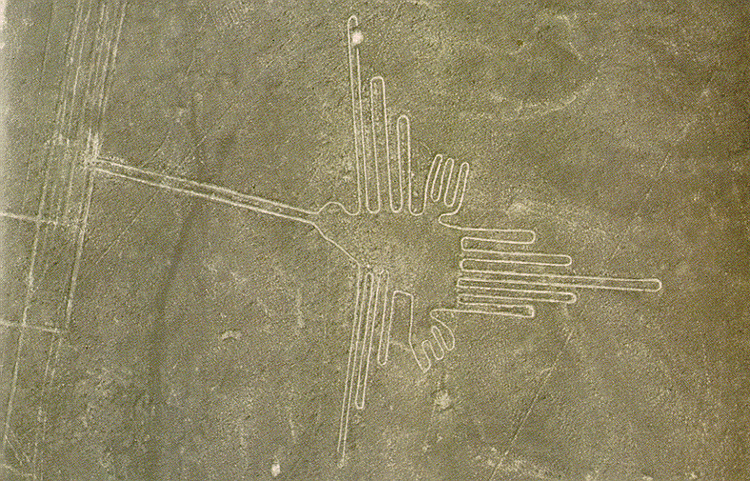
Some patterns may be more visible or detectable at certain temporal-spatial scales or resolutions than at others. Crisis mapping allows us to vary this scale freely; to see the Nazsca Lines of conflict from another perspective and at different altitudes. In short, crisis mapping allow us to escape the linear, two-dimensional world of Euclidean political science to see patterns that otherwise remain hidden.

In theory then, adding spatial data should improve the accuracy and explanatory power of conflict models. This should provide us with better and more rapid ways detect the patterns behind conflict ripples before they become warring tsunamis. But we need more rigorous and data-driven studies that demonstrate this theory in practice.

This is one theory of crisis mapping. Problem is, I have many others! There’s more to crisis mapping than modeling. In theory, crisis mapping should also provide better decision support, for example. Also, crisis mapping should theoretically be more conducive to tactical early response, not to mention monitoring & evaluation. Why? I’ll ramble on about that some other day. In the meantime, I’d be grateful for feedback on the above.

Patrick Philippe Meier

Towards a “Theory” (or analogy) of Crisis Mapping?

The etymology of the word “theory” is particularly interesting. The word originates from the ancient Greek; theoros means “spectator,” from thea “a view” + horan “to see.” In 1638, theory was used to describe “an explanation based on observation and reasoning.” How fitting that the etymologies of “theory” resonate with the purpose of crisis mapping.

But is there a formal theory of crisis mapping per se?  There are little bits and pieces here and there, sprinkled across various disciplines, peer-reviewed journals and conference presentations. But I have yet to come across a “unified theory” of crisis mapping. This may be because the theory (or theories) are implicit and self-evident. Even so, there may be value in rendering the implicit—why we do crisis mapping—more visible.

Crises occur in time and space. Yet our study of crises (and conflict in particular) has generally focused on identifying trends over time rather than over space. Why? Because unlike the field of disaster management, we do not have seismographs scattered around the planet that  precisely pint point the source of escalating social tremors. This means that the bulk of our datasets describe conflict as an event happening in countries and years, not cities and days, let alone towns and hours.

This is starting to change thanks to several factors: political scientists are now painstakingly geo-referencing conflict data (example); natural language processing algorithms are increasingly able to extract time and place data from online media and user-generated content (example);  and innovative crowdsourcing platforms are producing new geo-referenced conflict datasets (example).

In other words, we have access to more disaggregated data, which allows us to study conflict dynamics at a more appropriate scale. By the way, this stands in contrast to the “goal of the modern state [which] is to reduce the chaotic, disorderly, constantly changing social reality beneath it to something more closely resembling the administrative grid of its observations” (1). Instead of Seeing Like a State, crisis mapping corrects the myopic grid to give us The View from Below.

Crises are patterns; by this I mean that crises are not random. Military or militia tactics are not random either. There is a method to the madnes—the fog of war not withstanding. Peace is also a pattern. Crisis mapping gives us the opportunity to detect peace and conflict patterns at a finer temporal and spatial resolution than previously possible; a resolution that more closely reflects reality at the human scale.

Why do scientists increasingly build more sophisticated microscopes? So they can get more micro-level data that might explain patterns at a macro-scale. (I wonder whether this means we’ll get to a point where we cannot reconcile quantum conflict mechanics with the general theory of conflict relativity). But I digress.

Compare analog televisions with today’s high-definition digital televisions. The latter is a closer reflection of reality. Or picture a crystal clear lake on a fine Spring day. You peer over the water and see the pattern of rocks on the bottom of the lake. You also see a perfect reflection of the leaves on the trees by the lake shore. If the wind picks up, however, or if rain begins to fall, the water drops cause ripples (“noise” in the data) that prevent us from seeing the same patterns as clearly. Crisis mapping calms the waters.

Keeping with the lake analogy, the ripples form certain patterns. Conflict is also the result of ripples in the socio-political fabric. The question is how to dampen or absorb the ripples without causing unintended ripples elsewhere? What kinds of new patterns might we generate to “cancel out” conflict patterns and amplify peaceful patterns? Thinking about patterns and anti-patterns in time and space may be a useful way to describe a theory of crisis mapping.

Some patterns may be more visible or detectable at certain temporal-spatial scales or resolutions than at others. Crisis mapping allows us to vary this scale freely; to see the Nazsca Lines of conflict from another perspective and at different altitudes. In short, crisis mapping allow us to escape the linear, two-dimensional world of Euclidean political science to see patterns that otherwise remain hidden.

In theory then, adding spatial data should improve the accuracy and explanatory power of conflict models. This should provide us with better and more rapid ways detect the patterns behind conflict ripples before they become warring tsunamis. But we need more rigorous and data-driven studies that demonstrate this theory in practice.

This is one theory of crisis mapping. Problem is, I have many others! There’s more to crisis mapping than modeling. In theory, crisis mapping should also provide better decision support, for example. Also, crisis mapping should theoretically be more conducive to tactical early response, not to mention monitoring & evaluation. Why? I’ll ramble on about that some other day. In the meantime, I’d be grateful for feedback on the above.

Patrick Philippe Meier

Crisis Mapping and Health Geographics

Crisis Mapping is by definition a cross-disciplinary field. Crises can be financial, ecological, humanitarian, etc., but these crises all happen in time and space, and necessarily interact with social networks. We may thus want to learn how different fields such as health, environment, biology, etc., visualize and analyze large complex sets of data to detect and amplify or dampen specific patterns.

We can’t all become specialists in each others’ areas of expertise but we can learn from each other, especially if we share a common language. Like the field of complexity science, Crisis Mapping can provide a common but malleable language, taxonomy and conceptual framework to facilitate the exchange of insights driven by innovative thinking in diverse fields.

This explains why I was excited to come across the International Journal of Health Geographics a few days ago. The Journal is an online and open-access resource. This means new ideas can be shared openly, which is conducive to innovation, just like arXiv.

Two of the Journal’s latest articles caught my interest:

1) An Agent-Based Approach for Modeling Dynamics of Contagious Disease Spread

This study developed a spatially explicit epidemiological model of infectious disease to better understand how contagious diseases spatially diffuse through a network of human contacts. To do this, the authors developed an agent-based model (ABM) that integrates geographic information systems (GIS) to simulate the spatial diffusion. (See my previous post on ABM and crisis mapping).

What is very neat about the authors’ approach is that they chose to draw on georeferenced land use data and census data. In other words, they combined the fomalistic rules of ABM with empirical GIS data. This means that the model can actually be tested and different scenarios can be played out by adding or changing some of the parameters. Could we use this model for conflict contageon?

2) Combining Google Earth and GIS Mapping Technologies in a Dengue Surveillance System

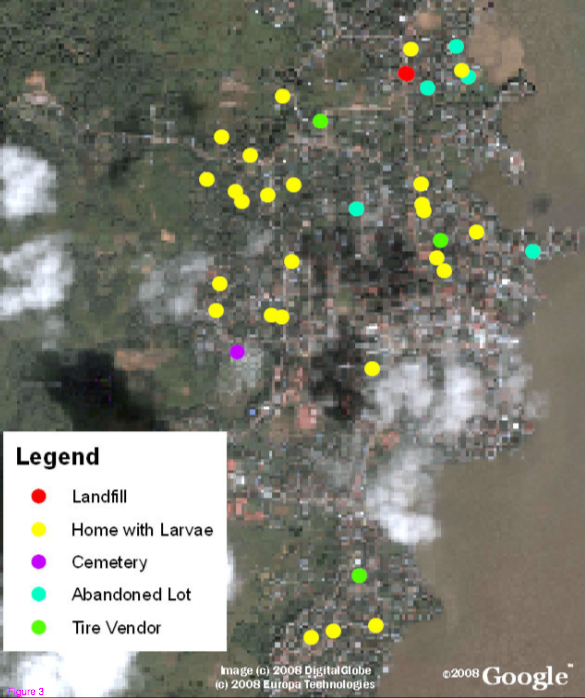
This study overlayed georeferenced epidemiological data on a town in Nicaragua with satellite imagery from Google Earth to enable dengue control specialists to prioritize specific neighborhoods for targetted interventions. The authors used ArcGIS to “accurately identify areas with high indices of mosquito infestation and interpret the spatial relationship of these areas with potential larval development sites such as garbage piles and large pools of standing water.”

It’s worth noting that the above Google Earth imagery was not particularly high resolution but the authors were still able to make full use of the imagery.

This approach to mapping for decision-support is particularly relevant for resource-limited settings since. As the authors note, the surveillance project “utilizes readily available technologies that do not rely on Internet access for daily use and can easily be implemented in many developing countries for very little cost.”

While the team had a free copy of ArcGIS thanks to the Global Fund, they plan to consider free and low-cost alternatives such as SaTScan, MapServer and Quantum GIS in the future. (See this post for additional alternatives like GeoCommons). I hope the authors also know about Walking Papers. I’ll email them just in case. Here’s to cross-disciplinary collaboration!

Patrick Philippe Meier


US Calls for UN Aerial Surveillance to Detect Preparations for Attacks

The US President:

“I am planning in the near future to submit to the United Nations a proposal for the creation of a United Nations aerial surveillance to detect preparations for attack. This plan I had intended to place before this conference. This surveillance system would operate in the territories of all nations prepared to accept such inspection. For its part, the United States is prepared not only to accept United Nations aerial surveillance but to do everything in its power to contribute to the rapid organization and successful operation of such international surveillance.”

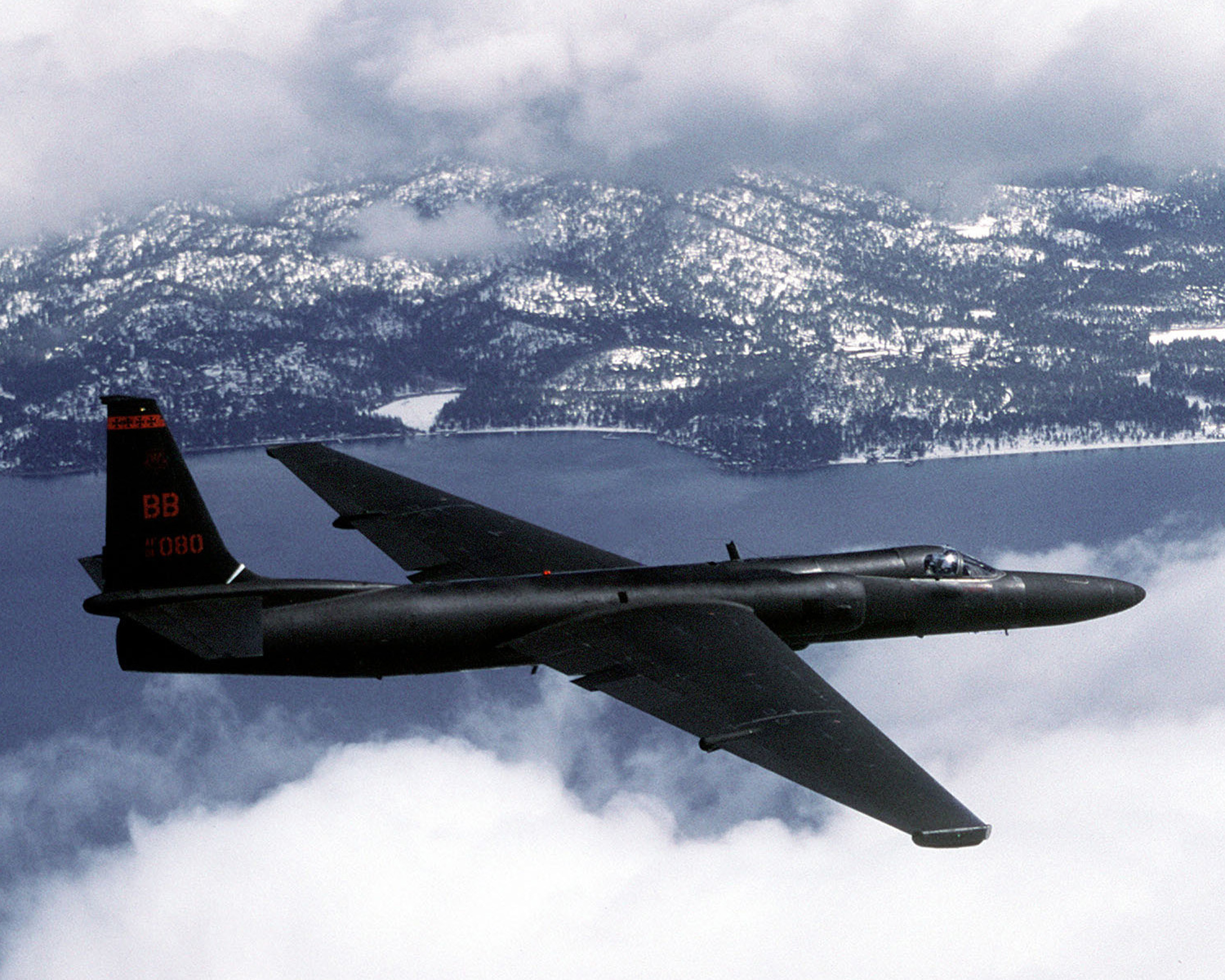
The conference in question was the US-Soviet Summit meeting held in Paris on May 16th, 1960, and the words above were Dwight Eisenhower’s. Just weeks earlier, the Soviets had shot down an American U-2 CIA spy plane and captured it’s pilot Gary Powers. The Soviet leader Nikita Khrushchev lost no time in lashing out against the US President during the Summit, holding him directly responsible for the collapse of the talks, which many on both sides had hoped would usher in a period of “peaceful coexistence” between the superpowers.

Khrushchev called the espionage sanctioned by Eisenhower a provocative and aggressive act against the Soviet Union.

“We regret that this Meeting has been torpedoed by the reactionary element in the United States as the outcome of provocative flights by American military planes over the Soviet Union. […] Let the shame and blame for it fall on those who have proclaimed a brigand policy in relation to the Soviet Union…” (1).

Eisenhower, who is said to have been furious at Khrushchev’s public attacks, replied forthwith:

“I have come to Paris to seek agreements with the Soviet Union which would eliminate the necessity for all forms of espionage, including overflights. I see no reason to use this incident to disrupt the conference.”

“Should it prove impossible, because of the Soviet attitude, to come to grips here in Paris with this problem and the other vital issues threatening world peace, I am planning in the near future to submit to the United Nations a proposal for the creation of a United Nations aerial surveillance to detect preparations for attack. This plan I had intended to place before this conference. This surveillance system would operate in the territories of all nations prepared to accept such inspection. For its part, the United States is prepared not only to accept United Nations aerial surveillance but to do everything in its power to contribute to the rapid organization and successful operation of such international surveillance” (2).

I find this all absolutely fascinating, and mentioned the exchange to colleagues at UNOSAT just a few weeks ago at CERN in Geneva. The UN’s Operational Satellite Program was actually created 40 years after Eisenhower’s threats to set up UN aerial surveillance unit. It was equally fascinating to learn about UNOSAT’s analysis of satellite imagery during Sri Lanka’s military attacks in April. The analysis clearly showed that the military shelled areas where civilians were sheltering in a no-fire zone.

As per UNOSAT’s mandate, this analysis was done regardless of whether the Sri Lankan government was prepared to accept such inspection, and rightly so.

Military attacks are not random, they are organized. This by definition means that preparations for military attacks reveal patterns. Heavy equipment, military trucks, jeeps, etc., all need to be mobilized in a coordinated manner. I recently spoke with one of the world’s leading experts on automated change detection of satellite imagery and he confirmed that algorithms could now be developed to detect specific types of traffic patterns, for example.

Will the UN ever be allowed to monitor and detect preparations for attack? After all, the first Article of the Charter commits the UN to “maintain international peace and security, and to that end: to take effective collective measures for the prevention and removal of threats to the peace […].” Can a US President today commit the UN to a full fledged international aerial surveillance program? There clearly is a strong precedent and it is important we not forget this important piece of history.

UPDATED: Professor Alan Kuperman just sent me an email the Open Skies Proposal that Eisenhower put forward 5 years before the US-Soviet Summit. The Open Skies Treaty actually entered into force in 2002:

The Treaty establishes a regime of unarmed aerial observation flights over the entire territory of its participants. The Treaty is designed to enhance mutual understanding and confidence by giving all participants, regardless of size, a direct role in gathering information about military forces and activities of concern to them. Open Skies is one of the most wide-ranging international efforts to date to promote openness and transparency of military forces and activities.

Absolutely fascinating, thanks Alan!

Patrick Philippe Meier

Proposing the Field of Crisis Mapping

There are no books on Crisis Mapping, no peer-reviewed journals, no undergraduate or graduate courses, no professional seminars. And yet, after co-directing the Harvard Humanitarian Initiative’s (HHI) Program on Crisis Mapping and Early Warning (CM&EW) for 2-years, I can confirm that an informal field and community of crisis mapping is veritably thriving.

The incredible interest around the first International Conference on Crisis Mapping (ICCM 2009) is further testament to this effect. Over 50 organizations are expected to participate and three leading donors have come together to generously support the formalization of Crisis Mapping as a field of study and practice. The conference is co-organized by myself at HHI and my colleague Professor Jen Ziemke at John Carroll University (JCU).

The findings from HHI’s 2-year program on Crisis Mapping were invaluable in developing a proposed research agenda for the field. This agenda serves the basis of ICCM 2009. I regularly refer to this research agenda when asked by colleagues: “What is crisis mapping?” Crisis Mapping is more than mapping crisis data. There are three key pillars that I have identified as being integral to crisis mapping.

1. Crisis Map Sourcing (CMS)
2. Crisis Mapping Analysis (CMA)
3. Crisis Mapping Response (CMR)

Each of these three pillars constitutes an important area of research for crisis mapping. I briefly describe what each of these constitutes below. Professor Ziemke and I are working together to further develop the crisis mapping taxonomy I crafted at HHI. If we are to begin formalizing the field, then the community may benefit from a common language. So we’re co-authoring a paper on the topic and look forward to sharing it in the near future.

Crisis Map Sourcing

How does one collect information in such a way that mapping can add value? There are four principal methodologies in crisis map sourcing: (1) Crisis Map Coding, (2) Participatory Crisis Mapping, (3) Mobile Crisis Mapping and (4) Automated Crisis Mapping. The common thread between the three is that they each look to extract event-data for crisis mapping purposes.

Crisis Map Coding (CMC) draws on hand-coding geo-referenced event-data like the project ACLED at the Peace Research Institute, Oslo (PRIO). This methodology is widely used by political scientists as evidenced by the peer-reviewed literature on the topic.  See also Jen Ziemke’s work on hand-coding conflict data on the Angolan civil war. While manually coding event data is certainly not a new approach, the focus on geo-referencing this data is relatively recent.

Participatory Crisis Mapping (PCM) is participatory mapping with a focus on crises. A good example is the UNDP’s Threat and Risk Mapping Analysis (TRMA) project in the Sudan, which uses focus groups to map local knowledge on threats and risks at the community level.

Mobile Crisis Mapping (MCM) seeks to leverage mobile technologies for crisis mapping. This includes the use of mobile phones, geospatial technologies and unmanned areal vehicles (UAVs). Ushahidi, AAAS and ITHACA are all good examples of mobile crisis mapping in action. These different technologies enable us to experiment with new methodologies such as the crowdsourcing of crisis information, automated change detection using satellite imagery and real-time mashups with UAVs. More information on MCM is available here.

Automated Crisis Mapping (ACM) looks at natural language processing and computational linguistics to extract event-data. While this field of study is not new, it has been progressing rapidly over the years as evidenced by Crimson Hexagon’s work on sentiment extraction and the European Media Monitor’s (EMM) clustering algorithms. What is new in this area is the focus on automated mapping like GDACS and the use  semantic web parsing like BioCaster.

Crisis Mapping Analysis

How does one analyze crisis mapping data to identify patterns over space and time? There are three principle approaches in crisis mapping analysis: (1) Crisis Mapping Visualization, (2) Crisis Mapping Analytics and (3) Crisis Map Modeling. Note that there is a pressing need to enable more collaboration in the analytical process. Platforms that facilitate collaborative analytics are far and few between. In addition, there is a shift towards mobile crisis mapping analysis. That is, leveraging mobile technologies to carry out analysis such as Folksomaps and Cartagen.

Crisis Mapping Visualization (CMV) seeks to visualize data in such a way that patterns are identifiable through visual analysis, i.e., using the human eye. For example, patterns may be discernible at one spatial and/or temporal scale, but not at another. Or patterns may not appear using 2D visualization but instead using 3D, like GeoTime. Varying the speed of data animation over time may also shed light on certain patterns. More on visualization here and here.

Crisis Mapping Analytics (CMA) is GIS analysis applied to crisis data. This approach draws on applied geo-statistics and spatial econometrics to identify crisis patterns otherwise hidden to the human eye. This includes Exploratory Spatial Data Analysis (ESDA). A good example of crisis mapping analytics is HunchLab and other crime mapping analysis platforms like GeoSurveillance.

Crisis Map Modeling (CMM) combines GIS analysis with agent-based modeling. See this example published in Science. While the conclusions of the article are suspect, the general approach highlights the purpose of crisis map modeling. The point is to use empirical data to simulate different scenarios using agent-based models. My colleague Nils Wiedmann is doing some of the most interesting work in this area.

Crisis Mapping Response

Like early warning, there is little point in doing crisis mapping if it is not connected to strategic and/or operational response. There are three principle components of crisis mapping response: (1) Crisis Map Dissemination, (2) Crisis Map Decision Support, and (3) Crisis Map Monitoring and Evaluation.

Crisis Map Dissemination (CMD) seeks to disseminate maps and/or share information provided by maps. Maps can be shared in hard copy format, such as with Walking Papers. They can also be shared electronically and the underlying data synchronized using Mesh4X. Another approach is crowdfeeding, where indicator alerts are subscribed to via email or SMS.

Crisis Map Decision Support (CMDS) leverages decision-support tools specifically for crisis mapping response. This approach entails the use of interactive mapping platforms that users can employ to query crisis data. There is thus a strong link with crisis mapping analysis since the decision process is informed by the patterns identified using crisis mapping analytics. In other words, the point is to identify patterns so we can amplify, mitigate or change them. It is vital that crisis map decision support platforms have well designed user interfaces.

Crisis Map Monitoring and Evaluation (CMME) combines crisis mapping with monitoring and evaluation (M&E) to produce basemaps (baselines mapped in space and time). This approach seeks to identify project impact or lack thereof by comparing basemaps with new data being collected throughout the project cycle. More information on this approach is available here.

I’d be grateful for feedback on this proposed taxonomy.

Patrick Philippe Meier

Crisis Mapping Angola

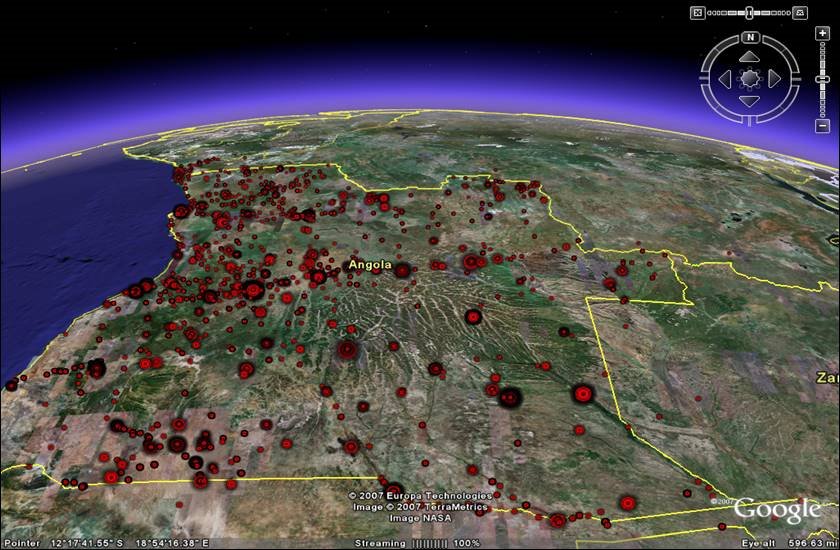
My colleague Jen Ziemke did her dissertation research on identifying patterns of civil war abuse in Angola. In particular, she sought to determine why combatants sometimes target civilians while at other time refrain from doing so. She explored this question by looking for both spatial and temporal patterns of conflict.

Picture1-full

Jen was one of the first scholars to do applied research in the field of crisis mapping and continues to be an invaluable source of expertise on the subject. For her doctoral work, she coded and geo-referenced 41 years of conflict data on Angola by drawing on more than 180 different sources. This yielded a stunning 9,216 events of violence between 1961 and 2002.

Jen’s spatial analysis of the data yielded the following conclusion:

Resource wealth, ethnicity, and ‘war by other means’ do not adequately explain the observed patterns of civilian abuse in the Angolan civil war. However, losses on the battlefield escalate patterns of violence against civilians. Belligerent actors do not always abuse civilians; rather they participate in these behaviors in relatively predictable ways: when they are losing and as the war progresses.  In short, a theory of loss best explains the variation in levels of civilian abuse across time in the Angolan war than any other explanation.

More on Jen’s research is available in a paper (PDF) she presented at Yale University last year entitled: “From Battles to Massacres: Explaining the patterns of civil war abuse in Angola, 1961-2002.”

Patrick Philippe Meier

Wasp: Paper-War as a Tactic of Civil Resistance

Eric Russell’s science fiction novel, Wasp, is brilliant. It was published in 1957 and weaves civil resistance theory with creative tactics that remain fully relevant half-a-century later. What I want to do here is share some excerpts that describe a very neat civil resistance tactic. Please see my previous post for the context of the story along with the novel’s compelling theory on civil resistance.

One of the tactics that our protagonist James Mowry employs is paper-based. He writes hundreds of letters to Sirian Empire officials threatening more resistance if they continue fighting the war against Earth. This gives the semblance that the fictitious resistance group, Dirac Angestun Gesept, is far more than a one-person show.

In the early evening, he mailed more than two hundred letters to newspaper editors, radio announcers, military leaders, senior civil servants, police chiefs, prominent politicians and key members of the government.

When one is fighting a paper-war, Mowry thought, one uses paper-war tactics that in the long run can be just as lethal as high explosive. And the tactics are not limited in scope by use of one material. Paper can convey a private warning, a public threat, leaflets dropped by the thousands from the rooftops, cards left of seats or slipped into pockets and purses.

For his next paper-based tactic, Mowry choice to mail dozens of small but heavy parcels.

Each held an airtight can containing a cheap clock and a piece of paper, nothing else. The clock emitted a sinister tick—just loud enough to be heard if a suspicious-minded person listened closely.

Paper threats, that was all—but they were effective enough to eat still further into the enemy’s war effort. They’d alarm the recipients and give their forces something more to worry about. Doubtless the military would provide a personal bodyguard for every big wheel on Jaimec; that alone could pin down a regiment.

Mail would be examined, and all suspicious parcels would be taken apart in a blast-proof room. There’d be a city-wide-search with radiation detectors for the component parts of a fission bomb. Civil defense would be alerted in readiness to cope with a mammoth explosion that might or might not take place. Anyone on the streets who walked with a secretive air and wore a slightly mad expression would be arrested and hauled in for questioning.

After disrupting every-day processes for several weeks, the Sirian regime was in a state of panic deploying several thousand additional plain-clothed police officers, carrying out hundreds of random checks a day, erecting hundreds of road blocks, etc; in effect mobilizing considerable resources and time in reaction to major disruption caused by just one person. Could one man pin down an entire army this way?

Mowry wondered […] how many precious man-hours had his presence cost the foe? Thousands, tens of thousands, millions? To what forms of war service would those man-hours have been devoted to if James Mowry had not compelled the enemy to waste them in other directions? Ah, in the answer to that hypothetical question lay the true measure of a wasp’s efficiency.

Another tactic (not included in the story) is to write messages on paper money, as recently happened in Iran.

Patrick Philippe Meier

Wasp: Sticker-War as a Tactic for Civil Resistance

Eric Russell’s science fiction novel, Wasp, is brilliant. It was published in 1957 and weaves civil resistance theory with creative tactics that remain fully relevant half-a-century later. What I want to do here is share some excerpts that describe a very neat civil resistance tactic. Please see my previous post for the context of the story along with the novel’s compelling theory on civil resistance.

One of the first tactics that Mowry employs is perhaps surprising—posting stickers with different messages. His strategy is to make the authorities think a powerful underground movement lead by Dirac Angestun Gesept (D.A.G.) is resisting the regime. This movement is entirely imaginary. The sticker read for example:

“War is wealth for the few, misery for the many. At the right time, Dirac Angestun Gesept will punish the former, bring aid and comfort to the latter.”

Mowry bet that folks who came across the he posted in very public places would be too shocked to try and remove them and would stay very clear of them. “The chances were equally good that they’d spread the news, and gossip is the same in every part of the cosmos: it gains compound interest as it goes the rounds.”

In one instance, Mowry had planted a sticker on a shop window. He then stands on the other side of the street to see what would unfold. Very quickly, a crowd forms and a scowling police officer was at the scene. He immediately summons the shopkeeper who becomes very anxious when he sees the sticker.

‘Get if off!’

‘Yes, Officer, Certainly, Officer. I shall remove it immediately.’

The manager started digging with his nails at the sticker corners, in an attempt to peel it off. He didn’t do so well, because [Earth’s] technical superiority extended even to common adhesives. After several futile efforts, the manager threw the cop an apologetic look, went inside, came out with a knife, and tried again. This time he succeeded in tearing a small triangle from each corner, leaving the message intact.

A few minutes later, James Mowry, glancing back from the far corner, saw the manager emerge with a steaming bucket and get busy swabbing the notice. He grinned to himself, knowing that hot water was just the thing to release and activate the hydrofluoric base beneath the print.

Sure enough, but the time he came back a few hours later, “the sticker had disappeared; in it’s place the same message was etched deeply and milkily in the glass. The policeman and the manager were now arguing heatedly upon the sidewalk, with half a dozen citizens now gaping alternately at them and the window.

As Mowry walked past, the cow bawled, ‘I don’t care if the window is valued at two thousand guilders. You’ve got to board it up or replace the glass.’

‘But, Officer…’

‘Do as you’re told. To exhibit subversive propaganda is a major offence.’

By the end of the night, Mowry had slapped exactly one hundred stickers on shops, offices, and vehicles of the city transport system; he also inscribed swiftly, clearly, and in large size letters D.A.G. upon twenty-four walls. The latter feat was performed with [Earth] crayon, a deceitfully chalklike substance that made full use of the porosity of brick when water was applied. In other words, the more furiously it was washed the more stubbornly it became embedded.

The following day, Mowry brought a paper and searched it for some mention of yesterday’s activities. There wasn’t a word on the subject. First he felt disappointed; then, on further reflection, he became heartened.

Opposition to the war and open defiance of the government definitely made news that justified a front-page spread. No reporter, no editor would pass it up if he could help it; therefore the papers had passed it up because they could not help it. Somebody high in authority had clamped down upon them with the heavy hand of censorship. Somebody with considerable power had been driven into making a weak countermove.

That was a start, anyway. Mowry’s first waspish buzzings had forced authority to interfere with the press. What’s more, the countermove was feeble and ineffective, serving only as a stopgap while officials beat their brains for more decisive measures.

The more persistently a government maintains silence on a given subject of discussion, the more the public talks about it and thinks about it. The longer and more stubborn the silence, the guiltier the government looks to the talkers and thinkers. In time of war, the most morale-lowering question that can be asked is, ‘What are they hiding from us now?”

Some hundreds of citizens would be asking themselves that same question tomorrow, the next day, or next week. The [messages on the stickers] would be on a multitude of lips, milling around in a like number of minds, merely because the powers that be were afraid to talk.

And if a government fears to admit even the pettiest facts of war, how much faith can the common man place in the leadership’s claim not to be afraid of anything?

I did a little research to see where we’re at with sticker technology. While stickers with hydrofluoric acid still belong to the realm of science fiction, there are stickers that give the very real semblance of being etched in glass are available.

Patrick Philippe Meier

What Does a Wasp Have To Do With Civil Resistance? Everything.

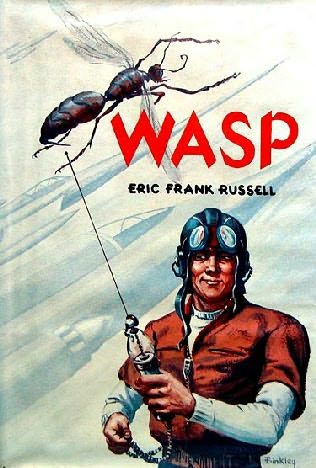
Google’s Vint Cerf recommended Eric Russell’s science fiction novel, Wasp, to a colleague of mine in the field of civil resistance. I’m very glad he did, I just read it and the novel is brilliant. It was published in 1957 and weaves civil resistance theory with creative tactics that remain fully applicable half-a-century later. Plus, it’s an action-packed page-turner. I highly recommend it.
wasp

What I want to do here is share some excerpts that elegantly highlight the theory behind civil resistance (my next posts expose creative tactics using stickers and paper-based wars).

The setting is an intergalactic war between Earth and the Sirian Empire. The latter has an advantage in personnel and equipment. Earth needs an edge and this is where James Mowry comes in. He is covertly dropped on the Sirian home planet to destabilize the entire empire. The aim is to divert the Empire’s resources and focus away from the war against Earth by creating a fictitious resistance movement at home. Wasp is the story of the strategies, creative tactics and real-world technologies that Mowry employs to accomplish his mission.

But first he has to be convinced to take on a mission that would have him single-handedly destabilize the entire empire from within. Naturally, he seriously questions the sanity of Agent Wolf, the unpleasant operator assigned to recruit him. Growing impatient with Mowry’s stubbornness, Wolf hands him some press reports.

Mowry glanced at them and perused them slowly.

The first told of a prankster in Roumania. This fellow had done nothing more than stand in the road and gaze fascinatedly at the sky, occasionally crying, ‘Blue flames!’ Curious people had joined him and gaped likewise. The group became a crowd; the crowd became a mob.

Soon the audience blocked the street and overflowed into the side streets. Police tried to break it up, making matters worse. Some fool summoned the fire squads. Hysterics on the fringes swore they could see, or had seen, something weird above the clouds. Reporters and cameramen rushed to scene; rumours raced around. The government sent up the air force for a closer look and panic spread over an area of two hundred square, from which the original cause had judiciously disappeared.

‘Amusing if nothing else,’ Mowry remarked. ‘Read on,’ commanded Wolf.

The second report concerned a daring escape from jail. Two notorious killers had stolen a car; they made six hundred miles before recapture, fourteen hours later. The third report detailed an automobile accident: three killed, one seriously injured, the car a complete wreck. The sole survivor died nine hours later.

Mowry handed back the papers. ‘What’s all this to me?’

Wolf: We’ll take those reports in order as read. They prove something of which we’ve been long aware but which you may not have realized. Now, let’s take the first one. That Roumanian did nothing, positively nothing, except stare at the sky and mumble. Yet he forced a government to start jumping around like fleas on a hot griddle. It shows that in given conditions, actions and reaction can be ridiculously out of proportion. By doing insignificant things in suitable circumstances, one can obtain results monstrously in excel of the effort.

Now consider the two convicts. They didn’t do much, either. They climbed a wall, seized a car, drove like made until they gas ran out, then got caught. But for the better part of fourteen hours, they monopolized the attention of six planes, ten helicopters, one hundred and twenty patrol-cars. They tied up eighteen telephone exchanges, uncountable phone lines and radio link-ups, not to mention police, deputies, posses of volunteers, hunters, trackers, forest rangers and National Guardsmen. The total was twenty-thousand, scattered over three states.

Finally, lets consider this auto smash-up. The survivor was able to tell us the cause before he died. He said the driver lost control at high speed while swiping at a wasp which had flown in through a window and was buzzing around his face. The weight of a wasp is under half an ounce. Compared with a human being, the waps’s size is minute, it’s strength negligible. Its sole armament is a tiny syringe holding a drop of irritant, formic acid. In this instance, the wasp didn’t even use it. Nevertheless, that wasp killed four big men and converted a larger, powerful car into a heap of scarp.

‘I see the point,” Mowry said, “but where do I come in?’

“Right here,” said Wolf. “We want you to become a wasp.”
wasp2

After several months of training, Mowry is dropped on Pertane, the home planet of the Sirian Empire. He spends the first evening exploring Jaimec, the capital.

He wandered around, memorizing all geographical features that might prove useful to recall later on. But primarily he was seeking to estimate the climate of public opinion with particular reference to minority opinions.

In every war, he knew, no matter how great a government’s power, it’s rule is never absolute. In every war, no matter how righteous the cause, the effort is never total. No campaign has ever been fought with the leadership united in favour of it and with the rank and file one hundred per cent behind them.

There is always the minority that opposes a war for such reasons as reluctance to make necessary sacrifices, fear of personal loss or suffering, or philosophical and ethical objection to warfare as a method of settling disputes. Then there is a lack of confidence in the ability of the leadership; resentment at being called upon to play a subordinate role; pessimistic belief that victory is far from certain and defeat very possible; egoistic satisfaction of refusing to run with the herd; psychological opposition to being yelled at on any and every pretext, and a thousand and one other reasons.

No political or military dictatorship ever has been one hundred per cent successful in identifying and suppressing the malcontents, who bid their time. Mowry could be sure that, by the law of averages, Jaimec must have its share of these.

For a description of the creative tactics used by Mowry, stay tuned for my following post.

Patrick Philippe Meier