
Tag Archives: Information

Google+ for Crowdsourcing Crisis Information, Crisis Mapping and Disaster Response

Facebook is increasingly used to crowdsource crisis information and response, as is Twitter. So is it just a matter of time until we see similar use cases with Google+? Another question I have is whether such uses cases will simply reflect more of the same or whether we’ll see new, unexpected applications and dynamics? Of course, it may be premature to entertain the role that Google+ might play in disaster response just days after it’s private beta launch, but the company seems fully committed to making  this new venture succeed. Entertain-ing how Google+ (G+) might be used as a humanitarian technology thus seems worthwhile.
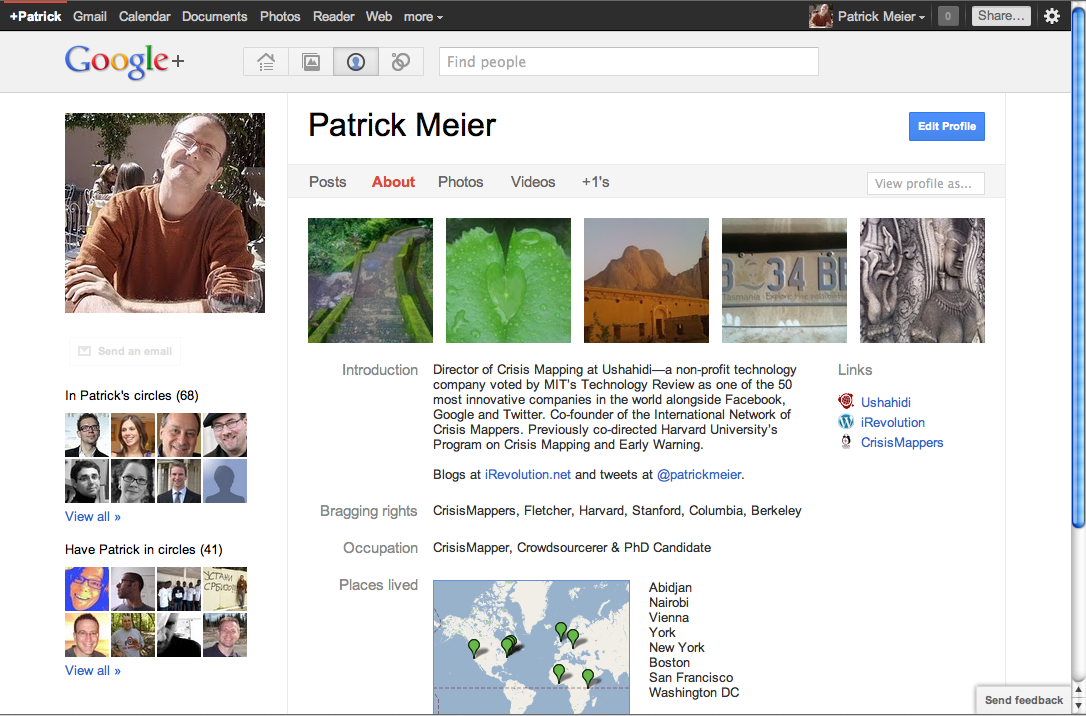
The fact that G+ is open and searchable is probably one of the starkest differences with the walled-garden that is Facebook; that, and their Data Liberation policy. This will make activity on G+ relatively easier to find—Google is the King of Search, after all. This openness will render serendipity and synergies more likely.

The much talked about “Circles” feature is also very appealing for the kind of organic and collaborative crowdsourcing work that we see emerging following a crisis. Think about these “Circles” not only as networks but also as “honeycombs” for “flash” projects—i.e., short-term and temporary—very much along the lines that Skype is used for live collaborative crisis mapping operations.

Google+’s new Hangout feature could also be used instead of Skype chat and video, with the advantage of having multi-person video-conferencing. With a little more work, the Sparks feature could facilitate media monitoring—an important component of live crisis mapping. And then there’s Google+ mobile, which is accessible on most phones with a browser and already includes a “check-in” feature as well as geo-referenced status updates. The native app for the Android is already available and the iPhone app is coming soon.
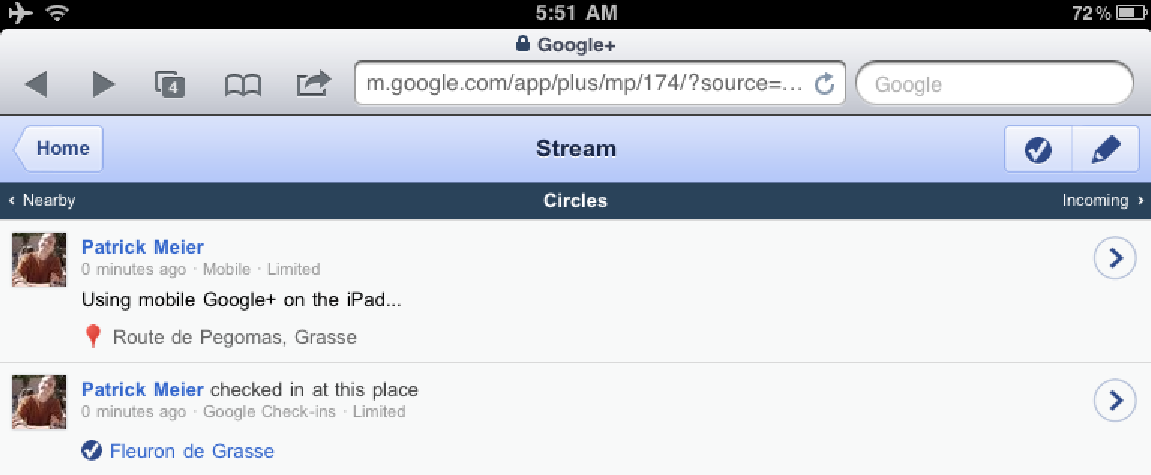
Clicking on my status update above, produces the Google Maps page below. What’s particularly telling about this is how “underwhelming” the use of Google Maps currently is within G+.  There’s no doubt this will change dramatically as G+ evolves. The Google+ team has noted that they already have dozens of new features ready to be rolled out in the coming months. So expect G+ to make full use of Google’s formidable presence on the Geo Web—think MapMaker+ and Earth Engine+. This could be a big plus for live crowdsourced crisis mapping, especially of the multimedia kind.

One stark difference with Facebook’s status updates and check-in’s is that G+ allows you to decide which Circles (or networks of contacts) to share your updates and check-in’s with. This is an important difference that could allow for more efficient information sharing in near real-time. You could set up your Circles as different teams, perhaps even along UN Cluster lines.

As the G+ mobile website reveals, the team will also be integrating SMS, which is definitely key for crisis response. I imagine there will also be a way to connect your Twitter feed with Google+ in the near future. This will make G+ even more compelling as a mobile humanitarian technology platform. In addition, I expect there are also plans to integrate Google News, Google Reader, Google Groups, Google Docs and Google Translate with G+. GMail, YouTube and Picasa are already integrated.

One feature that will be important for humanitarian applications is offline functionality. Google Reader and GMail already have this feature (Google Gears), which I imagine could be added to G+’s Stream and perhaps eventually with Google Maps? In addition, if Google can provide customizable uses of G+, then this could also make the new platform more compelling for humanitarian organizations, e.g., if OCHA could have their own G+ (“iG+”) by customizing and branding their G+ interface; much like the flexibility afforded by the Ning platform. One first step in that direction might be to offer a range of “themes” for G+, just like Google does with GMail.

Finally, the ability to develop third party apps for G+ could be a big win. Think of a G+ store (in contrast to an App Store). I’d love to see a G+ app for Ushahidi and OSM, for example.

If successful, G+ could be the best example of “What Technology Wants” to date. G+ is convergence technology par excellence. It is a hub that connects many of Google’s excellent products and from the looks of it, the G+ team is just getting warmed up with the converging.

I’d love to hear from others who are also brainstorming about possible applications of Google+ in the humanitarian space. Am I off on any of the ideas above? What am I missing? Maybe we could set up a Google+ 4 Disaster Response Circle and get on Hangout to brainstorm together?

Information Sharing During Crisis Management in Hierarchical vs. Network Teams

The month of May turned out to be ridiculously busy, so much so that I haven’t been able to blog. And when that happens, I know I’m doing too much. So my plan for June is to slow down, prioritize and do more of what I enjoy, e.g., blog.

In the meantime, the Journal of Contingencies and Crisis Management just published an interesting piece on “Information Sharing During Crisis Management in Hierarchical vs. Network Teams.” The topic and findings have implications for digital activism as well as crisis management.

Here’s the abstract:

This study examines the differences between hierarchical and network teams in emergency management. A controlled experimental environment was created in which we could study teams that differed in decision rights, availability of information, information sharing, and task division. Thirty-two teams of either two (network) or three (hierarchy) participants (N=80 in total) received messages about an incident in a tunnel with high-ranking politicians possibly being present. Based on experimentally induced knowledge, teams had to decide as quickly and as accurately as possible what the likely cause of the incident was: an attack by Al Qaeda, by anti-globalists, or an accident. The results showed that network teams were overall faster and more accurate in difficult scenarios than hierarchical teams. Network teams also shared more knowledge in the difficult scenarios, compared with the easier scenarios. The advantage of being able to share information that is inherent in network teams is thus contingent upon the type of situation encountered.

The authors define a hierarchical team as one in which members pass on information to a leader, but not to each other. In a network team, members can freely exchange information with each other. Here’s more on the conclusions derived by the study:

Our goal with the present study was to focus on a relatively simple comparison between a classic hierarchical structure and a network structure. The structures differed in terms of decision rights, availability of information, information sharing, and task division. Although previous research has not found unequivocal support in terms of speed or accuracy for one structure or the other, we expected our network structure to perform better and faster on the decision problems. We also expected the network teams to learn faster and exchange more specialist knowledge than the hierarchical teams.

Our hypotheses are partially supported. Network teams are indeed faster than hierarchical teams. Further analyses showed that network teams were, on average, as fast as the slowest working individual in the hierarchical teams. Analyses also showed that network teams very early on converged on a rapid mode of arriving at a decision, whereas hierarchical teams took more time. The extra time needed by hierarchical teams is therefore due to the time needed by the team leader to arrive at his or her decision.

We did not find an overall effect of team structure on the quality of team decision, contrary to our prediction. Interestingly, we did find that network teams were significantly better than hierarchical teams on the Al Qaeda scenarios (as compared with the anti-globalist scenarios). The Al Qaeda scenarios were the most difficult scenarios. Furthermore, scores on the Post-test showed that there was a larger transfer of knowledge on Al Qaeda from the specialist to the nonspecialist in the network condition as compared with the hierarchical condition. These results indicate that a high level of team member interaction leads to shared specialist knowledge, particularly in difficult scenarios. This in turn leads to more accurate decisions.

This study focused on the information assessment part of crisis management, not on the operative part. However, there may not be that much of a difference in terms of the actual teamwork involved. When team members have to carry out particular tasks, they may frequently also have to share specialist knowledge. Wilson, Salas, Priest, and Andrews (2007) have studied how teamwork breakdowns in the military may contribute to fratricide, the accidental shooting of one’s own troops rather than the enemy. This is obviously a very operative part of the military task. Teamwork breakdowns are subdivided into communication, coordination and cooperation, with information exchange mutual performance monitoring, and mutual trust as representative teamwork behaviours for each category (Wilson et al., 2007).

We believe that it is precisely these behaviours that are fostered by network structures rather than hierarchical structures. Network structures allow teams to exchange information quickly, monitor each other’s performance, and build up mutual trust. This is just as important in the operative part of crisis management work as it is in the information assessment part.

In conclusion, then, network teams are faster than hierarchical teams, while at the same time maintaining the same level of accuracy in relatively simple environments. In relatively complex environments, on the other hand, network teams arrive at correct decisions more frequently than hierarchical teams. This may very likely be due to a better exchange of knowledge in network teams.

Patrick Philippe Meier

Communication and Human Development

The Berkman Center at Harvard University hosted a fascinating panel discussion figuring Amartya Sen, Michael Spence, Yochai Benkler and Clotilde Fonseca. The panelists addressed the role of communication and ICTs in human development, growth and poverty reduction.  They discussed what has changed, been learned, not been learned, needs to be learned, needs to be done most urgently.

Source: Berkman Center

Some brief notes and take-away’s:

  • Amatya Sen compared access to information via mobile phone to nutrition. Just like better nutrition may have adverse effects such as domestic violence, so does the mobile phone vis-a-vis the expansion of freedom. But this doesn’t mean we should abandon nutrition projects. Sen cautions against setting dichotomous priorities, e.g., development first or democracy first.
  • Michael Spence explained that the mobile phone as an important input in the production function of an economy. One principal concern resulting from the incredible growth in the mobile phone network is that regulators may react strongly to regulate this growth. Spencer adds that there is no silver bullet in development.
  • Clotilde Fonseca noted that the mobile phone is not yet a powerful device in the developing world; the distinction between voice and data is key. Most mobile phones in the developing world do not carry a high through-put of data. Clotilde cautions against applying a linear view of development to the ICT4D field. She adds that the digital divide is also a cognitive divide. There is also a capacity divide, i.e., the ability to absorb information.
  • Yochai Benkler remarked that the mobile phone tends towards more decentralized communication. That said, the question is more decentralized relative to what? Benkler also notes that not all solutions here have to be mobile. He also foresees many new opportunities for entrepreneurship in decentralized technology ecosystem ripe with tools, training and services.

For a very good, more detailed summary, please see my colleague Kate Brodock’s blog post here.

Patrick Philippe Meier

UN Sudan Information Management Working (Group)

I’m back in the Sudan to continue my work with the UNDP’s Threat and Risk Mapping Analysis (TRMA) project. UN agencies typically suffer from what a colleague calls “Data Hugging Disorder (DHD),” i.e., they rarely share data. This is generally the rule, not the exception.

UN Exception

There is an exception, however: the recently established UN’s Information Management Working Group (IMWG) in the Sudan. The general goal of the IMWG is to “facilitate the development of a coherent information management approach for the UN Agencies and INGOs in Sudan in close cooperation with local authorities and institutions.”

More specifically, the IMWG seeks to:

  1. Support and advise the UNDAF Technical Working Groups and Work Plan sectors in the accessing and utilization of available data for improved development planning and programming;
  2. Develop/advise on the development of, a Sudan-specific tool, or set of tools, to support decentralized information-sharing and common GIS mapping, in such a way that it will be consistent with the DevInfo system development, and can eventually be adopted/integrated as a standard plug-in for the same.

To accomplish these goals, the IMWG will collectively assume a number of responsibilities including the following:

  • Agree on  information sharing protocols, including modalities of shared information update;
  • Review current information management mechanisms to have a coherent approach.

The core members of the working group include: IOM, WHO, FAO, UNICEF, UNHCR, UNPFA, WFP, OCHA and UNDP.

Information Sharing Protocol

These members recently signed and endorsed an “Information Sharing Protocol”. The protocol sets out the preconditions, the responsibilities and the rights of the IMWG members for sharing, updating and accessing the data of the information providers.

With this protocol, each member commits to sharing specific datasets, in specific formats and at specific intervals. The data provided is classified as either public access or classified accessed. The latter is further disaggregated into three categories:

  1. UN partners only;
  2. IMWG members only;
  3. [Agency/group] only.

There is also a restricted access category, which is granted on a case-by-case basis only.

UNDP/TRMA’s Role

UNDP’s role (via TRMA) in the IMWG is to technically support the administration of the information-sharing between IMWG members. More specifically, UNDP will provide ongoing technical support for the development and upgrading of the IMWG database tool in accoardance with the needs of the Working Group.

In addition, UNDP’s role is to receive data updates, to update the IMWG tool and to circulate data according to classification of access as determined by individual contributing agencies. Would a more seemless information sharing approach might work; one in which UNDP does not have to be the repository of the data let alone manually update the information?

In any case, the very existence of a UN Information Management Working Group in the Sudan suggests that Data Hugging Disorders (DHDs) can be cured.

Patrick Philippe Meier