Category Archives: Crisis Mapping

Crisis Mapping Libya: This is No Haiti (Updated)

Update: Public version of Libya Crisis Map now available:

http://libyacrisismap.net

We activated the Standby Volunteer Task Force (SBTF) on March 1st and quickly launched a Crisis Map of Libya to support humanitarian preparedness opera-tions. This is the largest deployment of the Task Force since it was formed at the 2010 International Conference on Crisis Mapping in Boston (ICCM 2010). Task Force partners include CrisisMappers, CrisisCommons, Humanity Road, ICT4Peace, Open Street Map and MapAction. The Task Force currently has trained 166 volunteers. I’m amazed at how far we’ve come since the response to the Haiti earthquake.
Crisis mapping Libya is definitely no Haiti, for many reasons. The first is that unlike Haiti, we didn’t have to recruit crisis mapping volunteers from scratch. We didn’t have to spend a third of our time training volunteers. We didn’t have to develop new work flows and protocols from thin air. All we had to do was activate the Standby Task Force and everyone knew what to do, like set up dedicated Skype chats (communicating via email is too slow in these scenarios, networked communication is the way to go). Our volunteer CrisisMappers had already been trained and had even participated in an official UN crisis simulation exercise with OCHA in Colombia a few months earlier.
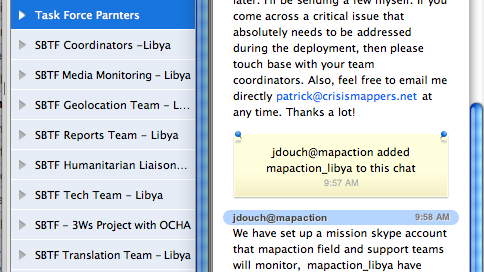
The second reason why this is no Haiti is because the request for activation of the Standby Task Force to provide live crisis mapping support came directly from the UN OCHA’s Information Management unit in Geneva. This was not the case in Haiti since there was no precedent for the crisis mapping efforts we launched at the time. We did not have buy in from the humanitarian community and the latter was reluctant to draw on anything other than official sources of information. Crowdsourcing and social media were unchartered territories. OCHA also reached out to CrisisCommons and OpenStreetMap and we are all working together more closely than ever before.

Contrast this to the case of Libya this week which saw an established humanitarian organization specifically request a volunteer technical community for a live map of reports generated from Twitter, Facebook, Flickr, YouTube and mainstream media sources. Seriously, I have never been more impressed by the humanitarian community than I am today. The pro-active approach they have taken and their constructive engagement is absolutely remarkable. This is truly spectacular and the group deserve very high praise.

From the official annoucement:

OCHA, UNOSAT and NetHope have been collaborating with the Volunteer Technical Community (VTC) specifically including the CrisisMappers, Crisis Commons, Open Street Map, and the Google Crisis Response Team over the past week. The CrisisMappers Standby Task Force has been undertaking a mapping of social media and new reports from within Libya and along the borders at the request of OCHA.  As well, the Task Force is aiding in the collection and mapping of 3W information for the response. UNOSAT is kindly hosting the Common Operational Datasets to be used during the emergency (http://www.unitar.org/unosat/libya). Interaction with these groups is being coordinated by OCHA’s Information Services Section. Focal Point: Andrej Verity [verity@un.org].

The third reason this is no Haiti is because we are creating a live map of a hostile situation still unfolding. Haiti provided a permissive environment, politically and geographically. Libya couldn’t be more different. We experienced the serious challenges of crisis mapping a hostile environment when we created a crisis map of Khartoum at the request of local Sudanese activists. This was a stressful deployment but one that was able to provide an important window into what was happening in Khartoum.

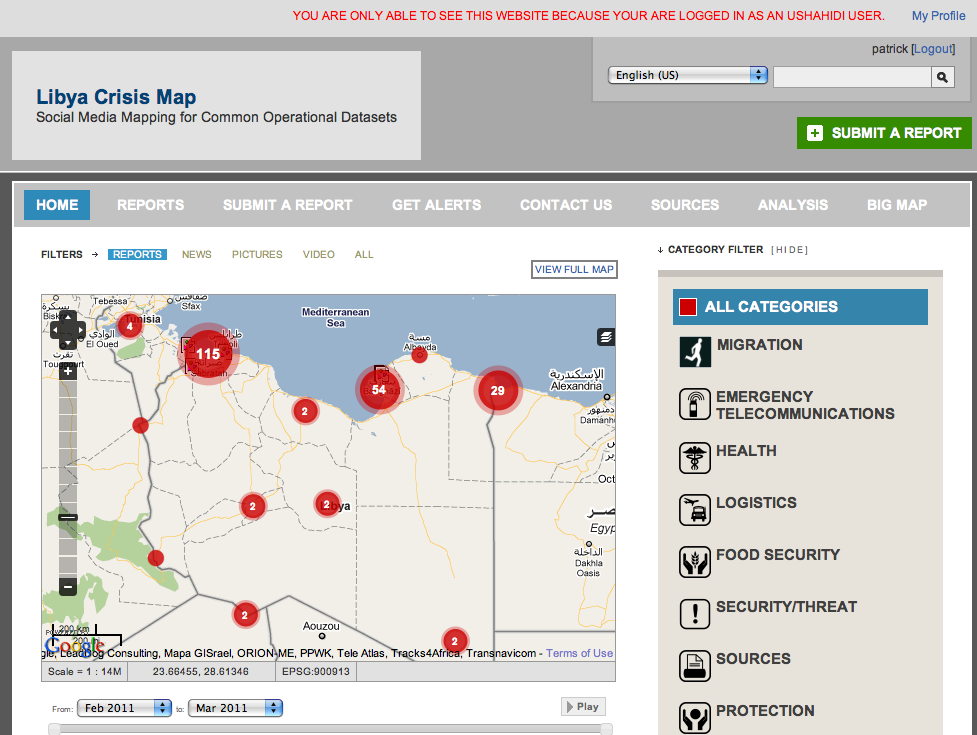
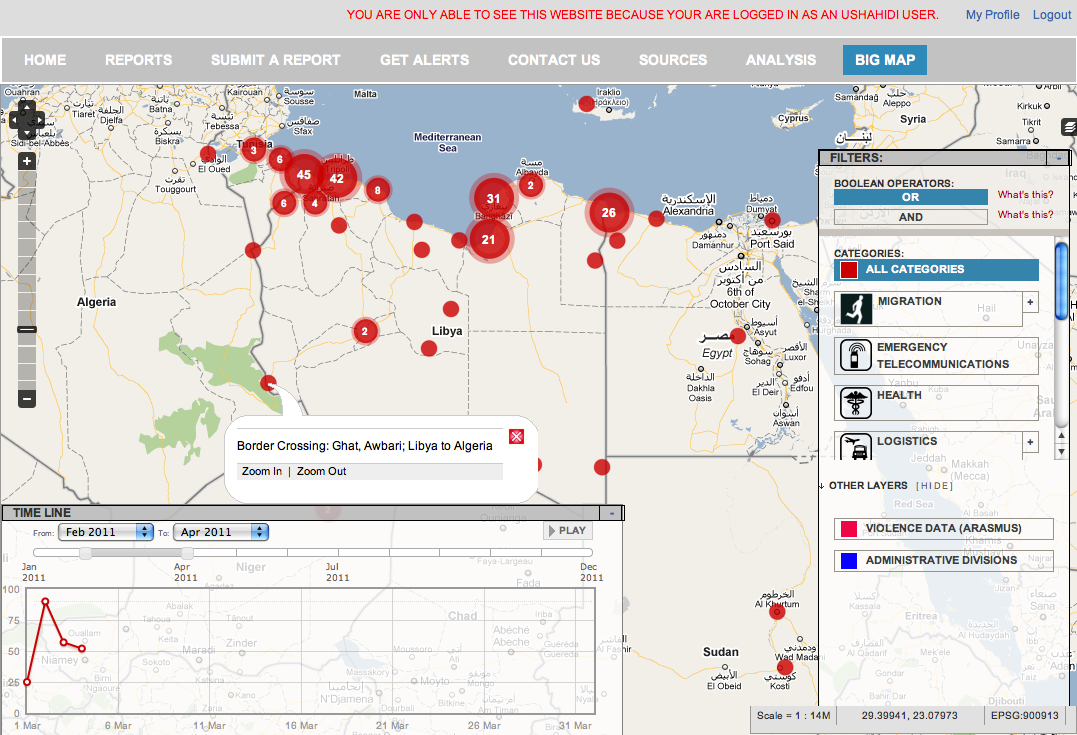
In the case of Libya, our humanitarian partner requested that the crisis map be password protected. We intend to make the map public after this phase of the humanitarian operations is over. In the meantime, the screenshots below provide a good picture of what the platform looks like. In the first 48 hours since the activation of the Task Force, over 220 individual reports have been mapped, many including pictures and some with video footage.
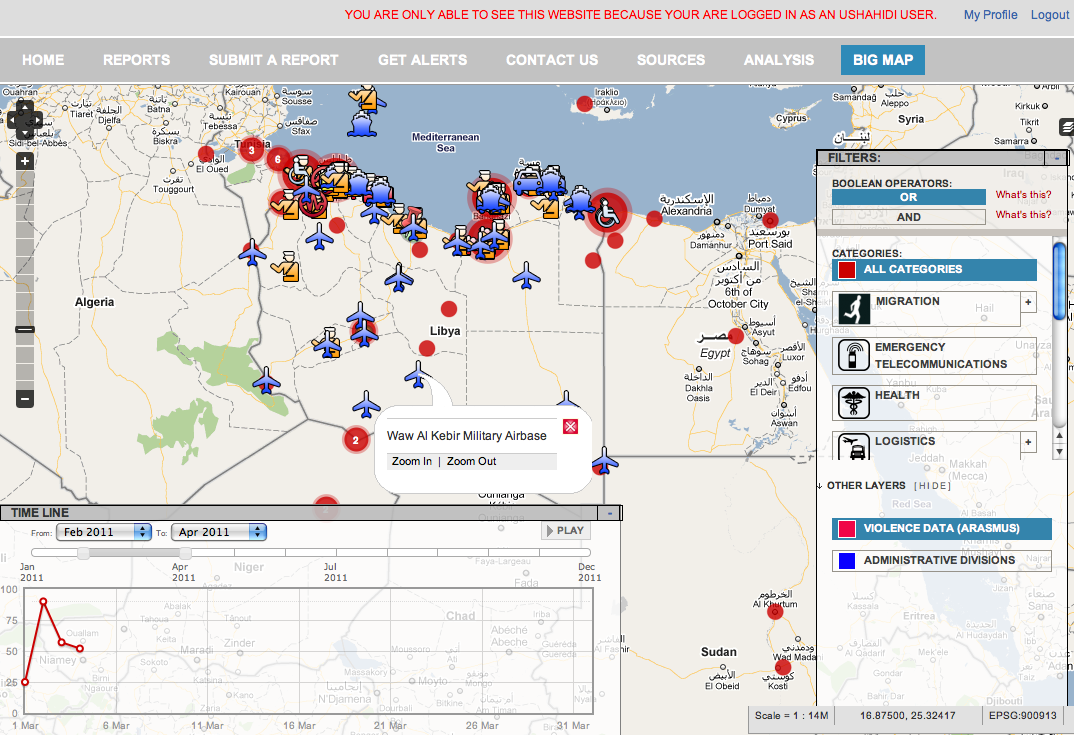
We also pulled in the data from the Google Map created by @Arasmus to complement our own live mapping:
None of the above would be possible without such a dedicated network of skilled crisis mapping volunteers. They are truly outstanding and a testament to what civic engagement can do online from thousands of miles away. There’s no doubt that our approach can still be improved. But there’s equally no doubt that all the learning we did in Haiti, Chile and Pakistan went beyond just recommendations but were actually  put into practice in a big way thanks to the Task Force.

The Task Force has over 160 volunteers from 18 different countries. Do you want to become one of those crisis mappers? If so, please send an email to join@standbytaskforce.com and we’ll train you on how to become a real pro in crisis mapping.

Check-In’s with a Purpose: Applications for Disaster Response

This is the second post in my check-in’s-with-a-purpose series. The first post looked at the use of check-in’s to coordinate activist campaigns and street protests. The check-in’s series builds on Ushahidi’s free and open-source check-in service (CI) slated to launch in just a few weeks at SxSW 2011.

So how might organizations and local groups be able to use CI for disaster response? In three ways: (1) preparedness; (2) coordination; and (3) evaluation.

Preparedness

When you walk into a disaster area, say following an earthquake, you don’t want to be swamped with all kinds of information imaginable. You only want information relevant to you and your responsibilities in a given geographic area (demand side versus supply side). CI provides an easy, intuitive interface for this. You check-in when you want additional info about the area you are in.

This is similar to the idea of geo-caching, hence the reference to preparedness. You embed (or pre-populate) a given map with relevant structural and event-data for a given area. By structural data, I mean physical infrastructure such as hospitals, schools, etc. Event-data simply refers to nearby incidents. New data could be regularly embedded into the map (via geo-RSS feeds) to provide the latest event-data available. When you check-in, CI provides you with information and updates relevant to your vicinity and profile. For example, if you’ve added “health” as a tag on your profile, CI could prioritize health-based information when you check-in, including the location of other health-workers and their contact info.

There is another equally important angle to preparedness when it comes to check-in’s. Mapping infrastructure vulnerable to disasters is common practice in disaster risk reduction projects. These can be community-driven and participatory, giving local communities a stake in building their own resilience. In one such project, local communities in neighborhoods around Istanbul mapped infrastructure vulnerable to earthquake damage, e.g., overhanging structures like balconies. They also mapped local shelters, possible escape routes, etc. CI could be used for this type of crowdsourced, participatory mapping. Crowdfeeding would then simply happen by checking-in. The sign “In case of emergency, break glass” would become “In case of emergency, check-in.”

Coordination

What about coordination? Keeping track of who is in a disaster area, and where, is no easy task. A check-in service would go a long way to addressing this coordination challenge. Call it instant mapping. Disaster responders would simply click the check-in app on their smart phones after they land in a disaster area to check-in. Each organization could set up their own check-in service to coordinate their staff with instant maps. Check-in deployments could also be project- or cluster-based.

In addition, an open check-in deployment could be set up for all responders. A separate CI deployment would be especially useful if hundreds of volunteers decide to fly in. They could be tasked more efficiently if they first checked-in. Doing so would provide coordinators with access to individual profiles with listed skill sets and contact info, much like a LinkedIn profile. Disaster responders and volunteers could also check-out once they leave a disaster area.

A check-in service could facilitate a number of other coordination challenges. Finding missing persons after a disaster has always been difficult, for example. One way to let others know you’re ok would be by checking in. Doing so would prompt the CI service to provide you with the latest on the disaster that took place, information on nearby services and who in your own professional or social network is in the vicinity long with their contact info. This could also be a way to coordinate corporate social responsibility projects in the immediate aftermath of a disaster. Large companies with employees wanting to help could simply check-in to their CI service to get information on how to help.

Evaluation

Check-in’s could also be used for evaluation and accountability purposes. Once you’ve accomplished a task, you could quickly check-in with an update, which would leave a digital trace of your accomplishment. Or say you’re on your way to a food distribution site and drive past some newly flooded houses, you could quickly check-in with that information to update everyone else on your network. CI can also be used with badges and points, allowing people to develop a track-record of their work in a disaster area.

Some Challenges

There are of course some challenges in using a CI service for disaster response. Keep it simple. This is perhaps the most important point. One could very easily go all out and add countless features to a CI service. Such is the beauty of open source software. For disaster response, however, the trick will be to keep it simple and not try to turn CI into a solution for everything. If data coverage isn’t possible, then a check-in service should allow for SMS-based check-in’s. This could be done by using SMSsync. Another challenge will be to provide a seamless way to check into multiple CI deployments at the same time and for these to be interoperable. For example, if I’m with WFP, I should be able to check-in on the WFP CI and have my check-in appear simultaneously on the Food Cluster CI, OCHA CI, etc.

If you have ideas about how a check-in service could be used for disaster response, or recommendations on what would make Ushahidi’s CI system more useful, please do add them in the comments section below. My next post in this check-in’s-with-a-purpose series will describe how a CI service combined with gaming can be used to catalyze civic participation and engagement across a range of activities.

Maps, Activism and Technology: Check-In’s with a Purpose

“Having a real-time map, complete with satellite photos, of where everyone is at any one moment is almost as good as having your own helicopter overhead — maybe better, if you can distract the crew of the helicopter.”

As recently announced on the Ushahidi blog, the group is launching a check-in service a la Foursquare called “Crowdmap : Check-In’s” or just CI for short. I’m excited by the different applications that a free and open-source check-in-with-a-purpose platform can have for social impact. In this blog post, I’ll share some ideas on how activists might use CI for popular nonviolent movements when the service is launched next month at SxSW 2011. I will also highlight another very cool project called Sukey, which was just launched in the UK.

Services like Foursquare provide a location-based mobile social networking platform that allows users to check-in at different venues to earn points and connect with friends. CI will work in a similar way but will allow users to create their very own “Foursquares”. This means that CI’s can be project- or group-specific, i.e., bounded to certain networks. Users will decide themselves where and what kind of points and badges to award to members of their CI network.

This quick check-in service has obvious applications for students coordinating nonviolent protests, especially when they need to rapidly adapt to a changing situation. I this saw again recently in Egypt when pro-Mubarak thugs were swarming certain avenues of downtown Cairo. I recall seeing a picture shared on Twitter with tactical drawings suggesting where anti-Mubarak protestors should position themselves as a result. This was drawn on a screenshot taken from satellite imagery of an area in the center of Cairo. (I spent an hour trying to find the original picture again but to no avail, so if you know which one I’m referring to, please get in touch. The one below is for illustration only).

With Internet and cell phone networks back up, protesters could use a check-in service to let others know where the thugs are being sighted and to recommend different locations to retreat or advance to. This would be a like a geo-tagged status update that could also be shared on your Facebook page or Twitter feed (minding the security implications). In addition, one could have pre-designated tags like “Thugs here”, “Don’t go here”, “Evacuate” etc., to avoid having to type when checking in. Call it the Q-CI feature, quick check-in’s.

These alerts or status updates could then be embedded geographically, something like geo-caching. So if I happen to check in within a hundred meters of someone who just recently updated their CI status as “evacuate”, I would get an immediate pop-up message showing me these nearby updates. Someone helping to coordinate the protests remotely from a laptop could quickly embed areas (rather than points) as  no-go zones if one or more updates show up with the tag “evacuate” at a given venue. Integrating Ushahidi’s new geometry mapping feature would make this possible.

A related project that I really like comes from the same student group in the UK that used live tactical mapping for protest swarming last year. The team has since designed and launched their very own mobile check-in platform to facilitate tactical maneuvering during demonstrations, keep protesters safe and avoid kettling:

“Kettling, also known as containment or corralling, is a police tactic for the management of large crowds during demonstrations or protests. It involves the formation of large cordons of police officers who then move to contain a crowd within a limited area. Protesters are left only one choice of exit, determined by the police, or are completely prevented from leaving” (1).

The project, called Sukey, is an excellent example of Maptivism. The name comes from the nursery rhyme: “Polly put the kettle on, Sukey take it off again.”

All you have to do is point your smart phone browser (it doesn’t have to be an iPhone!) to http://www.sukey.org/a to access the tactical map. The screenshot above is from their entertaining and helpful tutorial which you can access here. I really like the use of their simple “safety compass” which gives you immediate situational awareness about which direction safety (and danger) lies. The compass is specific to your GPS location and is updated in real-time as new reports are submitted by activists. These reports can be shared with all the other protesters and appear in the red box below the map.

If you don’t have a smart phone, Sukey relays updates via their Twitter feed which users can subscribe to via SMS thanks to Twitter’s SMS-following service. All you need to do is text “follow @sukeysms” to 8644. What if you forgot your phone at home? One protester noted that “Everyone who was getting the Sukey updates was telling everyone who wasn’t what was happening.”

As an unhappy security analyst recently noted,

“The proliferation of highly capable handheld ‘smartphones’ now makes it easy for protest organizers to communicate by voice, text and images, even with real-time video. The protesters may have more watchers and observation points than the police, and actually outpace the police in quantity and quality of intelligence. Having this kind of information available has made it possible for disrupters to create decoy incidents to draw resources away from where they are needed most. Having a real-time map, complete with satellite photos, of where everyone is at any one moment is almost as good as having your own helicopter overhead — maybe better, if you can distract the crew of the helicopter.”

Protesters claim they successfully avoided police kettling this week by using Sukey. If you’d like to learn more, I highly recommend this excellent piece by the UK Guardian on the project. I think Ushahidi can learn a lot from this group so I will be meeting with the team in London next month. In the meantime, I’m really looking forward to SxSW and Sukey II. In a future post, I’ll describe how check-in’s-with-a-purpose platforms can also be used for humanitarian relief and disaster response.

Using a Map to Bear Witness in Egypt #Jan25

[Cross-posted from the Ushahidi blog]

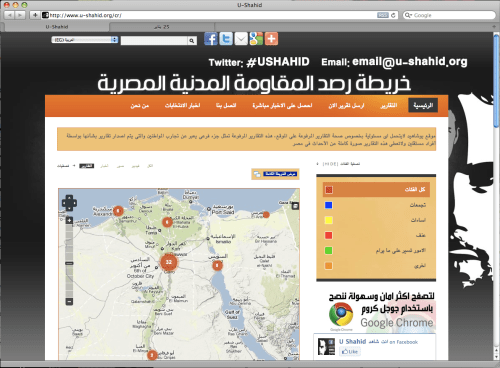
The Cairo-based Development and Institutionalization Support Center (DISC) has just launched their #U-Shahid map below. DISC previously used the Ushahidi platform to monitor the country’s Parliamentary Elections last November and December  (see this post for more info). This means they already know the technology and have a trained network of active crisis mappers that can verify reports before they are mapped.

The events in Egypt over the past two weeks have been nothing short of unprecedented. The Mubarak regime clamped down on many forms of communication including the Internet, cell phones and SMS. There were also reports of landline phones being blocked. The word still go out, however. And with Internet access now restored, the map will get out as well just as it did in the Sudan over the past few days.

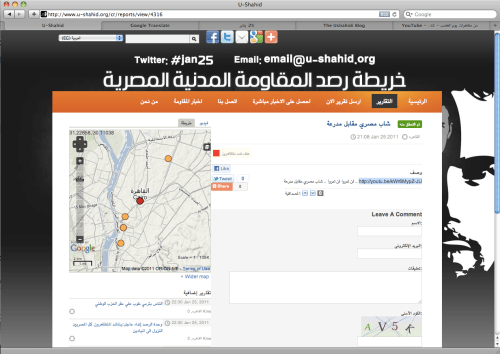
DISC has mapped some 50 reports based on events that took place over the past week. Take this report below, for example, which includes a YouTube video of protests. The map includes dozens of categories, including Riots, Breaking and looting, Arrests, Violence against protesters, Spraying water and Firing tear gas, for example.

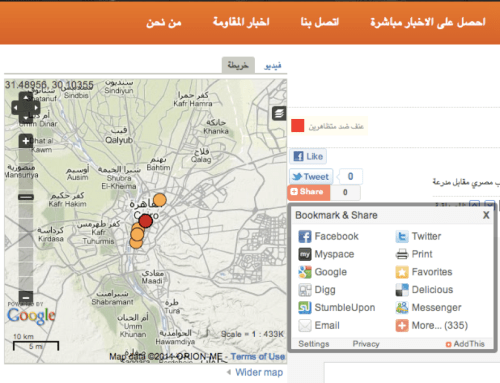
Notice how DISC has made it very easy to share information on individual events by allow direct Tweeting, Facebook posting, etc.

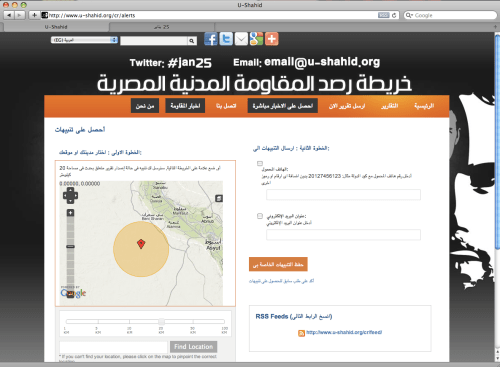
The group has also enabled the subscribe to alerts feature, which allows individuals to automatically get reports sent to their email and cell phone.

Since Egypt just got back online, we expect the map to receive more reports in the coming days. Perhaps the group may also end up using the dedicated Ushahidi smart phone apps to distribute the mapping further.

The Arabic Network for Human Rights Information (ANHRI) launched this Jan 25th CrowdMap in Cairo days before the regime shut down Internet access. It hasn’t been updated since but there are now discussions about reactivating the map to provide information on the location of ATMs, for example.

An ongoing and pressing concern about these maps (and others) is of course security. Crisis maps can depict important information that can be used for good and ill. We hope local groups that use these tools in non-permissive environments take every precaution possible when doing so as repressive regimes are becoming more sophisticated in electronic surveillance.  To learn more about communicating safely in such situations, we recommend some of the following links:

Crisis mapping is redefining the way we think about maps. Today’s maps are alive and dynamic. They are not hard copy static objects like this historical map of Ancient Egypt dating from 1,450 BC. Maps, like books, were written by the winners, the elite. They reflected and projected power. They depicted a fixed reality through one lens.

Today’s crisis maps can give voice to the distributed voiceless. They integrate tools like email, SMS, Twitter, Facebook, YouTube, Flickr, etc. What does this all add up to? “Will the triangulated crisis map be regarded as the new first draft of history?” asks New York Times journalist Anand Giridharadas. He considers some of the implications in this excellent piece,

“They say that history is written by the victors. But now, before the victors win, there is a fresh chance to scream out, with a text message that will not vanish. What we would know about what passed between Turks and Armenians, between Germans and Jews — and indeed would it have happened at all — if each of them had had a chance to declare and be heard saying: ‘I was here, and this is what happened to me?'”

Crisis Mapping Sudan: Protest Map of Khartoum

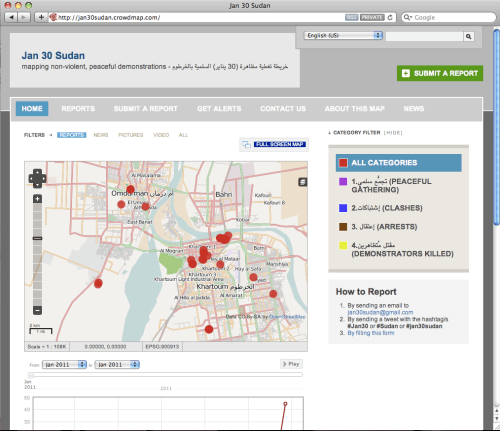
Unlike the many maps of the #Jan25 protests in neighboring Egypt there is but this one map for the #Jan30 protests taking place in the Sudan and Khartoum in particular. The map was requested by Sudanese colleagues in Khartoum who in their own words wanted a public map for the world to see what is happening in their own country.

Some 70 individual reports have been mapped thus far. These capture a range of incidents including the following:

  • Police use gas bombs against medical students [View Report]
  • Peaceful gatherings and demonstrations [View1 View2]
  • Sudanese security harassing foreign journalists [View1 View2]
  • Picture of police beating protesters on Palace Street [View]
  • Videos of protest in Khartoum [View]

While all eyes of the media are on Egypt, few are sharing the developments in the Sudan. This makes the Sudan map even more important. As Philip Howard has found in his comprehensive new study on “The Digital Origins of Dictatorship and Democracy: Information Technology and Political Islam,” the presence of a comparatively active online civil society appears to be one of the key ingredients for democratic transition. Compared to the online civil society in Egypt, the one in the Sudan is far smaller. But activists in Khartoum have reached out to digital activists outside the country for support. And this joint effort has  resulted in more than just a map.

Sudanese contacts have been sharing relevant information via email  and Skype throughout the day, some of which is mapped, and some which is included in the News section of the map. In addition, digital activists have provided training on Twitter and have set up a Flickr account for the Sudanese activists (at their request). See this DigiActive guide on how to use Twitter for activism, also available in Arabic (PDF).

The group has also been trying hard to set up a local FrontlineSMS number for activists to text their reports directly to the map. The first phone they tried didn’t work, so they’re looking to use a GSM modem in the coming days. (Update: an international number has been set up). Once a number is set up, the activists want to share it widely, including the 16,000+ members of the Jan30 Facebook group. Local activists hope this will help them overcome some of the coordination challenges that cropped up today when there was confusion over where and when the demonstrations were meant to take place. This resulted in smaller dispersed protests instead of mass action. You can read more on first hand accounts of this in the News section which includes an email written by Sudanese activist about what they saw today.

Despite the constraints in organization, activists still took to the streets but did face higher risks by being in smaller more dispersed groups. I’m hoping they’ll be able to regroup and plan their future protests in such a way that there is less confusion. The activists do have a full copy of the mass action strategy guide used by Egyptian protesters this week. This may serve them well if they can circulate it widely in the country.

Crisis Mapping Egypt: Collection of Protest Maps (Updated)

The CrisisMappers Twitter feed has shared a number of maps depicting the ongoing protests in Egypt. Here is a collection of them. Do let me know if we’re missing any. To learn more about crisis mapping, read this blog post: What is Crisis Mapping? and join www.CrisisMappers.net. For a protest map of the demonstrations in Khartoum, Sudan, see this link.

Update: The Cairo-based Development and Institutionalization Support Center (DISC) has launched the Ushahidi map below. DISC has previously used the platform to monitor the country’s Parliamentary Elections last November and December  (see this post for more info).

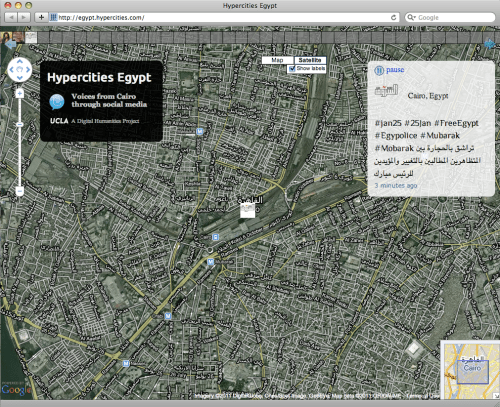
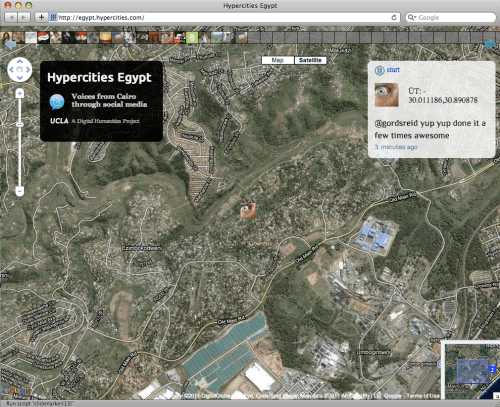
Update: These Twitter maps Hypercities provide another way to visualize the event unfolding across the country.

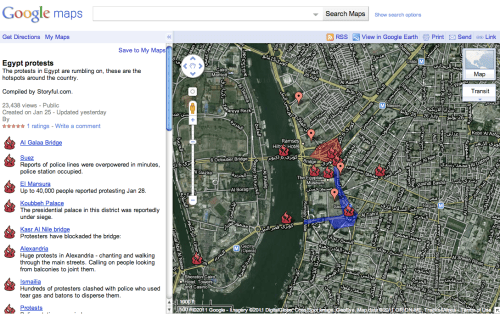
Update: Storyful has this Google Map of the protests in downtown Cairo:

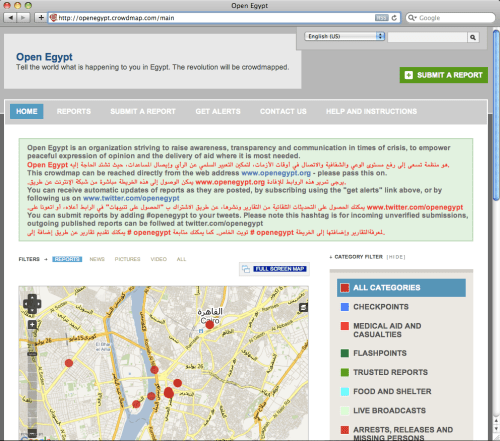
Update: OpenEgypt, an independent group of volunteers have set up the Open Egypt Crowdmap below:

The Arabic Network for Human Rights Information (ANHRI) has put up this Jan 25th CrowdMap:

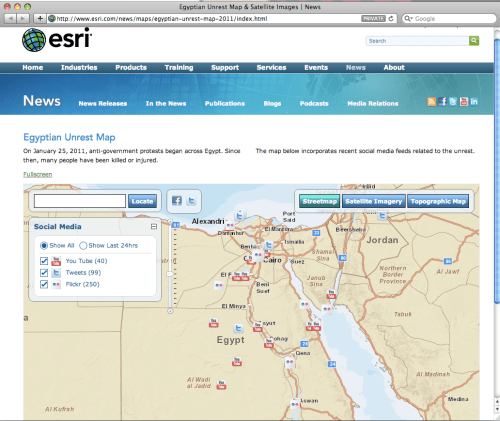
The company ESRI has produced the following Web Map of Egypt:

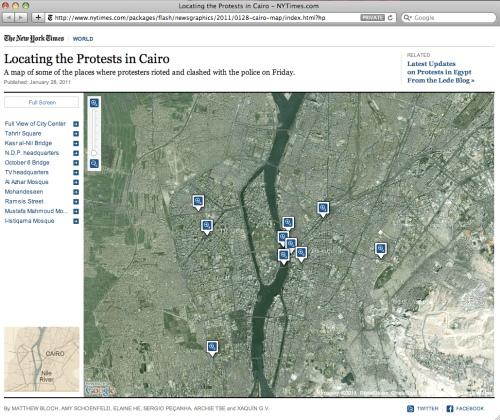
The New York Times has also put this protest map together:

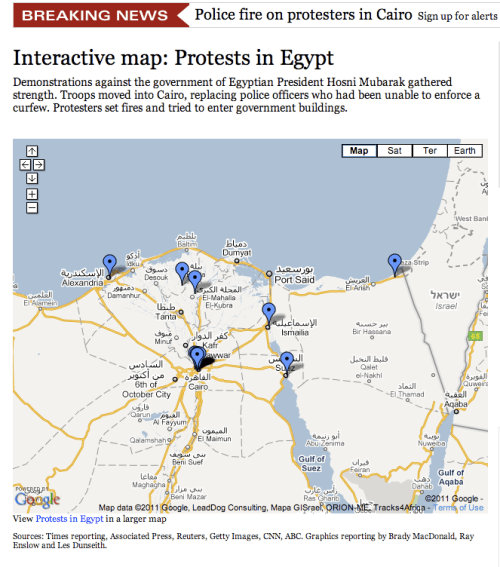
Finally, the LA Times has this map up on their website:

What is Crisis Mapping? An Update on the Field and Looking Ahead

I last updated my piece on A Brief History of Crisis Mapping some two years ago, well before the first International Conference on Crisis Mapping was held (ICCM 2009). So a brief update on the past 24 months may be in order, especially for a field that continues to grow so rapidly. When I Googled the term “crisis mapping” in September 2009, I got 8,680 hits. Today, one gets over 200,000. If you’re curious about the origins of the field and what happened before 2009, my original blog post still serves as a useful intro. I also recommend this recent video on Changing the World One Map at a Time and this earlier blog post on Proposing the Field of Crisis Mapping (also from 2009).

Clearly a full update on the past 24 months would constitute at least an MA thesis (if you’re a grad student and looking for a topic, email me!). So what is Crisis Mapping? “Dots on a map” is often the tongue-in-cheek reply. Crisis Mapping is of course a lot more than that. To place Crisis Mapping into context, it helps to think of the field as a subset of the “Live Mapping” space. I also often use the following analogy, crisis mapping platforms are to crises zones what MRI’s are to emergency rooms. Static, paper-based maps would be the equivalent of X-rays in this analogy. Crisis Mapping is thus live mapping focused on crises, and the term crisis here is deliberately broad, from slow-burn crises to sudden-onset disasters. Crisis Mapping is certainly not restricted to political crises but may include social and environmental crises, for example.

Crisis Mapping can be described as combining the following 3 components: information collection, visualization and analysis. Of course, all these elements are within the context of a dynamic, interactive map. So I typically use the following taxonomy:

  1. Crisis Map Sourcing
  2. Crisis Map Visualization
  3. Crisis Map Analysis

On Crisis Map Sourcing, there are multiple methodologies and technologies that one can use for information collection. These range from the traditional paper-based survey approaches and Walking-Papers to crowdsourcing reports via SMS and automatically parsing social media data on the web. Visualization is about rendering the information collected on a dynamic, interactive map in such a way that the rendering provides maximum insight on the data collected and any potential visual patterns. This is of course nothing new to the field of cartography and geographic information systems. What is perhaps new is that the technologies used for the visualization are free or open source or both, and that they don’t require much in the way of prior training. Some have referred to this as neogeography.

Crisis Map Analysis is also nothing new and simply entails the application of statistical techniques to spatial data for pattern or “signature” detection. What is perhaps novel is that the analysis is now happening more and more on the fly, i.e., in real-time. The point of doing this kind of analysis is to provide in-the-moment decision-support to users of a given Crisis Mapping platform. Thus the interface of said platforms should allow users to easily query the map and test out different scenarios to identify the best course of action given a changing or evolving environment. Ideally, a Crisis Mapping platform should also allow you to assess the impact of your actions.

So these are the terms and concepts that one can use to talk about the field of Crisis Mapping. But what exactly has changed over the two years?

I’d say the increasing use of free and open source crisis mapping software, for one. There has also been a lot more interest in the use of social media and up-to-date satellite imagery as a source of information. The same goes with using crowdsourcing to collect crisis information. The rise of online volunteers engaged in crisis mapping is another new and important development which holds much potential. This is particularly true as formal humanitarian organizations are now taking important steps to interface with these volunteer communities.

Perhaps what I am most excited about is the recent use of Crisis Mapping not just to identify problems but also existing solutions; the idea is to combine crowdsourcing with crowdfeeding to create a crowdsourcing “market place” that matches needs with resources. The basic idea is to help other help themselves. Professional disaster responders may not always be there to help but the crowd is always there. To learn more about this approach, please see this blog post.

One interesting impact of Crisis Mapping that hadn’t occurred to me two years ago is the social connectivity aspect. What do I mean by that? Simply this: the value of Crisis Mapping may at times have less to do with the actual map and more with the conversations and new collaborative networks catalyzed by launching a Crisis Mapping project. Indeed, this in part explains why the Standby Volunteer Task Force exists in the first place. So Collaborative Crisis Mapping can generate both weak and strong-ties.

Where do I see the field going over the next 24 months? I think we’ll see more focus on solutions to process large volumes of geo-data in real time, especially of the social media and SMS type. By process I  mean automated data-mining, entity-extraction, geo-location, categorization and language translation combined with human-driven curation tools. The application of “Mechanical Turk” services may also become more common place.

What else? Existing Crisis Mapping platforms are highly limited because the majority are only available in the English language. So I expect this to change in the near future if platforms are really to scale. The role of mobile technologies will remain center stage, of course, with more multimedia content appearing on crisis maps along with live video feeds. As a result, I also expect (and hope) to see more examples of Maptivism, i.e., tactical live mapping.

In addition, I’d like to see more on-the-fly mashups of live data. Take the flood mapping in Queensland, Australia, for example. I hope to see future live maps like this one include live traffic and weather updates (and forecasts) as dynamics layers. Colleagues Anahi Ayala and Helena Puig have also been playing around with the idea of combining geo-referenced crowdsourced SMS reports with cell phone coverage maps to identify potential areas of “over-” and “under-reporting.” One could then develop simple algorithms to potentially identify unusual gaps in SMS reporting.

Finally, I’d like to see more “check-in” (and check-out) features integrated into Crisis Mapping platforms, i.e., simple one-click updates on one’s location and activity has many use-cases in crisis response, particularly if this can be combined with alternative uses of geo-caching, e.g., pre-formulated messages that are automatically activated upon checking-in at given locations and points in time. So instead of  the traditional message “In case of an emergency, break glass” you’d have “In case of emergency, check-in for info on how to survive.”

What are your thoughts? Where do you see the field of Crisis Mapping going over the next 12-24 months?

Crisis Mapping by Fire: Satellite Imagery Analysis of Kenya’s Election Violence

My brother Brice just sent me a very interesting study that combines satellite imagery and field reporting to analyze Kenya’s 2008 election violence. The peer-reviewed piece is entitled “Violence and Exodus in Kenya’s Rift Valley, 2008: Predictable and Preventable?” and was pub- lished in the Journal of East African Studies.

Given the use of satellites to monitor the referendum in Sudan, this blog post reviews the methodology and insights gained from the Kenya analysis. I’ll do this by providing key excerpts from the study along with my own commentary. This case study is of particularly interest to me since I was in Kenya the time and because that was when the first Ushahidi platform was launched. For more information on the use of satellite imagery to document human rights abuses, I highly recommend Amnesty International’s Science for Human Rights Explorer.

I wasn’t aware how much scrambling for information was going on in the humanitarian community:

“Over the first days, and then weeks following the December election, information about the outbreak and extent of violence was fragmented and difficult to access. Even those tasked with responding most rapidly to violence and displacement faced problems in interpreting information that was frequently distorted by rumour and misinformation.”

Interesting to know that humanitarians were facing some of the same challenges as crowdsourcing presents. Would using SwiftRiver have made a difference to try and assess the validity of the information they were collecting?

“In the early days of January 2007, UN agencies and other humanitarian bodies had numerous sources reporting that tens of thousands of people had been displaced and dozens killed across the country, yet details on the extent, location, and chronology of the violence were hard to establish, making it difficult for these agencies to plan an effective response.”

Note the need for location and time-stamped information. Would drawing on reports from the Ushahidi platform have helped? See my co-authored study on Crisis Mapping Kenya’s Election Violence. That said, this was the first time that Ushahidi was deployed in Kenya so the reports may not have been of the highest quality.

“The Kenya Red Cross Society (KRCS), for example, implemented the election contingency plan it had put in place prior to the December polls, but staff could not confirm reports of violence, and could not deliver essential food and relief items to those people displaced by the fighting because of roadblocks mounted by protestors. Even after carrying out a helicopter assessment mission on 1 January 2008, the KRCS still found it difficult to present an overall picture of the location and timing of the violence.”

So UN agencies in Kenya turned to satellite imagery.

“In response to the challenges facing them in January 2007, UN agencies in Kenya asked UNOSAT to produce a series of maps showing the likely location of election-related violence in the west of the country. UNOSAT has a variety of satellite imaging data available to them, but one tool used to map conflict situations is data on active fires. Fire plays an important role in forcing people from their homes and terrorizing local populations, so the location of active burn sites in a conflict zone offers a reasonable indicator of where violence and displacement is occurring.”

“Indeed, upon examining available fire data from Kenya for 27 December to 3 January, staff at UNOSAT noticed unusual patterns of fires on tea plantations—areas where fire is never normally employed for agricultural management. They then carried out further analysis, and created maps of areas where, according to a chronological and spatial evaluation of the fire data, it was ‘probable that a majority of detected fires are directly or indirectly linked to the civil unrest’.”

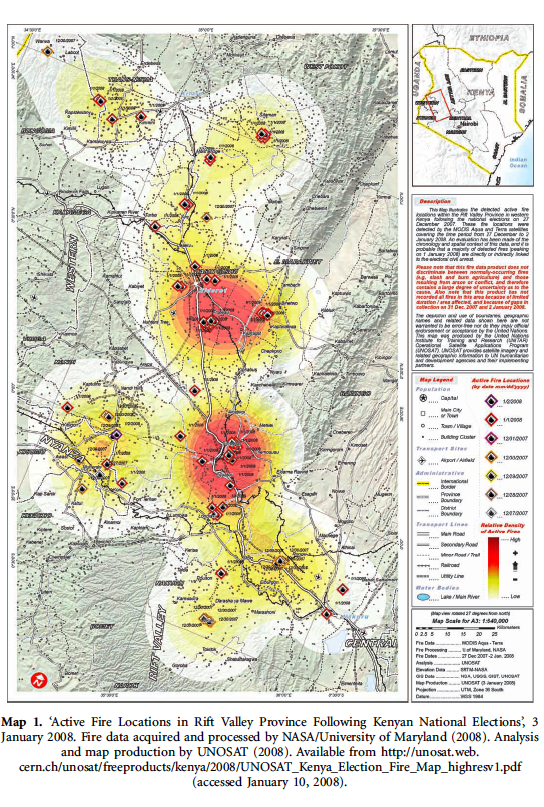
“The result was five maps covering a portion of Rift Valley Province from Nakuru to Kitale, as well as the eastern edges of Nyanza and Western Provinces. Map 1 provides an aggregate view of all active fire locations from 27 December 2007 to 3 January 2008.”

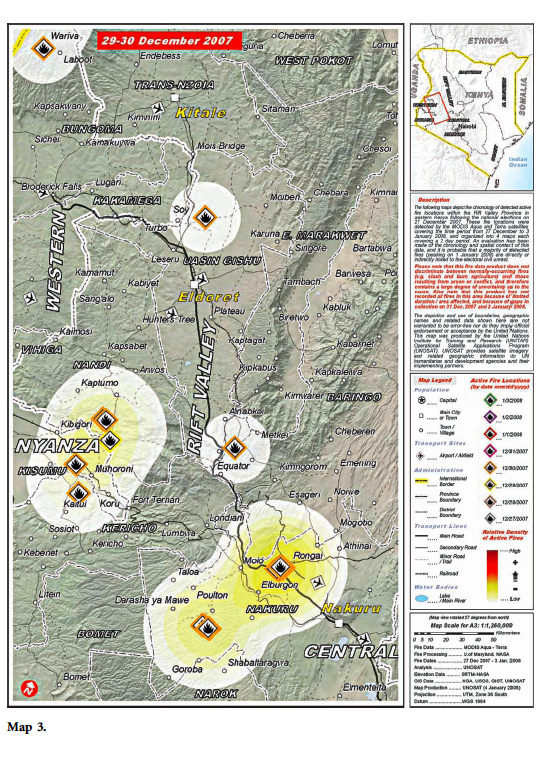
“Maps 2-5 show fires on specific days during that period. Each of the diamonds on the maps represents an area of a square kilometre that contained an active fire location at the time a satellite passed overhead. Fires generally have to cover an area of about fifty square metres to be noticed by this technology, though intensity can affect this. The colouring in the background, on the other hand, is a function of the relative clustering of active fire locations—purely a tool to direct the map-reader and not an indication of fire intensity.”

“Apart from demonstrating the geographical dimensions of the arson and conflict occurring in the area, the maps also begin to provide a general chronology of events into which more specific accounts from witness testimonies and other sources can be integrated. UNOSAT’s four chronological maps (Maps 2-5) cover the majority of the eight day period: 27-28 December, 29-30 December, 1 January, and 2!3 January, and provide powerful visuals of how events unfolded.”

“It is important to bear in mind that gaps in data collection occurred on 31 December and 2 January, and that satellite imagery captures what is happening in a particular fraction of a second—data acquisition times generally occurred around 10:30 a.m., 1:30 p.m., and 11 p.m. Kenyan local time. Bearing this in mind, it is possible using the maps to begin to understand the broad pattern of the escalation of the violence over the period.”

The authors of the study point out some limitations:

“These maps are visually compelling, but we should note that they ‘hide’ important dimensions of the violence—on a map all fires look the same. Violence in urban areas, for instance, differed markedly from that in rural areas, and these maps do not represent this difference. Another example is how little these maps reveal about the increasingly serious situation in Mt Elgon.”

This limitation is inherent to static maps, not so for live crisis maps that are interactive and dynamic.

“The mark of a single fire in the southern part of the district included on two of the maps does not stand out from the other fire locations. However, we know from other sources that violence in Mt Elgon continued to increase in severity after the elections. If violence was occurring on the Chebyuk land settlement schemes on Mt Elgon at this time, then it did not involve fires of sufficient magnitude to be detected by this satellite technology.”

“The mapping of fires can therefore tell us only part of the story. Cohesive explanations of specific situations can only begin to emerge if we triangulate the evidence provided by the maps with other kinds of information. This research is continuing, but at this stage we can offer a preliminary analysis that highlights several significant points:

  • Even before the first wave of violence in the Rift Valley was sparked by the announcement of the presidential poll result on 30 December 2007, conflict had already broken out in some areas over the two days between the closure of the polls and the announcement of the presidential result. This correlates with evidence in media and human rights reports that some majimboist activists planned violence after the election regardless of the outcome of the vote.
  • Over the hours following Kivuitu’s announcement of Kibaki’s victory, violence broke out in several different locations across the province, some of this undoubtedly a spontaneous reaction to the alleged ‘theft’ of the election, and targeted against persons associated with the PNU and its allies. However, many other attacks were evidently planned and orchestrated. Kikuyu-settled areas of Eldoret were ablaze within two hours of Kibaki’s re-election, armed Kalenjin men arriving in lorries to carry out the attacks. These assaults were not confined to ‘aliens’, but included attacks upon properties owned by ex-president Moi and his close Kalenjin associates, including Nicholas Biwott, whose KANU party had made an electoral pact with PNU.
  • The locations of this first major wave of violence in the first week of January show a clear spatial pattern: the outbreaks were invariably in places where non-indigenous populations were living. The targets of this violence were predominantly Kikuyu and Kisii communities, who were identified as PNU supporters. Though many attacks were murderous, the main purpose was to ‘chase away’ the victims. By 6 January, the Kenya Red Cross estimated a national figure of 211,000 persons internally displaced in violence since 30 December, the vast majority of these being within Rift Valley.
  • The violence accordingly coalesced in two types of location: the first was larger and smaller towns, where populations are ethnically more mixed and where businesses are concentrated—for example the rapid upsurge of conflict in and around Eldoret. The second was on rural settlement schemes, where land has been purchased or leased by farmers from a wide range of ethnic groups—for example, Burnt Forest, Ndalat, and the Molo area of Nakuru District. The settlement schemes at Burnt Forest, the scene of dreadful violence in the 1990s, were completely cut off by road barricades by the morning of 1 January, impeding the work of relief agencies, in what was clearly an organized and coordinated assault.”

This study clearly shows the added value of combining satellite imagery analysis with reporting from the ground. This analysis was all carried out retroactively, however. To this end, lets hope that the Satellite Sentinel Project, which I blogged about here, and Sudan Vote Monitor, which uses the Ushahidi platform, will be sharing information to allow for near real-time integrated analysis.

New Publications on Haiti, Crowdsourcing and Crisis Mapping

Two new publications that may be of interest to iRevolution readers:

MIT’s Journal, Innovations: Technology, Governance, Globalization just released a special edition focused on Haiti which includes lead articles by President Bill Clinton and Digicel’s CEO Denis O’Brien. My colleague Ida Norheim-Hagtun and I were invited to contribute the following piece: Crowdsourcing for Crisis Mapping in Haiti. The edition also includes articles by Mark Summer from Inveneo and my colleague Josh Nesbit from Medic:Mobile.

The SAIS Review of International Affairs recently published a special edition on the cyber challenge threats and opportunities in a networked world, which includes an opening article on Internet Freedom by Alec Ross. My colleague Robert Munro and I were invited to submit write the following piece: The Unprecedented Role of SMS in Disaster Response, which focuses specifically on Haiti. Colleagues from Havard University’s Berkman Center also had a piece on Political Change in the Digital Age, which I reviewed here.

Please feel free to get in touch if you’d like copies of the articles on Haiti. In the meantime, here is a must-read for everyone working in Haiti: “Foreign Friends, Leave January 12th to Haitians.”

Will Using ‘Live’ Satellite Imagery to Prevent War in the Sudan Actually Work?

Update: Heglig Crisis 2012, Border Clashes 2012, Invasion of Abyei 2012

The Satellite Sentinel Project has hired private satellites to monitor troop movements around the oil-rich region of Abyei during the upcoming Sudanese referendum and prevent war. The images and analysis will be made public on the Project’s website. George Clooney, who catalyzed this joint initiative between Google, UNOSAT, the Enough Project, Trellon and my colleagues at the Harvard Humanitarian Initiative (HHI), calls this the anti-genocide paparazzi:

“We want them to enjoy the level of celebrity attention that I usually get. If you know your actions are going to be covered, you tend to behave much differently than when you operate in a vacuum.”

The group hopes that they can deter war crimes by observing troop buildups and troop movements in advance. If successful, the project would accomplish an idea first proposed more than half-a-century ago  by US President Dwight Eisenhower during a US-Soviet Summit in Paris at the height of the Cold War. Eisenhower announced his plan to “submit to the United Nations a proposal for the creation of a United Nations aerial surveillance to detect preparations for attack.” Interestingly, Eisenhower had crafted this idea five years earlier as part of his Open Skies Proposal, which actually became a treaty in 2002:

“The Treaty establishes a regime of unarmed aerial observation flights over the entire territory of its participants. The Treaty is designed to enhance mutual understanding and confidence by giving all participants, regardless of size, a direct role in gathering information about military forces and activities of concern to them. Open Skies is one of the most wide-ranging international efforts to date to promote openness and transparency of military forces and activities.”

If you want to find out more about Eisenhower’s efforts, please see my blog post on the subject here.

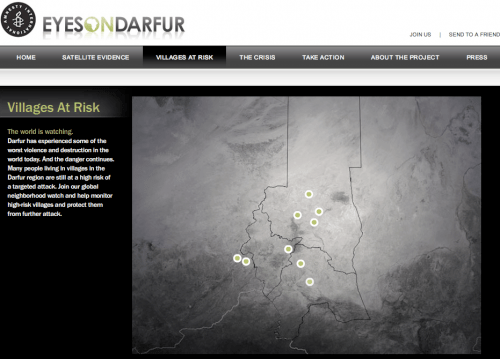
So there is some precedence for what Clooney is trying to pull off. But how is the Sentinel project likely to fare as a non-state effort? Looking at other non-state actors who have already operationalized Eisenhower’s ideas may provide some insights. Take Amnesty International’s “Eyes on Darfur” initiative, which “leverages the power of high- resolution satellite imagery to provide unim- peachable evidence of the atrocities being committed in Darfur–enabling action by private citizens, policy makers and international courts.”

According to Amnesty, the project “broke new ground in protecting human rights by allowing people around the world to literally ‘watch over’ and protect twelve intact, but highly vulnerable, villages using commercially available satellite imagery.” The imagery also enabled Amnesty to capture the movement of Janjaweed forces. Amnesty claims that their project has had a deterrence effect. Apparently, the villages monitored by the project have not been attacked while neighboring ones have. That said, at least two of the monitored villages were removed from the site after reported attacks.

Still Amnesty argues that there have been notable changes in decisions made by the Bashir government since “Eyes on Darfur” went live. They also note that the government of Chad cited their as one of the reasons they accepted UN peacekeepers along their border.

In my blog post on Eisenhower’s UN surveillance speech I asked whether the UN would ever be allowed to monitor and detect preparations for attack using satellite imagery. I now have my answer given that UNOSAT is involved in the Sentinel Project which plans to “deter the resumption of war between North and South Sudan” by providing an “early warning system to deter mass atrocities by focusing world attention and generating rapid responses on human rights and human security concerns” (Sentinel). But will these efforts really create an effective deterrence-based “Global Panopticon”?

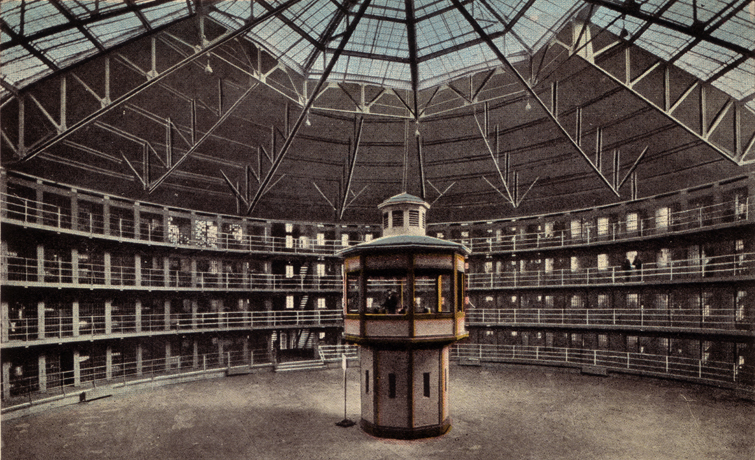
French philosopher Michel Foucault has famously written on the role of surveillance as an instrument of power. “He cites the example of Jeremy Bentham’s ‘Panopticon,’ an architectural model for a prison enabling a single guard, located in a central tower, to watch all of the inmates in their cells.  The ‘major effect of the Panopticon,’ writes Foucault, is ‘to induce in the inmate a state of conscious and permanent visibility that assures the automatic functioning of power.'”

According to Foucault, the Panopticon renders power both “visible and unverifiable”: Visible: the inmate will constantly have before his eyes the tall outline of the central tower from which he is being spied upon. Unverifiable: the inmate must never know whether he is being looked at at any one moment; but he must be sure that he may always be so. But potential perpetrators of the violence in the Sudan do not actually see the  outline of the satellites flying overhead. They are not being directly harassed by high-powered “cameras” stuck into their faces by the anti-genocide paparazzi. So the power is not directly visible in the traditional sense. But who exactly is the inmate in or connected to Abyei in the first place?

There are multiple groups in the area with different agendas that don’t necessarily tie back to the Sudanese government in Khartoum. The Arab Misseriya tribe has thus far remained north during this dry season to avert confrontation with the Ngok Dinka in the Southern part of Abyei. These nomadic tribes typically carry Kalashnikovs to guard their cattle. So distinguishing these nomads from armed groups prepared to raid and burn down villages is a challenge especially when dealing with satellite imagery. Using UAV’s may be more useful and cheaper. (Note that monitoring the location and movement of cattle could be insightful because cattle issues are political in the area).

If armed groups who intend to burn down villages are the intended inmates, do they even know or care about the Satellite Sentinel Project? The ICC has already struggled to connect the chain of command back to the Sudanese government. Besides, the expected turn-around time to develop the satellite imagery is between eight to twenty-four hours. Getting armed men on a truck and raiding a village or two doesn’t take more than a few hours. So the crimes may already have been committed by the time the pictures come in. And if more heavy military machinery like tanks are rolled in, well, one doesn’t need satellite imagery to detect those.

As scholars of the panopticon have noted, the successful use of surveillance has to be coupled with the threat of punishment for deviant acts. So putting aside the issue of who the intended inmates are, the question for the Sentinel Project is whether threats of punishment are perceived by inmates as sufficiently real enough for the deterrence to work. In international relations theory, “deterrence is a strategy by which governments threaten an immense retaliation if attacked, such that aggressors are deterred if they do not wish to suffer great damage as a result of an aggressive action.”

This means that official state actors need to step up and publicly pledge to carry out the necessary punishment if the satellite imagery collected by Sentinel provides evidence of wrong-doing. The ICC should make it crystal clear to all inmates (whoever they are) that evidence from the satellite imagery will be used for prosecution (and that they should care). There also need to be armed guards in  “the tower” who are proximate enough to be deployed and have the political will to use force if necessary. Or will the anti-genocide paparazzi’s many eyes be sufficient to keep the peace? It’s worth remembering that the Hollywood paparazzi haven’t exactly turned movie stars into alter boys or girls. But then again, they’d probably get away with a whole lot more without the paparazzi.

US spy satellites have no doubt monitored conflict-prone areas in the past but this  hasn’t necessarily deterred major crimes against humanity as far as I know. Of course, the imagery collected has remained classified, which means the general public hasn’t been able to lobby their governments and the international community to act based on this information and shared awareness.

The Sentinel Project’s open source approach changes this calculus. It may not deter the actual perpetrators, but the shared awareness created thanks to the open data will make it more difficult for those who can prevent the violence to look the other way. So the Satellite Sentinel Project may be more about keeping our own governments accountable to the Responsibility to Protect (R2P) than deterring actors in the Sudan from committing further crimes.

How will we know if Clooney succeeds? I’m not quite sure. But I do know that the Sentinel Project is a step in the right direction. More evidence is always more compelling than less evidence. And more public evidence is even better. I have no doubt therefore that Eisenhower would back this Open Skies project.

p.s. It is worth noting that the satellite imagery of Sri Lankan forces attacking civilians in 2009 were dismissed as fake by the Colombo government even though the imagery analysis was produced by UNOSAT.