Category Archives: Crisis Mapping

Behind the Scenes at the Crisis Mapping Conference

We are just five days away from launching the first International Conference on Crisis Mapping (ICCM 2009) but the seeds for this unique event were planted 15 months ago, on Facebook of all places.

My colleague Jen Ziemke and I had reconnected via Facebook where I had linked my status updates to my Twitter feed. I tweeted about my blog posts and this led Jen to this blog, iRevolution, where I published posts of crisis mapping. A few weeks later, I get a message from Jen in my Facebook inbox. She liked what I was writing on crisis mapping and asked if I’d be interested in co-organizing a small workshop on crisis mapping. The rest is history.

The idea to organize a workshop on crisis mapping was brilliant.

I had just completed two years of applied research on crisis mapping at the Harvard Humanitarian Initiative (HHI). The next logical step was indeed to hold a workshop to formalize the field of crisis mapping. We therefore drew on the taxonomy of crisis mapping I developed to inform the workshop’s agenda.

We originally envisaged 20-30 participants and received funding from the Open Society Institute (OSI) and the US Institute of Peace (USIP) to make this happen.

We soon had some 40 participants on our list, and then over 60 by the summer. This was no longer “workshop size” but an international conference in its own right. Humanitarian and human rights practitioners had signed on, as had leading scholars, software and technology developers, policy makers and major donors.

We chose to host ICCM 2009 at John Carroll University (JCU) in Cleveland,  which is where Jen is Professor of International Relations. Several factors contributed to this decision. First, the workshop idea was Jen’s to begin with (I just scaled it up); Second, we wanted to avoid the usual conference destinations and offer something different; and Third, JCU offered generous in-kind contributions and very kindly waived all overhead fees.

We plan to give participants a different kind of conference experience. Participating in MobileActive08 and particularly LIFT09 got me excited about conference design. Being a big fan of the TED and Pop!Tech conferences, I wanted to style them along those lines. This meant having Ignite Talks, a Tech Fair, Birds of a Feather Sessions and Open Roundtables. The key, I have learned, is to find the right balance between structured and unstructured time.

Humanity United (HU) saw the potential of ICCM 2009 and became the third official sponsor of the conference. This allowed us to expand the participant list to 80. Our collaboration with HU also gave us the opportunity to think post-ICCM 2009 in more detail.

Jen and I had talked strategy earlier in the year but this was with the assumption that the workshop would comprise 30 participants.

So we pondered this in early August and quickly realized that the incredible response to ICCM 2009 gave us a unique opportunity. Not only would the event be the first of it’s kind in the world in terms of focus, content and opportunities for collaboration and networking, but it would also serve to officially launch the field of crisis mapping in a very big way.

To be sure, with the majority of the world’s leading crisis mappers at the table, the conference presented an unprecedented opportunity to  define the future of the field.

As more high quality participants continued to sign up for the conference, we had to introduce registration fees to balance the budget which was already very tight. By mid-September, 100 conference participants had registered for ICCM 2009, a far cry from the original 30 we have envisaged. We were now starting to get overstretched in terms of space and facilities. And all throughout, it was just Jen and I trying to keep the ship on course.

We designed our strategy plan and rolled it out in September, adding a Twitter feed to ICCM 2009 which we have recently ramped up. We contacted several news organizations and have had some positive responses. We expect one or two articles in the mainstream media to reference the conference in the coming weeks.

Towards the end of September, we had little choice but to close off registration. This means a dozen late-arrivals were regrettably turned away. Neither Jen or I wanted to turn anyone away but we simply could not physically accommodate any more participants. One colleagues suggested that was a good problem to have.

So here we are, 5 days until show time. We’re busy with final preparations and excited to be welcoming some 100 participants to Cleveland (see this great NYT article on Cleveland). Participants from as far afield as New Zealand, Colombia and the Sudan are joining us for ICCM 2009. We look forward to kicking off the conference on Friday morning with the Ignite Talks.

The videos of the Ignite Talks will be uploaded to the ICCM website shortly after the conference. We look forward to a lot of user generated content via individual blogs and the conference blog as well as Twitter, Flickr, YouTube, Vimeo, etc. around ICCM. The hashtag for the conference is #ICCM09.

I hope this blog post gave you a good glimpse of ICCM 2009 behind the scenes. And while we haven’t yet started the conference, early explorations for a possible ICCM 2010 are already taking place.
Patrick Philippe Meier

Evolving a Global System of Info Webs

I’ve already blogged about what an ecosystem approach to conflict early warning and response entails. But I have done so with a country focus rather than thinking globally. This blog post applies a global perspective to the ecosystem approach given the proliferation of new platforms with global scalability.

Perhaps the most apt analogy here is one of food webs where the food happens to be information. Organisms in a food web are grouped into primary producers, primary consumers and secondary consumers. Primary producers such as grass harvest an energy source such as sunlight that they turn into biomass. Herbivores are primary consumers of this biomass while carnivores are secondary consumers of herbivores. There is thus a clear relationship known as a food chain.

This is an excellent video visualizing food web dynamics produced by researchers affiliated with the Santa Fe Institute (SFI):

Our information web (or Info Web) is also composed of multiple producers and consumers of information each interlinked by communication technology in increasingly connected ways. Indeed, primary producers, primary consumers and secondary consumers also crawl and dynamically populate the Info Web. But the shock of the information revolution is altering the food chains in our ecosystem. Primary consumers of information can now be primary producers, for example.

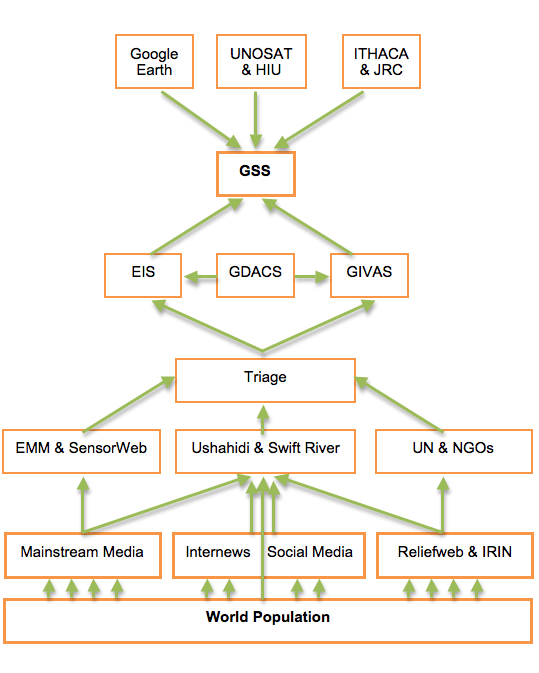
At the smallest unit of analysis, individuals are the most primary producers of information. The mainstream media, social media, natural language parsing tools, crowdsourcing platforms, etc, arguably comprise the primary consumers of that information. Secondary consumers are larger organisms such as the global Emergency Information Service (EIS) and the Global Impact and Vulnerability Alert System (GIVAS).

These newly forming platforms are at different stages of evolution. EIS and GIVAS are relatively embryonic while the Global Disaster Alert and Coordination Systems (GDACS) and Google Earth are far more evolved. A relatively new organism in the Info Web is the UAV as exemplified by ITHACA. The BrightEarth Humanitarian Sensor Web (SensorWeb) is further along the information chain while Ushahidi’s Crisis Mapping platform and the Swift River driver are more mature but have not yet deployed as a global instance.

InSTEDD’s GeoChat, Riff and Mesh4X solutions have already iterated through a number of generations. So have ReliefWeb and the Humanitarian Information Unit (HIU). There are of course additional organisms in this ecosystem, but the above list should suffice to demonstrate my point.

What if we connected these various organisms to catalyze a super organism? A Global System of Systems (GSS)? Would the whole—a global system of systems for crisis mapping and early warning—be greater than the sum of its parts? Before we can answer this question in any reasonable way, we need to know the characteristics of each organism in the ecosystem. These organisms represent the threads that may be woven into the GSS, a global web of crisis mapping and early warning systems.

Global System of Systems

Emergency Information Service (EIS) is slated to be a unified communications solution linking citizens, journalists, governments and non-governmental organizations in a seamless flow of timely, accurate and credible information—even when local communication infrastructures are rendered inoperable. This feature will be made possible by utilizing SMS as the communications backbone of the system.

In the event of a crisis, the EIS team would sift, collate, make sense of and verify the myriad of streams of information generated by a large humanitarian intervention. The team would gather information from governments, local media, the military, UN agencies and local NGOs to develop reporting that will be tailored to the specific needs of the affected population and translated into local languages. EIS would work closely with local media to disseminate messages of critical, life saving information.

Global Impact and Vulnerability Alert System (GIVAS) is being designed to closely monitor vulnerabilities and accelerate communication between the time a global crisis hits and when information reaches decision makers through official channels. The system is mandated to provide the international community with early, real-time evidence of how a global crisis is affecting the lives of the poorest and to provide decision-makers with real time information to ensure that decisions take the needs of the most vulnerable into account.

BrightEarth Humanitarian Sensor Web (SensorWeb) is specifically designed for UN field-based agencies to improve real time situational awareness. The dynamic mapping platform enables humanitarians to easily and quickly map infrastructure relevant for humanitarian response such as airstrips, bridges, refugee camps, IDP camps, etc. The SensorWeb is also used to map events of interest such as cholera outbreaks. The platform leverages mobile technology as well as social networking features to encourage collaborative analytics.

Ushahidi integrates web, mobile and dynamic mapping technology to crowdsource crisis information. The platform uses FrontlineSMS and can be deployed quickly as a crisis unfolds. Users can visualize events of interest on a dynamic map that also includes an animation feature to visualize the reported data over time and space.

Swift River is under development but designed to validate crowdsourced information in real time by combining machine learning for predictive tagging with human crowdsourcing for filtering purposes. The purpsose of the platform is to create veracity scores to denote the probability of an event being true when reported across several media such as Twitter, Online news, SMS, Flickr, etc.

GeoChat and Mesh4X could serve as the nodes connecting the above platforms in dynamic ways. Riff could be made interoperable with Swift River.

Can such a global Info Web be catalyzed? The question hinges on several factors the most important of which are probably awareness and impact. The more these individual organisms know about each other, the better picture they will have of the potential synergies between their efforts and then find incentives to collaborate. This is one of the main reasons I am co-organizing the first International Conference on Crisis Mapping (ICCM 2009) next week.

Patrick Philippe Meier

Cymatic Insights for Crisis Mapping

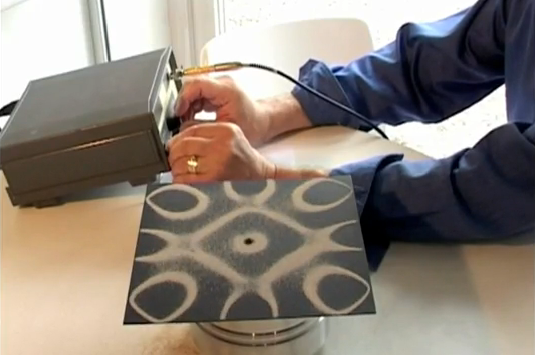
I just came across Evan Grant’s fascinating TED 2009 talk on “Making Sound Visible through Cymatics.” Cymatics describes the process of visualizing sound. Sound waves create vibrations—patterns—that can be visualized on the surface of a plate covered with sand as depicted below.

cymatics

In his talk, Evan demonstrates how different sound frequencies create distinctly different geometric sand patterns. As the sound frequencies increase, so does the complexity of the sand patterns themselves. He describes cymatics as a “looking glass into a hidden world” that can “unveil the substance of things not seen.”

For example, a lexicon of dolphin language is actually being created using cymatics by visualizing the sonar beams that dolphins emit. Cymatics can also be used to create natural art forms. The picture below is a visualization of Beethoven’s 9th Symphony created using a cymatic device. Cymatics can also recreate archetypal forms of nature such as snowflakes or starfish.

cymatics3

It’s not entirely clear what all this means. As Evan notes, cymatics is still a very young field and not many people are working in this line of research. Cymatics shows that sound has form and can effect form in matter. So Evan asks us to think about the universe forming, “about the immense sound of the universe forming, and to ponder on that … perhaps cymatics had an influence on the formation of the universe itself.” Watch Evan’s 5-minute TED Talk below.

In closing, Evan encourage us to apply our passions, knowledge and skills to areas like cymatics. I find this field very interesting because of the analogies with crisis mapping. As often mentioned on iRevolution, crisis mapping is about rendering otherwise hidden patterns visible to improve situational awareness and decision-making.

One can think of conflict processes as sound waves or vibrations and the “plates” as crisis mapping platforms like Ushahidi. We need to “vibrate” conflict data at different frequencies and to develop visual analytics—different templates for data visualization—in order to visualize patterns in a compelling fashion. One might call this the “String Theory” of Crisis Mapping.

——————————————————————————————–

A colleague and I tried analyzing conflict data as music back in 2006 when I was at the Santa Fe Institute (SFI). I had been inspired by the work of an Italian geophysicist who had taken seismic data (tremblings of the earth) and analyzed the data as music in order to look for “melodic” patterns. We used conflict event-data from Afghanistan but the result was not particularly music to my ears—but then again, neither is war.

Patrick Philippe Meier

Literature Review: GIS for Conflict Analysis

This interesting peer-reviewed study (PDF) was authored by researchers at the Joint Research Center (JRC) and published in the International Studies Review in September 2009.

Political and social scientists have quantitatively analyzed the drivers of conflicts in a large number of studies. Geographic components and territorial concepts have emerged as important drivers in interstate disputes. However, geographic components are rarely defined or measured with the same technique.

This study reviews geographic and territorial concepts, associated data sets and analysis methods. The study objective is to represent geographic and territorial concepts with Geographic Information Systems (GIS). The paper describes the challenges and potential opportunities for creating an integrated GIS model of security.

The literature review is a good introduction for anyone interested in the application of GIS to the spatial analysis of conflict. As a colleague mentioned, however, the authors of the study do not cite more recent work in this area, which is rather surprising and unfortunate. Perhaps this is due to the fact that the academic peer-review process can seemingly take forever.

Patrick Philippe Meier

Accurate Crowdsourcing for Human Rights

This is a short video of the presentation I will be giving at the Leir Conference on The Next Generation of Human Rights. My talk focuses on the use of digital technologies to leverage the crowdsourcing and crowdfeeding of human rights information. I draw on Ushahidi’s Swift River initiative to describe how crowdsourced information can be auto-validated.

Here’s a copy of the agenda (PDF) along with more details. This Leir Conference aims to bring together world-leading human rights practitioners, advocates, and funders for discussions in an intimate setting. Three panels will be convened, with a focus on audience discussion with the panelists. The topics will include:

  1. Trends in Combating Human Rights Abuses;
  2. Human Rights 2.0: The Next Generation of Human Rights Organizations;
  3. Challenges and Opportunities of  Technology for Human Rights.

I will be on presenting on the third panel together with colleagues from Witness.org and The Diarna Project. For more details on the larger subject of my presentation, please see this blog post on peer-producing human rights.

The desired results of this conference are to allow participants to improve advocacy, funding, or operations through collaborative efforts and shared ideas in a natural setting.

Patrick Philippe Meier

Promises and Pitfalls in the Spatial Prediction of Ethnic Violence

My colleague Nils Weidmann just published this co-authored piece with Harvard Professor Monica Toft. The paper deserves serious attention. Weidmann and Toft review this article on the spatial prediction of ethnic conflict that was authored by Lim, Metzler and Bar-Yam (LMB) and published in the prestigious journal Science.

I reviewed the article myself earlier this year and while I was highly suspicious of the findings—correlations of 0.9 (!) and above—I did not dig deeper. But Weidmann and Toft have done just this and their findings are worth reading.

The authors clearly show that the analysis by LMB “suffers from a biased selection of groups and regions, an inadequate null hypothesis and unit of analysis.” This really begs the following question: how did the LMB paper ever make it through the peer-review process?

The authors’ case selection is seriously biased as it “seems to adjust the group map as to better fit the model predictions,” for example. The isolationist policy recommendations that LMB put forward are thus founded on misleading methods and ought to be entirely dismissed.

Better yet, Science should retract the LMB paper or at least publish the commentary by Weidmann and Toft. Indeed, another question that follows from the conclusion reached by Weidmann and Toft is this: how many other below-par papers have been accepted and published by Science?

In sum, not only are the methods used by LMB questionable, but as Weidmann and Toft conclude, “the model provides little advance on prior research” in the field of crisis mapping.

On the plus side, the fact that there is push back on early articles in the field of crisis mapping is also a good sign and evidence that the field is becoming more formalized. In addition, the general approach taken by LMB still holds much promise for crisis mapping—it simply needs to be done with a lot more care and transparency. Indeed, combining agent-based models with real world empirical data and a sound understanding of ethnic conflict could become a winning strategy for crisis mapping analytics.

In closing, I look forward to following Nils Weidmann’s work at Princeton and have no doubt that he will continue to play an important role in the development of the field, and will do so with integrity and rigorous scholarship.

Patrick Philippe Meier

Mapping Massacres: GIS and State Terror in Guatemala

This is the title of a paper published in Geoforum in 2006 (PDF). Note that the paper was actually submitted in 2003 but the peer-review process appears to have taken 3 years. Ridiculous. I sympathize with the authors and hope they’ve turned to blogging. But the content of their paper is actually what I want to blog about here.

The authors use GIS to visually display the locations of massacres associated with Guatemala’s civil war at the department level and include information on indigenous populations as well as physical geography. They note that “maps have become tools of empowerment in Central America and elsewhere,” and highlight how indigenous groups “have begun to use maps as tools in their fight for land and marine resources, as well as greater political economy.”

It is worth understanding that “among some sectors of Guatemalan society, there is still wholesale denial and rejection of past violent events.” To this end, the purpose of “displaying exactly where violent acts took place is to […] educate the Guatemalan public regarding the terrible violence of the recent past.” The authors suggest that “knowing the name of a specific town where a massacre took place is more concrete, potentially leading to perception of place and people, rather than simply being aware of violence in the countryside.”

Guatemala massacres

The authors produced the maps above, which clearly show that most massacres were concentrated in landscapes whose majority populations are indigenous. “Massacres were not random events in Guatemala. Instead, they took place in very specific cultural landscapes. “

The following short excerpts very much resonate with my thinking on crisis mapping:

“Even information that is easily comprehensible without maps takes on new meaning when it is portrayed spatially.”

“However, knowing in a general sense where the violence took place is not enough. If we fail to accurately display such information spatially, we fail to fully understand where and especially why these events took place. […] By using some basic geographic information systems technologies, relationships between ethnicity, location, physical environment, and violence become much clearer.”

“Mapping these tragic events is critical because these maps also serve as another type of memorial for victims and their families. Many Guatemalans have yet to come to grips with the violence of the past. Maps, more so than words can help deconstruct violent events by providing a mental image of a location and event in the onlookers mind.”

The authors have certainly contributed a better spatial understanding of the violence thanks to this study. What is perhaps missing is an equally compelling temporal resolution so that events can be incrementally analyzed over time and space. Doing so may shed more light on the tactics and strategies employed to carry out the violence. These may produce specific patterns or a library of “fingerprints” that could then be used to investigate massacres in other countries.

Patrick Philippe Meier

Doctor Snow’s Health Map Propaganda

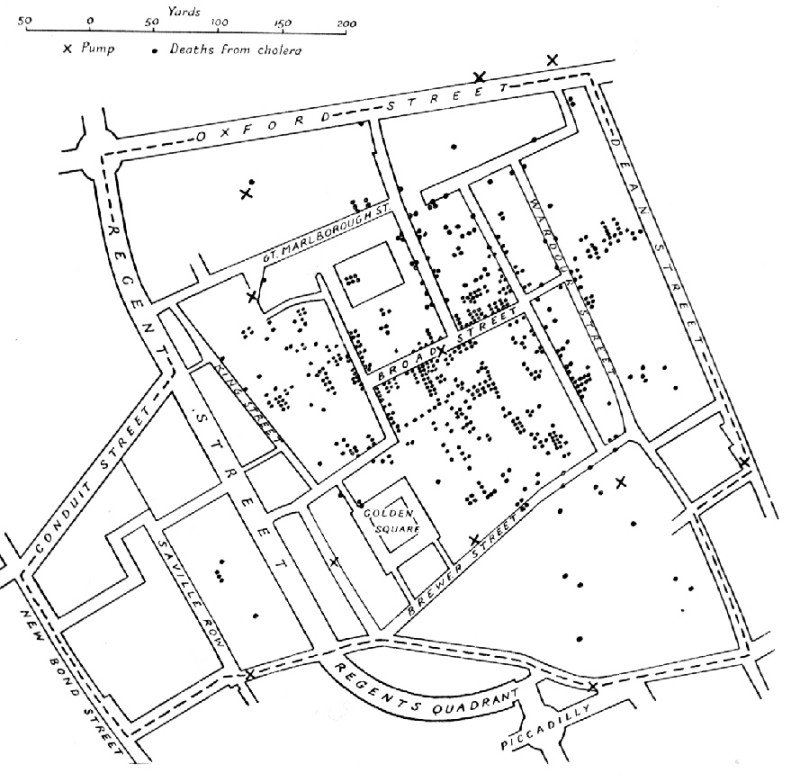
Doctor John Snow’s cholera map of 1854 is often heralded as an example of how mapping can illuminate powerful insights on otherwise hidden patterns. Not so, writes Mark Monmonier in his excellent book on “Spying with Maps” which I just reviewed here.

cholera-snow-map

Mark writes the following on John Snow’s famous map:

“If disease mapping has a poster child, it’s John Snow (1813-1858), the London anesthesiologist credited with discovering the water borne transmission of cholera. […] Snow is best known for his 1854 map showing victims’ homes clustered around Soho’s infamous Broad Street Pump, which he identified as a source of contaminated water. According to epidemiological lore, the good doctor tried unsuccessfully to convince public officials to close down the pump.”

“Undaunted, he too matters in his own hands, removed the pump’s handle, and demonstrated the correctness of his theory when new cases plummeted. Truth be told, the epidemic had already run its course. What’s more, Snow made his famous dot map several months later, for a revised edition of his book on cholera transmission. Even so, his pin map continues to embellish discussions of GIS and disease.”

“Medical geographers, GIS experts, and some epidemiologists perpetuate the Snow myth because it promotes disease mapping as a discovery tool and enhances the stature of their own disciplines. But a careful examination of Snow’s writings indicates that he understood cholera’s mode of transmission well before he made the map.”

“Although Snow was a thoughtful observer, neither his map nor those of his rivals were of any value in generating insightful hypotheses. Snow’s famous cholera map was pure propaganda—and copycat propaganda at that—but proved eminently useful later in the century, when public officials needed convincing arguments to isolate drinking water from sewage.”

Although Mark is rightfully critical of Dr. John Snow’s legendary map, the last sentence above is quite insightful. The map, while unhelpful in knowledge discovery of cholera’s source, did become “eminently useful” to influence public health policy.

Patrick Philippe Meier

Doctor Snow’s Health Map Propaganda

Doctor John Snow’s cholera map of 1854 is often heralded as an example of how mapping can illuminate powerful insights on otherwise hidden patterns. Not so, writes Mark Monmonier in his excellent book on “Spying with Maps” which I just reviewed here.

cholera-snow-map

Mark writes the following on John Snow’s famous map:

“If disease mapping has a poster child, it’s John Snow (1813-1858), the London anesthesiologist credited with discovering the water borne transmission of cholera. […] Snow is best known for his 1854 map showing victims’ homes clustered around Soho’s infamous Broad Street Pump, which he identified as a source of contaminated water. According to epidemiological lore, the good doctor tried unsuccessfully to convince public officials to close down the pump.”

“Undaunted, he too matters in his own hands, removed the pump’s handle, and demonstrated the correctness of his theory when new cases plummeted. Truth be told, the epidemic had already run its course. What’s more, Snow made his famous dot map several months later, for a revised edition of his book on cholera transmission. Even so, his pin map continues to embellish discussions of GIS and disease.”

“Medical geographers, GIS experts, and some epidemiologists perpetuate the Snow myth because it promotes disease mapping as a discovery tool and enhances the stature of their own disciplines. But a careful examination of Snow’s writings indicates that he understood cholera’s mode of transmission well before he made the map.”

“Although Snow was a thoughtful observer, neither his map nor those of his rivals were of any value in generating insightful hypotheses. Snow’s famous cholera map was pure propaganda—and copycat propaganda at that—but proved eminently useful later in the century, when public officials needed convincing arguments to isolate drinking water from sewage.”

Although Mark is rightfully critical of Dr. John Snow’s legendary map, the last sentence above is quite insightful. The map, while unhelpful in knowledge discovery of cholera’s source, did become “eminently useful” to influence public health policy.

Patrick Philippe Meier

Spying with Maps

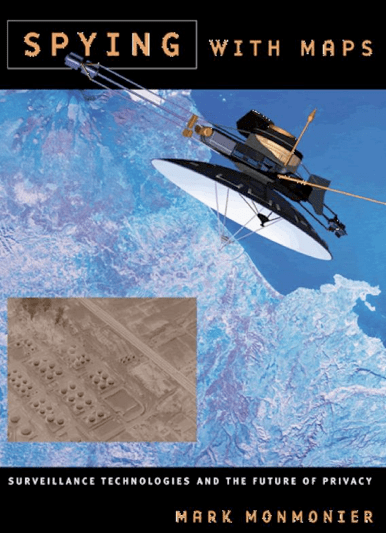
Mark Monmonier has written yet another excellent book on maps. I relished and reviewed his earlier book on “How To Lie with Maps” and enjoyed this one even more on “Spying with Maps.” I include below some short excerpts that I found particularly neat and interesting.

Picture 1

“Mapping, it turns out, can reveal quite a bit about what we do and who we are. I say mapping, rather than maps, because cartography is not limited to static maps printed on paper or displayed on computer screens. In the new cartographies of surveillance, the maps one looks at are less important than the spatial data systems that store and integrate facts about where we live and work. Location is a powerful key for relating disparate databanks and unearthing information […].”

Big Brother is doing most of the watching, at least for now, but corporations, local governments, and other Little Brothers are quickly getting involved.”

“Much depends, of course, on who’s in charge, us or them, and on who ‘them’ is. A police state could exploit geographic technology to round up dissidents—imagine the Nazi SS with a GeoSurveillance Corps. By contrast, a capitalist marketer can exploit locational data by making a cleverly tailored pitch at a time and place when you’re most receptive. Control is control whether it’s blatant or subtle.”

Corrona Satellites

“Spy satellites became a top priority during the Cold War, and Congress generously supported remote sensing. […] analysts with security clearances pored over images from the CIA’s top-secret Corona satellites at the agency’s clandestine National Reconnaissance Office (NRO).” By 1967, “a massive research and development effort had refined the [resolution] down to an impressive 1.5 meters (5 ft.).” Today’s “intelligence satellites have even sharper eyes: various estimates suggest that pictures from Corona’s most advanced successors have a resolution of roughly 3 inches.”

“Because image intelligence focuses on detecting change, 1-meter satellite imagery is often more informative [then people realize]. A new railway spur or clearing, for instance, could signify a new missile site or weapons factory. And a suspicious accumulation of vehicles might presage an imminent attack. As John Pike observes, ‘if a picture is worth 1,000 words, two pictures are worth 10,000 words.'”

“Washington strongly discourages the sale of high-resolution satellite imagery of Israel, and during the 2001 Middle Eastern campaign, the government thwarted enemy media hopes by buying exclusive rights to Ikonos imagery of Afghanistan.”

I really appreciated Mark’s take on the panopticon. His points below are largely ignored by the mainstream literature on the subject and go a long way to explaining just why satellite imagery has not (yet?) acted a strong deterrent against genocide and crimes against humanity. For more on this, please see this post on geospatial technologies for genocide prevention.

Panopticon

Panopticon

“Although the [panopticon] metaphor seems largely appropriate, I am not convinced  that the similarity between Bentham’s model prison and video surveillance tells us anything that’s not obvious about the watcher’s power over the watched. My hunch is that the prison’s walls and bars as well as the isolation of inmates in individual cells exert far greater control over prisoners’ lives than a ready ability to spy on their actions. […] What’s relevant […] is the power of surveillance to intimidate someone already under the watcher’s control, like a prisoner (who can be beaten), an employee (who can be fired), or a motorist who runs red lights (and could be fined or lose his or her license.”

I had come across ShotSpotter a while back but rediscovered the tool in Mark’s book. What is neat is that ShotSpotter combines audio and mapping in a way that may also be applicable to crisis mapping.

Shotspotter

Shotspotter

“[…] police in several California cities rely on ShotSpotter, which its investors describe as an ‘automatic real-time gunshot locator and display system’ […] a clever marriage of seismic analysis and acoustic filtering. […] Like an earthquake, a gunshot generates a sharply defined circular pulse, which expands outward at constant speed. […] ShotSpotter’s microphones detect the wave at slightly different times depending on their distance from the shooter’s location [which the computer can use] to triangulate a location in either two or three dimension. […] The process pinpoints gunshots within 15 yards […].”

Patrick Philippe Meier