Crisis Mapping for Monitoring & Evaluation

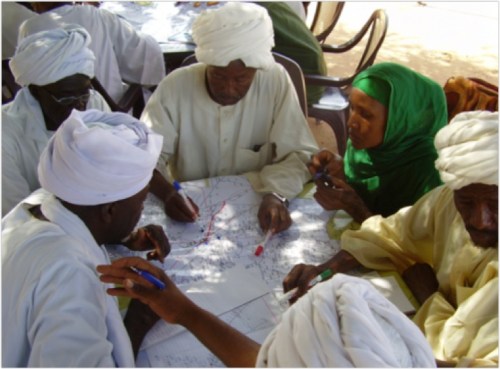
I was pleasantly surprised when local government ministry representatives in the Sudan (specifically Kassala) directly requested training on how to use the UNDP’s Threat and Risk Mapping Analysis (TRMA) platforms to monitor and evaluate their own programs.

Introduction

The use of crisis mapping for monitoring and evaluation (M&E) had cropped up earlier this year in separate conversations with the Open Society Institute (OSI) and MercyCorps. The specific platform in mind was Ushahidi, and the two organizations were interested in exploring the possibility of using the platform to monitor the impact of their funding and/or projects.

As far as I know, however, little to no rigorous research has been done on the use of crisis mapping for M&E. The field of M&E is far more focused on change over time than over space. Clearly, however, post-conflict recovery programs are implemented in both time and space. Furthermore, any conflict sensitivity programming must necessarily take into account spatial factors.

CartaMetrix

The only reference to mapping for M&E that I was able to find online was one paragraph in relation to the Cartametrix 4D map player. Here’s the paragraph (which I have split into to ease legibility) and below a short video demo I created:

“The Cartametrix 4D map player is visually compelling and fun to use, but in terms of tracking results of development and relief programs, it can be much more than a communications/PR tool. Through analyzing impact and results across time and space, the 4D map player also serves as a good program management tool. The map administrator has the opportunity to set quarterly, annual, and life of project indicator targets based on program components, regions, etc.

Tracking increases in results via the 4D map players, gives a program manager a sense of the pace at which targets are being reached (or not). Filtering by types of activities also provides for a quick and easy way to visualize which types of activities are most effectively resulting in achievements toward indicator targets. Of course, depending on the success of the program, an organization may or may not want to make the map (or at least all facets of the map) public. Cartametrix understands this and is able to create internal program management map applications alongside the publicly available map that doesn’t necessarily present all of the available data and analysis tools.”

Mapping Baselines

I expect that it will only be a matter of time until the M&E field recognizes the added value of mapping. Indeed, why not use mapping as a contributing tools in the M&E process, particularly within the context of formative evaluation?

Clearly, mapping can be one contributing tool in the M&E process. To be sure, baseline data can be collected, time-stamped and mapped. Mobile phones further facilitate this spatially decentralized process of information collection. Once baseline data is collected, the organization would map the expected outcomes of the projects they’re rolling out and estimated impact date against this baseline data.

The organization would then implement local development and/or conflict management programs  in certain geographical areas and continue to monitor local tensions by regularly collecting geo-referenced data on the indicators that said projects are set to influence. Again, these trends would be compared to the initial baseline.

These program could then be mapped and data on local tensions animated over time and space. The dynamic mapping would provide an intuitive and compelling way to demonstrate impact (or the lack thereof) in certain geographical areas where the projects were rolled out as compared to other similar areas with no parallel projects. Furthermore, using spatial analysis for M&E could also be a way to carry out a gap analysis and to assess whether resources are being allocated efficiently in more complex environments.

Next Steps

One of my tasks at TRMA is to develop a short document on using crisis mapping for M&E so if anyone has any leads on applied research in this area, I would be much obliged.
Patrick Philippe Meier

Pictures: Community Mapping in Action

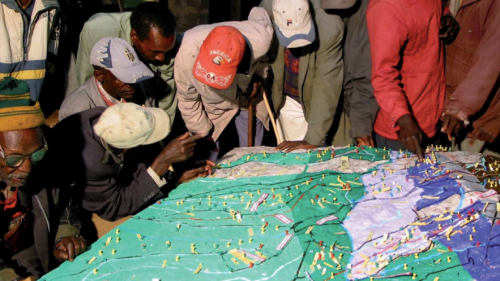
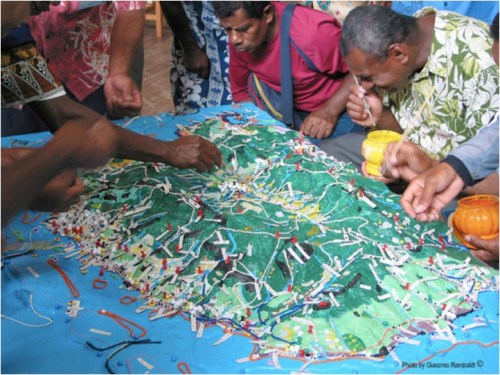
I find the pictures below inspiring. In many ways, the action of participatory mapping is where the real added value lies. The pictures are from TRMA and IFAD and IAPAD (Vietnam, Fiji and Kenya for the latter). They depict scenes from the Sudan, Botswana, Kenya, Vietnam, Indonesia, Fiji and the Philippines. What is striking, however, is the lack of women doing the actual mapping in these photographs.

Please send me additional pictures, I’d love to include them, especially of women focus groups and projects from South America. Kindly see my previous post for pictures of social maps.

trma1

ifad1

ifad2

ifad3

ifad4

ifad5

ifad6

ifad7

other1

ifad8

Patrick Philippe Meier

Content for Digital Activism and Civil Resistance

I’ve been advising a large scale digital activism and civil resistance project and am concerned by the lack of importance placed on content. The project’s donor (not implementer) literally thinks that flooding the country in question with mobile phones, for example, will catalyze an effective digital and civil resistance movement. Clearly, they know very little about civil resistance.

Content Matters

Here’s a personal story I often relate during conversations that tend toward technological determinism. I was in the Western Sahara in 2003 doing investigative research on the Polisario guerrilla movement. I made contact with a high ranking guerrilla fighter who had trained in Cuba and Libya and who just defected from the camp’s headquarters in Algeria. He was a wealth of information and we quickly became friends.

Click for credit/source

One of my most memorable moments was when he recounted what ultimately made him decide to leave the Polisario. “I got a Spanish copy of Animal Farm by George Orwell, and I couldn’t believe it, he described in detail the political nature of the Polisario movement. I did not want this life for my children and my wife. So I left.”

Click for credit/source

Now, don’t get me wrong, I’m absolutely pro self-determination for the Western Sahara which, like many others, I consider to be the oldest colony in Africa. The point of my story, however, is that a simply but brilliant book was enough to make my friend take a huge risk in defecting. Content is key, technology is secondary. (I’m actually reading a neat book, Wasp by Eric Russell, that gets exactly at this disproportionate, asymmetric dynamic vis-a-vis civil resistance).

Identifying Content

This brings me to my next point. I have been surprised to find little material that specifically lists the kind of content one would want to smuggle into a country under authoritarian rule. This is not to say we should restrict certain types of information, absolutely not, the first step is to provide full and secure access to all content on the web, for example.

At the same time, it behooves us to place some deliberate “sign posts” to specific content that can educate a closed society about digital activism and civil resistance. This means providing access to international and alternative news, such as mainstream media and GlobalVoices. Providing access to Wikipedia is also a good idea. But there’s a lot more content out there if the goal is to foster a peaceful transition to democracy.

As the Western Sahara story suggests, we would want to provide all of George Orwell’s books in print and/or electronic form. In addition, books on democracy and especially nonviolent revolutions and social movements. History books on civil resistance as well as video documentaries and even audio-books. I would also include multimedia material on nonviolent tactics and strategy.

afmp

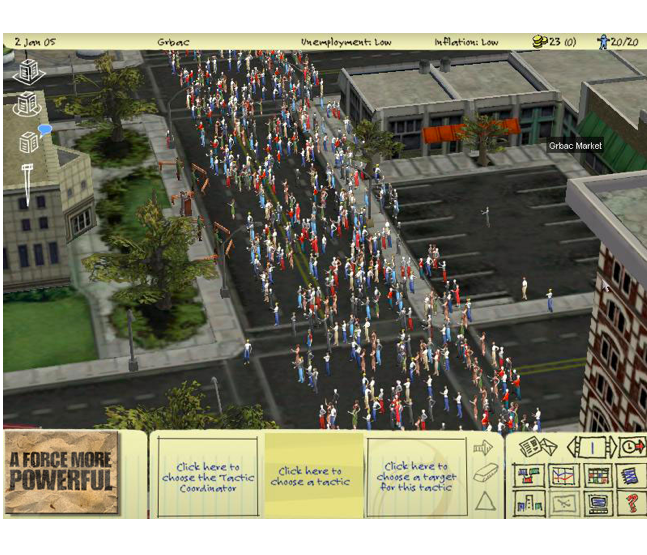
Finally, I’m interested in computer games, like A Force More Powerful (AFMP); see screenshot above. I’ve also been toying around with the idea of multi-player games on mobile phones that replicate swarm or smartmob-like behavior. Like a treasure hunt of sorts via SMS or beeping.

How You Can Help

The identification of content should be one of the very first steps in this kind of digital activism and civil resistance project. Only after the content is identified, acquired and translated into the appropriate language(s) should one turn to technology as a vehicle for safe and secure transmission using encryption, steganography, etc.

In the meantime, here’s what I  have so far:

  • A Force More Powerful (book, DVD and game)
  • Nonviolent Conflict: 50 Crucial Points (>)
  • Waging Nonviolent Struggle in the 20th Century Practice and 21st Century Potential (>)
  • Strategic Nonviolent Conflict: The Dynamics of People Power in the 20th Century (>)
  • Unarmed Insurrections: People Power in Non-Democracies (>)
  • On Strategic Nonviolent Conflict: Thinking About the Fundamentals (>)
  • Introduction to Nonviolent Conflict (>)
  • Bringing Down a Dictator (DVD)
  • Revolution in Orange (Book and DVD)
  • There Are Realistic Alternatives (>)
  • The Right to Rise Up: The Virtues of Civic Disruption (>)
  • Gene Sharp’s Theory of Power (>)
  • Civil Disobedience by Hannah Arendt (>)
  • War without Weapons (>)
  • Nonviolent Social Movements: A Geographic Perspective (>)
  • Nonviolence and the Case of the Extremely Ruthless Opponent (>)
  • Power and Persuasion: Nonviolent Strategies to Influence State Security Forces (>)
  • Strategic Nonviolent Conflict: Lessons from Past, Ideas for Future (>)
  • How Freedom is Won: From Civic Resistance to Durable Democracy (>)

There is more great content listed on the Albert Einstein Institution website, PeaceMakers, Civil Resistance Info, Nonviolent Conflict, DigiActive and David Cortright’s website.

I’m looking for free or paid content. This content can be text, audio and/or video. I’d also be interested in putting a list together of entertaining movies with an underlying message of democracy and nonviolent resistance. The same goes for computer games and games on mobile phones. In sum, any material you think could educate and empower a society closed from the world would be welcome.

Feel free to forward this call for feedback as widely as you’d like. Thank you.

Patrick Philippe Meier

New Media, Accuracy and Balance of Power in Crises

I just read Nik Gowing’s book entitled “Skyful of Lies and Black Swans: The New Tyranny of Shifting Information Power in Crises.” The term “Black Swan” refers to sudden onset crises and the title of an excellent book on the topic by Nassim Taleb. “Skyful of Lies,” were the words used by the Burmese junta to dismiss the deluge of digital evidence of the mass pro-democracy protests  that took place in 2007.

yournewmedia001_3

Nik packs in some very interesting content in this study, a lot of which is directly relevant to my dissertation research and consulting work. He describes the rise of new media as “having an asymmetric, negative impact on the traditional structures of power.”

Indeed, British Foreign Secretary David Miliband labeled this “shifting of power from state to citizen as the new ‘civilian surge.'” To be sure, “that ‘civilian surge’ of growing digital empowerment is forcing an enhanced level of accountability that […] is a ‘real change to democracy’.” As for authoritarian regimes, “the impact of new media technologies has been shown to be as potentially ‘subversive’ as for highly developed democratic states.”

However, Nik recognizes that “the implications for power and policy-makers is not well developed or appreciated.” He adds that “the implications of this new level of empowerment are profound but still, in many ways, unquantifiable.” Hence the purpose and focus of my dissertation.

Time Lines out of Sync

Nik notes that the time lines of media action and institutional reaction are increasingly out of sync. “The information pipelines facilitated by the new media can provide information and revelations within minutes. But the apparatus of government, the military or the corporate world remain conditioned to take hours.”

Take for example, the tube and train bombings in London, 2005. During the first three hours following the incidents, the official government line was that an accidental power surge had caused the catastrophe. Meanwhile, some 1,300 blog posts were written within just 80 minutes of the terrorist attack which pointed to explosive devices as the cause. “The content of the real-time reporting of 20,000 emails, 3,000 text messages, 1,000 digital images and 20 video clips was both dramatic and largely correct.”

New Media and Accuracy

I find the point about accuracy particularly interesting. According to Nik, the repeated warnings that new media and user-generated content (UGC) cannot be trusted “does not seem to apply in a major crisis.”

“Far from it. The accumulated evidence is that the asymmetric torrent of overwhelming ‘amateur’ inputs from the new generators of content produces largely accurate, if personalized, information in real time. It may be imperfect and incomplete as the crisis time line unfolds.

There is also the risk of exaggeration or downright misleading ‘reporting’. But the impact is profound. Internal BBC research discovered that audiences are understanding if errors or exaggerations creep in by way of such information doer material, as long as they are sourced and later corrected.

In addition, the concept of trust can ‘flex’ in a crisis. Trust does not diminish as long as the ongoing levels of doubt or lack of certainty are always made clear. It is about ‘doing your best in [a] world where speed and information are the keys’. But the research concluded that the BBC needed to do more work to analyze the implications of the UGC phenomenon for accuracy, speed, personalization, dialogue and trust. That challenge is the same for all traditional media organizations.

Low Tech Power

Nik describes the onslaught of new media as the low tech empowerment of the media space. During the Burma protests of 2007, “the ad hoc community of risk-taking information doers became empowered. Those undisputed and widely corroborated images swiftly challenged the authority and claims of the regime.”

burmaprotests1

During the aftermath of Cyclone Nargis, both foreign journalists and aid agencies were forbidden from entering the country. But one producer and camera operator from a major news organization “managed to enter the country on tourist visas. Before being arrested and deported they evaded security checks and military intelligence to record vivid video that confirmed the terrible impact and human cost of the cyclone. Hiding in ditches they beamed it out of the country on a new tiny, portable Bgan satellite uplink carried in a hiker’s backpack.”

The Question

This is definitely an example of the “asymmetric, negative impact on the traditional structures of power,” that Nik refers to in his introduction. Question is, how much of a threat does this asymmetry pose to repressive regimes? That is one of the fundamental questions I pose in my dissertation research.

Patrick Philippe Meier

MDG Monitor: Combining GIS and Network Analysis

I had some fruitful conversations with colleagues at the UN this week and learned about an interesting initiative called the MDG Monitor. The platform is being developed in collaboration with the Parsons Institute for Information Mapping (PIIM).

Introduction

The purpose of the MDG Monitor is to provide a dynamic and interactive mapping platform to visualize complex data and systems relevant to the Millennium Development Goals (MDGs). The team is particularly interested in having the MDG Monitor facilitate the visualization of linkages, connections and relationships between the MDGs and underlying indicators: “We want to understand how complex systems work.”

G8-MDG-logosThe icons above represent the 8 development goals.

The MDG Monitor is thus designed to be a “one-stop-shop for information on progress towards the MDGs, globally and at the country level.” The platform is for “policymakers, development practitioners, journalists, students and others interested in learning about the Goals and tracking progress toward them.”

The platform is under development but I saw a series of compelling mock-ups and very much look forward to testing the user-interface when the tool becomes public. I was particularly pleased to learn about the team’s interest in visualizing both “high frequency” and “low frequency” data. The former being rapidly changing data versus the latter slow change data.

In addition, the platform will allow users to drill down below the country admin level and overlay multiple layers. As one colleague mentioned, “We want to provide policy makers with the equivalent of a magnifying glass.”

Network Analysis

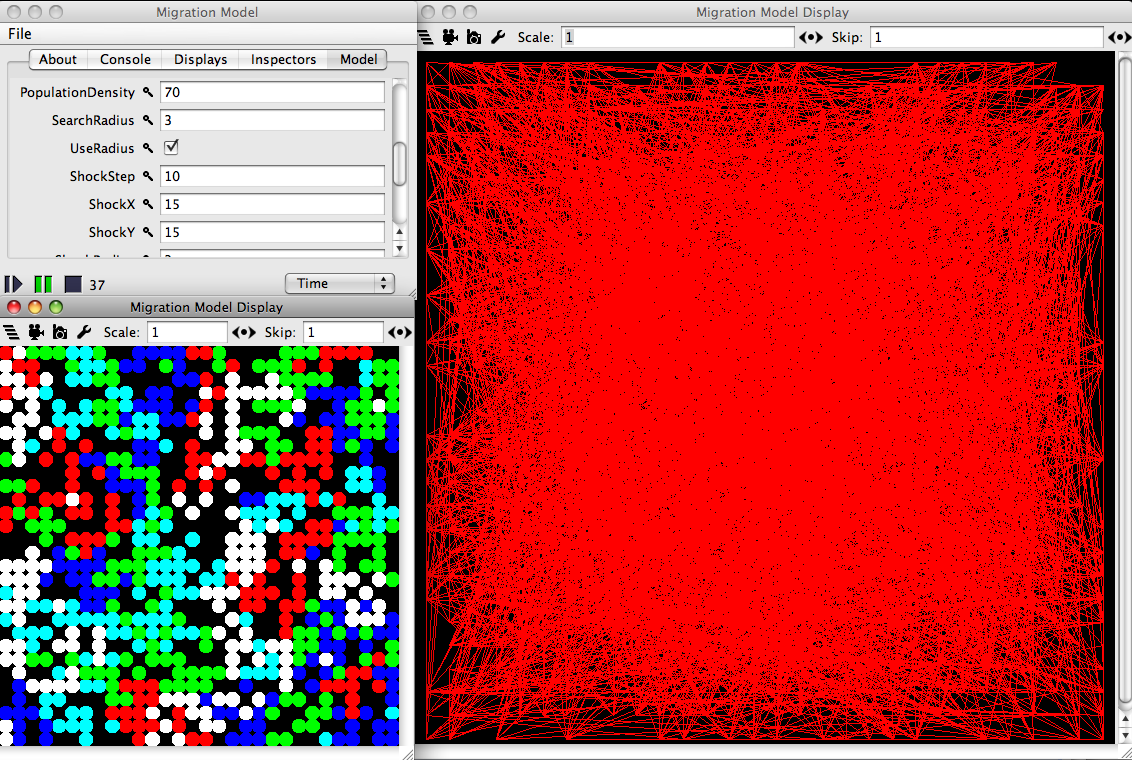
Perhaps most impressive but challenging is the team’s interest in combining spatial analysis with social networking analysis (SNA). For example, visualizing data or projects based on their geographic relationships but also on their functional relationships. I worked on a similar project at the Santa Fe Institute (SFI) back in 2006, when colleagues and I developed an Agent Based Model  (ABM) to simulate internal displacement of ethnic groups following a crisis.

abmSFI

Agent Based Model of Crisis Displacement

As the screenshot above depicts, we were interested in understanding how groups would move based on their geographical and ethnic or social ties. In any case, if the MDG Monitor team can combine the two types of dynamic maps, this will certainly be a notable advance in the field of crisis mapping.

Patrick Philippe Meier

Global Impact and Vulnerability Alert System (GIVAS): A New Early Warning Initiative?

Update: This project is now called UN Global Pulse.

UN Secretary-General Ban Ki-Moon is calling for better real-time data on the impact of the financial crisis on the poor. To this end, he is committing the UN to the development of a Global Impact and Vulnerability Alert System (or GIVAS) in the coming months.  While I commend the initiative’s focus on innovative data collection, I’m concerned that this is yet another “early warning system” that will fail to bridge alert and operational response.

The platform is being developed in collaboration with the World Bank and will use real time data to assess the vulnerability of particular countries or populations. “This will provide the evidence needed to determine specific and appropriate responses,” according to UNDP. UN-Habitat opines that the GVA will be a “vital tool to know what is happening and to hold ourselves accountable to those who most need our help.”

According to sources, the objective for the GIVAS is to “ensure that in times of global crisis, the fate of the poorest and most vulnerable populations is not marginalized in the international community’s response. By closely monitoring emerging and dramatically worsening vulnerabilities on the ground, the Alert would fill the information gap that currently exists between the point when a global crisis hits vulnerable populations and when information reaches decision makers through official statistical channels.”

GIVAS will draw on both high frequency and low frequency indicators:

The lower frequency contextual indicators would allow the Alert system to add layers of analysis to the real time “evidence” generated by the high frequency indicators. Contextual indicators would provide information, for example, on a country’s capacity to respond to a crisis (resilience) or its exposure to a crisis (transmission channels). Contextual indicators could be relatively easily drawn from existing data bases. Given their lesser crisis sensitivity, they are generally collected less frequently without losing significantly in relevance.”

The high frequency indicators would allow the system to pick up significant and immediately felt changes in vulnerability at sentinel sites in specific countries. This data would constitute the heart of the Alert system, and would provide the real-time evidence – both qualitative and quantitative – of the effects of external shocks on the most vulnerable populations. Data would be collected by participating partners and would be uploaded into the Alert’s technical platform.”

The pulse indicators would have to be highly crisis sensitive (i.e. provide early signals that there is a significant impact), should be available in high periodicity and should be able to be collected with relative ease and at a reasonable cost. Data would be collected using a variety of methodologies, including mobile communication tools (i.e. text messaging), quick impact assessment surveys, satellite imagery and sophisticated media tracking systems.”

The GIVAS is also expected to use natural language processing (NLP) to extract data from the web. In addition, GIVAS will also emphasize the importance of data presentation and possibly draw on Gapminder’s Trendalyzer software.

There’s a lot more to say on GIVAS and I will definitely blog more about this new initiative as more information becomes public. My main question at this point is simple: How will GIVAS seek to bridge the alert-response gap? Oh, and a related question: has the GIVAS team reviewed past successes and failures of early warning/response systems?

Patrick Philippe Meier

OCHA’s Humanitarian Dashboard

I recently gave a presentation on Crisis Mapping for UN-OCHA in Nairobi and learned a new initiative called the Humanitarian Dashboard. The Dashboard is still in its development phase so the content of this post is subject to change in the near future.

I was pleasantly surprised to find out that Nick Haan, a colleague from years back, is behind the initiative. I had consulted Nick on a regular basis back in 2004-2005 when working on CEWARN. He was heading the Food Security Assessment Unit (FSAU) at the time.

Here’s a quick introduction to the Humanitarian Dashboard:

The goal of the Dashboard is to ensure evidence-based humanitarian decision making for more needs-based, effective, and timely action.  The business world is well-accustomed to dashboards for senior executives in order to provide them with a real-time overview of core business data, alert them of potential problems, and keep operations on-track for desired results.

Stephen Few, a leader in dashboard design defines a dashboard as “a single-screen display of the most important information people need to do a job, presented in a way that allows them to monitor what’s going on in an instant.”   Such a single-screen or single-page overview, updated in real time, does not currently exist in the humanitarian world.”

The added values of the Dashboard:

  1. It would allow humanitarian decision-makers to more quickly access the core and common humanitarian information that they require and to more easily compare this information across various emergencies;
  2. It would provide a common platform from which essential big picture and cross sectoral information can be discussed and debated among key stakeholders, fostering greater consensus and thus a more coordinated and effective humanitarian response;
  3. It would provide a consolidated platform of essential information with direct linkages to underlying evidence in the form of reports and data sets, thus providing a much needed organizational tool for the plethora of humanitarian information;
  4. It would provide a consistently structured core data set that would readily enable a limitless range of humanitarian analysis across countries and over-time.

I look forward to fully evaluating this new tool, which is currently being piloted in Somalia, Kenya and Pakistan.

Patrick Philippe Meier

OCHA’s Humanitarian Dashboard

I recently gave a presentation on Crisis Mapping for UN-OCHA in Nairobi and learned a new initiative called the Humanitarian Dashboard. The Dashboard is still in its development phase so the content of this post is subject to change in the near future.

I was pleasantly surprised to find out that Nick Haan, a colleague from years back, is behind the initiative. I had consulted Nick on a regular basis back in 2004-2005 when working on CEWARN. He was heading the Food Security Assessment Unit (FSAU) at the time.

Here’s a quick introduction to the Humanitarian Dashboard:

The goal of the Dashboard is to ensure evidence-based humanitarian decision making for more needs-based, effective, and timely action.  The business world is well-accustomed to dashboards for senior executives in order to provide them with a real-time overview of core business data, alert them of potential problems, and keep operations on-track for desired results.

Stephen Few, a leader in dashboard design defines a dashboard as “a single-screen display of the most important information people need to do a job, presented in a way that allows them to monitor what’s going on in an instant.”   Such a single-screen or single-page overview, updated in real time, does not currently exist in the humanitarian world.”

The added values of the Dashboard:

  1. It would allow humanitarian decision-makers to more quickly access the core and common humanitarian information that they require and to more easily compare this information across various emergencies;
  2. It would provide a common platform from which essential big picture and cross sectoral information can be discussed and debated among key stakeholders, fostering greater consensus and thus a more coordinated and effective humanitarian response;
  3. It would provide a consolidated platform of essential information with direct linkages to underlying evidence in the form of reports and data sets, thus providing a much needed organizational tool for the plethora of humanitarian information;
  4. It would provide a consistently structured core data set that would readily enable a limitless range of humanitarian analysis across countries and over-time.

I look forward to fully evaluating this new tool, which is currently being piloted in Somalia, Kenya and Pakistan.

Patrick Philippe Meier

FSI09: The Future of Civil Resistance

The final presentation at the Fletcher Summer Institute (FSI) for the Advanced Study of Nonviolent Conflict focused on the future of nonviolent conflict. This future depends largely on the quality of our thinking.

There is a surprising development of civil resistance. To be sure, the frequency of occurrences is accelerating. At the same time, a consensus on concepts and dynamics is also surfacing. The definition of civil resistance which is gaining traction is as follows:

Civil resistance is a type of political action that relies on the use of non-violent methods. It is largely synonymous with certain other terms, including ‘non-violent action’, ‘non-violent resistance’, and ‘people power’. It involves a range of widespread and sustained activities that challenge a particular power, force, policy or regime—hence the term ‘resistance’. The adjective ‘civil’ in this context denotes that which pertains to a citizen or society, implying that a movement’s goals are ‘civil’ in the senes of being widley shared in a society; and it generally denotes that the action concerned is non-military or non-violent in charachter.

This definition is taken from the forthcoming book “Civil Resistance & Power Politics: The Experience of Non-violent Action from Ghandhi to the Present” edited by Adam Roberts and Timothy Garton Ash.

nvabook

Civil resistance will increasingly be the preferred strategy for countering repression. This is due to the better success/failure ratio of civil resistance and the fact that nonviolent transitions have a more democratic outcome.

Skill of civil resistance will become increasingly ascendant over restrictive conditions. They will be less limited by the brutality of the regime. In addition, they will be less constrained by low civil society development. Hence the need for training in civil resistance.

Foreign policy elites will increasingly recognize civil resistance as a contest without a predetermined outcome. To this end, we need to do the following:

  • End the sterile debate on whether to engage or not to engage rather than who to engage with;
  • End the distinction between hard and soft power;
  • Better understanding of the varieties of assistance to opposition movements;
  • Create norms for requests for assistance rather than right to protect.

In conclusion, we are neither at “the end of history” nor “the return of history.” The advancement of civil resistance puts us at “the end of the return of history.” So how do we accelerate this process?

Patrick Philippe Meier

FSI09: Civil Resistance in Democracies

The fourteenth presentation at the Fletcher Summer Institute (FSI) for the Advanced Study of Nonviolent Conflict focused on movements and elections. The talk was given by none other than Professor Doug McAdam from Stanford University. I’m a big fan McAdam’s research and have cited his work in my dissertation research.

What is absolutely stunning in the social movement literature is the almost complete lack of reference to the role of elections. Likewise, the literature on elections virtually ignores the role of social movements. These academic silos reminded of my dissertation proposal in which I note that the nonviolent civil resistance virtually ignores the role of communication technology.

There are five dynamic links between social movements and elections:

  • Elections as a social movement tactic
  • Proactive electoral mobilization
  • Reactive electoral mobilization
  • Elections shaping the longer-term waxing and waning of movement fortunes
  • Party polarization via social movement pressures

The standard explanation for social movement mobilization, known as political process theory (PPT), emphasizes the role of political opportunities, mobilizing structures, and framing processes, along with protest cycles and contentious repertoires. Movements can use an electoral strategy to manage political transitions. Social movements can also become part of important coalitions in the election process.

One of the most brilliant campaign strategies, according to McAdam, is Freedom Summer in 1964.

“This was a campaign in Mississippi launched to register as many African American voters as possible, which up to that time had almost totally excluded black voters. The project was organized by the Council of Federated Organizations (COFO), a coalition of four established civil rights organizations: the National Association for the Advancement of Colored People (NAACP), the Congress of Racial Equality (CORE), the Southern Christian Leadership Conference (SCLC) and the Student Nonviolent Coordinating Committee (SNCC), with SNCC playing the lead role.”

One participant noted that at times social movements (e.g., indigenous movements in Mexico and Guatemala) explicitly boycotts elections or at the very least deliberately do not place any importance in the electoral process. I don’t think this necessarily contradicts McAdam’s point, those indigenous movements did have a strategy—one of non-engagement.

The way I see it, elections are critical processes in any case. As McAdam explains, “elections do create a moment when mobilization is more or less legitimate, they provide a cover.” More fundamentally, I would crystallize the importance of elections around the notion of predictability. In other words, elections are scheduled events and provide an anchor around which resistance movements can plan and prepare for.

Patrick Philippe Meier