Category Archives: Crowdsourcing

Harnessing Social Media Tools to Fight Corruption

I had the distinct pleasure of being interviewed for this report on Harnessing Social Media Tools to Fight Corruption (PDF). The study was prepared by Dana Bekri, Brynne Dunn, Isik Oguzertem, Yan Su and Shivani Upreti as part of a final project for their degree from the Department of International Development at the London School of Economics and Political Science (LSE). The report was prepared for Transparency International (TI).

As part of this project, the authors compiled a very useful database of projects that apply social tools to create greater transparency and accountability around corruption issues. The authors recommend that TI draw on this list of projects to catalyze an active network of civil society initiatives that challenge corruption. The report also includes an interesting section on Mobilizing Volunteers and considers the role of volunteer networks as important in the fight against corruption. The authors write that,

“As an essential expression of citizenship and democracy, the past 25 years have seen rapid growth in the practice of volunteering worldwide. One study reports approximately 20.8 million volunteers in 37 countries, contributing US$ 400 billion to the world economy. The increasing enthusiasm of individuals to serve a cause while improving their own skills complements key goals of civil society organisations to build a strong volunteer force.”

This of course relates directly to the Standby Volunteer Task Force (SBTF), so I’m always keen to learn more about lessons learned and best practices in catalyzing a thriving volunteer network.

Do let me know if you’d like to get in touch with the authors, I’d be happy to provide an introduction via email.

Analyzing U-Shahid’s Election Monitoring Reports from Egypt

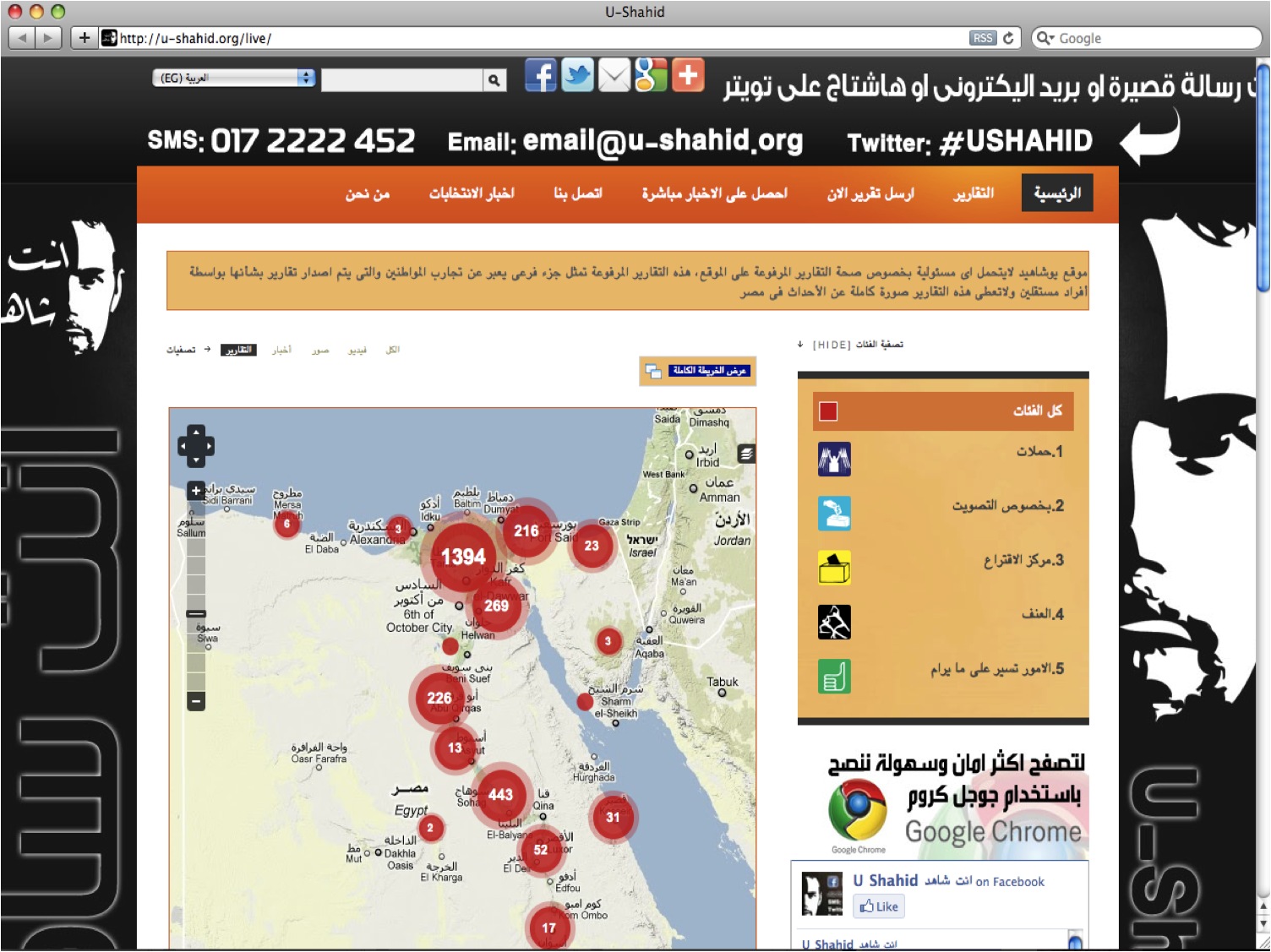
I’m excited to be nearing the completion of my dissertation research. As regular iRevolution readers will know, the second part of my dissertation is a qualitative and comparative analysis of the use of the Ushahidi platform in both Egypt and the Sudan. As part of this research, I am carrying out some content analysis of the reports mapped on U-Shahid and SudanVoteMonitor. The purpose of this blog post is to share my preliminary analysis of the 2,700 election monitoring reports published on U-Shahid during Egypt’s Parliamentary Elections in November & December 2010.

All of U-Shahid‘s reports are available in this Excel file. The reports were originally submitted in Arabic, so I’ve had them translated into English for my research. While I’ve spent a few hours combing through these reports, I’m sure that I didn’t pick up on all the interesting ones, so if any iRev readers do go through the data, I’d super grateful if you could let me know about any other interesting tid-bits you uncover.

Before I get to the content analysis, I should note that the Development and Institutionalization Support Center (DISC)—the Egyptian group based in Cairo that launched the U-Shahid project—used both crowdsourcing and “blogger-sourcing.” That is, the group trained some 130 bloggers and activists in five key cities around Egypt to monitor the elections and report their observations in real-time on the live map they set up. For the crowdsourced reports, DISC worked with a seasoned journalist from Thomson-Reuters to set up verification guidelines that allowed them to validate the vast majority of such reports.

My content analysis of the reports focused primarily on those that seemed to shed the most transparency on the elections and electoral campaigns. To this end, the analysis sought to pick up any trends or recurring patterns in the U-Shahid reports. The topics most frequently addressed in the reports included bribes for buying off votes, police closing off roads leading to polling centers, the destruction and falsification of election ballets, evidence of violence in specific locations, the closing of polling centers before the official time and blocking local election observers from entering polling centers.

What is perhaps most striking about the reports, however, are how specific they are and not only in terms of location, e.g., polling center. For example, reports that document the buying of votes often include the amount paid for the vote. This figure varied from 20 Egyptian Pounds (about $3) to 300 Egyptian Pounds (around $50). As to be expected, perhaps, the price increased through the election period, with one report citing that the bribe price at one location had gone from 40 Pounds to 100 over night.

Another report submitted on December 5, 2010 was even more specific: “Buying out votes in Al Manshiaya Province as following: 7:30[am] price of voter was 100 pound […]. At 12[pm] the price of voter was 250 pound, at 3 pm the price was 200 pound, at 5 pm the price was 300 pound for half an hour, and at 6 pm the price was 30 pound.” Another report revealed “bribe-fixing” by noting that votes ranged from 100-150 Pounds as a result of a “coalition between delegates to reduce the price in Ghirbal, Alexandria.” Other reports documented non-financial bribes, including mobile phones, food, gas and even “sex stimulators”, “Viagra” and “Tramadol tablets”.

Additional incidents mapped on the Ushahidi platform included reports of deliberate power cuts to prevent people from voting. As a result, one voter complained in “Al Saaida Zaniab election center: we could not find my name in voters lists, despite I voted in the same committee. Nobody helped to find my name on list because the electricity cut out.” In general, voters also complained about the lack of phosphoric ink for voting and the fact that they were not asked for their IDs to vote.

Reports also documented harassment and violence by thugs, often against Muslim Brotherhood candidates, the use of Quran verses in election speeches and the use of mini buses at polling centers to bus in people from the National Party. For example, one reported noted that “Oil Minister Samir Fahmy who is National nominee for Al Nassr City for Peoples Council uses his power to mobilize employees to vote for him. The employees used the companies buses carrying the nominee’ pictures to go to the election centers.” Several hundred reports included pictures and videos, some clearly documenting obvious election fraud. In contrast, however, there were also several reports that documented calm, “everything is ok” around certain voting centers.

In a future blog post, I’ll share the main findings from my interviews with the key Egyptian activists who were behind the U-Shahid project. In the meantime, if you choose to look through the election monitoring reports, please do let me know if you find anything else of interest, thank you!

Video: Changing the World, One Map at a Time

Hosted in the beautiful city of Berlin, Re:publica 2011 is Germany’s largest annual conference on blogs, new media and the digital society, drawing thousands of participants from across the world for three days of exciting conversations and presentations. The conference venue was truly a spectacular one and while conference presentations are typically limited to 10-20 minutes, the organizers gave us an hour to share our stories. So I’m posting the video of my presentation below for anyone interested in learning more about new media, crowdsourcing, crisis mapping, live maps, crisis response, civil resistance, digital activism and check-in’s. I draw on my experience with Ushahidi and the Standby Volunteer Task Force (SBTF) and share examples from Kenya, Haiti, Libya, Japan, the US and Egypt to illustrate how live maps can change the world. My slides are available on Slideshare here.

When the Network Bears Witness: From Photosynth to Allsynth?

I’ve blogged about Photosynth before and toyed around with the idea of an Allsynth platform, the convergence of multiple technologies and sensors for human rights monitoring and disaster response. The idea would be to “stitch” pictures and video footage together to reconstruct evidence in multi-media 3D type format. What if we could do this live and in networked way though?

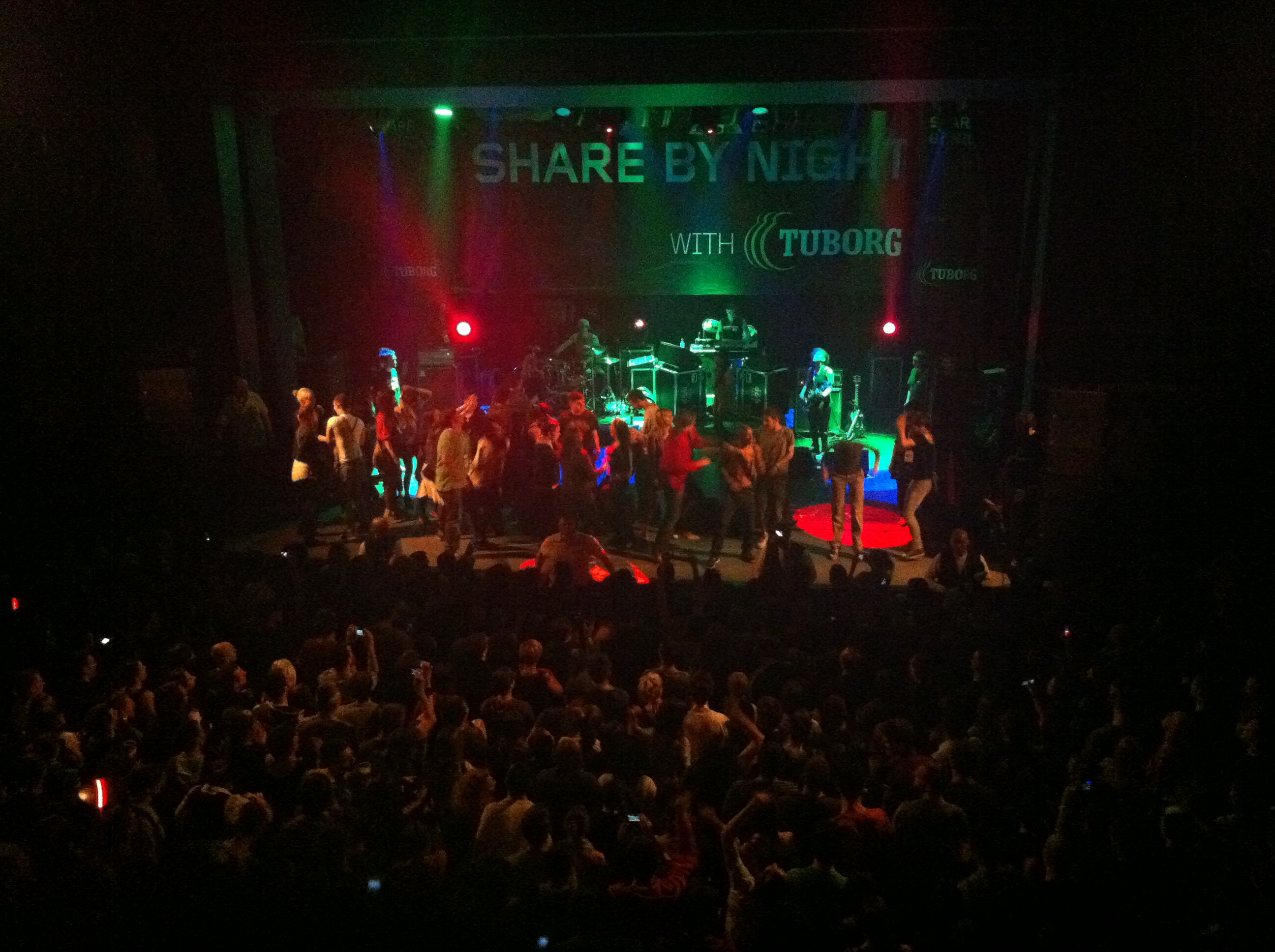
The thought popped into my head while at the Share Conference in Belgrade recently. The conference included a “Share by Night” track with concerts, live bands, etc., in the evenings. What caught my eye, one night, was not on stage but the dozens of smart phones being held up in the audience to capture the vibes, sounds, movements, etc on stage.

I then thought about that for a moment and the new start up, Color.com, that a colleague of mine co-founded. “Color creates new, dynamic social networks for your iPhone or Android wherever you go. It is meant to be used with other people right next to you who have the Color app on their smartphone. This way, you can take photos and videos together that everyone keeps.”

I was thinking about the concert and all zones bright screens. What if they were streaming live and networked? Meaning one could watch all the streaming videos from one website and pivot between different phones. Because the phones are geo-tagged, I’d be able to move closer to the stage, pivoting to phone users closer to the stage. Why need a film crew anymore? The phones in the audience become your cameras and you could even mix your own music video that way.

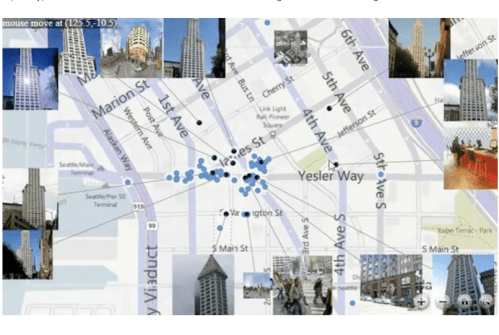
I’m at Where 2.0 today and Blaise Agüera y Arcas from Photosynth shared his most recent work, ReadWriteWorld, which he just announced today. “Technically it’s an index-ing, unification, and connection of the world’s geo-linked media. Informally, it’s the magic of:

  • Seeing your photos automatically connected to others;
  • Being able to simply create immersive experiences from your or your friends photos, videos, and panoramas;
  • “Fixing” the world, when the official imagery of your street is out of date;
  • Visually mapping your business, your favorite park, or your real estate for everyone to see;
  • Understanding the emergent information from the density and tagging of media.”
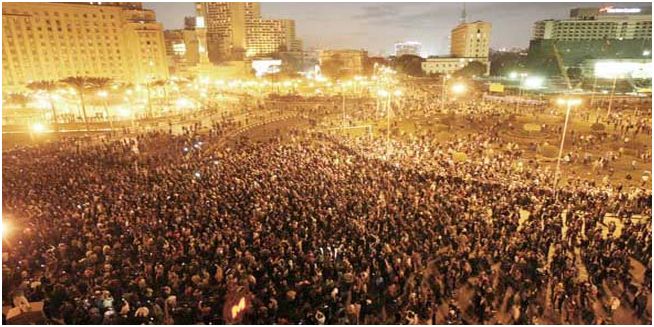
What if we applied this kind of networked, meshed technology to human rights monitoring or disaster response? Granted, most of the world does not own a smart phone. But that won’t always be the case. What if the hundreds of thousands of phones used in Tahrir Square were networked and streaming as if they were covering a concert?

 I don’t know the answer to that question, but I find the idea interesting.

An Open Letter to the Good People at Benetech

Dear Good People at Benetech,

We’re not quite sure why Benetech went out of their way in an effort to discredit ongoing research by the European Commission (EC) that analyzes SMS data crowdsourced during the disaster response to Haiti. Benetech’s area of expertise is in human rights (rather than disaster response), so why go after the EC’s findings, which had nothing to do with human rights?  To our fellow readers who desire context, feel free to read this blog postof mine along with these replies by Benetech’s CEO:

Issues with Crowdsourced Data Part 1
Issues with Crowdsourced Data Part 2

The short version of the debate is this: the EC’s exploratory study found that the spatial pattern of text messages from Mission 4636 in Haiti was positively correlated with building damage in Port-au-Prince. This would suggest that crowdsourced SMS data had statistical value in Haiti—in addition to their value in saving lives. But Benetech’s study shows a negative correlation. That’s basically it. If you’d like to read something a little more spicy though, do peruse this recent Fast Company article, fabulously entitled “How Benetech Slays Monsters with Megabytes and Math.” In any case, that’s the back-story.

So lets return to the Good People at Benetech. I thought I’d offer some of my humble guidance in case you feel threatened again in the future—I do hope you don’t mind and won’t take offense at my unsolicited and certainly imperfect advice. So by all means feel free to ignore everything that follows and focus on the more important work you do in the human rights space.

Next time Benetech wants to try and discredit the findings of a study in some other discipline, I recommend making sure that your own counter-findings are solid. In fact, I would suggest submitting your findings to a respected peer-reviewed journal—preferably one of the top tier scientific journals in your discipline. As you well know, after all, this really is the most objective and rigorous way to assess scientific work. Doing so would bring much more credibility to Benetech’s counter-findings than a couple blog posts.

My reasoning? Benetech prides itself (and rightly so) for carrying out some of the most advanced, cutting-edge quantitative research on patterns of human rights abuses. So if you want to discredit studies like the one carried out by the EC, I would have used this as an opportunity to publicly demonstrate the advanced expertise you have in quantitative analysis. But Benetech decided to use a simple non-spatial model to discredit the EC’s findings. Why use such a simplistic approach? Your response would have been more credible had you used statistical models for spatial point data instead. But granted, had you used more advanced models, you would have found evidence of a positive correlation. So you probably won’t want to read this next bit: a more elaborate “Tobit” correlation analysis actually shows the significance of SMS patterns as an explanatory variable in the spatial distribution of damaged buildings. Oh, and the correlation is (unfortunately) positive.

But that’s really beside the point. As my colleague Erik Hersman just wrote on the Ushahidi blog, one study alone is insufficient. What’s important is this: the last thing you want to do when trying to discredit a study in public is to come across as sloppy or as having ulterior motives (or both for that matter). Of course, you can’t control what other people think. If people find your response sloppy, then they may start asking whether the other methods you do use in your human rights analysis are properly peer-reviewed. They may start asking whether a strong empirical literature exists to back up your work and models. They may even want to know whether your expert statisticians have an accomplished track record and publish regularly in top-tier scientific journals. Other people may think you have ulterior motives and will believe this explains why you tried to discredit the EC’s preliminary findings. This doesn’t help your cause either. So it’s important to think through the implications of going public when trying to discredit someone’s research. Goodness knows I’ve made some poor calls myself on such matters in the past.

But lets take a step back for a moment. If you’re going to try and discredit research like the EC’s, please make sure you correctly represent the other side’s arguments. Skewing them or fabricating them is unlikely to make you very credible in the debate. For example, the EC study never concluded that Search and Rescue teams should only rely on SMS to save people’s lives. Furthermore, the EC study never claimed that using SMS is preferable over using established data on building density. It’s surely obvious—and you don’t need to demonstrate this statistically—to know that using a detailed map of building locations would provide a far better picture of potentially damaged buildings than crowdsourced SMS data. But what if this map is not available in a timely manner? As you may know, data layers of building density are not very common. Haiti was a good example of how difficult, expensive and time-consuming, the generation of such a detailed inventory is. The authors of the study simply wanted to test whether the SMS spatial pattern matched the damage analysis results, which it does. All they did was propose that SMS patterns could help in structuring the efforts needed for a detailed assessment, especially because SMS data can be received shortly after the event.

So to summarize, no one (I know) has ever claimed that crowdsourced data should replace established methods for information collection and analysis. This has never been an either or argument. And it won’t help your cause to turn it into a black-and-white debate because people familiar with these issues know full well that the world is more complex than the picture you are painting for them. They also know that people who take an either-or approach often do so when they have either run out of genuine arguments or had few to begin with. So none of this will make you look good. In sum, it’s important to (1) accurately reflect the other’s arguments, and (2) steer clear of creating an either-or, polarized debate. I know this isn’t easy to do, I’m guilty myself… on multiple counts.

I’ve got a few more suggestions—hope you don’t mind. They follow from the previous ones. The authors of the EC study never used their preliminary findings to extrapolate to other earthquakes, disasters or contexts. These findings were specific to the Haiti quake and the authors never claimed that their model was globally valid. So why did you extrapolate to human rights analysis when that was never the objective of the EC study? Regardless, this just doesn’t make you look good. I understand that Benetech’s focus is on human rights and not disaster response, but the EC study never sought to undermine your good work in the field of human rights. Indeed, the authors of the study hadn’t even heard of Benetech. So in the future, I would recommend not extrapolating findings from one study and assume they will hold in your own field of expertise or that they even threaten your area of expertise. That just doesn’t make any sense.

There are a few more tips I wanted to share with you. Everyone knows full well that crowdsourced data has important limitations—nobody denies this. But a number of us happen to think that some value can still be derived from crowdsourced data. Even Mr. Moreno-Ocampo, the head of the International Criminal Court (ICC), who I believe you know well, has pointed to the value of crowdsourced data from social media. In an interview with CNN last month, Mr. Moreno-Ocampo emphasized that Libya was the first time that the ICC was able to respond in real time to allegations of atrocities, partially due to social-networking sites such as Facebook. He added that, “this triggered a very quick reaction. The (United Nations) Security Council reacted in a few days; the U.N. General Assembly reacted in a few days. So, now because the court is up and running we can do this immediately,” he said. “I think Libya is a new world. How we manage the new challenge — that’s what we will see now.”

Point is, you can’t control the threats that will emerge or even prevent them, but you do control the way you decide to publicly respond to these threats. So I would recommend using your response as an opportunity to be constructive and demonstrate your good work rather than trying to discredit others and botching things up in the process.

But going back to the ICC and the bit in the Fast Company article about mathematics demonstrating the culpability of the Guatemalan government. Someone who has been following your work closely for years emailed me because they felt somewhat irked by all this. By the way, this is yet another unpleasant consequence of trying to publicly discredit others, new critics of your work will emerge. The critic in questions finds the claim a “little far fetched” re your mathematics demonstrating the culpability of the Guatemalan government. “There already was massive documented evidence of the culpability of the Guatemalan government in the mass killings of people. If there is a contribution from mathematics it is to estimate the number of victims who were never documented. So the idea is that documented cases are just a fraction of total cases and you can estimate the gap between the two. In order to do this estimation, you have to make a number of very strong assumptions, which means that the estimate may very well be unreliable anyway.”

Now, I personally think that’s not what you, Benetech, meant when you spoke with the journalist, cause goodness knows the number of errors that journalists have made writing about Haiti.

In any case, the critic had this to add: “In a court of law, this kind of estimation counts for little. In the latest trial at which Benetech presented their findings, this kind of evidence was specifically rejected. Benetech and others claim that in an earlier trial they nailed Milosevic. But Milosevic was never nailed in the first place—he died before judgment was passed and there was a definite feeling at the time that the trial wasn’t going well. In any case, in a court of law what matters are documented cases, not estimates, so this argument about estimates is really beside the point.”

Now I’m really no expert on any of these issues, so I have no opinion on this case or the statistics or the arguments involved. They may very well be completely wrong, for all I know. I’m not endorsing any of the above statements. I’m simply using them as an illustration of what might happen in the future if you don’t carefully plan your counter-argument before going public. People will take issue and try to discredit you in turn, which can be rather unpleasant.

In conclusion, I would like to remind the Good People at Benetech about what Ushahidi is and isn’t. The Ushahidi platform is not a methodology (as I have already written on iRevolution and the Ushahidi blog). The Ushahidi platform is a mapping tool. The methodology that people choose to use to collect information is entirely up to them. They can use random sampling, controlled surveys, crowdsourcing, or even the methodology used by Benetech. I wonder what the good people at Benetech would say if some of their data were to be visualized on an Ushahidi platform. Would they dismiss the crisis map altogether? And speaking of crisis maps, most Ushahidi maps are not crisis maps. The platform is used in a very wide variety of ways, even to map the best burgers in the US. Is Benetech also going to extrapolate the EC’s findings to burgers?

So to sum up, in case it’s not entirely clear, we know full well that there are important limitations to crowdsourced data in disaster response and have never said that the methodology of crowdsourcing should replace existing methodologies in the human rights space (or any other space for that matter). So please, lets not continue going in circles endlessly.

Now, where do we go from here? Well, I’ve never been a good pen pal, so don’t expect any more letters from me in response to the Good People at Benetech. I think everyone knows that a back and forth would be unproductive and largely a waste of time, not to mention an unnecessary distraction from the good work that we all try to do in the broader community to bring justice, voice and respect to marginalized communities.

Sincerely,

Information and Communication Technology in Areas of Limited Statehood: A New Form of Governance?

I recently had the distinct pleasure of participating in a fascination workshop on “Information and Communication Technology in Areas of Limited Statehood: A New Form of Governance?” The workshop was organized by the Frei Universität’s program on Governance in Areas of Limited Statehood and co-directed by Professors Gregor Walter-Drop and Steven Livingston. Update: the result of this meeting, and a follow up meeting in 2012 is a book on the topic to be published by Oxford University Press in 2013.

Throughout the workshop, I kept thinking back to one of my all time favorite books, James Scott’s “Seeing Like a State: How Certain Schemes to Improve the Human Condition Have Failed.”  But while I’ve been fully immersed in the field of crisis mapping since the early days (2007), I haven’t really taken the time to think through the deeper implications of these new tools with respect to governance and especially statehood.

My colleague Gregory Asmolov made the link explicit during his excellent presentation on “Russian Wildfires and Alternative Modes of Governance: The Role of Crowdsourcing in Areas of Limited Statehood.” Here’s a summary:

“Because of it’s geographical size, high degree of corruption, and reliance on an extraction economy, governance by government in Russia is often weak and ineffective. Russian political expert Liliya Shevtzova goes so far as to claim that the current regime is an imitation of governance. The 2010 wildfires demonstrated the limited capacity of the state to provide effective emergency response. Information technologies, and crowdsourcing platforms in particular, fulfill the gap of the limited statehood. At the same time, however, the Russian government is also trying to use ICT to increase its claims to effective governance.”

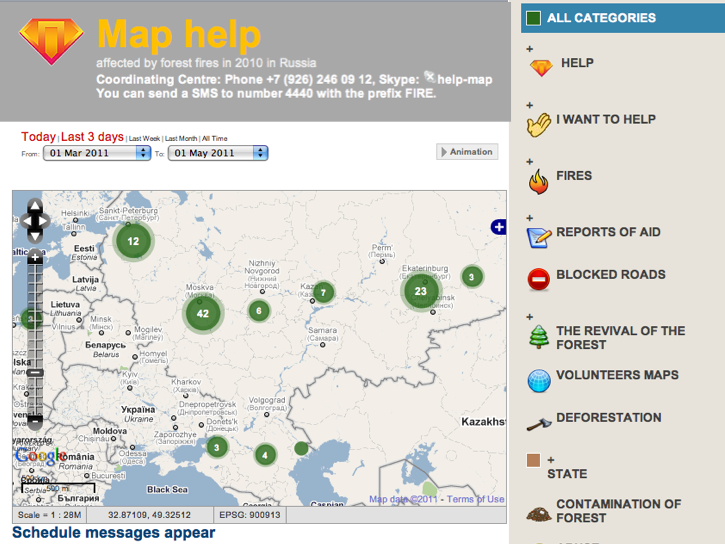
Gregory and his colleagues in Moscow used the Ushahidi platform to create a “Help Map” during the forest fires. They also set up a call center to facilitate communication between those who needed help and those who were offering it. While I knew this had been one of the most stunning examples of citizen-based crowdsourcing initiatives in Russia, I hadn’t thought through the deeper political implications. Not only were citizens helping themselves because of Russia’s limited statehood, they were actually taking over functions of the state, which the map made very explicit. Gregory noted that some Russian citizens even went out to buy firefighting equipment with their own money to combat the fires themselves. Many official fire stations didn’t even have basic equipment needed to respond. In some ways, these efforts laid bare and indeed exposed the Russian regime as an “imitation of governance.”

The Russian government apparently responded by setting up webcams around the country to show that it was in control and still able to monitor the situation. But as this cartoon shows (from Gregory’s presentation), many in Russia were not buying the pretense. See also this article from Christian Science Monitor that Gregory shared: “Russia’s YouTube Democracy is a Sham.

As James Scott notes in his book Seeing Like a State, “the legibility of a society provides the capacity for larger-scale social engineering, high-modernist ideology provides the desire, the authoritarian state provides the determination to act on that desire, and an incapacitated civil society provides the leveled social terrain on which to build.” By legibility, Scott means the ability of the state to index, search, understand and hence manipulate society. But unlike the past, and thanks to free mapping software and crowdsourcing, society is no longer as incapacitated as it used to be. Indeed, thanks to new free and open source mapping technologies, society is able to define it’s own legibility, the contours of which necessarily reveal the limits of statehood.

Moreover, as I have noted before, the resulting map is often not as profound as the social capital generated between the dozens, often hundreds, of people collaborating on a live crisis map. In turn, this social capital facilitates mass collective action. In other words, social capital is fungible. As Scott notes, “this transformative power resides not in the map, of course, but rather in the power possessed by those who deploy the perspective of that particular map.” In many ways, therefore, the Ushahidi platform is a social-capital and collective-action generating technology.

For more on the Russia Fires projects, I recommend the following links:

The political context of the project:

Disaster Relief 2.0: Between a Signac and a Picasso

The United Nations Foundation, Vodafone Foundation, OCHA and my “alma matter” the Harvard Humanitarian Initiative just launched an important report that seeks to chart the future of disaster response based on critical lessons learned from Haiti. The report, entitled “Disaster Relief 2.0: The Future of Information Sharing in Humanitarian Emergencies,” builds on a previous UN/Vodafone Foundation Report co-authored by Diane Coyle and myself just before the Haiti earthquake: “New Technologies in Emergencies and Conflict: The Role of Information and Social Networks.”

The authors of the new study begin with a warning: “this report sounds an alarm bell. If decision makers wish to have access to (near) real-time assessments of complex emergencies, they will need to figure out how to process information flows from many more thousands of individuals than the current system can handle.” In any given crisis, “everyone has a piece of information, everyone has a piece of that picture.” And more want to share their piece of the picture. So part of the new challenge lies in how to collect and combine multiple feeds of information such that the result paints a coherent and clear picture of an evolving crisis situation. What we need is a Signac, not a Picasso.

The former, Paul Signac, is known for using “pointillism,” a technique in which “small, distinct dots of pure color are applied in patterns to form an image.” Think of these dots as data points drawn from diverse pallets but combined to depict an appealing and consistent whole. In contrast, Pablo Picasso’s paintings from his Cubism and Surrealism period often resemble unfinished collages of fragmented objects. A Picasso gives the impression of impossible puzzle pieces in contrast to the single legible harmony of a Signac.

This Picasso effect, or “information fragmentation” as the humanitarian community calls it, was one of the core information management challenges that the humanitarian community faced in Haiti: “the division of data resources and analysis into silos that are difficult to aggregate, fuse, or otherwise reintegrate into composite pictures.” This plagued information management efforts between and within UN clusters, which made absorbing new and alternative sources of information–like crowdsourced SMS reports–even less possible.

These new information sources exist in part thanks to new players in the disaster response field, the so-called Volunteer Technical Communities (VTCs). This shift towards a more multi-polar system of humanitarian response brings both new opportunities and new challenges. One way to overcome “information fragmentation” and create a Signac is for humanitarian organizations and VTCs to work more closely together. Indeed, as “volunteer and technical communities continue to engage with humanitarian crises they will increasingly add to the information overload problem. Unless they can become part of the solution.” This is in large part why we launched the Standby Volunteer Task Force at the 2010 International Conference on Crisis Mapping (ICCM 2010): to avoid information overload by creating a common canvas and style between volunteer crisis mappers and the humanitarian community.

What is perhaps most striking about this new report is the fact that it went to press the same month that two of the largest crisis mapping operations since Haiti were launched, namely the Libya and Japan Crisis Maps. One could already write an entirely new UN/Vodafone Foundation Report on just the past 3 months of crisis mapping operations. The speed with which learning and adaptation is happening in some VTCs is truly astounding. As I noted in this earlier blog post, “Crisis Mapping Libya: This is no Haiti“, we have come a long way since the Haiti response. Indeed, lessons from last year have been identified, they have been learned and operationally applied by VTCs like the Task Force. The fact that OCHA formally requested activation of the Task Force to provide a live crisis map of Libya just months after the Task Force was launched is a clear indication that we are on the right track. This is no Picasso.

Referring to lessons learned in Haiti will continue to be important, but as my colleague Nigel Snoad has noted, Haiti represents an outlier in terms of disasters. We are already learning new lessons and implementing better practices in response to crises that couldn’t be more different than Haiti, e.g., crisis mapping hostile, non-permissive environments like Egypt, Sudan and Libya. In Japan, we are also learning how a more hierarchical society with a highly developed and media rich environment presents a different set of opportunities and challenges for crisis mapping. This is why VTCs will continue to be at the forefront of Disaster 2.0 and why reports like this one are so key: they clearly show that a Signac is well within our reach if we continue working together.

How To Use Technology To Counter Rumors During Crises: Anecdotes from Kyrgyzstan

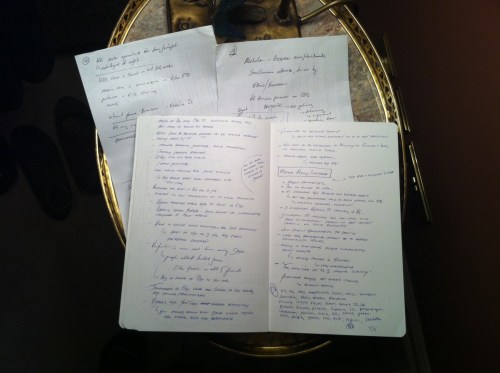
I just completed a short field mission to Kyrgyzstan with UN colleagues and I’m already looking forward to the next mission. Flipping through several dozen pages of my handwritten notes just now explains why: example after example of the astute resourcefulness and creative uses of information and communication technologies in Kyrgyzstan is inspiring. I learned heaps.

For example, one challenge that local groups faced during periods of ethnic tension and violent conflict last year was the spread of rumors, particularly via SMS. These deliberate rumors ranged from humanitarian aid being poisoned to cross border attacks carried out by a particular ethnic group. But many civil society groups were able to verify these rumors in near real-time using Skype.

When word of the conflict spread, the director of one such groups got online and invited her friends and colleagues to a dedicate Skype chat group. Within two hours, some 2,000 people across the country had joined the chat group with more knocking but the group had reached the maximum capacity allowed by Skype. (They subsequently migrated to a web-based platform to continue the real-time filtering of information from around the country).

The Skype chat was abuzz with people sharing and validating information in near real-time. When someone got wind of a rumor, they’d simply jump on Skype and ask if anyone could verify. This method proved incredibly effective. Why? Because members of this Skype group constituted a relevant, trusted and geographically distributed network. A person would only add a colleague or two to the chat if they knew who this individual was, could vouch for them and believed that they had—or could have—important information to contribute given their location and/or contacts. (This reminded me of Gmail back in the day when you only had a certain number of invites, so one tended to chose carefully how to “spend” those invites).

The degrees of separation needed to verify a rumor was close to one. In the case of the supposed border attack, one member of the chat group had a contact with the army unit guarding the border crossing in question. They called them on their cell phone and confirmed within minutes that no attack was taking place. As for the rumor about the poisoned humanitarian aid, another member of the chat found the original phone numbers from which these false SMS’s were being sent. They called a personal contact at one of the telecommunication companies and asked whether the owners of these phones were in fact texting from the place where the aid was reportedly poisoned; they weren’t. Meanwhile, another member of the chat group had himself investigated the rumor in person and confirmed that the text messages were false.

This Skype detective network proved an effective method for the early detection and response to rumors. Once a rumor was identified as such, 2,000 people could share that information with their own networks within minutes. In addition, members of this Skype group were able to ping their media contacts and have the word spread even further. In at least two cases and in two different cities, telecommunication companies also collaborated by sending out broadcast SMS to notify subscribers about the false rumors.

I wonder if this model can be further improved on and replicated. Any thoughts from iRevolution readers would be most welcome.

Can Live Crisis Maps Help Prevent Mass Atrocities?

Live crisis maps tell stories, hopefully compelling stories the last chapters of which have yet to be written. To paraphrase my New York Times colleague Anand Giridharadas: They used to say that history is written by the victors. But today, before the victors win, if they win, there is a chance to scream out with a text message, a text message that will not vanish, a text message that will remain immortalized on a map for the world to bear witness. What would we know about what passed between Turks and Armenians, Germans and Jews, Hutus and Tutsis, if every one of them had had the chance, before the darkness, to declare for all time: “I was here, and this is what happened to me”?

Anand recently sat down with Elie Wiesel to talk about the power of bearing witness. “If one idea has animated Mr. Wiesel’s life, it is that of the power of memory: memory gives culture, he likes to say; memories spoken and shared can prevent remembered tragedies from recurring.”

This afternoon, I sat down with someone who recounted to me in graphic detail the absolute horrors he witnessed during weeks of relentless violence in Central Asia less than a year ago. Survivors uploaded their videos and pictures of the targeted violence but they did so weeks after the murders and uploaded them on several different websites, making the aggregation of evidence difficult. The international media remained unresponsive which hampered advocacy efforts. The remaining survivors were so desperate for attention that they even painted SOS in large letters on nearby roads in hopes that passing helicopters or airplanes would come to the rescue. But help from the skies above never came.

Would a live crisis map have made a difference? Would a single, public repos-itory of geo-referenced evidence mapped in real-time and multi-media format have mattered?  There are of course those who still ask, “What’s the point of putting dots on a map? How’s that supposed to change anything?” As my Ushahidi colleague Brian Herbert likes to respond, “Well then, what’s the point of having words on a page, huh? How are words going to change anything?” They say that the pen is mightier than the sword. Can the live crisis map be even mightier than the pen? If a picture is worth a 1,000 words, what is a live map worth? Will all live maps have the desired impact? Of course not, just like not every letter or book ever written has had significant impact.

But some live crisis maps may create unprecedented pressure to respond in a more timely manner. As my colleague Olga Werby recently noted,

“Mr. Moreno-Ocampo, the ICC [International Criminal Court] Prosecutor, sited Facebook and other social media as key influence in ICC taking action in Libya: ‘[Facebook and social-networking] triggered a very quick reaction. The [United Nations] Security Council reacted in a few days; the U.N. General Assembly reacted in a few days. So, now because the court is up and running we can do this immediately,’ he said. ‘I think Libya is a new world. How we manage the new challenge—that’s what we will see now.” (CNN World News article: “Gadhafi faces investigation for crimes against humanity” by Atika Shubert (watch the video at 1:40), published on March 3, 2011.) Mr. Moreno-Ocampo talks about sea-change in the world’s reaction time to crisis due to the effects of ICT!”

In his recent piece on “The Political Power of Social Media“, Clay Shirky noted that access to conversation is more important, politically, than access to information. He writes that change in behavior does not come from mass media alone. Rather, it is a two-step process where the second, social step, stems from the conversations that happen between family, friends and colleagues about new information related by the media. This is when political change becomes possible. I have witnessed first hand how crisis maps catalyze conversations and prompt questions about the patterns that materialize on the maps, the actions of a government or secret police, the reasons for the status-quo, etc.

After his conversation with Elie Wiesel, Anand wrote the following:

“The debate has tended to dwell on the question of whether all this overseas digital mirroring of a crisis, especially when the Internet is inaccessible or censored in the nation in crisis, is of any use to those on the ground. But what is often missing from the debate is the idea of bearing witness: the notion, as Mr. Wiesel, a survivor of the Auschwitz and Buchenwald concen- tration camps and a Nobel Peace Prize laureate, once put it, that an experience like the one he endured ‘cannot stay with me alone. It must be opened, it must become an offering, it must be deepened and given and shared.’ Today, at age 82, he is a trace removed from the latest technology trends, but he was more vigorous than many half his age in seeing a place for technology in tragedy. It is partly that the sufferings of others are available to much of the world in real time today, he said, and partly that the multiplication of avenues to publish and to access what others publish makes people less confined to particular sources:

‘Since they come from a variety of sources, from a variety of people, representing all ideologies and all sensitivities, we know. We cannot not know,’ Mr. Wiesel said.  ‘Whether you want it or not,’ he added a moment later, ‘we are witnesses.’ Because of technology, and because of the progress made in technology, especially in the field of communication, no one has any excuse anymore to say, ‘I don’t know; I didn’t know; I wasn’t aware’.”

After listening to the horrors that happened in Central Asia, I reached for my laptop and turned to the live Crisis Map of Libya. The person who had just recounted some of the atrocities he had witnessed had never seen a map quite like this one nor heard of Ushahidi. I explained to him the range of possible features and the different ways that people around the world have used the mapping platform over the past three years.

I felt some hope from my interlocutor, he was excited but I could tell that—like myself—he was also trying not to get his hopes too high. But there are definitely grounds for hope. He said something like this had never been tried in his part of the world before. Will it work? There’s only one way to find out. The last chapters of this story have yet to be written.

The Volunteers Behind the Libya Crisis Map: A True Story

My colleague Clay Shirky calls it “Cognitive Surplus” in his recent book. Don Tapscott and Anthony Williams refer to it as “MacroWikinomics” in theirs. What is cognitive surplus? The trillion hours of free time enjoyed by the world’s educated population every year. Don and Tony describe MacroWikinomics as mass distributed collaboration on scales we’ve never seen before thanks to technology. We’re familiar with deficits and shortages, writes, Clay, but when it comes to surplus social capital, things quickly become unpredictable—especially when this capital scales thanks to the use of social networking platforms and Web 2.0 technologies. But then again, says Clay, “Many of the unexpected uses of communication tools are surprising because our old beliefs about human nature were so lousy.”

We saw cognitive surplus and macrowikinomics in action in the wake of the Haiti earthquake when more than a thousand Creole-speaking volunteers in no fewer than 49 countries around the world contributed thousands of hours of their own free time to translate tens of thousands of text messages coming from the disaster-affected population in Haiti. The map above depicts the location of each digital volunteer based on their ISP address.

As I noted in my talk at PopTech last year, it was an emotional reaction to the breaking news on CNN that prompted me to call my colleague David Kobia at Ushahidi to launch a crisis map of Haiti. But it was access to social networks, cognitive surplus, free social networking and easy mapping tools that translated that initially private, emotional reaction into public, collective action. And this was by no means a one-off, as I recently noted in my blog post on Changing the World One Map at a Time.

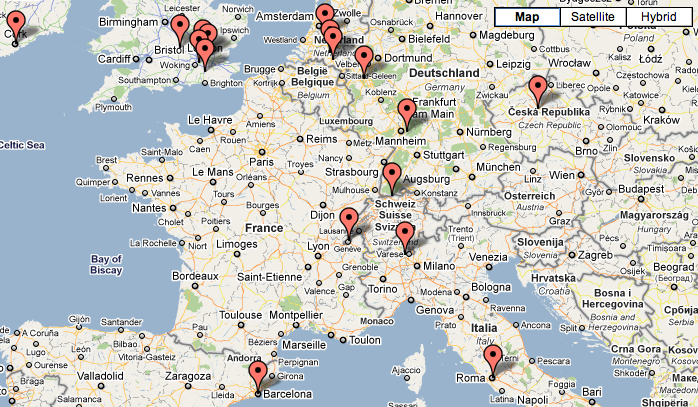
The Standby Task Force volunteers behind the Libya crisis map have been equally inspiring. They come from diverse backgrounds and live in some 30 countries. The map above doesn’t (yet) include all the 220+ Task Force volunteers, but it  gives you an idea of just how global this initiative is.

Just yesterday, I found out that one volunteer is an airside manager at Heathrow airport in charge of real-time crisis management and incident control. He jumps on Skype to help out on the Libya crisis map after the last aircraft have taken off around midnight. Another is 63 and was part of an initial group that put the pieces together leading to the modern tour business of rock and roll concerts back in the 1970s. He did the setup for the Simon & Garfunkle tour in the early 80s. A third volunteer brings 16 years of disaster management experience to the Task Force and has lead a number of international search & rescue teams around the world. I could go on, and on—there are more than 200 of such profiles!

It’s also great to see that the Task Force is nowhere close to just being a “Global North” initiative. We have volunteers from (or based in) Haiti, Ghana, Egypt, Sudan, United Arab Emirates, Tajikistan, Sri Lanka, Singapore, Australia, Samoa, Colombia and Brazil. And this is again just a subset.

These volunteers have accomplished so much over the past 7 days. An hour after UN/OCHA requested activation of the Task Force, the Tech Team launched the technical platform for the crisis map using Ushahidi, which they’ve been customizing (front-end and back-end) every day since. They launched a second map for the public just days later and in the first 3 days of that launch, the site received 18,000+ unique visitors and 44,000+ pageviews from 65 countries.

The Media Monitoring Team, Geolocation Team, Reports Team and Verification Team have mapped some 500 individual reports in just 7 days. They’ve been monitoring over 70 individual online sources almost around the clock for relevant content that can be added to the map. The Geolocation Team has found GPS coordinates for all the reports that end up on the map thanks to the Reports Team. The Analysis Team has produced a number of important heat maps and trends analysis reports for OCHA. The Verification Team has been providing quality control for the mapped data and triangulating reports whenever possible.

Meanwhile, the Task Team has focused on two core and urgent research projects solicited by the UN to improve the crisis map and their preparedness operations. The Humanitarian Liaison Team is composed of Task Force coordinators and representatives from the UN and other humanitarian groups. They facilitate communication between the teams listed above and our humanitarian partners. Between them, all of these teams have written over 1,200 Word document pages, font size 10, based on their exchanges on the Skype—again in just 7 days. Did I mention that these are all volunteers contributing their own “cognitive surplus” above and beyond their current jobs, classes, family lives?

It’s incredible to think that the Task Force only launched last October. And it’s only going to keep getting better, keep growing. Indeed, we’re now in touch with the coordinators of the United Nations Volunteer (UNV) program after I suggested to the UN in a phone conversation and my previous blog post that we tap into that resource to scale the Task Force’s support for Libya and beyond. It turns out the UN has an Online Volunteers Service (OVS) website!

According to our contacts at OVS,

“Many NGOs, governments and United Nations agencies already recognize the value of online volunteering, their satisfaction with the collaboration with online volunteers runs at 90%.  In 2010, our three person OVS staff team mobilized 10,000 online volunteers from 168 countries who completed 15,000 assignments, amongst them online volunteers who supported UN OCHA Colombia in the area of disaster related data gathering and management.”

To say I’m super, super excited about this potential collaboration would be an understatement. In fact, I always grin when writing the following to recruit new volunteers: “So, you want to be a Crisis Mapper?” Totally stealing Yoda’s line from StarWars when he asks young Luke Skywalker: “So, you want to be a Jedi, hmmmm?” For me, today’s Jedis are definitely the crisis mappers I work with on the Task Force. So as I’m fond of saying:

“May the Crowd be with you, always.”