Category Archives: Digital Activism

Time-Critical Crowdsourcing for Social Mobilization and Crowd-Solving

My good friend Riley Crane just co-authored a very interesting study entitled “Time-Critical Social Mobilization” in the peer-reviewed journal Science. Riley spearheaded the team at MIT that won the DARPA Red Balloon competition last year. His team found the locations of all 10 weather balloons hidden around the continental US in under 9 hours. While we were already discussing alternative approaches to crowdsourcing for social impact before the competition, the approach he designed to win the competition certainly gave us a whole lot more to talk about given the work I’d been doing on crowd sourcing crisis information and near real-time crisis mapping.

Crowd-solving non-trivial problems in quasi real-time poses two important challenges. A very large number of participants is typically required couple with extremely fast execution. Another common challenge is the need for some sort of search process. “For example, search may be conducted by members of the mobilized community for survivors after a natural disaster.” Recruiting large numbers of participants, however, requires that individuals be motivated to actually conduct the search and participate in the information diffusion. Clearly, “providing appropriate incentives is a key challenge in social mobilization.”

This explains the rationale behind DARPA decision to launch their Red Balloon Challenge: “to explore the roles the Internet and social networking play in the timely communication, wide-area team-building, and urgent mobilization required to solve broad-scope, time-critical problems.” So 10 red weather balloons were discretely placed at different locations in the continental US. A senior analyst at the National Geospatial-Intelligence Agency is said to have characterized the challenge is impossible for conventional intelligence-gathering methods. Riley’s team found all 10 balloons in 8 hours and 36 minutes. How did they do it?

Some 36 hours before the start of the challenge, the team at MIT had already recruited over 4,000 participants using a “recursive incentive mechanism.” They used the $40,000 prize money that would be awarded by the winners of the challenge as a “financial incentive structure rewarding not only the people who correctly located the balloons but also those connecting the finder [back to the MIT team].” If Riley and colleagues won:

we would allocate $4000 in prize money to each of the 10 balloons. We promised $2000 per balloon to the first person to send in the cor- rect balloon coordinates. We promised $1000 to the person who invited that balloon finder onto the team, $500 to whoever invited the in- viter, $250 to whoever invited that person, and so on. The underlying structure of the “recursive incentive” was that whenever a person received prize money for any reason, the person who in- vited them would also receive money equal to half that awarded to their invitee

In other words, the reward offers by Team MIT “scales with the size of the entire recruitment tree (because larger trees are more likely to succeed), rather than depending solely on the immediate recruited friends.” What is stunning about Riley et al.’s approach is that their “attrition rate” was almost half the rate of other comparable social network experiments. In other words, participants in the MIT recruitment tree were about twice as likely to “play the game” so-to-speak rather than give up. In addition, the number recruited by each individual followed a power law distribution, which suggests a possible tipping point dynamic.

In conclusion, the mechanism devised by the winning team “simultaneously provides incentives for participation and for recruiting more individuals to the cause.” So what insights does this study provide vis-a-vis live crisis mapping initiatives that are volunteer-based, like those spearheaded by the Standby Volunteer Task Force (SBTF) and the Humanitarian OpenStreetMap (HOT) communities? While these networks don’t have any funding to pay volunteers (this would go against the spirit of volunteerism in any case), I think a number of insights can nevertheless be drawn.

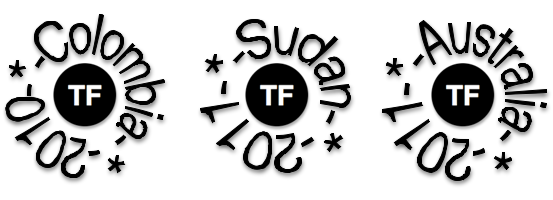
In the volunteer sector, the “currency of exchange” is credit. That is, the knowledge and acknowledgement that I participated in the Libya Crisis Map to support the UN’s humanitarian operations, for example. I recently introduced SBTF “deployment badges” to serve in part the public acknowledgment incentive. SBTF volunteers can now add badges for deployments there were engaged in, e.g., “Sudan 2011”; “New Zealand 2011”, etc.
What about using a recursive credit mechanism? For example, it would be ideal if volunteers could find out how a given report they worked on was ultimately used by a humanitarian colleague monitoring a live map. Using the Red Balloon analogy, the person who finds the balloon should be able to reward all those in her “recruitment tree” or in our case “SBTF network”. Lets say Helena works for the UN and used the Libya Crisis Map whilst in Tripoli. She finds an important report on the map and shares this with her colleagues on the Tunisian border who decide to take some kind of action as a result. Now lets say this report came from a tweet that Chrissy in the Media Monitoring Team found while volunteering on the deployment. She shared the tweet with Jess in the GPS Team who found the coordinates for the location referred to in that tweet. Melissa then added this to the live map being monitored by the UN. Wouldn’t be be ideal if each could be sent an email letting them know about Helena’s response? I realize this isn’t trivial to implement but what would have to be in place to make something like this actually happen? Any thoughts?

On the recruitment side, we haven’t really done anything explicitly to incentivize current volunteers to recruit additional volunteers. Could we incentivize this beyond giving credit? Perhaps we could design a game-like point system? Or a fun ranking system with different titles assigned according to the number of volunteers recruited? Another thought would be to simply ask existing volunteers to recruit one or two additional volunteers every year. We currently have about 700 volunteers in the SBTF, so this might be one way to increase substantially in size.

I’m not sure what type of mechanism we could devise to simultaneously provide incentives for participation and recruitment. Perhaps those incentives already exist, in the sense that the SBTF response to international crises, which perhaps serves as a sufficient draw. I’d love to hear what iRevolution readers think, especially if you have good ideas that we could realistically implement!
Amplifying Somali Voices Using SMS and a Live Map

Update: http://irevolution.net/2011/12/08/somaliaspeaks

I recently had the pleasure to meet with Al-Jazeera’s Social Media Team in Doha, Qatar. It was immediately clear that they were also interested in partnering on a joint project in Somalia when I suggested a few ideas. Several weeks later, this project is almost ready to launch. The purpose of this initiative is to let Somalis speak for themselves and to amplify those voices in the international media.

As Al-Jazeera has noted, Somalia is quickly slipping from global media attention. With Somalia out of the headline news, however, advocacy and lobbying groups will find it increasingly difficult to place pressure on policymakers and humanitarian organiza-tions to scale their intervention in this major crisis. This project therefore offers a direct and innovative way to keep Somalia in the international news. The project described below is the product of a novel collaborative effort between Al-Jazeera, Ushahidi, Souktel and Crowdflower in direct partnership with the Somali Diaspora.

The project will “interview” ordinary Somalis in Somalia and let them speak for themselves in the international media space. Interview questions drafted by Al-Jazeera will be broadcast via SMS by Souktel to 10% of their existing 50,000+ subscribers in the country. The interview questions will also invite Somalis to share in which town they are based. (Note that we are reviewing the security protocols for this). The Somali Diaspora will then translate and geolocate incoming text messages from Somali to English using a customized Crowdflower plugin. The processed messages will then be pushed (in both Somali and English) to a live Ushahidi map. Al-Jazeera will promote the live map across their main-stream and social media channels. Mapped SMS’s will each have a comments section for viewers and readers to share their thoughts. Al-Jazeera will then select the most compelling responses and text these back to the original senders in Somalia. This approach is replicable and scalable given that the partners and technologies are largely in place already.

In sum, the purpose of this project is to increase global media attention on Somalia by letting Somali voices take center stage—voices that are otherwise not heard in the international, mainstream media. If journalists are not going to speak about Somalia, then lets invite Somalis speak to the world themselves. The project will highlight these voices on a live, public map for the world to engage in a global conversation with the people of Somalia, a conversation in which Somalis and the Diaspora are themselves at the centerfold.

If you want to help out with this initiative, we’re looking for Somali-English speakers to translate and map the incoming text messages. It’s important that volunteers are familiar with the location of many cities, towns, etc., in Somalia in order to map the SMS’s. If you have the skills and time, then please add your name, email address and short bio here—would be great to have you on the team!


Crisis Mapping Analysis of London Riots 2011

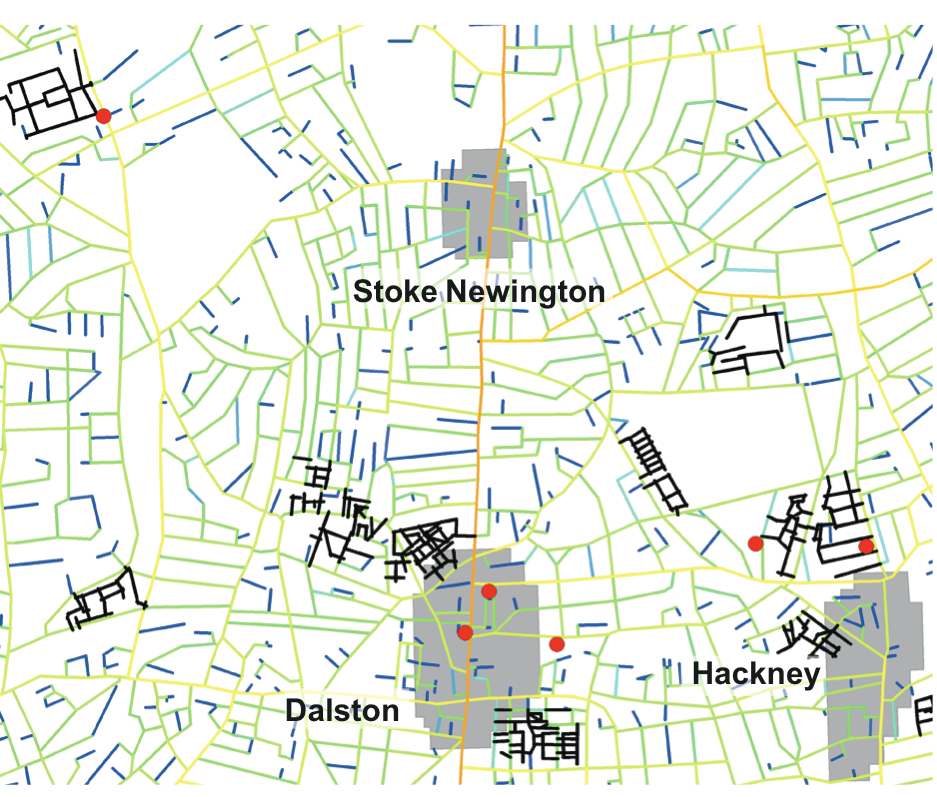
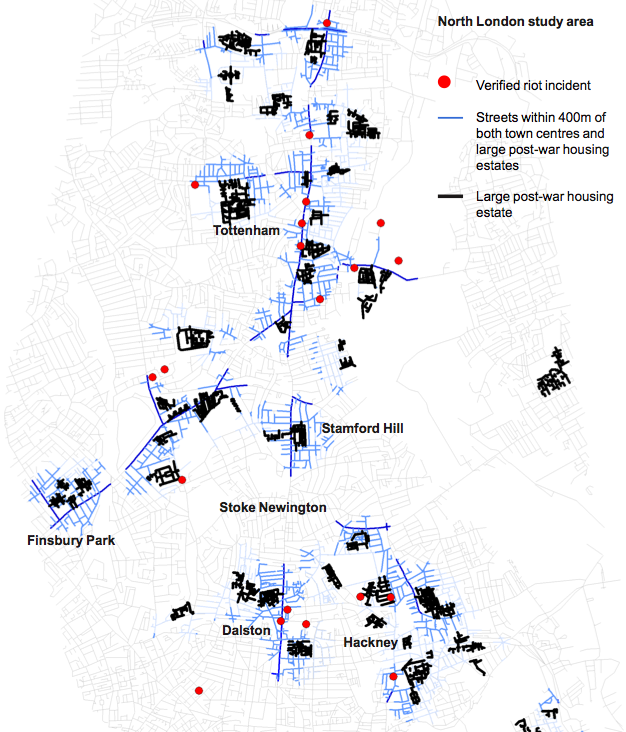
My colleague Adam White from GroupShot just shared an interesting location analysis study of the recent London riots. The study was carried out by the group Space Syntax and is available here (PDF). The purpose of the study was to test whether the overly complex spatial layout of large post-war housing estates has “an effect on social patterns, often leading to social malaise and anti-social behavior.” While the study’s methods are interesting, I’m concerned about some of the underlying socio-economic assumptions that buttress the analysis.

According to the study, 84% of verified incidents in north London and 96% in south London took place within a five minute walk—400 meters—of both: 1) An established town centre, and 2) a large post-war housing estate. Meanwhile, local centres without large post-war estates nearby were unaffected.

The study makes some interesting assumptions, e.g., “most post-war housing estates have been designed in such a way that they create over-complex, and as a result, under-used spaces. These spaces are populated by large groups of unsupervised children and teenagers, where peer socialisation can occur between them without the influence of adults. This pattern of activity, and the segregation of user groups, is not found in non-estate street networks. Our analysis of court records shows that the majority of convicted rioters in the study areas live on large post-war housing estates.”

The reason I’m uncomfortable with the above has to do with the implied solution, i.e., simplify the complex spaces and bring more social traffic to under-utilized areas. This will ensure that children and teenagers are more supervised and prevent peer socialization from taking place without the influence of adults. In other words, simply replace the “hardware” so the “social software” won’t have any more bugs. Snap, if only Mubarak could have hacked Tahrir Square before the revolution. Sarcasm aside, there were some real and legitimate grievances that motivated some of the protestors in England (and Egypt), which this study doesn’t address.

The next version of the analysis is supposed to include socio-economic data to understand the relationship between deprivation and rioting, which in my mind should have come first. But better late than never. In the meantime, here is a post on the tactical use of technology for nonviolent protests with a reference to London: “Maps, Activism and Technology: Check-In’s with a Purpose.”

Theorizing Ushahidi: An Academic Treatise

[This is an excerpt taken from Chapter 1 of my dissertation]

Activists are not only turning to social media to document unfolding events, they are increasingly mapping these events for the world to bear witness. We’ve seen this happen in Tunisia, Egypt, Libya, Syria, Yemen and beyond. My colleague Alexey Sidorenko describes this new phenomenon as a “mapping reflex.” When student activists from Khartoum got in touch earlier this year, they specifically asked for a map, one that would display their pro-democracy protests and the government crackdown. Why? They wanted the world to see that the Arab Spring extended to the Sudan.

The Ushahidi platform is increasingly used to map information generated by crowds in near-real time like the picture depicted above. Why is this important? Because live public maps can help synchronize shared awareness, an important catalyzing factor of social movements, according to Jürgen Habermas. Recall Habermas’s treatise that “those who take on the tools of open expression become a public, and the presence of a synchronized public increasingly constrains un-democratic rulers while expanding the right of that public.”

Sophisticated political maps have been around for hundreds of years. But the maps of yesteryear, like the books of old, were created and controlled by the few. While history used to be written by the victors, today, journalists like my colleague Anand Giridharadas from the New York Times are asking whether the triangulated crisis map will become the new first draft of history. In the field of geography and cartography, some refer to this new wave of democratized map-making as “neo-geography.” But this new type of geography is not only radically different from traditional approaches because it is user-generated and more par-ticipatory; the fact that today’s dynamic maps can also be updated and shared in near real-time opens up an entire new world of possibilities and responses.

Having a real time map is almost as good as having your own helicopter. A live map provides immediate situational awareness, a third dimension and additional perspective on events unfolding in time and space. Moreover, creating a map catalyzes conversations between activists, raises questions about geographic patterns or new incidents, and leads to more questions regarding the status quo in a repressive environment. To be sure, mass media alone does not change people’s minds.  Recall that political change is a two-step process, with the second—social step—being where political opinions are formed (Katz and Lazarsfeld 1955). “This is the step in which the Internet in general, and social media in particular, can make a difference” (Shirky 2010). In addition, the collaboration that takes place when creating a live map can also reinforce weak and strong ties, both of which are important for civil resistance.

The Ushahidi platform enables a form of live-mapped “sousveillance,” which refers to the recording of an activity using portable personal technologies. In many respects, however, the use of Ushahidi goes beyond sousveillance in that it generates the possibility of “dataveillance” and a possible reversal of Bentham’s panopticon. “With postmodernity, the panopticon has been informationalized; what once was organized around hierarchical observation is now organized through decoding and recoding of information” (Lyon 2006). In Seeing Like a State, James Scott argues eloquently that this process of decoding and recoding was for centuries the sole privilege of the State. In contrast, the Ushahidi platform provides a participatory digital canvas for the public decoding, recoding of information and synchronization of said information. In other words, the platform serves to democratize dataveillance by crowdsourcing what was once the exclusive realm of the “security-informational complex.”

In Domination and the Arts of Resistance: Hidden Transcripts published in 1990, James Scott distinguishes between public and hidden transcripts. The former describes the open, public interactions that take place between domina-tors and oppressed while hidden transcripts relate to the critique of power that “goes on offstage” and which the power elites cannot decode. This hidden transcript is comprised of the second step, social conversations, that Katz and Lazarsfeld (1955) argue ultimately change political behavior. Scott writes that when the oppressed classes publicize this “hidden transcript”, they become conscious of its common status. Borrowing from Habermas, the oppressed thereby become a public and more importantly a synchronized public. In many ways, the Ushahidi platform is a vehicle by which the hidden transcript is collectively published and used to create shared awareness—thereby threatening to alter the balance of power between the oppressors and oppressed.

The new dynamics that are enabled by “liberation technologies” like Ushahidi may enable a different form of democracy, one which arising from “the inability of electoral/representative politics to keep it promises [has thus] led to the development of indirect forms of democracy” (Rosanvallon 2008). More specifically, Rosanvallon indentifies three channels whereby civil society can hold the state accountable not just during elections but also between elections and independent of their results. “The first refers to the various means whereby citizens (or, more accurately, organizations of citizens) are able to monitor and publicize the behavior of elected and appointed rulers; the second to their capacity to mobilize resistance to specific policies, either before or after they have been selected; the third to the trend toward ‘juridification’ of politics  [cf. dataveillance] when individuals or social groups use the courts and, especially, jury trials to bring delinquent politicians to judgment” (Schmitter 2008, PDF).

These three phases correspond surprisingly well with the three waves of Ushahidi uses witnessed over the past three years. The first wave was reactive and documentary focused. The second was more pro-active and focused on action beyond documentation while the third seeks to capitalize on the first two to complete the rebalancing of power. Perhaps this final wave is the teleological purpose of the Ushahidi platform or What Technology Wants as per Kevin Kelly’s treatise. However, this third wave, the trend toward the “juridificaiton” of democracy bolstered by crowdsourced evidence that is live-mapped on a public Ushahidi platform, is today more a timid ripple than a tsunami of change reversing the all-seeing “panopticon”. A considerable amount of learning-by-doing remains to be done by those who wish to use the Ushahidi platform for impact beyond the first two phases of Rosanvallon’s democracy.

The Standby Volunteer Task Force: One Year On

The Standby Volunteer Task Force (SBTF) was launched exactly a year ago tomorrow and what a ride it has been! It was on September 26, 2010, that I published the blog post below to begin rallying the first volunteers to the cause.

The first blog post announcing the SBTF

Some three hundred and sixty plus days later, no fewer than 621 volunteers have joined the SBTF. These amazing individuals are based in the following sixty plus countries, including: Afghanistan, Algeria, Argentina, Armenia, Australia, Belgium, Brazil, Canada, Chile, Colombia, Czech Republic, Denmark, Egypt, Finland, France, Germany, Ghana, Greece, Guam, Guatemala, Haiti, Hungary, India, Indonesia, Iran, Ireland, Israel, Italy, Japan, Jordan, Kenya, Republic of South Korea, Lebanon, Liberia, Libya, Mexico, Morocco, Nepal, Netherlands, New Zealand, Nigeria, Pakistan, Palestine, Peru, Philippines, Poland, Portugal, Senegal, Serbia, Singapore, Slovenia, Somalia, South Africa, Spain, Sudan, Switzerland, Tajikistan, Trinidad and Tobago, Tunisia, Turkey, Uganda, United Kingdom, United States and Venezuela.

Most members have added themselves to the SBTF map below.

Between them, members of the SBTF represent several hundred organizations, including the American Red Cross, the American University in Cairo, Australia’s National University, Bertelsmann Foundation, Briceland Volunteer Fire Department, Brussels School of International Studies, Carter Center, Columbia University, Crisis Commons, Deloitte Consulting, Engineers without Borders, European Commission Joint Research Center, Fairfax County International Search & Rescue Team, Fire Department of NYC, Fletcher School, GIS Corps, Global Voices Online, Google, Government of Ontario, Grameen Development Services, Habitat for Humanity, Harvard Humanitarian Initiative, International Labor Organization, International Organization for Migration, John Carroll University, Johns Hopkins University, Lewis and Clark College, Lund University, Mercy Corps, Ministry of Agriculture and Forestry of New Zealand, Medecins Sans Frontieres, NASA, National Emergency Management Association, National Institute for Urban Search and Rescue, Nethope, New York University, OCHA, Open Geospatial Consortium, OpenStreetMap, OSCE, Pan American Health Organization, Portuguese Red Cross, Sahana Software Foundation, Save the Children, Sciences Po Paris, Skoll Foundation, School of Oriental and African Studies, Tallinn University, Tech Change, Tulane University, UC Berkeley,  UN Volunteers, UNAIDS, UNDP Bangladesh, University of Algiers, University of Colorado, University of Portsmouth, UNOPS, Ushahidi-Liberia, WHO, World Bank and Yale University.

Over the past twelve months, major SBTF deployments have included the Colombia Disaster Simulation with UN OCHA Colombia, Sudan Vote Monitor, Cyclone Yasi, Christchurch Earthquake, Libya Crisis Map and the Alabama Tornado. SBTF volunteers were also involved in other projects in Mumbai, Khartoum, Somalia and Syria with partners such as UNHCR and AI-USA. The latter two saw the establishment of a brand new SBTF team, the Satellite Imagery Team, the eleventh team to joint the SBTF Group (see figure below).  SBTF Coordinators organized and held several trainings for new members in 2011, as have our partners like the Humanitarian OpenStreetMap Team. You can learn more about all this (and join!) by visiting the SBTF blog.

We’re  grateful to have been featured in the media on several occasions over the past year, documenting how we’re changing the world, one map at a time. CNN, UK Guardian, The Economist, Fast Company, IRIN News, Washington Post, Technology Review, PBS and NPR all covered our efforts. The SBTF has also been presented at numerous conferences such as TEDxSilicon Valley, The Skoll World Forum, Re:publica, ICRC Global Communications Forum, ESRI User Conference and Share Conference. But absolutely none of this would be possible without the inspiring dedication of SBTF members and Team Coordinators.

Indeed, were it not for them, the Libya Crisis Map that we launched for UN OCHA would have looked like this (as would all the other maps):

So this digital birthday cakes goes to every SBTF member who offered their time and thereby made what this global network is today, you all know who you are and have my sincere gratitude, respect and deep admiration. SBTF Coordinators and Core Team Members deserve very special thanks and recognition for the many, many extra days and indeed weeks they have committed to the SBTF. We are also most grateful to our partners, including Ning, UN OCHA-Geneva and OCHA-Colombia for their support, camaraderie and mentorship. So a big, big thank you to all and a very happy birthday, Mapsters! I look forward to the second candle!

How to Crowdsource Happiness

I was in Kansas last week for TEDxKC. The venue for the event was spectacular: The Nelson-Atkins Museum of Art. The curator kept the museum open that evening for participants to enjoy after the talks. I relished the tranquility and found myself lost in thought in front of a quiet masterpiece by Francois Boucher. I had shared my story “Changing the World, One Map at a Time” on the TEDx stage earlier that evening and realized that live maps and museums weren’t that different. Both are curated and display moments in history, the good and bad.

The opening speaker of TEDxKC 2011 was Jenn Lim, the CEO and Chief Happiness Officer of Delivering Happiness, a company she co-founded to inspire happiness in work, community and everyday life. I found Jenn during the reception and asked: “How about crowdsourcing happiness and creating a happiness map?” The thought had come to me just minutes before my talk. I’ve been focusing on crisis mapping for a while but there’s obviously so much more to live maps.

Historian Geoffrey Blainey argues that “for every thousand pages on the causes of war, there is less than one page on the causes of peace.” And yet, peace is far more pervasive than war, we simply don’t write about it. The same is true of things that go well in general. So what if we made the good stuff more visible and showed just how much more frequent and pervasive peace and happiness are then we may at first realize?

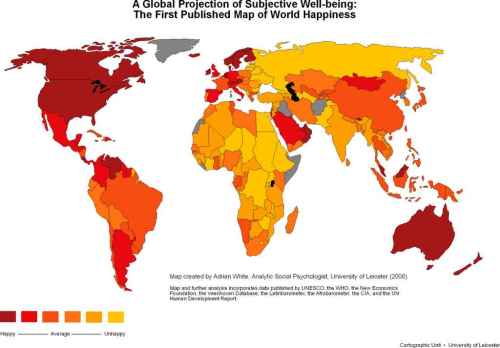
Current world happiness maps are computed by academics using various structural indicators and macro-level statistics. These maps are limited to the nation-state level of analysis which suggests that everyone in a given country is equally happy throughout an entire year. Maps don’t get more old school than this. What is blatantly missing is something like Gross National Happiness (GNH) data but disaggregated, user-generated and mapped in real-time.

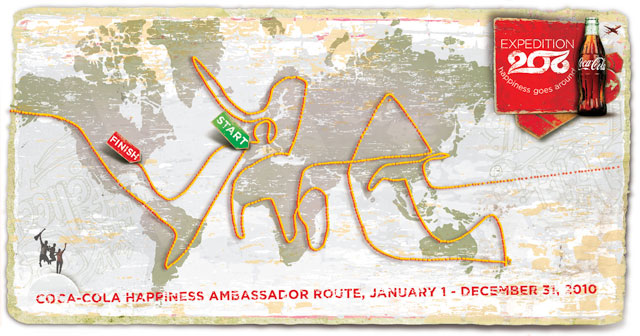
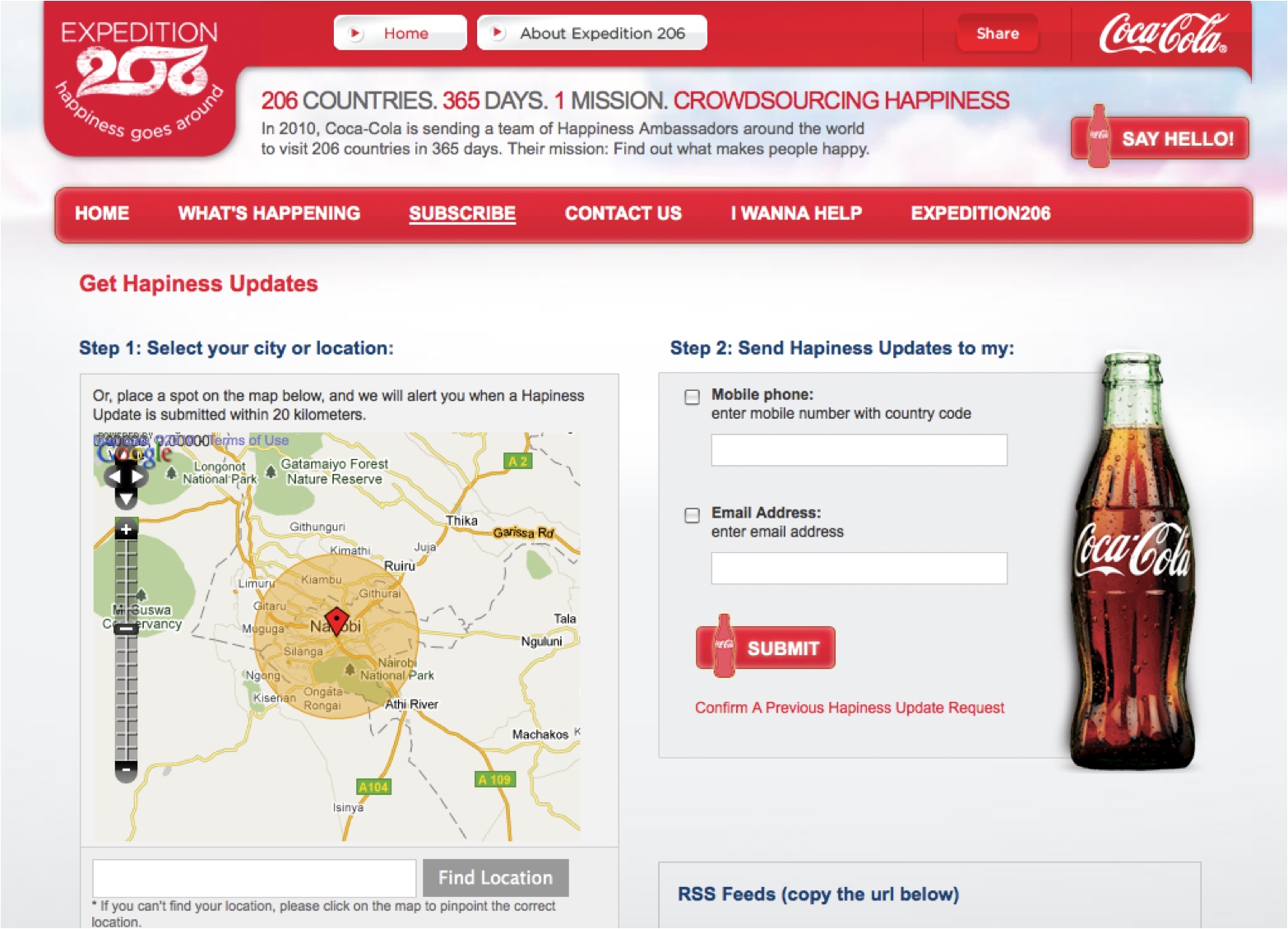
I had pitched the same idea to Coca-Cola two years ago as part of their Expedition 206 campaign. Three “Happiness Ambassadors” travelled to 206 countries in 2010 to find what happiness means to the world. I had heard about the project through a good friend who had auditioned to be one of the Happiness Ambassadors.

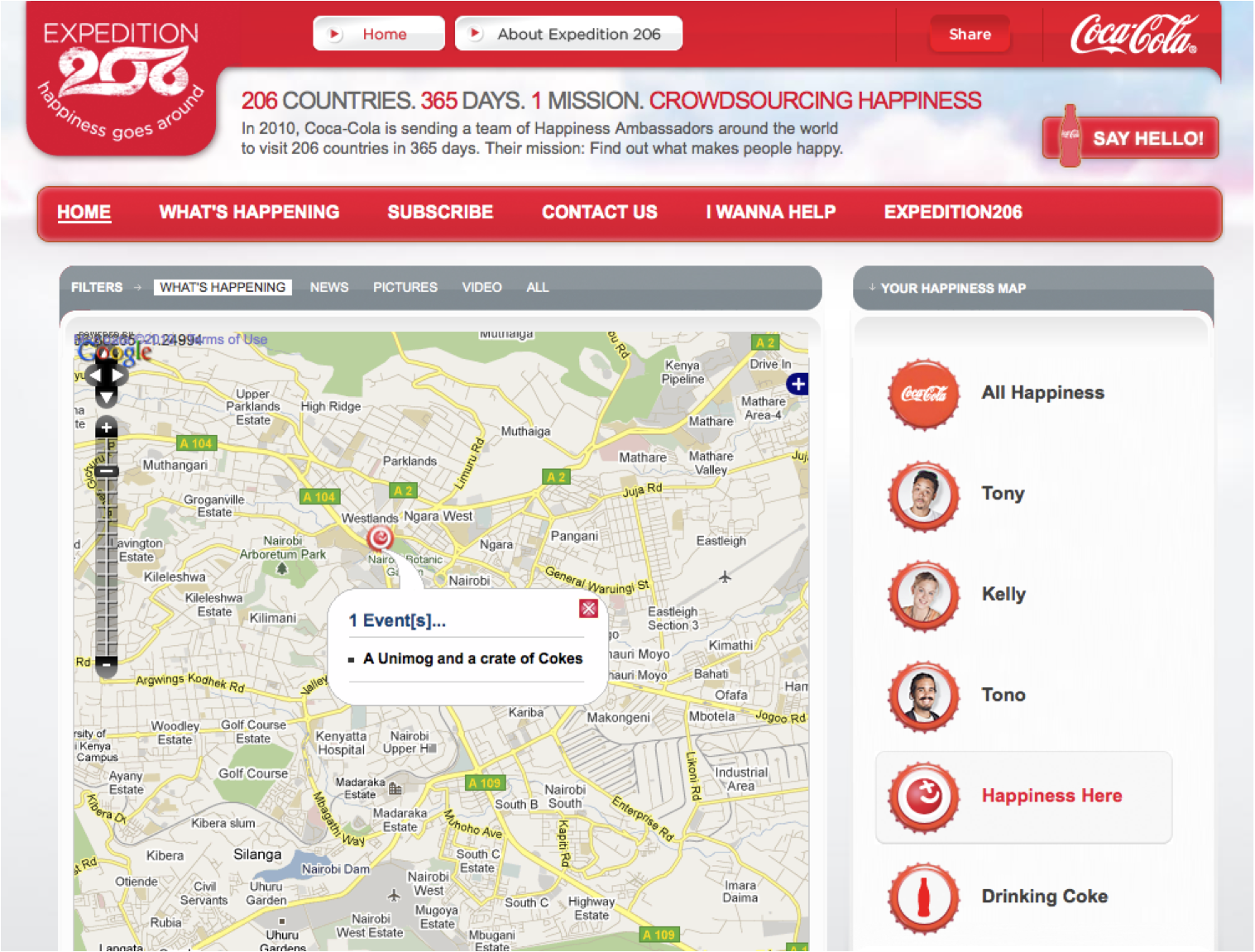
The idea of a happiness world tour appealed to me a  lot but why not let people speak for themselves and map what happiness means to them? The Expedition 206 Team was already using social media and a map as part of their campaign, so a crowdsourced happiness world map made perfect sense.

This is precisely what I pitched to Coca-Cola as the screenshot below shows. My colleague and friend Caleb Bell from Ushahidi did some awesome interface design work for the pitch.

While Coca-Cola was intrigued by the idea, they had already launched their Expedition 206 Social Media strategy. In any case, this project came to mind just minutes before I got on the TEDxKC stage last week and it’s something I’d like to take up again and would love some help on.

We could customize the Ushahidi platform and smart phone apps. People could then share what happiness means to them by “checking in” with a status update and/or a picture. The content could then be automatically mapped on a World Happiness Map.

Happiness badges could also be won when people check into certain places and/or with certain updates. Happiness messages or pictures could be embedded across the map (geo-fencing) so that anyone checking in at any given time place/time would receive a message/picture that would make them smile.

One could also “Subscribe to Happiness!” by allowing people to receive any happiness updates/pictures from people around them. For example, Mike could subscribe to happiness updates say within a 5 mile radius of the Nelson-Atkins Art Museum. When Kelly checks in on her way to the museum, Mike would  get an update with the happiness message (either anonymous or with Kelly’s name/picture).

I think this could be quite a powerful campaign, especially given the state of the world economy and ongoing crises. Incidentally, smiling has been scientifically shown to have positive health effects such as extending lifespans, as my colleague Ron Gutman points out in this TED talk.

A crowdsourcing happiness campaign would  help remind people about what they do have and what they can be grateful for. One idea, then, might be to launch this campaign as part of the upcoming Thanksgiving holidays. I’d love to partner with someone to make this happen. So please get in touch if you’d like to help. In the meantime, smile! : )

On Synchrony, Technology and Revolutions: The Political Power of Synchronized Resistance

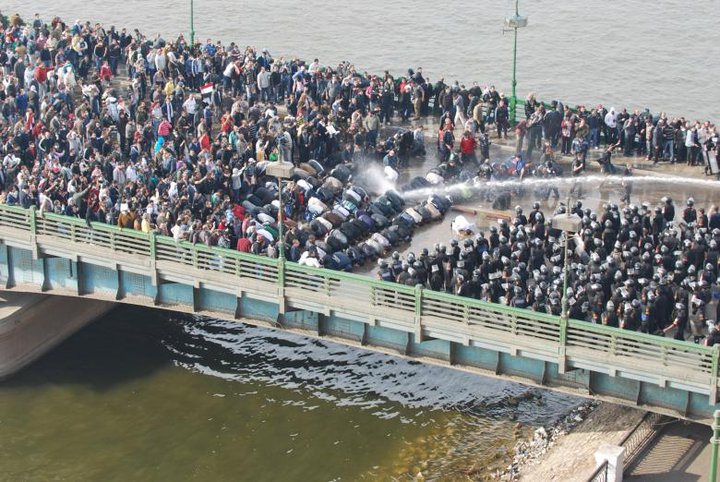
Synchronized action is a powerful form of resistance against repressive regimes. Even if the action itself is harmless, like walking, meditation or worship, the public synchrony of that action by a number of individuals can threaten an authoritarian state. To be sure, synchronized public action demonstrates independency which may undermine state propaganda, reverse information cascades and thus the shared perception that the regime is both in control and unchallenged.

This is especially true if the numbers participating in synchrony reaches a tipping point. As Karl Marx writes in Das Kapital, “Merely quantitative differences, beyond a certain point, pass into qualitative changes.” We call this “emergent behavior” or “phase transitions” in the field of complexity science. Take a simple example from the physical world: the heating of water. A one degree increase in temperature is a quantitative change. But keep adding one degree and you’ll soon reach the boiling point of water and surprise! A physical phase transition occurs: liquid turns into gas.

In social systems, information creates friction and heat. Moreover, today’s information and communication technologies (ICTs) are perhaps the most revolutionary synchronizing tools for “creating heat” because of their scalability. Indeed, ICTs today can synchronize communities in ways that were unimaginable just a few short years ago. As one Egyptian activist proclaimed shortly before the fall of Mubarak, “We use Facebook to scheduled our protests, Twitter to coordinate, and YouTube to tell the world.” The heat is already on.

Synchrony requires that individuals be connected in order to synchronize. Well guess what? ICTs are mass, real-time connection technologies. There is conse-quently little doubt in my mind that “the advent and power of connection technologies—tools that connect people to vast amounts of information and to one another—will make the twenty-first century all about surprises;” surprises that take the form of “social phase transitions” (Schmidt and Cohen 2011). Indeed, ICTs can  dramatically increase the number of synchronized participants while sharply reducing the time it takes to reach the social boiling point. Some refer to this as “punctuated equilibria” or “reversed information cascades” in various academic literatures. Moreover, this can all happen significantly faster than ever before, and as argued in this previous blog post on digital activism, faster is indeed different.

Clay Shirky argues that “this basic hypothesis is an updated version of that outlined by Jürgen Habermas in his 1962 publication, The Structural Transformation of the Public Sphere: an Inquiry into a Category of Bourgeois Society. A group of people, so Habermas’s theory goes, who take on the tools of open expression becomes a public, and the presence of a synchronized public increasingly constrains undemocratic rulers while expanding the rights of that public […].” But to understand the inherent power of synchrony and then leverage it, we must first recognized that synchrony is a fundamental force of nature that goes well beyond social systems.

In his TED Talk from 2004, American mathematician Steven Strogatz argues that synchrony may be one of the most pervasive drivers in all of nature, extending from the subatomic scale to the farthest reaches of the cosmos. In many ways, this deep tendency towards spontaneous order is what pushes back against the second law of thermodynamics, otherwise known as entropy. 

Strogatz shares example from nature and shows a beautiful ballet of hundreds of birds flocking in unison. He explains that this display of synchrony has to do with defense. “When you’re small and vulnerable […] it helps to swarm to avoid and/or confuse predators.” When a predator strikes, however, all bets are off, and everyone disperses—but only temporarily. “The law of attraction,” says Strogatz, brings them right back together in synchrony within seconds. “There’s this constant splitting and reforming,” grouping and dispersion—swarming—which has several advantages. If you’re in a swarm, the odds of getting caught are far lower. There are also many eyes to spot the danger.

What’s spectacular about these ballets is how quickly they phase from one shape to another, dispersing and regrouping almost instantaneously even across vast distances. Individual changes in altitude, speed and direction are communicated and acted on across half-a-kilometer within just seconds. The same is true of fireflies in Borneo that synchronize their blinking across large distances along the river banks. Thousands and thousands of fireflies somehow overcoming the communication delay between the one firefly at one end of the bank and the other firefly at the furthest opposite end. How is this possible? The answer to this question may perhaps provide insights for social synchrony in the context of resistance against repressive regimes.

Strogatz and Duncan Watts eventually discovered the answer, which they published in their seminal paper entitled “Collective dynamics of small-world networks.” Published in the prestigious journal Nature,  the paper became the most highly cited article about networks for 10 years and the sixth most cited paper in all of physics. A small-world network is a type of network in which even though most nodes are not neighbors of one another, most can still be reached from other nodes by a small number of hops or steps. In the context of social systems, this type of network results in the “small world phenomenon of strangers being linked by a mutual acquaintance.”

These types of networks often arise out of preferential attachment, an inherently social dynamic. Indeed, small world networks pervade social systems. So what does this mean for synchrony as applied to civil resistance? Are smart-mobs synonymous with synchronized mobs? Do ICTs increase the prevalence of small world networks in social systems—thus increasing robustness and co-synchrony between social networks. Will meshed-communication technologies and features like check-in’s alter the topology of small world networks?

Examples of synchrony from nature clearly show that real-time communication and action across large distances don’t require mobile phones. Does that mean the same is possible in social systems? Is it possible to disseminate information instantaneously within a large crowd without using communication technologies? Is strategic synchrony possible in this sense? Can social networks engage in instantaneous dispersion and cohesion tactics to confuse the repressive regime and remain safe?

I recently spoke with a colleague who is one of the world’s leading experts on civil resistance, and was astonished when she mentioned (without my prompting) that many of the tactics around civil resistance have to do with synchronizing cohesion and dispersion. On a different note, some physicists argue that small world networks are more robust to perturbations than other network structures. Indeed, the small work structure may represent an evolutionary advantage.

But how are authoritarian networks structured? Are they too of the small world variety? If not, how do they compare in terms of robustness, flexibility and speed? In many ways, state repression is a form of synchrony itself—so is genocide. Synchrony is clearly not always a good thing. How is synchrony best interrupted or sabotaged? What kind of interference strategies are effective in this context?

Digital Activism, Epidemiology and Old Spice: Why Faster is Indeed Different

The following thoughts were inspired by one of Zeynep Tufekci’s recent posts entitled “Faster is Different” on her Technosociology blog. Zeynep argues “against the misconception that acceleration in the information cycle means would simply mean same things will happen as would have before, but merely at a more rapid pace. So, you can’t just say, hey, people communicated before, it was just slower. That is wrong. Faster is different.”

I think she’s spot on and the reason why goes to the heart of complex systems behavior and network science. “Combined with the reshaping of networks of connectivity from one/few-to-one/few (interpersonal) and one-to-many (broadcast) into many-to-many, we encounter qualitatively different dynamics,” writes Zeynep. In a very neat move, she draws upon “epidemiology and quarantine models to explain why resource-constrained actors, states, can deal with slower diffusion of protests using ‘whack-a-protest’ method whereas they can be overwhelmed by simultaneous and multi-channel uprisings which spread rapidly and ‘virally.’ (Think of it as a modified disease/contagion model).” She then uses the “unsuccessful Gafsa protests in 2008 in Tunisia and the successful Sidi Bouzid uprising in Tunisia in 2010 to illustrate the point.”

I love the use of epidemiology and quarantine models to demonstrate why faster is indeed different. One of the complex systems lectures we had when I was at the Sante Fe Institute (SFI) focused on explaining why epidemics are so unpredictable. It was a real treat to have Duncan Watts himself present his latest research on this question. Back in 1998, he and Steven Strogatz wrote a seminal paper presenting the mathematical theory of the small world phenomenon. One of Duncan’s principle area of research has been information contagion and for his presentation at SFI, he explained that, amazingly, mathematical  epidemiology currently has no way to answer how big a novel outbreak of an infectious disease will get.

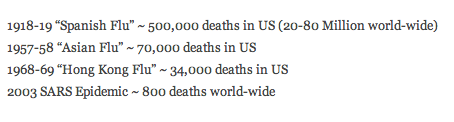
I won’t go into the details of traditional mathematical epidemiology and the Standard (SIR) Model but suffice it to say that the main factor thought to determine the spread of an epidemic was the “Basic Reproduction Number”, i.e., the average number of newly infected individuals by a single infected individual in a susceptible population. However, the following epidemics, while differing dramatically in size, all have more or less the same Basic Reproduction Number.

Standard models also imply that outbreaks are “bi-modal” but empirical research clearly shows that epidemics tend to be “multi-modal.” Real epidemics are also resurgent with several peaks interspersed with lulls. So the result is unpredictability: Multi-modal size distributions imply that any given outbreak of the same disease can have dramatically different outcomes while Resurgence implies that even epidemics which seem to be burning out can regenerate themselves by invading new populations.

To this end, there has been a rapid growth in “network epidemiology” over the past 20 years. Studies in network epidemiology suggest that the size of an epidemic depends on Mobility: the expected number of infected individuals “escaping” a local context; and Range: the typical distance traveled.” Of course, the “Basic Reproduction Number” still matters, and has to be greater than 1 as a necessary condition for an epidemic in the first place. However, when this figure is greater than 1, the value itself tells us very little about size or duration. Epidemic size tends to depend instead on mobility and range, although the latter appears to be more influential. To this end, simply restricting the range of travel of infected individuals may be an effective strategy.

There are, however, some important differences in terms of network models being compared here. The critical feature of biological disease in contrast with information spread is that individuals need to be co-located. But recall when during the recent Egyptian revolution the regime had cut off access to the Internet and blocked cell phone use. How did people get their news? The good old fashioned way, by getting out in the streets and speaking in person, i.e., by co-locating. Still, information can be contagious regardless of co-location. This is where Old Spice comes in vis-a-vis their hugely effective marking campaign in 2010 where their popular ads on YouTube went viral and had a significant impact on sales of the deodorant, i.e., massive offline action. Clearly, information can lead to a contagion effect. This is the “information cascade” that Dan Drezner and others refer to in the context of digital activism in repressive environments.

“Under normal circumstances,” Zeynep writes, “autocratic regimes need to lock up only a few people at a time, as people cannot easily rise up all at once. Thus, governments can readily fight slow epidemics, which spread through word-of-mouth (one-to-one), by the selective use of force (a quarantine). No country, however, can jail a significant fraction of their population rising up; the only alternative is excessive violence. Thus, social media can destabilize the situation in unpopular autocracies: rather than relatively low-level and constant repression, regimes face the choice between crumbling in the face of simultaneous protests from many quarters and massive use of force.”
 
For me, the key lesson from mathematical epidemiology is that predicting when an epidemic will go “viral” and thus the size of this epidemic is particularly challenging. In the case of digital activism, the figures for Mobility and Range are even more accentuated than the analogous equivalent for biological systems. Given the ubiquity of information communication networks thanks to the proliferation of social media, Mobility has virtually no limit and nor does Range. That accounts for the speed of “infection” that may ultimately mean the reversal of an information cascade. This unpredictability is why, as Zeynep puts it, “faster is different.” This is also why regimes like that of Mubarak’s and Al-Assad’s try to quarantine information communication and why doing so completely is very difficult, perhaps impossible.
 
Obviously, offline action that leads to more purchases of Old Spice versus offline action that spurs mass protests in Tahrir Square are two very different scenarios. The former may only require weak ties while the latter, due to high-risk actions, may require strong ties. But there are many civil resistance tactics that can be considered as micro-contributions and hence don’t involve relatively high risk to carry out. So communication can still change behavior which may then catalyze high-risk action, especially if said communication comes from someone you know within your own social network. This is one of the keys to effective marketing and advertising strategies. You’re more likely to consider taking offline action if one of your friends or family members do even if there are some risks involved. This is where the “infection” is most likely to take place. These infections can spur low-risk actions at first, which can synchronize “micro-motives” that lead to more risky “macro-behavior” and thus reversals in information cascades.

Identifying Strategic Protest Routes for Civil Resistance: An Analysis of Optimal Approaches to Tahrir Square

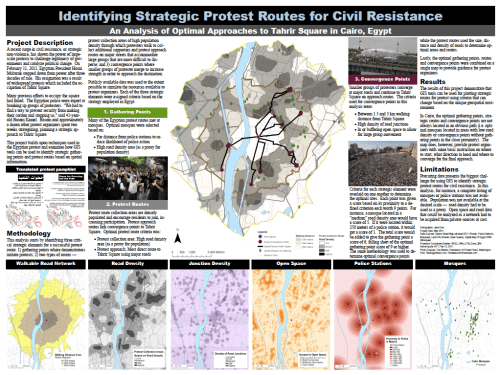
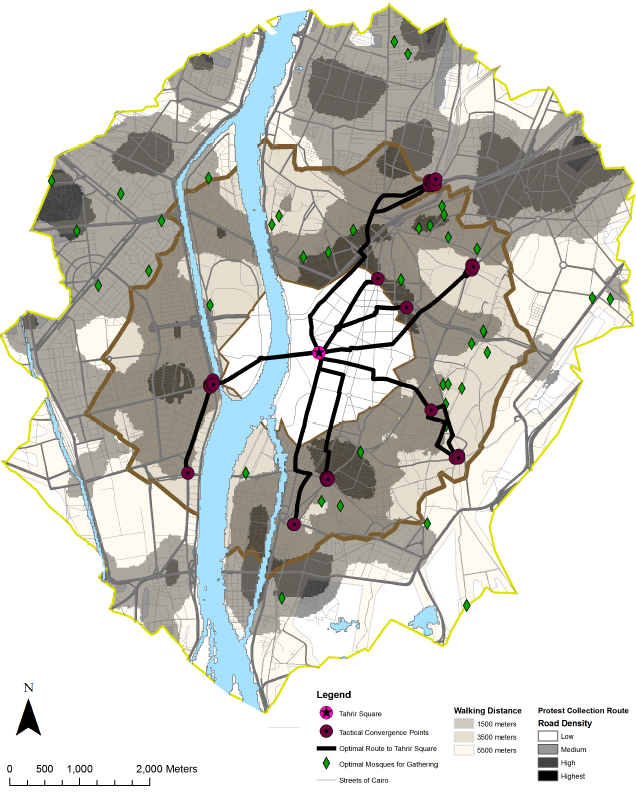
My colleague Jessica recently won the Tufts GIS Poster Expo with her excellent poster on civil resistance. She used GIS data to analyze optimal approaches to Tahrir Square in Cairo. According to Jessica, many previous efforts to occupy the square had failed. So Egyptian activists spent two weeks brainstorming the best strategies to approach Tahrir Square.

Out of curiosity, Jessica began to wonder whether the use of GIS data and spatial analysis might shed some light on possible protest routes. She began her analysis by  identifying three critical strategic elements for a successful protest route:

“1) Gathering points where demonstrators initiate protests; 2) two types of routes—protest collection areas of high population density through which protesters walk to collect additional supporters and protest approach routes on major streets that accommodate large groups that are more difficult to disperse; and 3) convergence points where smaller groups of protester merge to increase strength in order to approach the destination.”

For her analysis, Jessica took gathering points and convergence points into consideration. For example, many Egyptian activist met at Mosques. So she selected optimal Mosques based on their distance to police stations (the farther the better) and high road density area “as a proxy for population density.” In terms of convergence points, smaller groups of protestors converged on major roads and intersections. The criteria that Jessica used to select these points were: distance to Tahrir Square, high density of road junctions and open space to allow for large group movement. She also took into account protest route collection areas. These tend to be “densely populated and encourage residents to join, increasing participation.” So Jessica selected these based on high road density and most direct route to Tahrir Square using major roads.

Overlaying the data and using GIS analysis on each strategic element yields the following optimal routes to Tahrir:

Jessica writes that “the results of this project demonstrate that GIS tools can be used for plotting strategic routes for protest using criteria that can change based on the unique geospatial environment. In Cairo, the optimal gathering points, strategic routes and convergence points are not always located in an obvious path (i.e. optimal mosques located in areas with low road density or convergence points without gathering points in the close proximity). The map does, however, provide protest organizers with some basic instruction on where to start, what direction to head and where to converge for the final approach.”

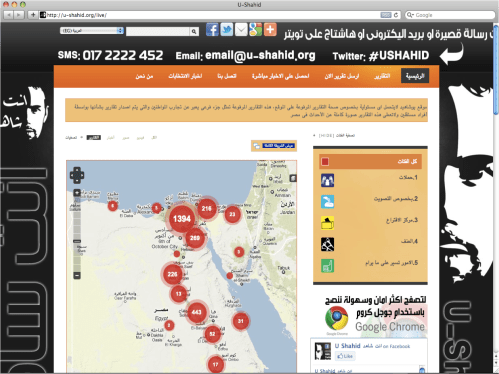
She does also acknowledge some of the limitations of the study owing to lack of high-resolution spatial data. I would add temporal data since civil resistance is fluid and changes, which requires rapid adaptation and re-strategizing. If her analysis could be combined with real time information coming from crowdsourced data such as U-Shahid, then I think this could be quite powerful.

For more on the civil resistance tactics used in Egypt during the revolution, please see this blog post.

How Egyptian Activists Kept Their Ushahidi Project Alive Under Mubarak

This is my second blog post on the U-Shahid project in Egypt. The first one analyzed 2,000+ reports mapped on the Ushahidi platform during the country’s recent Parliamentary Elections. Egypt is one of my dissertation case studies and in this blog post I summarize some initial findings based on a series of interviews I had several Egyptian activists who were part of the U-Shahid project.

The Egyptian government began asking questions about U-Shahid well before the project was even launched. They found out about the project by tapping phone lines and emails. Once the project was launched, the Egyptian Ministry of the Interior continued to shadow the project in several ways. They requested copies of all meeting agendas and a list of names for everyone who was trained on the Ushahidi platform, for example.

In order to remain operational, the Egyptian activists spearheading the U-Shahid project said that they “stressed the technical aspect of the project, and remained fully open and transparent about our work. We gave Egyptian National Security a dedicated username and password [to access the Ushahidi platform], one that we could control and monitor [their actions]. This gave them a false sense of control, we could restore anything they deleted.” That said, one activist recounted how “there were attempts by the government to overload our website with many fake reports […] but we were on it and we were able to delete them. This happened a minute or two every three hours or so, attacks, overload, but eventually they gave up.”

When asked why the regime had not shut down the platform given the potential threat that U-Shahid represented, one blogger explained that “many of the activists who began using Ushahidi had many followers on Facebook and Twitter, they also had the attention of the international media, which could create unwanted attention on the regime’s actions.” This same blogger also noted that many of the activists who collaborated on the U-Shahid project were “connected with people in the US Congress, directors of international human rights NGOs, and so on.” Perhaps the Mubarak Regime was concerned that cracking down on the U-Shahid project would backfire.

In any case, the activists “did a lot of scenario building, considered many ‘what if’ situations. The fact that we were so well prepared is why they [the regime] could not touch us. We tried to connect all the data on Facebook and Twitter so that if they closed our Ushahidi map, we would move to a new domain name and let all our followers know. We also had a large database of SMS numbers, which would allow us to text our followers with information on the new website. Finally, we had a fully trained team in Lebanon ready to take over the project if we were completely shut down.”

“We were well prepared,” added another blogger, “we knew they could not arrest all of us on the day of the election, and just in case, we trained a group in Lebanon who could take over all operations if we were stopped.” According to one activist, “using this mapping technology provided a way to collect and recruit a lot of activists, and not just any activists, but more effective ones. This actually created a headache for the regime because a growing number of digital activists became interested in using the Ushahidi platform.” Another interviewee added that the technology acted as a “magnet” for activists. One activist also remarked that “they [the government] don’t understand how we work; we can learn very fast but the government has many rules and processes, they have to write up reports, submit them for approval, and allocate funding to acquire technology. But for us, we don’t need permission. If we want to use Tor, we simply use Tor.”

Another explained that their project’s credibility came from the realization by many that they were simply focused on “getting the facts out without agenda. We were both transparent and moderate, with no political or party affiliation, and we emphasized that our goal was to try and make the election process transparent.” In sum, said another activist, “we let people decide for themselves whether the content mapped on Ushahidi was good or not.” Another activist argued that the use of the Ushahidi platform “created more transparency around the elections, allowing easier access than in any previous election.” More specifically, “in previous elections and before the existence of Ushahidi, many NGOs made reports of election irregularities, but these were rarely shared publicly with policy maker or even with other NGOs. And even after the elections had taken place, it was very difficult to access these repots. But the Ushahidi [platform] is open and online, allowing anyone to access any of the information mapped in near real-time.”

Still it is really challenging to fully assess the potential political impact (if any) the U-Shahid project had–something the activists are very aware of. One can only investigate so much for so long. One activist noted that “next time we use the Ushahidi platform, this year for the presidential elections, we will be sure to track the reports submitted to the judicial courts and compare them with those we collect. We also plan to better advertise our project with lawyers and political candidates so that they can use our reports including videos and photos in court and for trials.”

What I’m particularly pleased about in addition all the learning that has taken place is the fact that the U-Shahid project spawned off a number of *copy cats during the elections and new maps are being launched almost every other month in Egypt now. The project also increased the number of Egyptian who participated in directly monitoring their own elections. Lastly, I’m excited that the Egyptians who spearheaded the U-Shahid project are now training activists in Tunisia and other Arab countries. They have acquired a wealth of practical knowledge and experience in using the platform in authoritarian environments, and now they’re sharing all this hard-won expertise.

There’s a lot more to share from the interviews, and I hope to do so in future posts. I also plan to blog about the findings from my case study of the Sudan.