Category Archives: Humanitarian Technologies

Analyzing the Libya Crisis Map Data in 3D (Video)

I first blogged about GeoTime exactly two years ago in a blog post entitled “GeoTime: Crisis Mapping in 3D.” The rationale for visualizing geospatial data in 3D very much resonates with me and in my opinion becomes particularly compelling when analyzing crisis mapping data.

This is why I invited my GeoTime colleague Adeel Khamisa to present their platform at the first International Conference on Crisis Mapping (ICCM 2009). Adeel used the Ushahidi-Haiti data to demonstrate the added value of using a 3D approach, which you can watch in the short video below.

Earlier this year, I asked Adeel whether he might be interested in analyzing the Libya Crisis Map data using GeoTime. He was indeed curious and kindly produced the short video below on his preliminary findings.

The above visual overview of the Libya data is really worth watching. I hope that fellow Crisis Mappers will consider making more use of GeoTime in their projects. The platform really is ideal for Crisis Mapping Analysis.

The Role of Facebook in Disaster Response

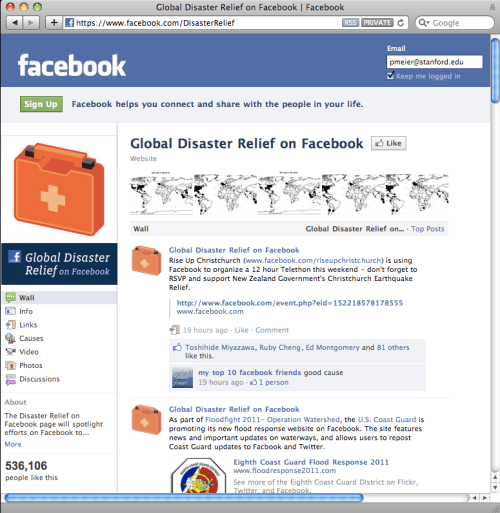
I recently met up with some Facebook colleagues to discuss the role that they and their platform might play in disaster response. So I thought I’d share some thoughts that come up during the conversation seeing as I’ve been thinking about this topic with a number of other colleagues for a while. I’m also very interested to hear any ideas and suggestions that iRevolution readers may have on this.

There’s no doubt that Facebook can—and already does—play an important role in disaster response. In Haiti, a colleague used Facebook to recruit hundreds of Creole speaking volunteers to translate tens of thousands of text messages into English as part of our Ushahidi-Haiti crisis mapping efforts. When an earth-quake struck New Zealand earlier this year, thousands of students organized their response via a Facebook group and also used the platform’s check-in’s feature to alert others in their social network that they were alright.

But how else might Facebook be used? The Haiti example demonstrates that the ability to rapidly recruit large numbers of volunteers is really key. So Facebook could create a dedicated landing page when a crisis unfolds, much like Google does. This landing page could then be used to recruit thousands of new volunteers for live crisis mapping operations in support of humanitarian organizations (for example). The landing page could spotlight a number of major projects that new volunteers could join, such as the Standby Volunteer Task Force (SBTF) or perhaps highlight the deployment of an Ushahidi platform for a particular crisis.

The use of Facebook to recruit volunteers presents several advantages, the most important ones being identity and scale. When we recruited hundreds of new volunteers for the Libya Crisis Map in support of the UN’s humanitarian response, we had to vet and verify each and every single one of them twice to ensure they were who they really said they were. This took hours, which wouldn’t be the case using Facebook. If we could set up a way for Facebook users to sign into an Ushahidi platform directly from their Facebook account, this too would save many hours of tedious work—a nice idea that my colleague Jaroslav Valuch suggested. See Facebook Connect, for example.

Facebook also operates at a scale of more than half-a-billion people, which has major “Cognitive Surplus” potential. We could leverage Facebook’s ad services as well—a good point made one Facebook colleague (and also Jon Gosier in an earlier conversation). That way, Facebook users would receive targeted adds on how they could volunteer based on their existing profiles.

So there’s huge potential, but like much else in the ICT-for-you-name-it space, you first have to focus on people, then process and then the technology. In other words, what we need to do first is establish a relationship with Facebook and decide on the messaging and the process by which volunteers on Facebook would join a volunteer network like the Standby Volunteer Task Force and help out on an Ushahidi map, for example.

Absorbing several hundred or thousands of new volunteers is no easy task but as long as we have a simple and efficient micro-tasking system via Facebook, we should be able to absorb this surge. Perhaps our colleagues at Facebook could take the lead on that, i.e, create a a simple interface allowing groups like the Task Force to farm out all kinds of micro-tasks, much like Crowdflower, which already embeds micro-tasks in Facebook. Indeed, we worked with Crowdflower during the floods in Pakistan to create this micro-tasking app for volunteers.

As my colleague Jaroslav also noted, this Mechanical Turk approach would allow these organizations to evaluate the performance of their volunteers on particular tasks. I would add to this some gaming dynamics to provide incentives and rewards for volunteering, as I blogged about here. Having a public score board based on the number of tasks completed by each volunteer would be just one idea. One could add badges, stickers, banners, etc., to your Facebook profile page as you complete tasks. And yes, the next question would be: how do we create the Farmville of disaster response?

On the Ushahidi end, it would also be good to create a Facebook app for Ushahidi so that users could simply map from their own Facebook page rather than open up  another browser to map critical information. As one Facebook colleague also noted, friends could then easily invite others to help map a crisis via Facebook. Indeed, this social effect could be most powerful reason to develop an Ushahidi Facebook app. As you submit a report on a map, this could be shared as a status update, for example, inviting your friends to join the cause. This could help crisis mapping go viral across your own social network—an effect that was particularly important in launching the Ushahidi-Haiti project.

As a side note, there is an Ushahidi plugin for Facebook that allows content posted on a wall to be directly pushed to the Ushahidi backend for mapping. But perhaps our colleagues at Facebook could help us add more features to this existing plugin to make it even more useful, such add integrating Facebook Connect, as noted earlier.

In sum, there are some low hanging fruits and quick wins that a few weeks of collaboration with Facebook could yield. These quick wins could make a really significant impact even if they sound (and are) rather simple. For me, the most exciting of these is the development of a Facebook app for Ushahidi.

Discussing the Recommendations of the Disaster 2.0 Report

It’s been well over a month since the Disaster 2.0 Report was publicly launched and while some conversations on the report have figured on the Crisis Mappers Network list-serve and the Standby Task Force blog, much of this discussion has largely overlooked the report’s detailed recommendations. I had hoped by now that someone would have taken the lead on catalyzing a debate around these recommendations, but since that still hasn’t happened, I might as well start.

The report’s authors clearly state that, “the development of an interface between the Volunteer and Technical Communities (V&TCs) and formal humanitarian system is a design problem that must be left to the stakeholders.” In addition, they clarify that “the purpose of this document is not to set forth the final word on how to connect new information flows into the international humanitarian system; but to initiate a conversation about the design challenges involved with this endeavor.” This conversation has yet to happen.

While the humanitarian community has proposed some design ideas, V&TCs have not responded in any detail to these proposals—although to be fair, no deadline for feedback has been suggested either. In any case, the proposed designs are meant to create an interface between humanitarian organizations and V&TCs—the two main stakeholders discussed in the Disaster 2.0 Report. It would be unfortunate and probably defeat the purpose of the report if the final interface were operationalized before any V&TCs had the chance to explain what would work best for them in terms of interface. Indeed, without an open and pro-active conversation that includes both stakeholder groups, it is unlikely that the final interface design will gain buy-in from both groups, which would result in wasted funding.

So here’s an open and editable Google Doc that includes the report’s recommen-dations. I have already added some of my comments to the Google Doc and hope others will as well. On June 1st, I will publish a new blog post that will summarize all the feedback added to the Google Doc. I hope this summary will serve to move the conversations forward so we can co-develop an interface that will prove useful and effective to all those concerned.

Video: Changing the World, One Map at a Time

Hosted in the beautiful city of Berlin, Re:publica 2011 is Germany’s largest annual conference on blogs, new media and the digital society, drawing thousands of participants from across the world for three days of exciting conversations and presentations. The conference venue was truly a spectacular one and while conference presentations are typically limited to 10-20 minutes, the organizers gave us an hour to share our stories. So I’m posting the video of my presentation below for anyone interested in learning more about new media, crowdsourcing, crisis mapping, live maps, crisis response, civil resistance, digital activism and check-in’s. I draw on my experience with Ushahidi and the Standby Volunteer Task Force (SBTF) and share examples from Kenya, Haiti, Libya, Japan, the US and Egypt to illustrate how live maps can change the world. My slides are available on Slideshare here.

An Open Letter to the Good People at Benetech

Dear Good People at Benetech,

We’re not quite sure why Benetech went out of their way in an effort to discredit ongoing research by the European Commission (EC) that analyzes SMS data crowdsourced during the disaster response to Haiti. Benetech’s area of expertise is in human rights (rather than disaster response), so why go after the EC’s findings, which had nothing to do with human rights?  To our fellow readers who desire context, feel free to read this blog postof mine along with these replies by Benetech’s CEO:

Issues with Crowdsourced Data Part 1
Issues with Crowdsourced Data Part 2

The short version of the debate is this: the EC’s exploratory study found that the spatial pattern of text messages from Mission 4636 in Haiti was positively correlated with building damage in Port-au-Prince. This would suggest that crowdsourced SMS data had statistical value in Haiti—in addition to their value in saving lives. But Benetech’s study shows a negative correlation. That’s basically it. If you’d like to read something a little more spicy though, do peruse this recent Fast Company article, fabulously entitled “How Benetech Slays Monsters with Megabytes and Math.” In any case, that’s the back-story.

So lets return to the Good People at Benetech. I thought I’d offer some of my humble guidance in case you feel threatened again in the future—I do hope you don’t mind and won’t take offense at my unsolicited and certainly imperfect advice. So by all means feel free to ignore everything that follows and focus on the more important work you do in the human rights space.

Next time Benetech wants to try and discredit the findings of a study in some other discipline, I recommend making sure that your own counter-findings are solid. In fact, I would suggest submitting your findings to a respected peer-reviewed journal—preferably one of the top tier scientific journals in your discipline. As you well know, after all, this really is the most objective and rigorous way to assess scientific work. Doing so would bring much more credibility to Benetech’s counter-findings than a couple blog posts.

My reasoning? Benetech prides itself (and rightly so) for carrying out some of the most advanced, cutting-edge quantitative research on patterns of human rights abuses. So if you want to discredit studies like the one carried out by the EC, I would have used this as an opportunity to publicly demonstrate the advanced expertise you have in quantitative analysis. But Benetech decided to use a simple non-spatial model to discredit the EC’s findings. Why use such a simplistic approach? Your response would have been more credible had you used statistical models for spatial point data instead. But granted, had you used more advanced models, you would have found evidence of a positive correlation. So you probably won’t want to read this next bit: a more elaborate “Tobit” correlation analysis actually shows the significance of SMS patterns as an explanatory variable in the spatial distribution of damaged buildings. Oh, and the correlation is (unfortunately) positive.

But that’s really beside the point. As my colleague Erik Hersman just wrote on the Ushahidi blog, one study alone is insufficient. What’s important is this: the last thing you want to do when trying to discredit a study in public is to come across as sloppy or as having ulterior motives (or both for that matter). Of course, you can’t control what other people think. If people find your response sloppy, then they may start asking whether the other methods you do use in your human rights analysis are properly peer-reviewed. They may start asking whether a strong empirical literature exists to back up your work and models. They may even want to know whether your expert statisticians have an accomplished track record and publish regularly in top-tier scientific journals. Other people may think you have ulterior motives and will believe this explains why you tried to discredit the EC’s preliminary findings. This doesn’t help your cause either. So it’s important to think through the implications of going public when trying to discredit someone’s research. Goodness knows I’ve made some poor calls myself on such matters in the past.

But lets take a step back for a moment. If you’re going to try and discredit research like the EC’s, please make sure you correctly represent the other side’s arguments. Skewing them or fabricating them is unlikely to make you very credible in the debate. For example, the EC study never concluded that Search and Rescue teams should only rely on SMS to save people’s lives. Furthermore, the EC study never claimed that using SMS is preferable over using established data on building density. It’s surely obvious—and you don’t need to demonstrate this statistically—to know that using a detailed map of building locations would provide a far better picture of potentially damaged buildings than crowdsourced SMS data. But what if this map is not available in a timely manner? As you may know, data layers of building density are not very common. Haiti was a good example of how difficult, expensive and time-consuming, the generation of such a detailed inventory is. The authors of the study simply wanted to test whether the SMS spatial pattern matched the damage analysis results, which it does. All they did was propose that SMS patterns could help in structuring the efforts needed for a detailed assessment, especially because SMS data can be received shortly after the event.

So to summarize, no one (I know) has ever claimed that crowdsourced data should replace established methods for information collection and analysis. This has never been an either or argument. And it won’t help your cause to turn it into a black-and-white debate because people familiar with these issues know full well that the world is more complex than the picture you are painting for them. They also know that people who take an either-or approach often do so when they have either run out of genuine arguments or had few to begin with. So none of this will make you look good. In sum, it’s important to (1) accurately reflect the other’s arguments, and (2) steer clear of creating an either-or, polarized debate. I know this isn’t easy to do, I’m guilty myself… on multiple counts.

I’ve got a few more suggestions—hope you don’t mind. They follow from the previous ones. The authors of the EC study never used their preliminary findings to extrapolate to other earthquakes, disasters or contexts. These findings were specific to the Haiti quake and the authors never claimed that their model was globally valid. So why did you extrapolate to human rights analysis when that was never the objective of the EC study? Regardless, this just doesn’t make you look good. I understand that Benetech’s focus is on human rights and not disaster response, but the EC study never sought to undermine your good work in the field of human rights. Indeed, the authors of the study hadn’t even heard of Benetech. So in the future, I would recommend not extrapolating findings from one study and assume they will hold in your own field of expertise or that they even threaten your area of expertise. That just doesn’t make any sense.

There are a few more tips I wanted to share with you. Everyone knows full well that crowdsourced data has important limitations—nobody denies this. But a number of us happen to think that some value can still be derived from crowdsourced data. Even Mr. Moreno-Ocampo, the head of the International Criminal Court (ICC), who I believe you know well, has pointed to the value of crowdsourced data from social media. In an interview with CNN last month, Mr. Moreno-Ocampo emphasized that Libya was the first time that the ICC was able to respond in real time to allegations of atrocities, partially due to social-networking sites such as Facebook. He added that, “this triggered a very quick reaction. The (United Nations) Security Council reacted in a few days; the U.N. General Assembly reacted in a few days. So, now because the court is up and running we can do this immediately,” he said. “I think Libya is a new world. How we manage the new challenge — that’s what we will see now.”

Point is, you can’t control the threats that will emerge or even prevent them, but you do control the way you decide to publicly respond to these threats. So I would recommend using your response as an opportunity to be constructive and demonstrate your good work rather than trying to discredit others and botching things up in the process.

But going back to the ICC and the bit in the Fast Company article about mathematics demonstrating the culpability of the Guatemalan government. Someone who has been following your work closely for years emailed me because they felt somewhat irked by all this. By the way, this is yet another unpleasant consequence of trying to publicly discredit others, new critics of your work will emerge. The critic in questions finds the claim a “little far fetched” re your mathematics demonstrating the culpability of the Guatemalan government. “There already was massive documented evidence of the culpability of the Guatemalan government in the mass killings of people. If there is a contribution from mathematics it is to estimate the number of victims who were never documented. So the idea is that documented cases are just a fraction of total cases and you can estimate the gap between the two. In order to do this estimation, you have to make a number of very strong assumptions, which means that the estimate may very well be unreliable anyway.”

Now, I personally think that’s not what you, Benetech, meant when you spoke with the journalist, cause goodness knows the number of errors that journalists have made writing about Haiti.

In any case, the critic had this to add: “In a court of law, this kind of estimation counts for little. In the latest trial at which Benetech presented their findings, this kind of evidence was specifically rejected. Benetech and others claim that in an earlier trial they nailed Milosevic. But Milosevic was never nailed in the first place—he died before judgment was passed and there was a definite feeling at the time that the trial wasn’t going well. In any case, in a court of law what matters are documented cases, not estimates, so this argument about estimates is really beside the point.”

Now I’m really no expert on any of these issues, so I have no opinion on this case or the statistics or the arguments involved. They may very well be completely wrong, for all I know. I’m not endorsing any of the above statements. I’m simply using them as an illustration of what might happen in the future if you don’t carefully plan your counter-argument before going public. People will take issue and try to discredit you in turn, which can be rather unpleasant.

In conclusion, I would like to remind the Good People at Benetech about what Ushahidi is and isn’t. The Ushahidi platform is not a methodology (as I have already written on iRevolution and the Ushahidi blog). The Ushahidi platform is a mapping tool. The methodology that people choose to use to collect information is entirely up to them. They can use random sampling, controlled surveys, crowdsourcing, or even the methodology used by Benetech. I wonder what the good people at Benetech would say if some of their data were to be visualized on an Ushahidi platform. Would they dismiss the crisis map altogether? And speaking of crisis maps, most Ushahidi maps are not crisis maps. The platform is used in a very wide variety of ways, even to map the best burgers in the US. Is Benetech also going to extrapolate the EC’s findings to burgers?

So to sum up, in case it’s not entirely clear, we know full well that there are important limitations to crowdsourced data in disaster response and have never said that the methodology of crowdsourcing should replace existing methodologies in the human rights space (or any other space for that matter). So please, lets not continue going in circles endlessly.

Now, where do we go from here? Well, I’ve never been a good pen pal, so don’t expect any more letters from me in response to the Good People at Benetech. I think everyone knows that a back and forth would be unproductive and largely a waste of time, not to mention an unnecessary distraction from the good work that we all try to do in the broader community to bring justice, voice and respect to marginalized communities.

Sincerely,

Disaster Relief 2.0: Between a Signac and a Picasso

The United Nations Foundation, Vodafone Foundation, OCHA and my “alma matter” the Harvard Humanitarian Initiative just launched an important report that seeks to chart the future of disaster response based on critical lessons learned from Haiti. The report, entitled “Disaster Relief 2.0: The Future of Information Sharing in Humanitarian Emergencies,” builds on a previous UN/Vodafone Foundation Report co-authored by Diane Coyle and myself just before the Haiti earthquake: “New Technologies in Emergencies and Conflict: The Role of Information and Social Networks.”

The authors of the new study begin with a warning: “this report sounds an alarm bell. If decision makers wish to have access to (near) real-time assessments of complex emergencies, they will need to figure out how to process information flows from many more thousands of individuals than the current system can handle.” In any given crisis, “everyone has a piece of information, everyone has a piece of that picture.” And more want to share their piece of the picture. So part of the new challenge lies in how to collect and combine multiple feeds of information such that the result paints a coherent and clear picture of an evolving crisis situation. What we need is a Signac, not a Picasso.

The former, Paul Signac, is known for using “pointillism,” a technique in which “small, distinct dots of pure color are applied in patterns to form an image.” Think of these dots as data points drawn from diverse pallets but combined to depict an appealing and consistent whole. In contrast, Pablo Picasso’s paintings from his Cubism and Surrealism period often resemble unfinished collages of fragmented objects. A Picasso gives the impression of impossible puzzle pieces in contrast to the single legible harmony of a Signac.

This Picasso effect, or “information fragmentation” as the humanitarian community calls it, was one of the core information management challenges that the humanitarian community faced in Haiti: “the division of data resources and analysis into silos that are difficult to aggregate, fuse, or otherwise reintegrate into composite pictures.” This plagued information management efforts between and within UN clusters, which made absorbing new and alternative sources of information–like crowdsourced SMS reports–even less possible.

These new information sources exist in part thanks to new players in the disaster response field, the so-called Volunteer Technical Communities (VTCs). This shift towards a more multi-polar system of humanitarian response brings both new opportunities and new challenges. One way to overcome “information fragmentation” and create a Signac is for humanitarian organizations and VTCs to work more closely together. Indeed, as “volunteer and technical communities continue to engage with humanitarian crises they will increasingly add to the information overload problem. Unless they can become part of the solution.” This is in large part why we launched the Standby Volunteer Task Force at the 2010 International Conference on Crisis Mapping (ICCM 2010): to avoid information overload by creating a common canvas and style between volunteer crisis mappers and the humanitarian community.

What is perhaps most striking about this new report is the fact that it went to press the same month that two of the largest crisis mapping operations since Haiti were launched, namely the Libya and Japan Crisis Maps. One could already write an entirely new UN/Vodafone Foundation Report on just the past 3 months of crisis mapping operations. The speed with which learning and adaptation is happening in some VTCs is truly astounding. As I noted in this earlier blog post, “Crisis Mapping Libya: This is no Haiti“, we have come a long way since the Haiti response. Indeed, lessons from last year have been identified, they have been learned and operationally applied by VTCs like the Task Force. The fact that OCHA formally requested activation of the Task Force to provide a live crisis map of Libya just months after the Task Force was launched is a clear indication that we are on the right track. This is no Picasso.

Referring to lessons learned in Haiti will continue to be important, but as my colleague Nigel Snoad has noted, Haiti represents an outlier in terms of disasters. We are already learning new lessons and implementing better practices in response to crises that couldn’t be more different than Haiti, e.g., crisis mapping hostile, non-permissive environments like Egypt, Sudan and Libya. In Japan, we are also learning how a more hierarchical society with a highly developed and media rich environment presents a different set of opportunities and challenges for crisis mapping. This is why VTCs will continue to be at the forefront of Disaster 2.0 and why reports like this one are so key: they clearly show that a Signac is well within our reach if we continue working together.

The Volunteers Behind the Libya Crisis Map: A True Story

My colleague Clay Shirky calls it “Cognitive Surplus” in his recent book. Don Tapscott and Anthony Williams refer to it as “MacroWikinomics” in theirs. What is cognitive surplus? The trillion hours of free time enjoyed by the world’s educated population every year. Don and Tony describe MacroWikinomics as mass distributed collaboration on scales we’ve never seen before thanks to technology. We’re familiar with deficits and shortages, writes, Clay, but when it comes to surplus social capital, things quickly become unpredictable—especially when this capital scales thanks to the use of social networking platforms and Web 2.0 technologies. But then again, says Clay, “Many of the unexpected uses of communication tools are surprising because our old beliefs about human nature were so lousy.”

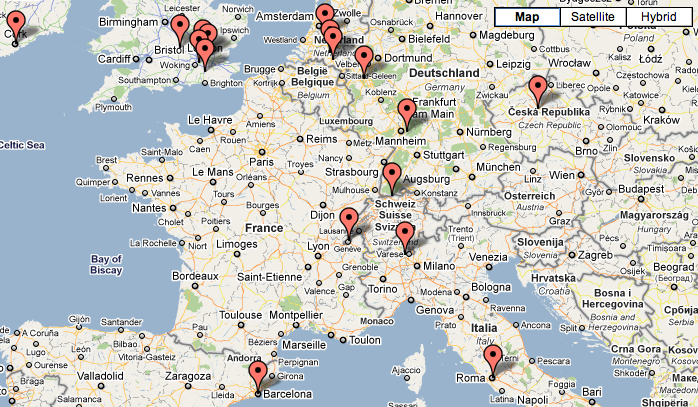
We saw cognitive surplus and macrowikinomics in action in the wake of the Haiti earthquake when more than a thousand Creole-speaking volunteers in no fewer than 49 countries around the world contributed thousands of hours of their own free time to translate tens of thousands of text messages coming from the disaster-affected population in Haiti. The map above depicts the location of each digital volunteer based on their ISP address.

As I noted in my talk at PopTech last year, it was an emotional reaction to the breaking news on CNN that prompted me to call my colleague David Kobia at Ushahidi to launch a crisis map of Haiti. But it was access to social networks, cognitive surplus, free social networking and easy mapping tools that translated that initially private, emotional reaction into public, collective action. And this was by no means a one-off, as I recently noted in my blog post on Changing the World One Map at a Time.

The Standby Task Force volunteers behind the Libya crisis map have been equally inspiring. They come from diverse backgrounds and live in some 30 countries. The map above doesn’t (yet) include all the 220+ Task Force volunteers, but it  gives you an idea of just how global this initiative is.

Just yesterday, I found out that one volunteer is an airside manager at Heathrow airport in charge of real-time crisis management and incident control. He jumps on Skype to help out on the Libya crisis map after the last aircraft have taken off around midnight. Another is 63 and was part of an initial group that put the pieces together leading to the modern tour business of rock and roll concerts back in the 1970s. He did the setup for the Simon & Garfunkle tour in the early 80s. A third volunteer brings 16 years of disaster management experience to the Task Force and has lead a number of international search & rescue teams around the world. I could go on, and on—there are more than 200 of such profiles!

It’s also great to see that the Task Force is nowhere close to just being a “Global North” initiative. We have volunteers from (or based in) Haiti, Ghana, Egypt, Sudan, United Arab Emirates, Tajikistan, Sri Lanka, Singapore, Australia, Samoa, Colombia and Brazil. And this is again just a subset.

These volunteers have accomplished so much over the past 7 days. An hour after UN/OCHA requested activation of the Task Force, the Tech Team launched the technical platform for the crisis map using Ushahidi, which they’ve been customizing (front-end and back-end) every day since. They launched a second map for the public just days later and in the first 3 days of that launch, the site received 18,000+ unique visitors and 44,000+ pageviews from 65 countries.

The Media Monitoring Team, Geolocation Team, Reports Team and Verification Team have mapped some 500 individual reports in just 7 days. They’ve been monitoring over 70 individual online sources almost around the clock for relevant content that can be added to the map. The Geolocation Team has found GPS coordinates for all the reports that end up on the map thanks to the Reports Team. The Analysis Team has produced a number of important heat maps and trends analysis reports for OCHA. The Verification Team has been providing quality control for the mapped data and triangulating reports whenever possible.

Meanwhile, the Task Team has focused on two core and urgent research projects solicited by the UN to improve the crisis map and their preparedness operations. The Humanitarian Liaison Team is composed of Task Force coordinators and representatives from the UN and other humanitarian groups. They facilitate communication between the teams listed above and our humanitarian partners. Between them, all of these teams have written over 1,200 Word document pages, font size 10, based on their exchanges on the Skype—again in just 7 days. Did I mention that these are all volunteers contributing their own “cognitive surplus” above and beyond their current jobs, classes, family lives?

It’s incredible to think that the Task Force only launched last October. And it’s only going to keep getting better, keep growing. Indeed, we’re now in touch with the coordinators of the United Nations Volunteer (UNV) program after I suggested to the UN in a phone conversation and my previous blog post that we tap into that resource to scale the Task Force’s support for Libya and beyond. It turns out the UN has an Online Volunteers Service (OVS) website!

According to our contacts at OVS,

“Many NGOs, governments and United Nations agencies already recognize the value of online volunteering, their satisfaction with the collaboration with online volunteers runs at 90%.  In 2010, our three person OVS staff team mobilized 10,000 online volunteers from 168 countries who completed 15,000 assignments, amongst them online volunteers who supported UN OCHA Colombia in the area of disaster related data gathering and management.”

To say I’m super, super excited about this potential collaboration would be an understatement. In fact, I always grin when writing the following to recruit new volunteers: “So, you want to be a Crisis Mapper?” Totally stealing Yoda’s line from StarWars when he asks young Luke Skywalker: “So, you want to be a Jedi, hmmmm?” For me, today’s Jedis are definitely the crisis mappers I work with on the Task Force. So as I’m fond of saying:

“May the Crowd be with you, always.”

Crisis Mapping Libya: This is No Haiti (Updated)

Update: Public version of Libya Crisis Map now available:

http://libyacrisismap.net

We activated the Standby Volunteer Task Force (SBTF) on March 1st and quickly launched a Crisis Map of Libya to support humanitarian preparedness opera-tions. This is the largest deployment of the Task Force since it was formed at the 2010 International Conference on Crisis Mapping in Boston (ICCM 2010). Task Force partners include CrisisMappers, CrisisCommons, Humanity Road, ICT4Peace, Open Street Map and MapAction. The Task Force currently has trained 166 volunteers. I’m amazed at how far we’ve come since the response to the Haiti earthquake.

Crisis mapping Libya is definitely no Haiti, for many reasons. The first is that unlike Haiti, we didn’t have to recruit crisis mapping volunteers from scratch. We didn’t have to spend a third of our time training volunteers. We didn’t have to develop new work flows and protocols from thin air. All we had to do was activate the Standby Task Force and everyone knew what to do, like set up dedicated Skype chats (communicating via email is too slow in these scenarios, networked communication is the way to go). Our volunteer CrisisMappers had already been trained and had even participated in an official UN crisis simulation exercise with OCHA in Colombia a few months earlier.

The second reason why this is no Haiti is because the request for activation of the Standby Task Force to provide live crisis mapping support came directly from the UN OCHA’s Information Management unit in Geneva. This was not the case in Haiti since there was no precedent for the crisis mapping efforts we launched at the time. We did not have buy in from the humanitarian community and the latter was reluctant to draw on anything other than official sources of information. Crowdsourcing and social media were unchartered territories. OCHA also reached out to CrisisCommons and OpenStreetMap and we are all working together more closely than ever before.

Contrast this to the case of Libya this week which saw an established humanitarian organization specifically request a volunteer technical community for a live map of reports generated from Twitter, Facebook, Flickr, YouTube and mainstream media sources. Seriously, I have never been more impressed by the humanitarian community than I am today. The pro-active approach they have taken and their constructive engagement is absolutely remarkable. This is truly spectacular and the group deserve very high praise.

From the official annoucement:

OCHA, UNOSAT and NetHope have been collaborating with the Volunteer Technical Community (VTC) specifically including the CrisisMappers, Crisis Commons, Open Street Map, and the Google Crisis Response Team over the past week. The CrisisMappers Standby Task Force has been undertaking a mapping of social media and new reports from within Libya and along the borders at the request of OCHA.  As well, the Task Force is aiding in the collection and mapping of 3W information for the response. UNOSAT is kindly hosting the Common Operational Datasets to be used during the emergency (http://www.unitar.org/unosat/libya). Interaction with these groups is being coordinated by OCHA’s Information Services Section. Focal Point: Andrej Verity [verity@un.org].

The third reason this is no Haiti is because we are creating a live map of a hostile situation still unfolding. Haiti provided a permissive environment, politically and geographically. Libya couldn’t be more different. We experienced the serious challenges of crisis mapping a hostile environment when we created a crisis map of Khartoum at the request of local Sudanese activists. This was a stressful deployment but one that was able to provide an important window into what was happening in Khartoum.

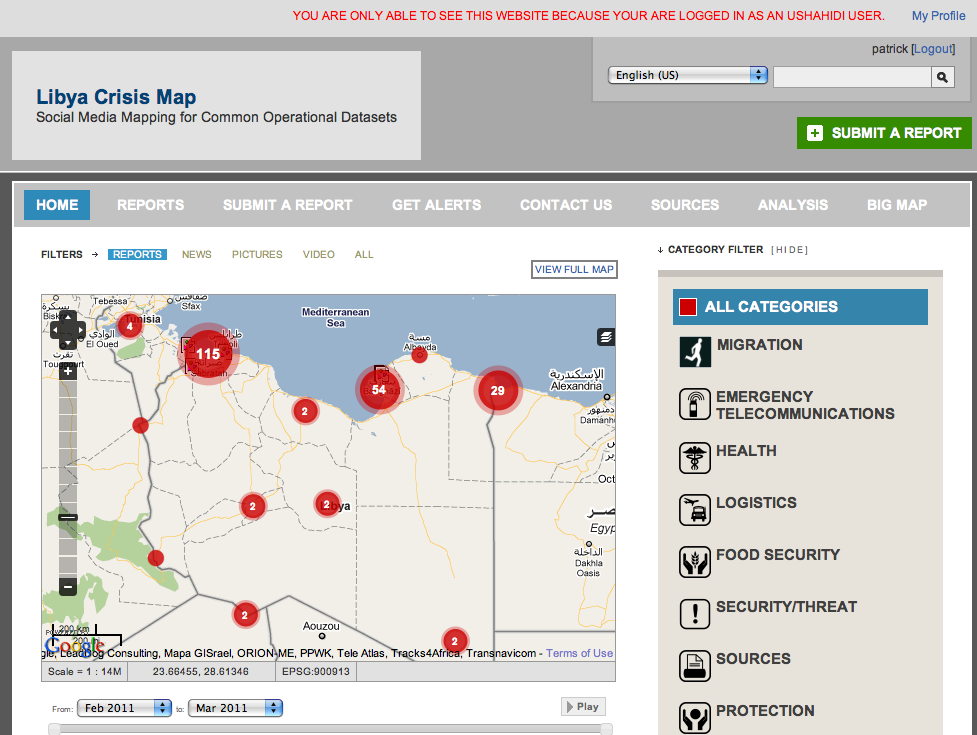
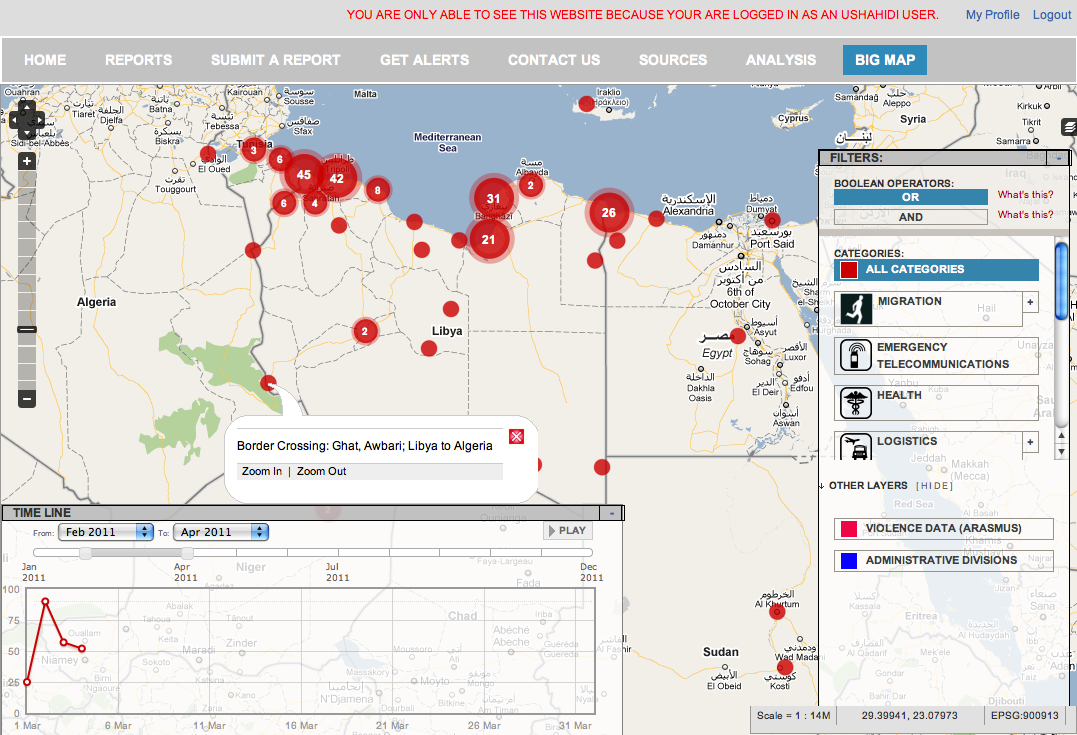
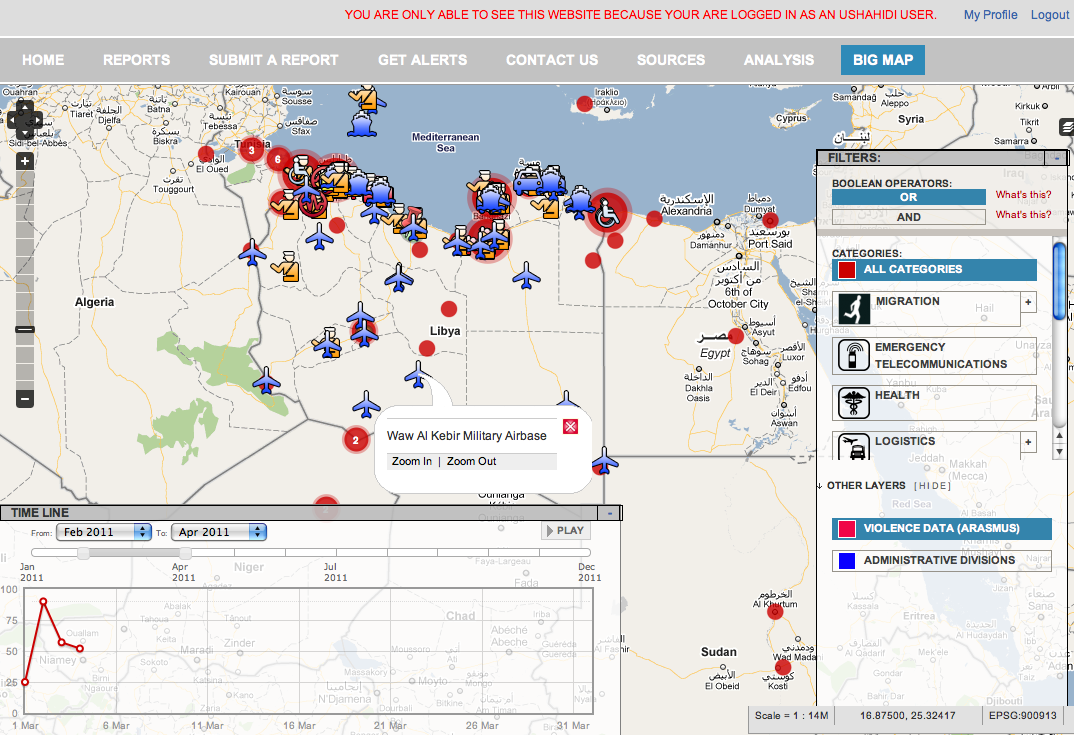
In the case of Libya, our humanitarian partner requested that the crisis map be password protected. We intend to make the map public after this phase of the humanitarian operations is over. In the meantime, the screenshots below provide a good picture of what the platform looks like. In the first 48 hours since the activation of the Task Force, over 220 individual reports have been mapped, many including pictures and some with video footage.

We also pulled in the data from the Google Map created by @Arasmus to complement our own live mapping:

None of the above would be possible without such a dedicated network of skilled crisis mapping volunteers. They are truly outstanding and a testament to what civic engagement can do online from thousands of miles away. There’s no doubt that our approach can still be improved. But there’s equally no doubt that all the learning we did in Haiti, Chile and Pakistan went beyond just recommendations but were actually  put into practice in a big way thanks to the Task Force.

The Task Force has over 160 volunteers from 18 different countries. Do you want to become one of those crisis mappers? If so, please send an email to join@standbytaskforce.com and we’ll train you on how to become a real pro in crisis mapping.

Check-In’s with a Purpose: Applications for Disaster Response

This is the second post in my check-in’s-with-a-purpose series. The first post looked at the use of check-in’s to coordinate activist campaigns and street protests. The check-in’s series builds on Ushahidi’s free and open-source check-in service (CI) slated to launch in just a few weeks at SxSW 2011.

So how might organizations and local groups be able to use CI for disaster response? In three ways: (1) preparedness; (2) coordination; and (3) evaluation.

Preparedness

When you walk into a disaster area, say following an earthquake, you don’t want to be swamped with all kinds of information imaginable. You only want information relevant to you and your responsibilities in a given geographic area (demand side versus supply side). CI provides an easy, intuitive interface for this. You check-in when you want additional info about the area you are in.

This is similar to the idea of geo-caching, hence the reference to preparedness. You embed (or pre-populate) a given map with relevant structural and event-data for a given area. By structural data, I mean physical infrastructure such as hospitals, schools, etc. Event-data simply refers to nearby incidents. New data could be regularly embedded into the map (via geo-RSS feeds) to provide the latest event-data available. When you check-in, CI provides you with information and updates relevant to your vicinity and profile. For example, if you’ve added “health” as a tag on your profile, CI could prioritize health-based information when you check-in, including the location of other health-workers and their contact info.

There is another equally important angle to preparedness when it comes to check-in’s. Mapping infrastructure vulnerable to disasters is common practice in disaster risk reduction projects. These can be community-driven and participatory, giving local communities a stake in building their own resilience. In one such project, local communities in neighborhoods around Istanbul mapped infrastructure vulnerable to earthquake damage, e.g., overhanging structures like balconies. They also mapped local shelters, possible escape routes, etc. CI could be used for this type of crowdsourced, participatory mapping. Crowdfeeding would then simply happen by checking-in. The sign “In case of emergency, break glass” would become “In case of emergency, check-in.”

Coordination

What about coordination? Keeping track of who is in a disaster area, and where, is no easy task. A check-in service would go a long way to addressing this coordination challenge. Call it instant mapping. Disaster responders would simply click the check-in app on their smart phones after they land in a disaster area to check-in. Each organization could set up their own check-in service to coordinate their staff with instant maps. Check-in deployments could also be project- or cluster-based.

In addition, an open check-in deployment could be set up for all responders. A separate CI deployment would be especially useful if hundreds of volunteers decide to fly in. They could be tasked more efficiently if they first checked-in. Doing so would provide coordinators with access to individual profiles with listed skill sets and contact info, much like a LinkedIn profile. Disaster responders and volunteers could also check-out once they leave a disaster area.

A check-in service could facilitate a number of other coordination challenges. Finding missing persons after a disaster has always been difficult, for example. One way to let others know you’re ok would be by checking in. Doing so would prompt the CI service to provide you with the latest on the disaster that took place, information on nearby services and who in your own professional or social network is in the vicinity long with their contact info. This could also be a way to coordinate corporate social responsibility projects in the immediate aftermath of a disaster. Large companies with employees wanting to help could simply check-in to their CI service to get information on how to help.

Evaluation

Check-in’s could also be used for evaluation and accountability purposes. Once you’ve accomplished a task, you could quickly check-in with an update, which would leave a digital trace of your accomplishment. Or say you’re on your way to a food distribution site and drive past some newly flooded houses, you could quickly check-in with that information to update everyone else on your network. CI can also be used with badges and points, allowing people to develop a track-record of their work in a disaster area.

Some Challenges

There are of course some challenges in using a CI service for disaster response. Keep it simple. This is perhaps the most important point. One could very easily go all out and add countless features to a CI service. Such is the beauty of open source software. For disaster response, however, the trick will be to keep it simple and not try to turn CI into a solution for everything. If data coverage isn’t possible, then a check-in service should allow for SMS-based check-in’s. This could be done by using SMSsync. Another challenge will be to provide a seamless way to check into multiple CI deployments at the same time and for these to be interoperable. For example, if I’m with WFP, I should be able to check-in on the WFP CI and have my check-in appear simultaneously on the Food Cluster CI, OCHA CI, etc.

If you have ideas about how a check-in service could be used for disaster response, or recommendations on what would make Ushahidi’s CI system more useful, please do add them in the comments section below. My next post in this check-in’s-with-a-purpose series will describe how a CI service combined with gaming can be used to catalyze civic participation and engagement across a range of activities.

Facebook https is now live for Sudan

A very big thank you to the team at Facebook for allowing users in the Sudan to access Facebook securely. Instead of using the regular http:// access to the site, using https:// means that your connection is securely encrypted. This prevents malicious users from spying on your account and seeing your password, for example. This is why all online banking websites use https, as does Google with gmail. Tunisia in many ways set the precedent. Read this excellent account on the inside story of how Facebook responded to Tunisian hacks.

As we have seen in many situations, Facebook is often used by activists to schedule and coordinate mass action. This is equally true of the Sudan, with this Jan30 Facebook group, which now has over 17,000 members. However, in my recent Skype conversations with a number of Sudanese activists, I’ve realized that many of them didn’t know that the Tunisian government (for example) had been able to hack into Facebook accounts. While using https is not a complete panacea, it definitely is a step in the right direction re communicating securely in repressive environments. I’ve also encouraged colleagues to switch to using Hushmail for email communication.

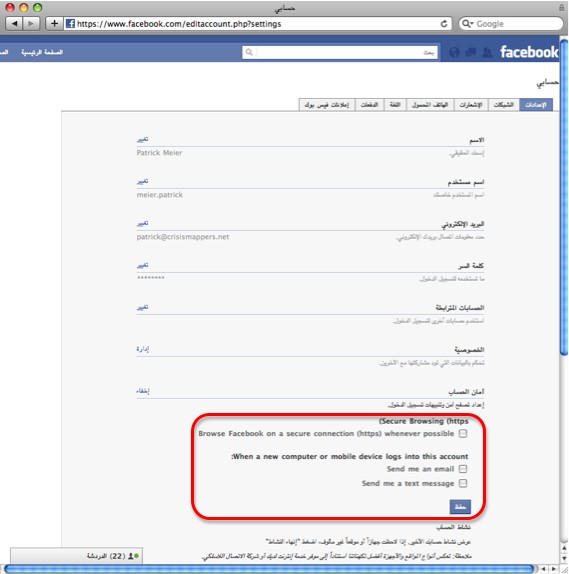
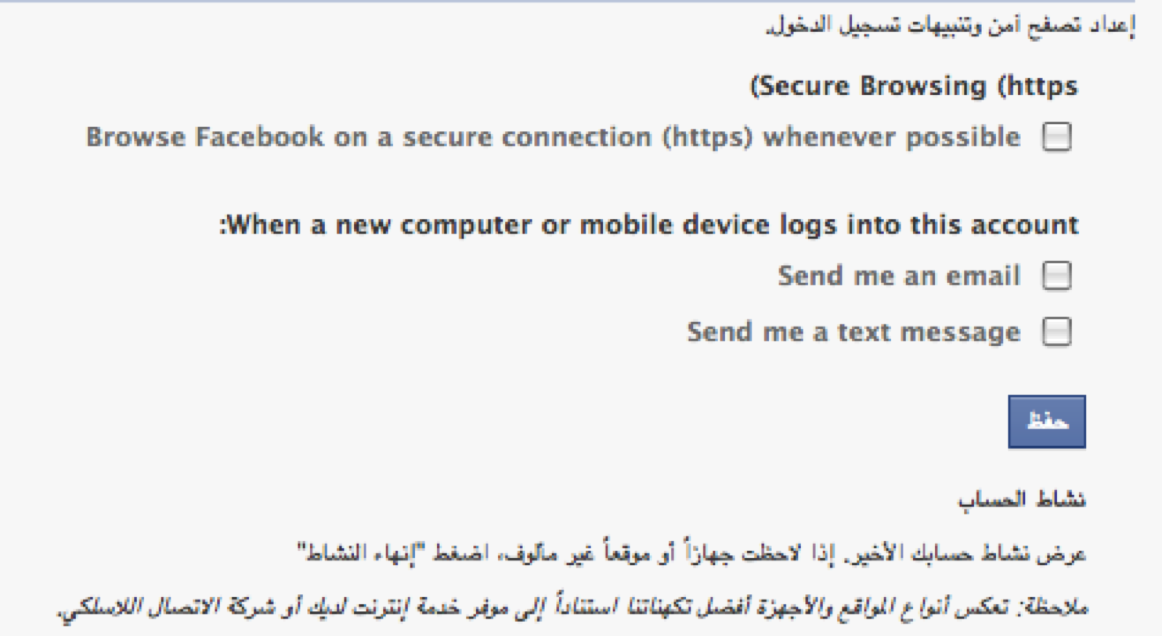
So for colleagues in the Sudan, to set up https:// access, go to “My Account” then “Settings” and then “Account Security.” Here’s the equivalent in the Arabic interface:

You should click on “Browse Facebook on a secure connection (https) whenever possible” and also on “Send me an email” that way you get sent an automated email when a new computer or mobile phone logs into your account. If you have any questions, feel free to add them in the comments section of this blog.

Here are some other steps you can take to use Facebook more securely:

1. Do not share sensitive info on FB
2. User passphrases instead of passwords
3. Change you name, or at least do not provide your full name on FB*
4. Do not use a picture of yourself for your FB profile picture
5. Logout of FB when not using the site

* Use this with caution as it violates FB’s terms of service and if someone is targeting you, they can report you to FB. Also do not give FB your identification if asked (@JillianYork).

Again, using https and following these five steps is no guarantee that your account won’t be hacked, but it maximizes your chances of using Facebook more safely. If you have any security tips to share, please add them in the comments section of this blog post.

A big thank you once again to Facebook. I emailed them (via another colleague) with my concerns regarding Sudanese activists and they responded in a just a matter of hours. Facebook is also in the process of rolling this https option out for all their users worldwide.