Category Archives: Humanitarian Technologies

Google’s New Earth Engine for Satellite Imagery Analysis: Applications to Humanitarian Crises

So that’s what they’ve been up to. Google is developing a new computational platform for global-scale analysis of satellite imagery to monitor deforestation. But this is just “the first of many Earth Engine applications that will help scientists, policymakers, and the general public to better monitor and understand the Earth’s ecosystems.”

How about the Earth’s social systems? Humanitarian crises? Armed conflicts? This has been one of the main drivers of the Program on Crisis Mapping and Early Warning (CM&EW) which I co-direct at the Harvard Humanitarian Initiative (HHI) with Dr. Jennifer Leaning. Indeed, we had a meeting with the Google Earth team earlier this year to discuss the development of a computational platform to analyze satellite imagery of humanitarian crises for the purposes of early detection and early response.

In particular, we were interested in determining whether certain spatial patterns could be identified and if so whether we could develop a taxonomy of different spatial patterns of humanitarian crises; something like a library of “crisis finger prints.” As we noted to Google in writing following the conversations,

It is our view that the work of interpretation will be powerfully enhanced by the development of valid patterns relating to issues of importance in specific sets of circumstances that can be reproducibly recognized in satellite imagery. To be sure, the geo-spatial analysis of humanitarian crisis can serve as an important control mechanism for Google’s efforts in extending the functionality of Google Earth and Google’s analytical expertise.

This is something that a consortium of organizations including HHI can get engaged in. Population movement and settlement, shelter options and conditions, environmental threats, access to food and water, are discernible from various elements and resolution levels of satellite imagery.  But much more could be apprehended from these images were patterns assembled and then tested against other information sources and empirical field assessments. For an excellent presentation on this, see my colleague Jennifer Leaning’s excellent Keynote address at ICCM 2009:

The military uses of satellite imagery are far more developed than the humanitarian capacities because the interpretive link between what can be seen in the image and what is actually happening on the ground has been made, in great iterative detail, over a period of many years, encompassing a wide span of geographies and technological deployments. We need to develop a process to explore and validate what can be understood from satellite imagery about key humanitarian concerns by augmenting standard satellite analytics with time-specific and informed assessments of what was concurrently taking place in the location being photographed.

The potential for such applications has just begun to surface in humanitarian circles.  The Darfur Google initiative has demonstrated the force of vivid images of destruction tethered to actual locations of villages across the span of Darfur.  Little further detail is available from the actual images, however, and much of the associated information depicted by clicking on the image is static derived from other sources, somewhat laboriously acquired.  The full power of what might be gleaned simply from the satellite image remains to be explored.

Because systematic and empirical analysis of what a series of satellite images might reveal about humanitarian issues has not yet been undertaken, any effort to draw inferences from current images does not lead far.  The recent coverage of the war in Sri Lanka included satellite photos of the same contested terrain in the northeast, for two time frames, a month apart.  The attempt to determine what had transpired in that interim, relating to population movement, shelter de-construction and reconstruction, and land bombardment, was a matter of conjecture.

Bridging this gap from image to insight will not only be a matter of technological enhancement of satellite imaging. It will require interrogating the satellite images through the filter of questions and concerns that are relevant to humanitarian action and then infusing other kinds of information, gathered through a range of methods, to create visual metrics for understanding what the images project.

There is a lot of exciting work to be done in this space and I do hope that Google will seek to partner with humanitarian organizations and applied research institutes to develop an Earth Engine for Humanitarian Crises. While the technological and analytical breakthroughs are path breaking, let us remember that they can be even more breathtaking by applying them to save lives in humanitarian crises.
Patrick Philippe Meier

New Tech in Emergencies and Conflicts: Role of Information and Social Networks

I had the distinct pleasure of co-authoring this major new United Nations Foundation & Vodafone Foundation Technology Report with my distinguished colleague Diane Coyle. The report looks at innovation in the use of technology along the time line of crisis response, from emergency preparedness and alerts to recovery and rebuilding.

“It profiles organizations whose work is advancing the frontlines of innovation, offers an overview of international efforts to increase sophistication in the use of IT and social networks during emergencies, and provides recommendations for how governments, aid groups, and international organizations can leverage this innovation to improve community resilience.”

Case studies include:

  • Global Impact and Vulnerability Alert System (GIVAS)
  • European Media Monitor (EMM, aka OPTIMA)
  • Emergency Preparedness Information Center (EPIC)
  • Ushahidi Crowdsourcing Crisis Information
  • Télécoms sans Frontières (TSF)
  • Impact of Social Networks in Iran
  • Social Media, Citizen Journalism and Mumbai Terrorist Attacks
  • Global Disaster Alert and Coordination System (GDACS)
  • InSTEDD RIFF
  • UNOSAT
  • AAAS Geospatial Technologies for Human Rights
  • Info Technology for Humanitarian Assistance, Cooperation and Action (ITHACA)
  • Camp Roberts
  • OpenStreetMap and Walking Papers
  • UNDP Threat and Risk Mapping Analysis project (TRMA)
  • Geo-Spatial Info Analysis for Global Security, Stability Program (ISFEREA)
  • FrontlineSMS
  • M-PESA and M-PAISA
  • Souktel

I think this long and diverse list of case studies clearly shows that the field of humanitarian technology is coming into it’s own.  Have a look at the report to learn how all these fit in the ecosystem of humanitarian technologies. And check out the tag #Tech4Dev on Twitter or the UN Foundation’s Facebook page to discuss the report and feel free to add any comments to this blog post below. I’m happy to answer all questions. In the meantime, I salute the UN Foundation for producing a forward looking report on projects that are barely two years old, and some just two months old.

Patrick Philippe Meier

Applying Technology to Crisis Mapping and Early Warning in Humanitarian Settings

The Harvard Humanitarian Initiative (HHI) just published a working paper I co-authored with my colleague Dr. Jennifer Leaning. Jennifer and I co-founded the Program on Crisis Mapping and Early Warning (CM&EW) back in 2007 with the generous support of Humanity United (HU).

During this two-year period, HU commissioned a series of internal working papers to inform their thinking in the field of crisis mapping. The report just published by HHI is one of the first internal papers we produced for HU. I am particularly indebted to my HHI colleague Enzo Bollettino for pushing this initiative working paper series at HHI.

This inaugural working paper presents a conceptual framework that distinguishes between the “big world” and “small world” to assess the use of ICTs for communication in conflict zones. The study does so by delineating the multiple information pathways relevant for conflict early warning, crisis mapping and humanitarian response.

The second and third working paper in the series will address information collection and visual analysis respectively. Each working paper will highlight existing projects or case studies; draw on informative anecdotes; and/or relay the most recent thinking on future applications of ICTs.

This working paper series is not meant to be exhaustive since humanitarian tech as a field of study and practice is still in formative phases. The analysis that follows is simply one step forward in trying to understand where the field is headed. We very much welcome feedback and input from fellow colleagues in the community. Feel free to use the comments section below to share your thoughts.

The working paper is available on the website of HHI’s Crisis Mapping Program.

Patrick Philippe Meier

Evolving a Global System of Info Webs

I’ve already blogged about what an ecosystem approach to conflict early warning and response entails. But I have done so with a country focus rather than thinking globally. This blog post applies a global perspective to the ecosystem approach given the proliferation of new platforms with global scalability.

Perhaps the most apt analogy here is one of food webs where the food happens to be information. Organisms in a food web are grouped into primary producers, primary consumers and secondary consumers. Primary producers such as grass harvest an energy source such as sunlight that they turn into biomass. Herbivores are primary consumers of this biomass while carnivores are secondary consumers of herbivores. There is thus a clear relationship known as a food chain.

This is an excellent video visualizing food web dynamics produced by researchers affiliated with the Santa Fe Institute (SFI):

Our information web (or Info Web) is also composed of multiple producers and consumers of information each interlinked by communication technology in increasingly connected ways. Indeed, primary producers, primary consumers and secondary consumers also crawl and dynamically populate the Info Web. But the shock of the information revolution is altering the food chains in our ecosystem. Primary consumers of information can now be primary producers, for example.

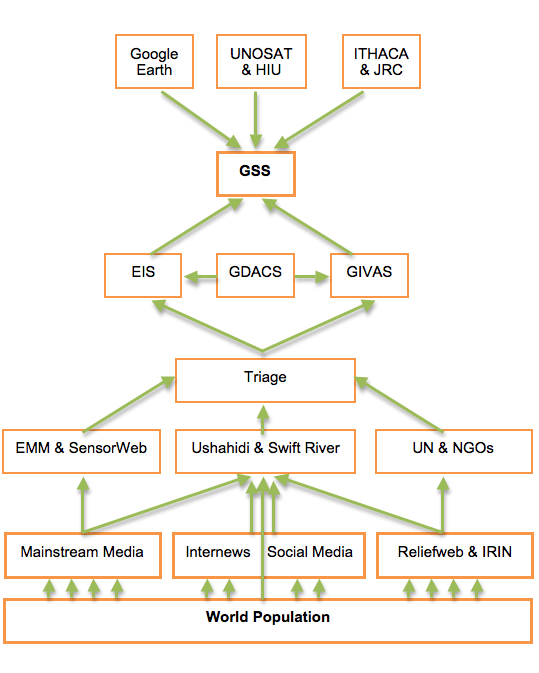
At the smallest unit of analysis, individuals are the most primary producers of information. The mainstream media, social media, natural language parsing tools, crowdsourcing platforms, etc, arguably comprise the primary consumers of that information. Secondary consumers are larger organisms such as the global Emergency Information Service (EIS) and the Global Impact and Vulnerability Alert System (GIVAS).

These newly forming platforms are at different stages of evolution. EIS and GIVAS are relatively embryonic while the Global Disaster Alert and Coordination Systems (GDACS) and Google Earth are far more evolved. A relatively new organism in the Info Web is the UAV as exemplified by ITHACA. The BrightEarth Humanitarian Sensor Web (SensorWeb) is further along the information chain while Ushahidi’s Crisis Mapping platform and the Swift River driver are more mature but have not yet deployed as a global instance.

InSTEDD’s GeoChat, Riff and Mesh4X solutions have already iterated through a number of generations. So have ReliefWeb and the Humanitarian Information Unit (HIU). There are of course additional organisms in this ecosystem, but the above list should suffice to demonstrate my point.

What if we connected these various organisms to catalyze a super organism? A Global System of Systems (GSS)? Would the whole—a global system of systems for crisis mapping and early warning—be greater than the sum of its parts? Before we can answer this question in any reasonable way, we need to know the characteristics of each organism in the ecosystem. These organisms represent the threads that may be woven into the GSS, a global web of crisis mapping and early warning systems.

Global System of Systems

Emergency Information Service (EIS) is slated to be a unified communications solution linking citizens, journalists, governments and non-governmental organizations in a seamless flow of timely, accurate and credible information—even when local communication infrastructures are rendered inoperable. This feature will be made possible by utilizing SMS as the communications backbone of the system.

In the event of a crisis, the EIS team would sift, collate, make sense of and verify the myriad of streams of information generated by a large humanitarian intervention. The team would gather information from governments, local media, the military, UN agencies and local NGOs to develop reporting that will be tailored to the specific needs of the affected population and translated into local languages. EIS would work closely with local media to disseminate messages of critical, life saving information.

Global Impact and Vulnerability Alert System (GIVAS) is being designed to closely monitor vulnerabilities and accelerate communication between the time a global crisis hits and when information reaches decision makers through official channels. The system is mandated to provide the international community with early, real-time evidence of how a global crisis is affecting the lives of the poorest and to provide decision-makers with real time information to ensure that decisions take the needs of the most vulnerable into account.

BrightEarth Humanitarian Sensor Web (SensorWeb) is specifically designed for UN field-based agencies to improve real time situational awareness. The dynamic mapping platform enables humanitarians to easily and quickly map infrastructure relevant for humanitarian response such as airstrips, bridges, refugee camps, IDP camps, etc. The SensorWeb is also used to map events of interest such as cholera outbreaks. The platform leverages mobile technology as well as social networking features to encourage collaborative analytics.

Ushahidi integrates web, mobile and dynamic mapping technology to crowdsource crisis information. The platform uses FrontlineSMS and can be deployed quickly as a crisis unfolds. Users can visualize events of interest on a dynamic map that also includes an animation feature to visualize the reported data over time and space.

Swift River is under development but designed to validate crowdsourced information in real time by combining machine learning for predictive tagging with human crowdsourcing for filtering purposes. The purpsose of the platform is to create veracity scores to denote the probability of an event being true when reported across several media such as Twitter, Online news, SMS, Flickr, etc.

GeoChat and Mesh4X could serve as the nodes connecting the above platforms in dynamic ways. Riff could be made interoperable with Swift River.

Can such a global Info Web be catalyzed? The question hinges on several factors the most important of which are probably awareness and impact. The more these individual organisms know about each other, the better picture they will have of the potential synergies between their efforts and then find incentives to collaborate. This is one of the main reasons I am co-organizing the first International Conference on Crisis Mapping (ICCM 2009) next week.

Patrick Philippe Meier

Global Impact and Vulnerability Alert System (GIVAS): A New Early Warning Initiative?

Update: This project is now called UN Global Pulse.

UN Secretary-General Ban Ki-Moon is calling for better real-time data on the impact of the financial crisis on the poor. To this end, he is committing the UN to the development of a Global Impact and Vulnerability Alert System (or GIVAS) in the coming months.  While I commend the initiative’s focus on innovative data collection, I’m concerned that this is yet another “early warning system” that will fail to bridge alert and operational response.

The platform is being developed in collaboration with the World Bank and will use real time data to assess the vulnerability of particular countries or populations. “This will provide the evidence needed to determine specific and appropriate responses,” according to UNDP. UN-Habitat opines that the GVA will be a “vital tool to know what is happening and to hold ourselves accountable to those who most need our help.”

According to sources, the objective for the GIVAS is to “ensure that in times of global crisis, the fate of the poorest and most vulnerable populations is not marginalized in the international community’s response. By closely monitoring emerging and dramatically worsening vulnerabilities on the ground, the Alert would fill the information gap that currently exists between the point when a global crisis hits vulnerable populations and when information reaches decision makers through official statistical channels.”

GIVAS will draw on both high frequency and low frequency indicators:

The lower frequency contextual indicators would allow the Alert system to add layers of analysis to the real time “evidence” generated by the high frequency indicators. Contextual indicators would provide information, for example, on a country’s capacity to respond to a crisis (resilience) or its exposure to a crisis (transmission channels). Contextual indicators could be relatively easily drawn from existing data bases. Given their lesser crisis sensitivity, they are generally collected less frequently without losing significantly in relevance.”

The high frequency indicators would allow the system to pick up significant and immediately felt changes in vulnerability at sentinel sites in specific countries. This data would constitute the heart of the Alert system, and would provide the real-time evidence – both qualitative and quantitative – of the effects of external shocks on the most vulnerable populations. Data would be collected by participating partners and would be uploaded into the Alert’s technical platform.”

The pulse indicators would have to be highly crisis sensitive (i.e. provide early signals that there is a significant impact), should be available in high periodicity and should be able to be collected with relative ease and at a reasonable cost. Data would be collected using a variety of methodologies, including mobile communication tools (i.e. text messaging), quick impact assessment surveys, satellite imagery and sophisticated media tracking systems.”

The GIVAS is also expected to use natural language processing (NLP) to extract data from the web. In addition, GIVAS will also emphasize the importance of data presentation and possibly draw on Gapminder’s Trendalyzer software.

There’s a lot more to say on GIVAS and I will definitely blog more about this new initiative as more information becomes public. My main question at this point is simple: How will GIVAS seek to bridge the alert-response gap? Oh, and a related question: has the GIVAS team reviewed past successes and failures of early warning/response systems?

Patrick Philippe Meier

OCHA’s Humanitarian Dashboard

I recently gave a presentation on Crisis Mapping for UN-OCHA in Nairobi and learned a new initiative called the Humanitarian Dashboard. The Dashboard is still in its development phase so the content of this post is subject to change in the near future.

I was pleasantly surprised to find out that Nick Haan, a colleague from years back, is behind the initiative. I had consulted Nick on a regular basis back in 2004-2005 when working on CEWARN. He was heading the Food Security Assessment Unit (FSAU) at the time.

Here’s a quick introduction to the Humanitarian Dashboard:

The goal of the Dashboard is to ensure evidence-based humanitarian decision making for more needs-based, effective, and timely action.  The business world is well-accustomed to dashboards for senior executives in order to provide them with a real-time overview of core business data, alert them of potential problems, and keep operations on-track for desired results.

Stephen Few, a leader in dashboard design defines a dashboard as “a single-screen display of the most important information people need to do a job, presented in a way that allows them to monitor what’s going on in an instant.”   Such a single-screen or single-page overview, updated in real time, does not currently exist in the humanitarian world.”

The added values of the Dashboard:

  1. It would allow humanitarian decision-makers to more quickly access the core and common humanitarian information that they require and to more easily compare this information across various emergencies;
  2. It would provide a common platform from which essential big picture and cross sectoral information can be discussed and debated among key stakeholders, fostering greater consensus and thus a more coordinated and effective humanitarian response;
  3. It would provide a consolidated platform of essential information with direct linkages to underlying evidence in the form of reports and data sets, thus providing a much needed organizational tool for the plethora of humanitarian information;
  4. It would provide a consistently structured core data set that would readily enable a limitless range of humanitarian analysis across countries and over-time.

I look forward to fully evaluating this new tool, which is currently being piloted in Somalia, Kenya and Pakistan.

Patrick Philippe Meier

OCHA’s Humanitarian Dashboard

I recently gave a presentation on Crisis Mapping for UN-OCHA in Nairobi and learned a new initiative called the Humanitarian Dashboard. The Dashboard is still in its development phase so the content of this post is subject to change in the near future.

I was pleasantly surprised to find out that Nick Haan, a colleague from years back, is behind the initiative. I had consulted Nick on a regular basis back in 2004-2005 when working on CEWARN. He was heading the Food Security Assessment Unit (FSAU) at the time.

Here’s a quick introduction to the Humanitarian Dashboard:

The goal of the Dashboard is to ensure evidence-based humanitarian decision making for more needs-based, effective, and timely action.  The business world is well-accustomed to dashboards for senior executives in order to provide them with a real-time overview of core business data, alert them of potential problems, and keep operations on-track for desired results.

Stephen Few, a leader in dashboard design defines a dashboard as “a single-screen display of the most important information people need to do a job, presented in a way that allows them to monitor what’s going on in an instant.”   Such a single-screen or single-page overview, updated in real time, does not currently exist in the humanitarian world.”

The added values of the Dashboard:

  1. It would allow humanitarian decision-makers to more quickly access the core and common humanitarian information that they require and to more easily compare this information across various emergencies;
  2. It would provide a common platform from which essential big picture and cross sectoral information can be discussed and debated among key stakeholders, fostering greater consensus and thus a more coordinated and effective humanitarian response;
  3. It would provide a consolidated platform of essential information with direct linkages to underlying evidence in the form of reports and data sets, thus providing a much needed organizational tool for the plethora of humanitarian information;
  4. It would provide a consistently structured core data set that would readily enable a limitless range of humanitarian analysis across countries and over-time.

I look forward to fully evaluating this new tool, which is currently being piloted in Somalia, Kenya and Pakistan.

Patrick Philippe Meier

Part 6: Mobile Technologies and Collaborative Analytics

This is Part 6 of 7 of the highlights from “Illuminating the Path: The Research and Development Agenda for Visual Analytics.” Please see this post for an introduction to the study and access to the other 6 parts.

Mobile Technologies

The National Visual Analytics Center (NVAC) study recognizes that “mobile technologies will play a role in visual analytics, especially to users at the front line of homeland security.” To this end, researchers must “devise new methods to best employ these technologies and provide a means to allow data to scale between high-resolution displays in command and control centers to field-deployable displays.”

Collaborative Analytics

While collaborative platforms from wiki’s to Google docs allow many individuals to work collaboratively, these functionalities rarely feature in crisis mapping platforms. And yet, humanitarian crises (just like homeland security challenges) are so complex that they cannot be addressed by individuals working in silos.

On the contrary, crisis analysis, civilian protection and humanitarian response efforts are “sufficiently large scale and important that they must be addressed through the coordinated action of multiple groups of people, often with different backgrounds working in disparate locations with differing information.”

In other words, “the issue of human scalability plays a critical role, as systems must support the communications needs of these groups of people working together across space and time, in high-stress and time-sensitive environments, to make critical decisions.”

Patrick Philippe Meier

UN Sudan Information Management Working (Group)

I’m back in the Sudan to continue my work with the UNDP’s Threat and Risk Mapping Analysis (TRMA) project. UN agencies typically suffer from what a colleague calls “Data Hugging Disorder (DHD),” i.e., they rarely share data. This is generally the rule, not the exception.

UN Exception

There is an exception, however: the recently established UN’s Information Management Working Group (IMWG) in the Sudan. The general goal of the IMWG is to “facilitate the development of a coherent information management approach for the UN Agencies and INGOs in Sudan in close cooperation with local authorities and institutions.”

More specifically, the IMWG seeks to:

  1. Support and advise the UNDAF Technical Working Groups and Work Plan sectors in the accessing and utilization of available data for improved development planning and programming;
  2. Develop/advise on the development of, a Sudan-specific tool, or set of tools, to support decentralized information-sharing and common GIS mapping, in such a way that it will be consistent with the DevInfo system development, and can eventually be adopted/integrated as a standard plug-in for the same.

To accomplish these goals, the IMWG will collectively assume a number of responsibilities including the following:

  • Agree on  information sharing protocols, including modalities of shared information update;
  • Review current information management mechanisms to have a coherent approach.

The core members of the working group include: IOM, WHO, FAO, UNICEF, UNHCR, UNPFA, WFP, OCHA and UNDP.

Information Sharing Protocol

These members recently signed and endorsed an “Information Sharing Protocol”. The protocol sets out the preconditions, the responsibilities and the rights of the IMWG members for sharing, updating and accessing the data of the information providers.

With this protocol, each member commits to sharing specific datasets, in specific formats and at specific intervals. The data provided is classified as either public access or classified accessed. The latter is further disaggregated into three categories:

  1. UN partners only;
  2. IMWG members only;
  3. [Agency/group] only.

There is also a restricted access category, which is granted on a case-by-case basis only.

UNDP/TRMA’s Role

UNDP’s role (via TRMA) in the IMWG is to technically support the administration of the information-sharing between IMWG members. More specifically, UNDP will provide ongoing technical support for the development and upgrading of the IMWG database tool in accoardance with the needs of the Working Group.

In addition, UNDP’s role is to receive data updates, to update the IMWG tool and to circulate data according to classification of access as determined by individual contributing agencies. Would a more seemless information sharing approach might work; one in which UNDP does not have to be the repository of the data let alone manually update the information?

In any case, the very existence of a UN Information Management Working Group in the Sudan suggests that Data Hugging Disorders (DHDs) can be cured.

Patrick Philippe Meier

Disaster Theory for Techies

I’ve had a number of conversations over the past few weeks on the delineation between pre- and post-disaster phases. We need to move away from this linear concept of disasters, and conflicts as well for that matter. So here’s a quick introduction to “disaster theory” that goes beyond what you’ll find in the mainstream, more orthodox literature.

What is a Disaster?

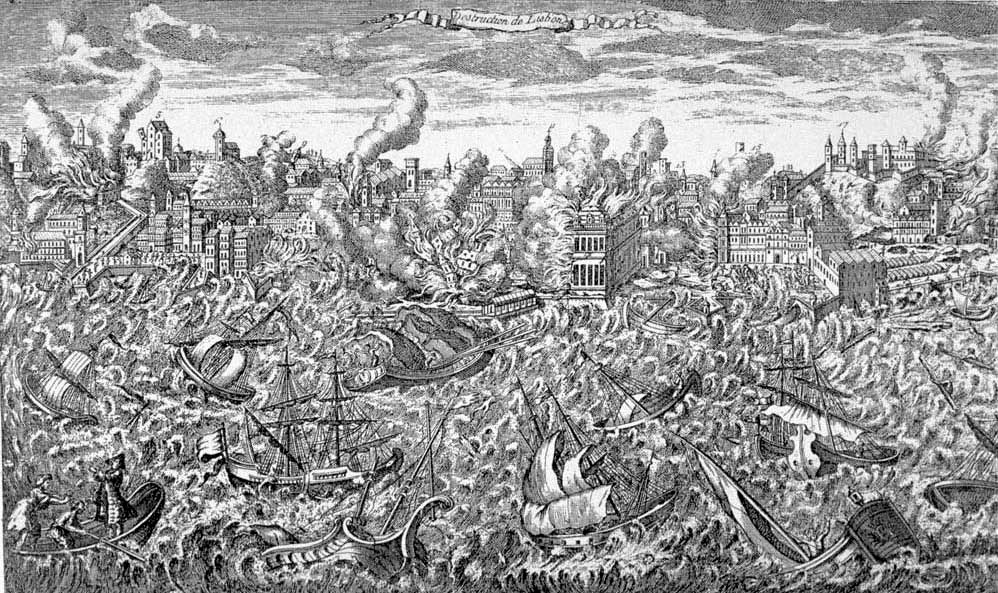
There is a subtle but fundamental difference between disasters (processes) and hazards (events); a distinction that Jean-Jacques Rousseau first articulated in 1755 when Portugal was shaken by an earthquake. In a letter to Voltaire one year later, Rousseau notes that, “nature had not built  [process] the houses which collapsed and suggested that Lisbon’s high population density [process] contributed to the toll” (1).

(Incidentally, the earthquake in Portugal triggered extensive earthquake research in Europe and also served as the focus for various publications, ranging from Kant’s essays about the causes of earthquakes to Voltaire’s Poème sur le désastre de Lisbonne).

In other words, natural events are hazards and exogenous while disasters are the result of endogenous social processes. As Rousseau added in his note to Voltaire, “an earthquake occurring in wilderness would not be important to society” (2). That is, a hazard need not turn to disaster since the latter is strictly a product of social processes.

And so, while disasters were traditionally perceived as “sudden and short lived events, there is now a tendency to look upon disasters in African countries in particular, as continuous processes of gradual deterioration and growing vulnerability,” which has important “implications on the way the response to disasters ought to be made” (3).

But before we turn to the issue of response, what does the important distinction between events and processes mean for early warning?

Blast From the Past

In The Poverty of Historicism (1944), the German Philosopher Karl Popper makes a distinction between two kinds of predictions: “We may predict (a) the coming of a typhoon [event], a prediction which may be of the greatest practical value because it may enable people to take shelter in time; but we may also predict (b) that if a certain shelter is to stand up to a typhoon, it must be constructed [process] in a certain way […].”

A typhoon, like an  earthquake, is certainly a hazard, but it need not lead to disaster if shelters are appropriately built since this process culminates in minimizing social vulnerability.

In contemporary disaster research, “it is generally accepted among environmental geographers that there is no such thing as a natural disaster. In every phase and aspect of a disaster—causes, vulnerability, preparedness, results and response, and reconstruction—the contours of disaster and the difference between who lives and  dies is to a greater or lesser extent a social calculus” (4).

In other words, the term “natural disaster” is an oxymoron and “phrases such as a ‘disaster hit the city,’ ‘tornadoes kill and destroy,’ or a ‘catastrophe is known by its works’ are, in the last resort, animistic thinking” (5).

The vulnerability or resilience of a given system is not simply dependent on the outcome of future events since vulnerability is the complex product of past political, economic and social processes. When hazards such as landslides interface with social systems the risk of disasters may increase. “The role of vulnerability as a causal factor in disaster losses tends to be less well understood, however. The idea that disasters can be managed by identifying and managing specific risk factors is only recently becoming widely recognized” (6).

A Complex System

Consider an hourglass or sand clock as an illustration of vulnerability-as-causality. Grains of sand sifting through the narrowest point of the hourglass represent individual events or natural hazards. Over time a sand pile starts to form, which represents the evolution of society or the connectedness of a social network. Occasionally, a grain of sand falls on the pile and an avalanche or disaster follows.

Why does the avalanche occur? One might ascribe the cause of the avalanche to one grain of sand, i.e., a single event. On the other hand, a systems approach to vulnerability analysis would associate the avalanche with the pile’s increasing slope and to the connectedness (or population density) of the grains constituting the pile since these factors render the structure increasingly vulnerable to falling grains.

Left on its own, the sand pile’s stability, or the social network, becomes increasingly critical or vulnerable. From this perspective, “all disasters are slow onset when realistically and locally related to conditions of susceptibility”. A hazard event might be rapid-onset, but the disaster, requiring much more than a hazard, is a long-term process, not a one-off event.

We must therefore “reduce as much as we can the force of the underlying tectonic stresses in order to lower the risk of synchronous failure—that is, of catastrophic collapse that cascades across boundaries between technological, social and ecological systems” (7).

Recall Rousseau’s comment on population density as a contributing cause of the earthquake disaster and Popper’s remark that adequate shelter or resilience could offset the impact of typhoons. The sand pile at the bottom of the hourglass is constrained by the glass’s circumference. While abstract, this image mimics the growth of densely populated cities that become increasingly vulnerable to hazards, either natural or technological.

Unlike the clock’s lifeless grains of sand, however, human beings can minimize their vulnerability to exogenous shocks through disaster preparedness, mitigation and adaptation. In doing so, individuals can “flatten” the structure of the sand pile into a less hierarchical system and thereby shift or diffuse the risk of an avalanche. In conflict prevention terms, this means structural prevention, which typically focuses on local livelihoods and local capacity building.

Implications

Clearly, early warning should seek to monitor both the falling grains and the vulnerability of the sand pile to determine the risk and magnitude of an avalanche. In more formalistic language, a dual approach is important because it is not always clear a priori whether a disaster is due to a strong exogenous shock, to the internal dynamics of the system or a combination of both (8).

As the disaster management community has learned, in “support[ing] good decision-making, the issue is not one of being able to predict the unpredictable. Rather, the fundamental question is that, given that we cannot have reliable predictions of future outcomes, how can we prevent excessive hazard levels today and in the future in a cost-effective manner?”

More on resilience:

  • Disaster Response, Self-Organization and Resilience [Link]
  • On Technology and Building Resilient Societies to Mitigate the Impact of Disasters [Link]
  • Social Media = Social Capital = Disaster Resilience? [Link]
  • Failing Gracefully in Complex Systems: A Note on Resilience [Link]
  • Towards a Match.com for Economic Resilience [Link]