Tag Archives: Conflict

The Mathematics of War: On Earthquakes and Conflicts

A conversation with my colleague Sinan Aral at PopTech 2011 reminded me of some earlier research I had carried out on the mathematics of war. So this is a good time to share some of the findings from this research. The story begins some 60 years ago, when British physicist Lewis Fry Richardson found that international wars follow what is called a power law distribution. A power law distribution relates the frequency and “magnitude” of events. For example, the Richter scale, relates the size of earthquakes to their frequency. Richardson found that the frequency of international wars and the number of causalities each produced followed a power law.

More recently, my colleague Erik-Lars Cederman sought to explain Richardson’s findings in his 2003 peer-reviewed publication “Modeling the Size of Wars: From Billiard Balls to Sandpiles.” However, Lars used an invalid statistical technique to test for power law distributions. In 2005, I began collaborating with Pro-fessors Neil Johnson and Michael Spagat on related research after I came across their fascinating co-authored study that tested casualty distributions in new wars (internal conflicts) for power laws. Though he was not a co-author on the 2005 study, my colleague Sean Gourely presented this research at TED in 2009.

In any case, I invited Michael to present his research at The Fletcher School in the Fall of 2005 to generate interest here. Shortly after, I suggested to Michael that we test whether conflict events, in addition to casualties, followed a power law distribution. I had access to an otherwise proprietary dataset on conflict events that spanned a longer time period than the casualty datasets that he and Neils were working off. I also suggested we try to test whether casualties from natural disasters follow a power law distribution.

We chose to pursue the latter first and I submitted an abstract to the 2006 American Political Science Association (APSA) conference to present our findings. Soon after, I was accepted to the Santa Fe Institute’s Complex Systems Summer Institute for PhD students and took the opportunity to pursue my original research in testing conflict events for power law distributions with my colleague Dr. Ryan Woodard.

The APSA paper, presented in August 2006, was entitled “Natural Disasters, Casualties and Power Laws:  A Comparative Analysis with Armed Conflict” (PDF). Here is the paper’s abstract and findings:

Power-law relationships, relating events with magnitudes to their frequency, are common in natural disasters and violent conflict. Compared to many statistical distributions, power laws drop off more gradually, i.e. they have “fat tails”. Existing studies on natural disaster power laws are mostly confined to physical measurements, e.g., the Richter scale, and seldom cover casualty distributions. Drawing on the Center for Research on the Epidemiology of Disasters (CRED) International Disaster Database, 1980 to 2005, we find strong evidence for power laws in casualty distributions for all disasters combined, both globally and by continent except for North America and non-EU Europe. This finding is timely and gives useful guidance for disaster preparedness and response since natural catastrophes are increasing in frequency and affecting larger numbers of people.  We also find that the slopes of the disaster casualty power laws are much smaller than those for modern wars and terrorism, raising an open question of how to explain the differences. We show that many standard risk quantification methods fail in the case of natural disasters.

apsa1

Dr. Woodard and I presented our research on power laws and conflict events at SFI in June 2006. We produced a paper in August of that year entitled “Concerning Critical Correlations in Conflict, Cooperation and Casualties” (PDF). As the title implies, we also tested whether cooperative events followed a power law. As far as I know, we were the first to test conflict events not to mention cooperative events for power laws. In addition, we looked at conflict/cooperation (C/C) events in Western countries.

The abstract and some findings are included below:

Knowing that the number of casualties of war are distributed as a power law and given a rich data set of conflict and cooperation (C/C) events, we ask: Are there correlations among C/C events? Is there a correlation between C/C events and war casualties? Can C/C data be used as proxy for (potentially) less reliable casualty data? Can C/C data be used in conflict early warning systems? To begin to answer these questions we analyze the distribution of C/C event data for the period 1990–2004 in Afghanistan, Colombia, Iran, Iraq, North Korea, Switzerland, UK and USA. We find that the distributions of individual C/C event types scale as power laws, but only over approximately a single decade, leaving open the possibility of a more appropriate fit (for which we have not yet tested). However, the average exponent of the power law (2.5) is the same as that found in recent studies of casualties of war. We find low levels of correlations between C/C events in Iraq and Afghanistan but not in the other countries studied. We find that the distribution of the sum of all conflict or cooperation events scales exponentially. Finally, we find low levels of correlations between a two year time series of casualties in Afghanistan and the corresponding conflict events.

sfi1sfi2sfi3

I’m looking to discuss all this further with Sinan and learning more about his fascinating area of research.

The Quest for a Disaster Early Warning System (1988)

I assign this short report (PDF) by Kumar Rupesinghe as required reading in my courses and professional seminars on conflict early warning and crisis mapping. This paper could be published today—20 years later—and still be considered forward looking. I highly recommend reading the report along with Rupesinghe’s new edited book on Third Generation Early Warning Systems, which I reviewed in detail here.

I stumbled across this report while working for Norway’s Former Secretary of State at the Peace Research Institute, Oslo (PRIO) in 2006. Rupesinghe was also a research fellow at PRIO and I found the worn-down report hidden away in the Institute’s library. I carefully scanned the report and have been disseminating it as widely as possible ever since.

The excerpts below are the main highlights of the report. While some of these may seem obvious, keep in mind that Rupesinghe was writing this in 1988—well before the field of conflict early warning became formalized.

I realize there are numerous excerpts below but this just reflects how important I think this piece is.

  • It is crucial for the viability and credibility of developing information and communication systems to discuss ways in which the information can be used. Information is useful if acted upon, and when the information so produced provides choices of action to policy makers as well as to the victims to the victims of the impending disasters.
  • Discussions on ‘early warning’ systems would remain academic if information systems are developed which bear little relationship to social policy or social action.
  • Important to the discussion of early warnings are some of the issues related to the demand for a ‘new information order’. Here we have to raise the entire question of who controls information. Generally, discussions relating to early warning systems emanate from the North, and particularly in environments, which can handle large amounts of information. Little attention is paid, however, to the victims of disasters, or to the competence of local NGOs to strengthen their own capacity to handle information, to evaluate and control their own environment.
  • Akira Onishi suggests a highly sophisticated information system, since in the fields of present day technology, particularly in the astounding developments of computers in the 1980s, extraordinary sophisticated handling of information has become possible both in software and hardware systems. Onishi suggests this field of research as been stimulated by the progress made in global modeling.
  • The distinction between a ‘natural’ and a ‘social’ disaster has also been challenged, particularly by those who have witnessed the recent famines in Africa:

The causes of the African crises are increasingly perceived as man made, or they are at least attributed to human activities more than to natural phenomena. Such terms as ‘man made’ and ‘natural disasters’ widely used to distinguish two categories in the past disaster jargon, are of little relevance or may even be misleading. It is now understood that some of the major interlinked factors behind the growing disaster problem in Africa are man made.”

  • Within the discussion on restraining military technology and redeeming modern science and technology for the good of humanity, Marek Thee has proposed that research and development be subjected to national and international scrutiny. Further, he writes:

National and international technological assessment bodies can be established to serve as a kind of ‘watch and early warning system’ against military excesses. Such concurrent international measures may not be easily achieved. But, if we have the political will informed by human rationality and a comprehension of the scientific-technological global interdependence, reinforced by an awakened public opinion, the barriers for change are not insurmountable.

  • Although billions of dollars have been invested in developing sophisticated data banks and early warnings, we have to note that even the most expensive systems have shown a striking inability to forecast political events.

‘Quite simply, the record has been terrible, despite all the technological improvements of the last twenty years. The Soviet intervention in Czechoslovakia, the Yom Kippur war, and the Argentine take over of the Falklands all caught the American government by surprise.’

  • A specific proposal for [a United Nations] early warning system was made by the Speial Rapporteur, Prince Sadruddin Aga Khan in his report on Massive Exodus and Human Rights to the UN Human Rights Commission on December 1981. In his study, Sadruddin Aga Khan drew attention to the increase in the phenomenon of mass exodus:

‘which is becoming a tragically permanent feature of our times, … The problem is to become more serious with time unless imaginative and concrete measures are urgently taken to contain, if not avert, situations of mass exodus. … It is however my considered opinion that if we are to succeed in any measure to spare future generations the spectre of millions of uprooted peoples, more is required than reports and resolutions, however pertinent and useful they may be.’

  • A recent report of the United Nations that the UN’s own capacity to deliver is its existing commitments is seriously at stake. The report suggests that ‘today’s structure is both too top heavy and too complex.’ Further, ‘its present organizational structure is too fragmented’, and ‘without enlarging secretariat functions’, a ‘leaner Secretariat will enhance productivity and improve efficiency.’
  • In many cases, the problem has not been one of insufficient information about probable crises, but that the specialized [UN] agencies or the secretariat lack the mandate or the authority to act on the information.
  • The United Nations alone would not be in a position to assist in the building of adequate information systems, without the participation of a range of NGOs. This is particularly relevant for developing countries, who themselves can be involved in an active partnership in the exchange of information.
  • What is increasingly realized is that the NGO community in general has a profound role to play in early warnings, monitoring, providing immediate relief, and finding creative ways of resolving conflicts. […] NGOs, particularly in the Third World, and the media, can play a crucial role in early warnings, sounding the alarm in cases of emergency.
  • Most of the discussions with regard to early warning systems have emanated from a concern with the early prediction and reporting of events which could lead to social disasters. […] However, these systems have been developed in advanced environments where the intention is to gather data so as to predict events in distant places. This leads to a division of labor between those who predict and those predicted upon. And this in turn tends to draw attention only to those efforts which continue to reinforce existing unequal distribution of information.
  • A democratic flow of information is the first condition for a democratic and open system of warnings and resolution. However, ‘information’ is a highly explosive and political issues, especially in the Third World. Many countries have elaborate laws to prevent people from gaining access to information, or censorship laws which prevent people from reporting on what actually happens in a society.
  • Thus, efforts must be made to strengthen the capacity and competence of Third World NGOs to communicate locally and internationally so as to create a democratic global communication system. An information system of the monolithic type developed by the superpowers cannot be encouraged as far as the NGOs are concerned.
  • [There is a] wealth of knowledge available within the local societies [hence the] importance of finding ways of tapping this wealth of information [and] of involving the local societies and integrating their work, so as to build local competence in monitoring and evaluating, their own experiences.
  • […] NGOs, both international and national, will have a vital role to play in the development of a global, decentralized early warning system. They now need the capacity to build information systems, and to provide the basis for rapid information exchange. In general, NGOs will have to confront the monopolization of information with a demand for the democratic access to information technology. Further, the working conditions of most NGOs and NGO networks, especially in developing countries, remain difficult.
  • Increasingly, bureaucracies are exhibiting their incapacity to manage the complexities of our global village. And today the alternative structures most likely to succeed these bureaucracies are rapidly emerging. The most common term for these structures is ‘networks’. They tend to be decentralized, where policies tend to be flexible and fluid, where staff relations are not monolithic and hierarchical, where the structure tends to be polycentric rather than monocentric.
  • NGOs lack systematization and standardization of information. Each small NGO uses its own methods often based around their previous normal systems. Thus, NGOs have to build competence in standardization of information and cataloguing procedures, to facilitate exchange of data and easy retrieval.  HURIDOCS, Human Rights Information and Documentation System, ahs been established on this basis as a network to assist information sharing and usage.
  • Low cost computers provide opportunities for information recording and retrieval and for the development of data bases in highly specialized areas. Once electronic mail becomes cheaper than the conventional post, every NGO will be able to do cheap mass mailings in a fraction of the present time.
  • With regard to the use of satellite technology, there is a strong case for involving grass roots movements and international NGOs alike in the learning process about satellites as well as radio communication. The aim would be to ensure adequate access to the airwaves for the non-governmental sector as a whole and guarantee the democratization of satellite communication.
  • In this discussion of communications and information for early warnings, we have stressed the need to strengthen the capacity and the competence in the South to store, retrieve, and analyze their own information. […] Here Northern NGOs and donors have an important role to play.

Mobile Technologies for Conflict Management

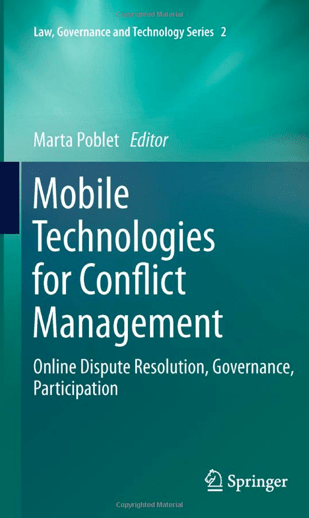
“Mobile Technologies for Conflict Management: Online Dispute Resolution, Governance, Participation” is the title of a new book edited by Marta Poblet. I recently met Marta in Vienna, Austria during the UN Expert Meeting on Croudsource Mapping organized by UN SPIDER. I’m excited that her book has just launched. The chapters are is divided into 3 sections: Disruptive Applications of Mobile Technologies; Towards a Mobile ODR; and Mobile Technologies: New Challenges for Governance, Privacy and Security.

The book includes chapters by several colleagues of mine like Mike Best on “Mobile Phones in Conflict Stressed Environments”, Ken Banks on “Appropriate Mobile Technologies,” Oscar Salazar and Jorge Soto on “How to Crowdsource Election Monitoring in 30 Days,” Jacok Korenblum and Bieta Andemariam on “How Souktel Uses SMS Technology to Empower and Aid in Conflict-Affected Communities,” and Emily Jacobi on “Burma: A Modern Anomaly.”

My colleagues Jessica Heinzelman, Rachel Brown and myself also contributed one of the chapters. I include the introduction below.

I had long wanted to collaborate on a peer-reviewed chapter in which I could combine my earlier study of conflict resolution theory with my experience in conflict early warning and crisis mapping. See also this earlier blog post on “Crowdsourcing for Peace Mapping.”  I’ve been a big fan of Will Ury’s approach ever since coming across his work while at Columbia University back in 2003. Little did I know then that I’d be co-authoring this book chapter with two new stellar colleagues. Rachel has taken much of this thinking and applied it to the real world in her phenomenal project called Sisi ni Amni, or “We Are Peace.” You can follow them on Twitter. Jessica now serves on their Advisory Board.

Will Using ‘Live’ Satellite Imagery to Prevent War in the Sudan Actually Work?

Update: Heglig Crisis 2012, Border Clashes 2012, Invasion of Abyei 2012

The Satellite Sentinel Project has hired private satellites to monitor troop movements around the oil-rich region of Abyei during the upcoming Sudanese referendum and prevent war. The images and analysis will be made public on the Project’s website. George Clooney, who catalyzed this joint initiative between Google, UNOSAT, the Enough Project, Trellon and my colleagues at the Harvard Humanitarian Initiative (HHI), calls this the anti-genocide paparazzi:

“We want them to enjoy the level of celebrity attention that I usually get. If you know your actions are going to be covered, you tend to behave much differently than when you operate in a vacuum.”

The group hopes that they can deter war crimes by observing troop buildups and troop movements in advance. If successful, the project would accomplish an idea first proposed more than half-a-century ago  by US President Dwight Eisenhower during a US-Soviet Summit in Paris at the height of the Cold War. Eisenhower announced his plan to “submit to the United Nations a proposal for the creation of a United Nations aerial surveillance to detect preparations for attack.” Interestingly, Eisenhower had crafted this idea five years earlier as part of his Open Skies Proposal, which actually became a treaty in 2002:

“The Treaty establishes a regime of unarmed aerial observation flights over the entire territory of its participants. The Treaty is designed to enhance mutual understanding and confidence by giving all participants, regardless of size, a direct role in gathering information about military forces and activities of concern to them. Open Skies is one of the most wide-ranging international efforts to date to promote openness and transparency of military forces and activities.”

If you want to find out more about Eisenhower’s efforts, please see my blog post on the subject here.

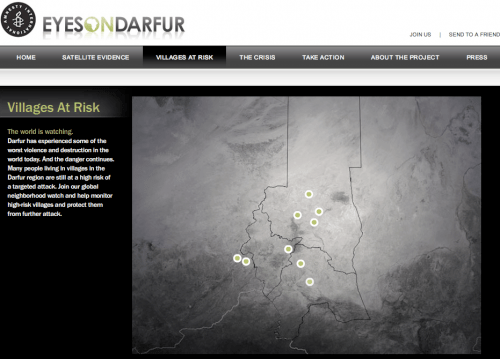
So there is some precedence for what Clooney is trying to pull off. But how is the Sentinel project likely to fare as a non-state effort? Looking at other non-state actors who have already operationalized Eisenhower’s ideas may provide some insights. Take Amnesty International’s “Eyes on Darfur” initiative, which “leverages the power of high- resolution satellite imagery to provide unim- peachable evidence of the atrocities being committed in Darfur–enabling action by private citizens, policy makers and international courts.”

According to Amnesty, the project “broke new ground in protecting human rights by allowing people around the world to literally ‘watch over’ and protect twelve intact, but highly vulnerable, villages using commercially available satellite imagery.” The imagery also enabled Amnesty to capture the movement of Janjaweed forces. Amnesty claims that their project has had a deterrence effect. Apparently, the villages monitored by the project have not been attacked while neighboring ones have. That said, at least two of the monitored villages were removed from the site after reported attacks.

Still Amnesty argues that there have been notable changes in decisions made by the Bashir government since “Eyes on Darfur” went live. They also note that the government of Chad cited their as one of the reasons they accepted UN peacekeepers along their border.

In my blog post on Eisenhower’s UN surveillance speech I asked whether the UN would ever be allowed to monitor and detect preparations for attack using satellite imagery. I now have my answer given that UNOSAT is involved in the Sentinel Project which plans to “deter the resumption of war between North and South Sudan” by providing an “early warning system to deter mass atrocities by focusing world attention and generating rapid responses on human rights and human security concerns” (Sentinel). But will these efforts really create an effective deterrence-based “Global Panopticon”?

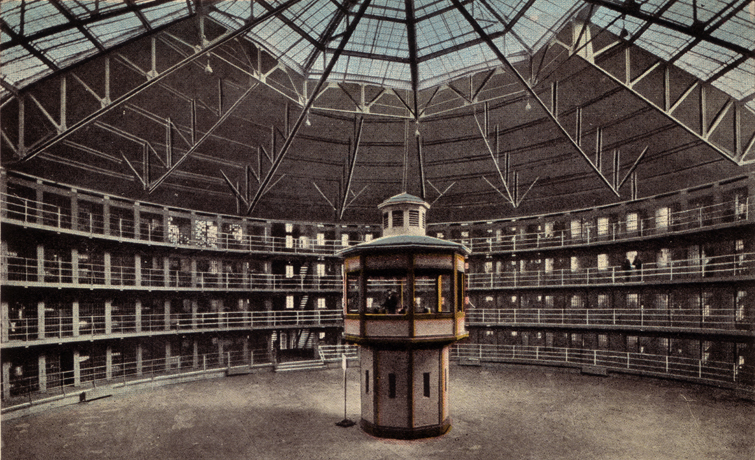
French philosopher Michel Foucault has famously written on the role of surveillance as an instrument of power. “He cites the example of Jeremy Bentham’s ‘Panopticon,’ an architectural model for a prison enabling a single guard, located in a central tower, to watch all of the inmates in their cells.  The ‘major effect of the Panopticon,’ writes Foucault, is ‘to induce in the inmate a state of conscious and permanent visibility that assures the automatic functioning of power.'”

According to Foucault, the Panopticon renders power both “visible and unverifiable”: Visible: the inmate will constantly have before his eyes the tall outline of the central tower from which he is being spied upon. Unverifiable: the inmate must never know whether he is being looked at at any one moment; but he must be sure that he may always be so. But potential perpetrators of the violence in the Sudan do not actually see the  outline of the satellites flying overhead. They are not being directly harassed by high-powered “cameras” stuck into their faces by the anti-genocide paparazzi. So the power is not directly visible in the traditional sense. But who exactly is the inmate in or connected to Abyei in the first place?

There are multiple groups in the area with different agendas that don’t necessarily tie back to the Sudanese government in Khartoum. The Arab Misseriya tribe has thus far remained north during this dry season to avert confrontation with the Ngok Dinka in the Southern part of Abyei. These nomadic tribes typically carry Kalashnikovs to guard their cattle. So distinguishing these nomads from armed groups prepared to raid and burn down villages is a challenge especially when dealing with satellite imagery. Using UAV’s may be more useful and cheaper. (Note that monitoring the location and movement of cattle could be insightful because cattle issues are political in the area).

If armed groups who intend to burn down villages are the intended inmates, do they even know or care about the Satellite Sentinel Project? The ICC has already struggled to connect the chain of command back to the Sudanese government. Besides, the expected turn-around time to develop the satellite imagery is between eight to twenty-four hours. Getting armed men on a truck and raiding a village or two doesn’t take more than a few hours. So the crimes may already have been committed by the time the pictures come in. And if more heavy military machinery like tanks are rolled in, well, one doesn’t need satellite imagery to detect those.

As scholars of the panopticon have noted, the successful use of surveillance has to be coupled with the threat of punishment for deviant acts. So putting aside the issue of who the intended inmates are, the question for the Sentinel Project is whether threats of punishment are perceived by inmates as sufficiently real enough for the deterrence to work. In international relations theory, “deterrence is a strategy by which governments threaten an immense retaliation if attacked, such that aggressors are deterred if they do not wish to suffer great damage as a result of an aggressive action.”

This means that official state actors need to step up and publicly pledge to carry out the necessary punishment if the satellite imagery collected by Sentinel provides evidence of wrong-doing. The ICC should make it crystal clear to all inmates (whoever they are) that evidence from the satellite imagery will be used for prosecution (and that they should care). There also need to be armed guards in  “the tower” who are proximate enough to be deployed and have the political will to use force if necessary. Or will the anti-genocide paparazzi’s many eyes be sufficient to keep the peace? It’s worth remembering that the Hollywood paparazzi haven’t exactly turned movie stars into alter boys or girls. But then again, they’d probably get away with a whole lot more without the paparazzi.

US spy satellites have no doubt monitored conflict-prone areas in the past but this  hasn’t necessarily deterred major crimes against humanity as far as I know. Of course, the imagery collected has remained classified, which means the general public hasn’t been able to lobby their governments and the international community to act based on this information and shared awareness.

The Sentinel Project’s open source approach changes this calculus. It may not deter the actual perpetrators, but the shared awareness created thanks to the open data will make it more difficult for those who can prevent the violence to look the other way. So the Satellite Sentinel Project may be more about keeping our own governments accountable to the Responsibility to Protect (R2P) than deterring actors in the Sudan from committing further crimes.

How will we know if Clooney succeeds? I’m not quite sure. But I do know that the Sentinel Project is a step in the right direction. More evidence is always more compelling than less evidence. And more public evidence is even better. I have no doubt therefore that Eisenhower would back this Open Skies project.

p.s. It is worth noting that the satellite imagery of Sri Lankan forces attacking civilians in 2009 were dismissed as fake by the Colombo government even though the imagery analysis was produced by UNOSAT.

Africa’s Crossborder Conflicts on Google Earth

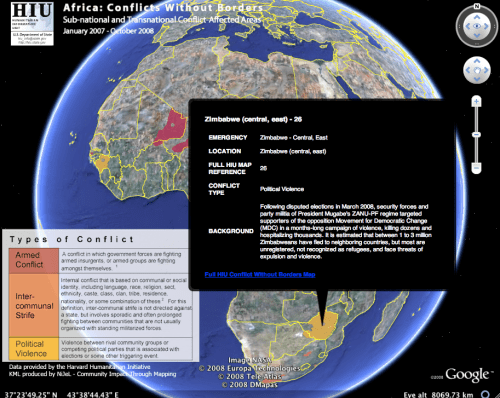
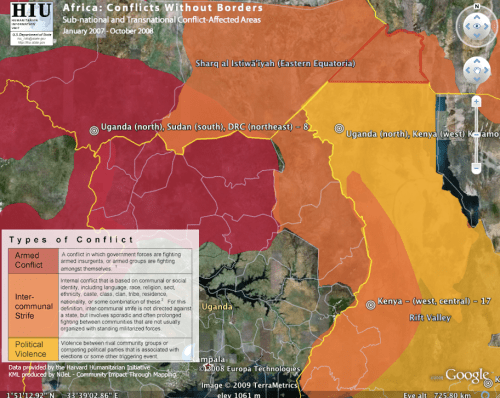
This post is an update on the Humanitarian Information Unit’s (HIU) crisis map of crossborder conflicts in Africa. Dennis King at HIU kindly shared with me the shapefiles for the static conflict map so we could create a Google Earth layer from the data. When I write “we”, I actually mean my colleague Lela Prashad who is the co-Executive Director at NiJeL.org.

NiJeL is a member of CrisisMappers and they are doing some phenomenal work in the mapping space. In fact, they have two excellent projects in the Top 15 of USAID’s Development 2.0 Challenge. When Dennis King agreed to share the HIU data, I therefore turned to Lela to create the Google Earth layer.

HIU

The main conclusion to draw from this little exercise is that time matters. Not exactly earth shattering news but let me spell it out nevertheless. Because the underlying data is static, visualizing the data on Google Earth is not as compelling as mapping dynamic event-data, such as HHI’s Crisis Map of Kenya’s Post-Election Violence. That said, the Google Earth layer at least provides the user with far more “spatial freedom” than the PDF version.

HIU2

The Google Earth layer is available here for download. The Harvard Humanitarian Initiative (HHI) and I hope to collaborate with NiJeL again in early 2009 to create a dynamic (space-time) crisis map of the recent Georgia/Russia conflict. In the mean time, many, many thanks to both Lela and Dennis for their time and kind support.

Patrick Philippe Meier

Africa’s Crossborder Conflicts on Google Earth

This post is an update on the Humanitarian Information Unit’s (HIU) crisis map of crossborder conflicts in Africa. Dennis King at HIU kindly shared with me the shapefiles for the static conflict map so we could create a Google Earth layer from the data. When I write “we”, I actually mean my colleague Lela Prashad who is the co-Executive Director at NiJeL.org.

NiJeL is a member of CrisisMappers and they are doing some phenomenal work in the mapping space. In fact, they have two excellent projects in the Top 15 of USAID’s Development 2.0 Challenge. When Dennis King agreed to share the HIU data, I therefore turned to Lela to create the Google Earth layer.

HIU

The main conclusion to draw from this little exercise is that time matters. Not exactly earth shattering news but let me spell it out nevertheless. Because the underlying data is static, visualizing the data on Google Earth is not as compelling as mapping dynamic event-data, such as HHI’s Crisis Map of Kenya’s Post-Election Violence. That said, the Google Earth layer at least provides the user with far more “spatial freedom” than the PDF version.

HIU2

The Google Earth layer is available here for download. The Harvard Humanitarian Initiative (HHI) and I hope to collaborate with NiJeL again in early 2009 to create a dynamic (space-time) crisis map of the recent Georgia/Russia conflict. In the mean time, many, many thanks to both Lela and Dennis for their time and kind support.

Patrick Philippe Meier

Crisis Mapping the Conflict in Georgia (Updated)

Update: Jon Thompson had initially mistakenly blogged that all roads/cities in Georgia had “disappeared” from Google Maps and Google Earth. A colleague of mine at Google has since informed me that they never had a roads layer for Georgia. According to this same contact, Google has just released this formal statement:

It is untrue to suggest, as some media reports have, that Google has removed data or imagery from our Google Maps product in Georgia, Armenia or Azerbaijan.  We have never had local data for those countries and that is why local details such as landmarks and cities do not appear.

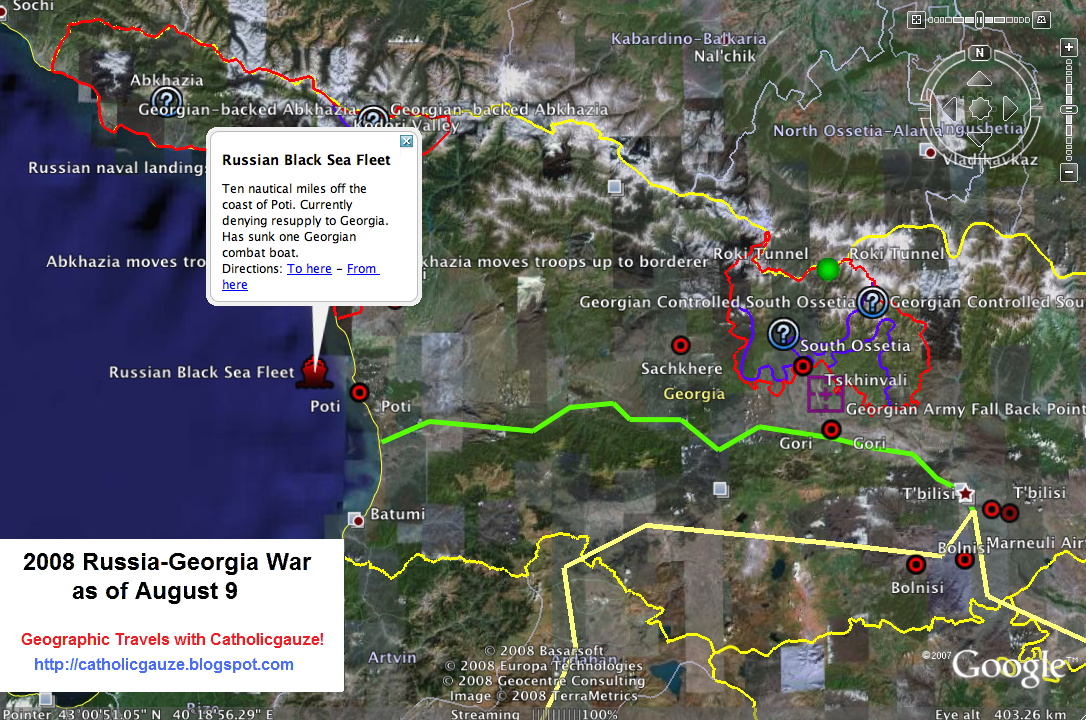
An initial crisis map of the escalating violence between Georgia and Russia has been created for Google Earth. While dynamic maps add more value than static maps, we need a more interactive interface that permits for crowdsourcing crisis information in quasi-real time with fully geo-referenced information.

Here I am thinking of Ushahidi and the Humanitarian Sensor Web (HSW). Humanitarian organizations have already moved into the disputed region and have no doubt learned important information, which is likely changing every hour. But the one person behind these initial Google Earth maps may not have easy access to organizations on the ground.

This is precisely when we need a crisis mapping platform that enables field-based organizations and local communities to text in important information on events as they unfold. As more information surfaces, we’ll need that same platform to provide quantitative, time-stamped analysis within the same interface. Finally, we would want to let affected communities know how to receive or subscribe to this information as it is posted and validated. This is where Dial-Up-Radio could come in handy.

Patrick Philippe Meier


Tactical Survival in El Salvador

The story of El Salvador is one that gets little attention in the mainstream media on conflict early warning and operational response. Indeed, the story surfaces instead in the sociology and nonviolence literature. The best study on countering attack in El Salvador is Barton Meyer‘s “Defense Against Aerial Attack in El Salvador” published in 1994. Brian Martin, a prolific author in the field of nonviolent action, drew on Meyer’s case study in his excellent book on “Technology for Nonviolent Struggle” published in 2001. Finally, Casey Barrs, a Senior Protection Fellow, who has carried out substantial research in civilian protection, brought the story to my attention in 2006.

From Martin:

To survive bombing from El Salvador’s air force, both civilians and guerrillas developed and used a range of methods. No sophisticated warning systems were available, so people had to develop their own skills in detecting and identifying aircraft. When spotter planes were seen, people froze in place so they wouldn’t be seen; any moving target was subject to attack. When the spotter plane changed course, people would seek shelter, sometimes setting off a firecracker to warn others.

Concealment was widely used. Leafy trees were grown next to houses to hide them. Houses that were partly destroyed were left unrepaired to hide the fact that they were still being lived in. At the sound of aircraft, fires were quickly doused; alternatively, underground ovens were used with long tunnels to absorb smoke. Radio transmissions were not used by guerrillas to avoid being intercepted. Peasants wore dark clothing to avoid detection. They grew crops whose colour was not readily noticeable from the air and crops that were hidden by other plants.

Shelters were built and disguised. Natural features, such as forests and ravines, were also used for shelter. Guerrillas built extensive tunnel systems. In areas subject to frequent attack, shelter drills were carried out. When the government army invaded following air attack, guerrillas often would lead an evacuation of the
population, returning later.

The guerrillas, in the face of heavy air attack, dispersed their forces to groups of 4 to 15 fighters spread out over hundreds of meters. Larger units would have been more vulnerable to air power. The dispersed fighters were concentrated only for attacks or briefly at night. Another tactic was to deploy the guerrillas very near to government troops, where aerial attack might harm the government’s own soldiers.

As well as methods of surviving attack, other techniques of struggle were used, such as broadcasting reports of deaths or injuries of civilians due to air attack. Such human rights appeals were highly effective, and would be even more so in the context of a purely nonviolent resistance.

There is a great need for many more studies like that of Meyers, as well as a need to circulate the findings to people who can use them. Unfortunately, the contemporary field of disaster studies has neglected the study of war as a disaster. One factor behind this may be that most war disasters occur in poor countries whereas disaster studies are largely carried out in the rich countries which sponsor and provide weapons for these wars.

As well as knowing how to respond to aerial attack, there are many other areas in need of investigation, including firearms, landmines, biological agents, chemical weapons and nuclear weapons. A first step would be to provide basic technical information that is accessible to nonspecialists and which can be used to provide a realistic assessment of dangers and possibly to expose uses of the weapons.

My iRevolution question: some 14 years later, how can at-risk communities today use ICTs to get out of harm’s way? Conflict prevention can no longer afford to be a non cross-disciplinary effort. We in the conflict early warning community have much to learn from lessons learned in nonviolent action and tactical survival. For more examples of survival tactics in conflict, please see my previous blog entry and this piece by Casey Barrs.

Patrick Philippe Meier