Category Archives: Digital Activism

Crowdsourcing Disaster Response in Iran: How Volunteers Bypassed the State

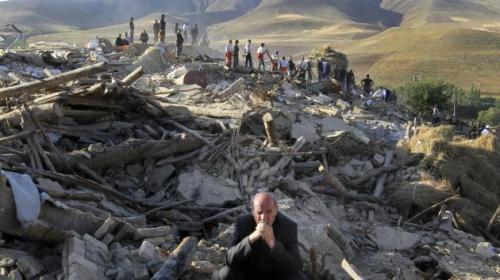
The double earthquakes that recently struck Iran’s East Azerbaijan Province killed over 300 people and left thousands more homeless. Iranians are par-ticularly adept at using Facebook and other social media platforms. So I was hardly surprised to learn that Iranian journalists launched a Facebook group to collect and and share reliable information related to the earthquake’s impact. Some of these journalists also visited the disaster-struck region to document the deva-station and aid in the relief efforts.

Existing Facebook groups were also used to bring help to those in need. One such group, called Female Equals Male, encouraged followers to donate blood at centers across the country. An Iranian who works at one of these centers was taken aback by the response: “… it was the first time that I have ever seen people being so eager to donate blood. It has always been us, pushing, advertising and asking people to do so.” Female Equals Male already had over 140,000 “likes” before the earthquake.

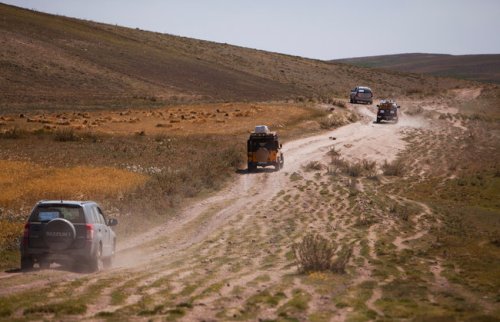
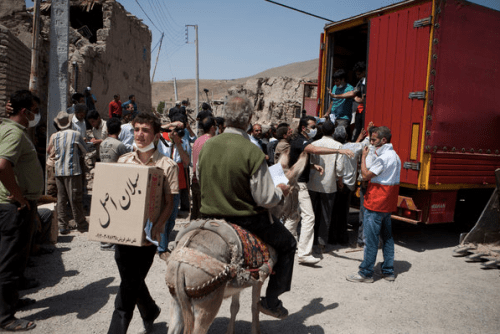
Like their Egyptian counterparts who crowdsourced volunteer convoys into Libya last year, young Iranians also organized caravans to bring relief to victims of the earthquake in the north of the country. They spontaneously organized a charity effort using SMS, Facebook and phone calls to collect money and relief supplies. “But instead of handing over their collection to the Iranian Red Crescent Society —which is close to the government—as the authorities had asked in the state media, these youths were determined to transport it themselves to the most remote hill villages ravaged by the earthquakes […].” And so they did.

There seem to be more and more examples like this one occurring–ordinary citizens and volunteers taking (disaster response) matters into their own hands:

Of course, this phenomenon is hardly new. First responders, by definition, are the disaster affected population themselves. What is new is that these people-centered crowdsourced efforts are increasingly public and easier to coordinate thanks to social networking platforms and mobile technologies. “In Iran, where the state is involved in all layers of society, it is exceptional for a group of young people to organize a public effort of disaster relief” (NYTimes). As I have hinted in previous blog posts, this ability to mobilize, organize and coordinate can have important political ramifications.

Could Social Media Have Prevented the Largest Mass Poisoning of a Population in History?

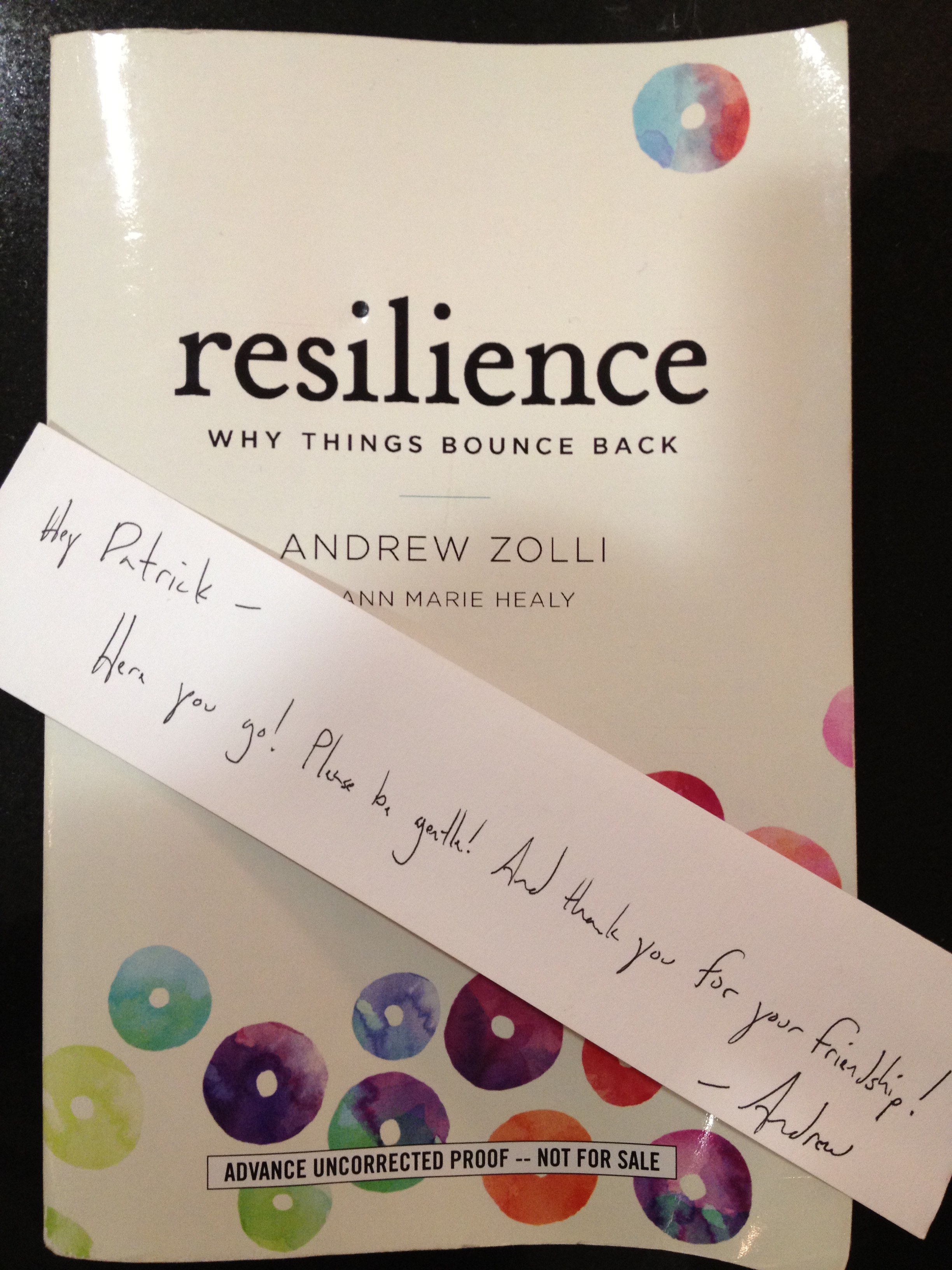
I just finished reading a phenomenal book. Resilience: Why Things Bounce Back, was co-authored by my good friend Andrew Zolli of PopTech fame and his won-derful colleague Ann Marie Healey. I could easily write several dozen blog posts on this brilliant book. Consider this the first of possibly many more posts to follow. Some will summarize and highlight insights that really resonated with me while others like the one below will use the book as a spring board to explore related questions and themes.

In one of the many interesting case studies that Andrew and Ann discuss in their book, the following one may very well be the biggest #FAIL in all of development history. The vast majority of Bangladeshis did not have access to clean water during the early 1970s, which contributed to numerous diseases that claimed hundreds of thousands of lives every year. So UNICEF launched a “nationwide program to sink shallow tube wells across the country. Once a small hand pump was installed to the top of the tube, clean water rose quickly to the surface.”

By the end of the 1970s, over 300,000 tube wells had been installed and some 10 million more went into operation by the late 1990s. With access to clean water, the child mortality rate dropped by more than half, from 24% to less than 10%. UNICEF’s solution was thus “touted as a model for South Asia and the world.” In the early 1980s, however, signs of widespread arsenic poising began to appear across the country. “UNICEF had mistaken deep water for clean water and never tested its tube wells for this poison.” WHO soon predicted that “one in a hundred Bangladeshis drinking from the contaminated wells would die from an arsenic-related cancer.” The government estimated that about half of the 10 million wells were contaminated. A few years later, WHO announced that Bangladesh was “facing the largest mass poisoning of a population in history.”

In a typical move that proves James Scott’s thesis Seeing Like a State: How Certain Schemes to Improve the Human Condition Have Failed, the Bangladeshi government partnered with the World Bank to paint the sprout of each well red if the water was contaminated and green if safe to drink. Five years and over $40 million later, the project had only been able to test half of the 10 million wells. “Officially, this intervention was hailed as almost instantaneous success.” But the widespread negative socio-economic impact and community-based conflicts that resulted from this one-off, top-down intervention calls into question the purported success of this intervention.

As Andrew and Ann explain, water use in Bangladesh (like many other countries) starts and ends with women and girls. “They are the ones who will determine if a switch to a green well is warranted because they are the ones who fetch the water in water numerous times a day.” The location of these green wells will largely determine “whether or not women and girls can access them in a way that is deemed socially appropriate.” As was the case with many of these wells, “the religious and cultural norms impeded a successful switch.”

In addition, “negotiating use of someone else’s green well was an act fraught with potential conflict.” As a result, some still used water from red-painted wells. In fact, “reports started to come in of families and communities chipping away at the red paint on their wells,” with some even repainting theirs with green. Such was the stigma of being a family linked to a red well. Indeed, “young girls living within the vicinity of contaminated wells [recall that there were an estimated 5 million such wells] suffered from diminishing marriage prospects, if they were able to marry at all.” In addition, because the government was unable to provide alternative sources of clean water for half of the communities with a red well, “many women and girls returned to surface water sources like ponds and lakes, significantly more likely to be contaminated with fecal pathogens.” As a result, “researchers estimated that abandonment of shallow tube wells increased a household’s risk of diarrheal disease by 20%.”

In 2009, a water quality survey carried out by the government found that “approximately 20 million people were still being exposed to excessive quantities of arsenic.” And so, “while the experts and politicians discuss how to find a solution for the unintended consequences of the intervention, the people of Bangladesh continue bringing their buckets to the wells while crossing their fingers behind their backs.”

I have several questions (and will omit the ones that start with WTF?). Could social media have mitigated this catastrophic disaster? It took an entire decade for UNICEF and the Bangladeshi government to admit that massive arsenic poisoning was taking place. And even then, when UNICEF finally responded to the crisis in 1998, they said “We are wedded to safe water, not tube wells, but at this time tube wells remain a good, affordable idea and our program will go on.” By then it was too late anyway since arsenic in the wells had “found their way into the food supply. Rice irrigated with the tube wells was found to contain more than nine times the normal amount of arsenic. Rice concentrated the poison, even if one managed to avoid drinking contaminated well water, concentrated amounts would just up in one’s food.”

Could social media—had they existed in the 1980s—been used to support the early findings published by local scientists 15 years before UNICEF publicly recognized (but still ignored) the crisis? Could scientists and activists have launched a public social media campaign to name and shame? Could hundreds of pictures posted on Flickr and videos uploaded to YouTube made a difference by directly revealing the awful human consequences of arsenic poisoning?

Could an Ushahidi platform powered by FrontlineSMS have been used to create a crowdsourced complaints mechanism? Could digital humanitarian volunteers from the Standby Volunteer Task Force (SBTF) have worked with local counterparts to create a live country-wide map of concerns posted anonymously by girls and women across thousands of communities in Bangladesh? Could an interactive voice response (IVR) system like this one been set up to address concerns and needs of illiterate individuals? Could a PeaceTXT approach have been used to catalyze behavior change? Can these technologies build more resilient societies that allow them to bounce back from crises like these?

And since mass arsenic poisoning is still happening in Bangladesh today, 40 years after UNICEF’s first intervention, are initiatives like the ones described above being tried at all?

Traditional vs. Crowdsourced Election Monitoring: Which Has More Impact?

Max Grömping makes a significant contribution to the theory and discourse of crowdsourced election monitoring in his excellent study: “Many Eyes of Any Kind? Comparing Traditional and Crowdsourced Monitoring and their Contribu-tion to Democracy” (PDF). This 25-page study is definitely a must-read for anyone interested in this topic. That said, Max paints a false argument when he writes: “It is believed that this new methodology almost magically improves the quality of elections […].” Perhaps tellingly, he does not reveal who exactly believes in this false magic. Nor does he cite who subscribes to the view that  “[…] crowdsourced citizen reporting is expected to have significant added value for election observation—and by extension for democracy.”

My doctoral dissertation focused on the topic of crowdsourced election observa-tion in countries under repressive rule. At no point in my research or during interviews with activists did I come across this kind of superficial mindset or opinion. In fact, my comparative analysis of crowdsourced election observation showed that the impact of these initiatives was at best minimal vis-a-vis electoral accountability—particularly in the Sudan. That said, my conclusions do align with Max’s principle findings: “the added value of crowdsourcing lies mainly in the strengthening of civil society via a widened public sphere and the accumulation of social capital with less clear effects on vertical and horizontal accountability.”

This is huge! Traditional monitoring campaigns don’t strengthen civil society or the public sphere. Traditional monitoring teams are typically composed of inter-national observers and thus do not build social capital domestically. At times, traditional election monitoring programs may even lead to more violence, as this recent study revealed. But the point is not to polarize the debate. This is not an either/or argument but rather a both/and issue. Traditional and crowdsourced election observation efforts can absolutely complement each other precisely because they each have a different comparative advantage. Max concurs: “If the crowdsourced project is integrated with traditional monitoring from the very beginning and thus serves as an additional component within the established methodology of an Election Monitoring Organization, the effect on incentive structures of political parties and governments should be amplified. It would then include the best of both worlds: timeliness, visualization and wisdom of the crowd as well as a vetted methodology and legitimacy.”

Recall Jürgen Habermas and his treatise that “those who take on the tools of open expression become a public, and the presence of a synchronized public increasingly constrains un-democratic rulers while expanding the right of that public.” Why is this important? Because crowdsourced election observation projects can potentially bolster this public sphere and create local ownership. Furthermore, these efforts can help synchronize shared awareness, an important catalyzing factor of social movements, according to Habermas. Furthermore, my colleague Phil Howard has convincingly demonstrated that a large active online civil society is a key causal factor vis-a-vis political transitions towards more democratic rule. This is key because the use of crowdsourcing and crowd-mapping technologies often requires some technical training, which can expand the online civil society that Phil describes and render that society more active (as occurred in Egypt during the 2010 Parliamentary Elections—see  dissertation).

The problem? There is very little empirical research on crowdsourced election observation projects let alone assessments of their impact. Then again, these efforts at crowdsourcing are only a few years old and many do’ers in this space are still learning how to be more effective through trial and error. Incidentally, it is worth noting that there has also been very little empirical analysis on the impact of traditional monitoring efforts: “Further quantitative testing of the outlined mechanisms is definitely necessary to establish a convincing argument that election monitoring has positive effects on democracy.”

In the second half of his important study, Max does an excellent job articulating the advantages and disadvantages of crowdsourced election observation. For example, he observes that many crowdsourced initiatives appear to be spon-taneous rather than planned. Therein lies part of the problem. As demonstrated in my dissertation, spontaneous crowdsourced election observation projects are highly unlikely to strengthen civil society let alone build any kind of social capital. Furthermore, in order to solicit a maximum number of citizen-generated election reports, a considerable amount of upfront effort on election awareness raising and education needs to take place in addition to partnership outreach not to mention a highly effective media strategy.

All of this requires deliberate, calculated planning and preparation (key to an effective civil society), which explains why Egyptian activists were relatively more successful in their crowdsourced election observation efforts compared to their counterparts in the Sudan (see dissertation). This is why I’m particularly skeptical of Max’s language on the “spontaneous mechanism of protection against electoral fraud or other abuses.” That said, he does emphasize that “all this is of course contingent on citizens being informed about the project and also the project’s relevance in the eyes of the media.”

I don’t think that being informed is enough, however. An effective campaign not only seeks to inform but to catalyze behavior change, no small task. Still Max is right to point out that a crowdsourced election observation project can “encou-rage citizens to actively engage with this information, to either dispute it, confirm it, or at least register its existence.” To this end, recall that political change is a two-step process, with the second—social step—being where political opinions are formed (Katz and Lazarsfeld 1955). “This is the step in which the Internet in general, and social media in particular, can make a difference” (Shirky 2010). In sum, Max argues that “the public sphere widens because this engagement, which takes place in the context of the local all over the country, is now taken to a wider audience by the means of mapping and real-time reporting.” And so, “even if crowdsourced reports are not acted upon, the very engagement of citizens in the endeavor to directly make their voices heard and hold their leaders accountable widens the public sphere considerably.”

Crowdsourcing efforts are fraught with important and very real challenges, as is already well known. Reliability of crowdsourced information, risk of hate speech spread via uncontrolled reports, limited evidence of impact, concerns over security and privacy of citizen reporters, etc. That said, it is important to note that this “field” is evolving and many in this space are actively looking for solutions to these challenges. During the 2010 Parliamentary Elections in Egypt, the U-Shahid project was able to verify over 90% of the crowdsourced reports. The “field” of information forensics is becoming more sophisticated and variants to crowdsourcing such as bounded crowdsourcing and crowdseeding are not only being proposed but actually implemented.

The concern over unconfirmed reports going viral has little to do with crowd-sourcing. Moreover, the vast majority of crowdsourced election observation initiatives I have studied moderate all content before publication. Concerns over security and privacy are issues not limited to crowdsourced election observation and speak to a broader challenge. There are already several key initiatives underway in the humanitarian and crisis mapping community to address these important challenges. And lest we forget, there are few empirical studies that demonstrate the impact of traditional monitoring efforts in the first place.

In conclusion, traditional monitors are sometimes barred from observing an election. In the past, there have been few to no alternatives to this predicament. Today, crowdsourced efforts are sure to swell up. Furthermore, in the event that traditional monitors conclude that an election was stolen, there’s little they can do to catalyze a local social movement to place pressure on the thieves. This is where crowdsourced election observation efforts could have an important contribution. To quote Max: “instead of being fearful of the ‘uncontrollable crowd’ and criticizing the drawbacks of crowdsourcing, […] governments would be well-advised to embrace new social media. Citizens […] will use new techno-logies and new channels for information-sharing anyway, whether endorsed by their governments or not. So, governments might as well engage with ICTs and crowdsourcing proactively.”

Big thanks to Max for this very valuable contribution to the discourse and to my colleague Tiago Peixoto for flagging this important study.

DeadUshahidi: Neither Dead Right Nor Dead Wrong

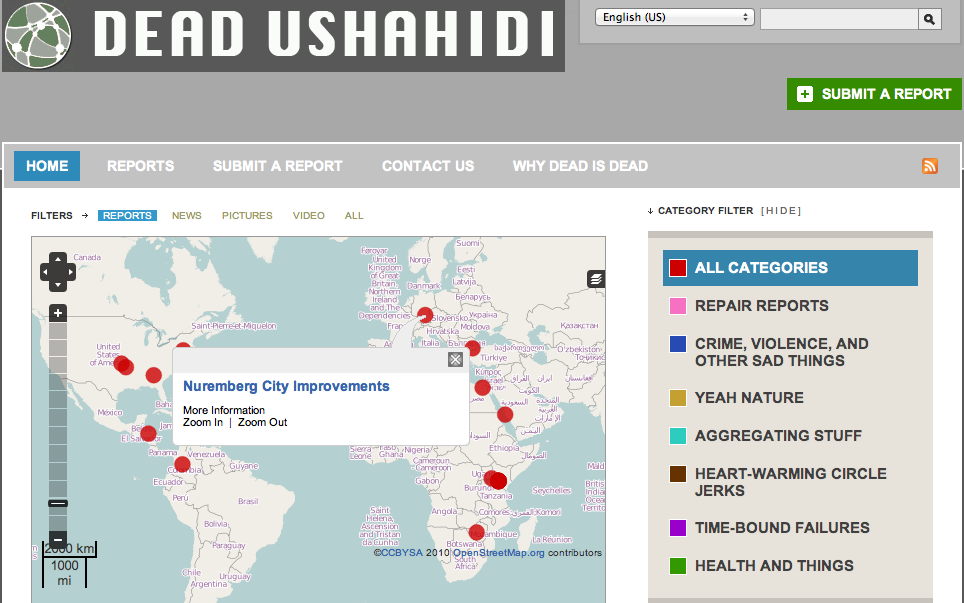
There’s a new Crowdmap in town called DeadUshahidi. The site argues that “Mapping doesn’t equal change. Using crowdsourcing tech like Ushahidi maps without laying the strategic and programmatic ground work is likely not going to work. And while we think great work has been done with crowdsourced reporting, there is an increasing number of maps that are set up with little thought as to why, who should care, and how the map leads to any changes.”

In some ways this project is stating the obvious, but the obvious sometimes needs repeating. As Ushahidi’s former Executive Director Ory Okolloh warned over two years ago: “Don’t get too jazzed up! Ushahidi is only 10% of solution.” My own doctoral research, which included a comparative analysis of Ushahidi’s use in Egypt and the Sudan, demonstrated that training, preparedness, outreach and strategic partnerships were instrumental. So I do appreciate DeadUshahidi’s constructive (and entertaining!) efforts to call attention to this issue and explain what makes a good crowd-sourced map.

At the same time, I think some of the assumptions behind this initiative need questioning. According to the project, maps with at least one of the following characteristics is added to the cemetery:

  • No one has submitted a report to your map in the last 12 months.
  • For time-bound events, like elections and disasters, the number of reports are so infinitesimally small (in relation to the number of the community the map is targeting) that the map never reached a point anywhere near relevance. (Our measure for elections is, for instance, # of submissions / # of registered voters > .0001).
  • The map was never actually started (no category descriptions, fewer than 10 reports). We call that a stillbirth.

Mapping doesn’t equal change, but why assume that every single digital map is launched to create change? Is every blog post written to create change? Is every Wikipedia article edit made to effect change? Every tweet? What was the impact of the last hard copy map you saw? Intention matters and impact cannot be measured without knowing the initial motivations behind a digital map, the intended theory of change and some kind of baseline to measure said change. Also, many digital maps are event-based and thus used for a limited period of time only. They may no longer receive new reports a year after the launch, but this doesn’t make it a “dead” map, simply a completed project. A few may even deserve to go to map heaven—how about a UshahidiHeaven crowdmap?

I’m also not entirely convinced by the argument that the number of reports per map has to cross a certain threshold for the crowdsourced map to be successful. A digital map of a neighborhood in Sydney with fewer than one hundred reports could very well have achieved the intended goal of the project. So again, without knowing or being able to reliably discern the motivations behind a digital map, it is rather farfetched to believe that one can assess whether a project was success-ful or not. Maybe most of the maps in the DeadUshahidi cemetery were never meant to live beyond a few days, weeks or months in the first place.

That said, I do think that one of the main challenges with Ushahidi/Crowdmap use is that the average number of reports per map is very, very low. Indeed, the vast majority of Crowdmaps are stillborn as a forthcoming study from Internews shows. Perhaps this long-tail effect shouldn’t be a surprise though. The costs of experimenting are zero and the easier the technology gets, the more flowers will bloom—or rather the more seeds become available. Whether these free and open source seeds actually get planted and grow into flowers (let alone lush eco-systems) is another issue and one dependent on a myriad of factors such as the experience of the “gardener”, the quality of the seeds, the timing and season, the conditions of the soil and climate, and the availability of other tools used for planting and cultivation.

Or perhaps a better analogy is photography. Thanks to Digital Cameras, we take zillions more pictures than we did just 5 years ago because each click is virtually free. We’re no longer limited to 24 or 36 pictures per roll of film, which first required one to buy said roll and later to pay for it again to be developed. As a result of digital cameras, one could argue that there are now a lot more bad quality (dead) pictures being uploaded everywhere. So what? Big deal. There is also more excellent amateur photography out there as well. What about other technologies and media? There are countless of “dead” Twitter accounts, WordPress blogs, Ning platforms, customized Google Maps, etc. Again, so what?

Neogeography is about democratizing map-making and user-generated maps. Naturally, there’s going to be learning and experimentation involved. So my blog post is not written in defense of Ushahidi/Crowdmap but rather in defense of all amateur digital mappers out there who are curious and just want to map whatever the heck they well please. In sum, and to return to the gardening analogy if I may, the more important question here is why the majority of (Usha)seeds aren’t planted or don’t grow, and what can be done about this in a pro-active manner. Is there something wrong with the seed? Do would-be gardeners simply need more gardening manuals? Or do they need more agile micro-tasking and data-mining tools? The upcoming Internews report goes a long way to explaining the why & what and TechChange’s course on Ushahidi may be one way to save some future maps from ending up in the DeadUshahidi cemetery prematurely.

Evolution in Live Mapping: The 2012 Egyptian Presidential Elections

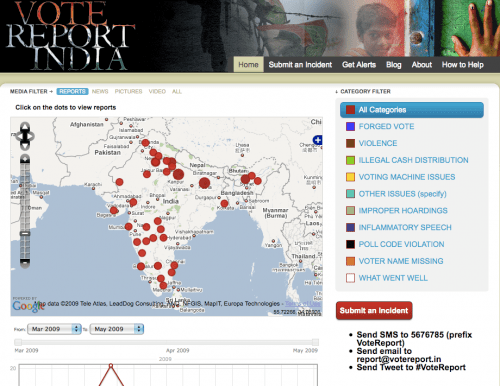
My doctoral dissertation compared the use of live mapping technology in Egypt and the Sudan during 2010. That year was the first time that Ushahidi was deployed in those two countries. So it is particularly interesting to see the technology used again in both countries in 2012. Sudanese activists are currently using the platform to map #SudanRevolts while Egyptian colleagues have just used the tool to monitor the recent elections in their country.

Analyzing the evolution of live mapping technology use in non-permissive environments ought to make for a very interesting piece of research (any takers?). In the case of Egypt, one could compare the use of the same technology and methods before and after the fall of Mubarak. In 2010, the project was called U-Shahid. This year, the initiative was branded as the “Egypt Elections Project.”

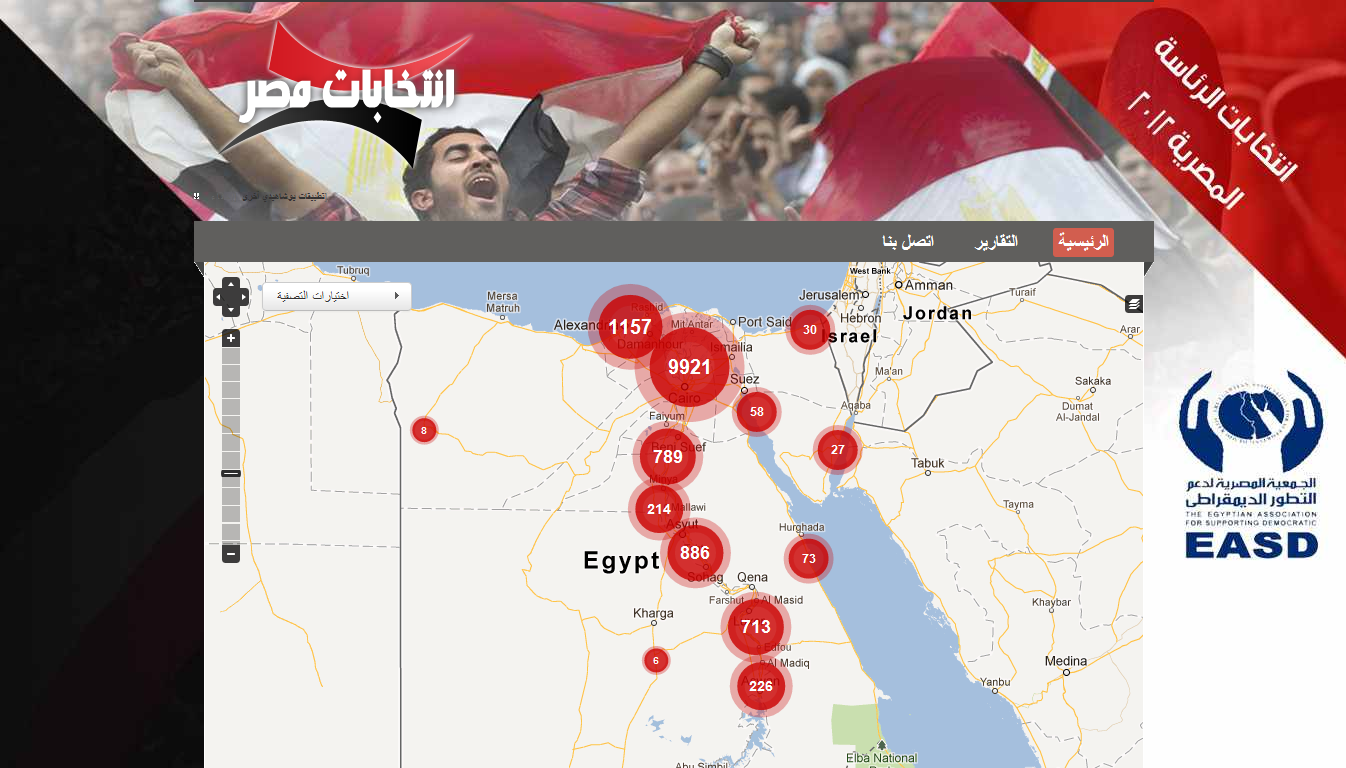
According to my colleagues in Cairo who managed the interactive map, “more than 15 trainers and 75 coordinators were trained to work in the ‘operation room’ supporting 2200 trained observers scattered all over Egypt. More than 17,000 reports, up to 25000 short messages were sent by the observers and shown on Ushahid’s interactive map. Although most reports received shown a minimum amount of serious violations, and most of them were indicating the success of the electoral process, our biggest joy was being able to monitor freely and to report the whole process with full transparency.”

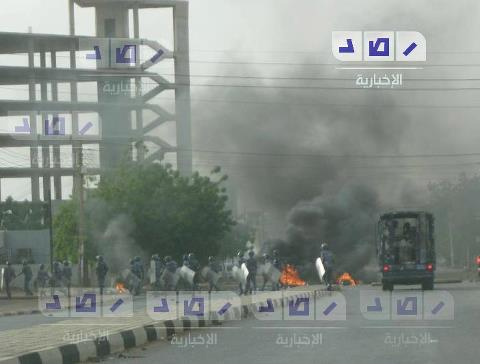
Contrast this situation with how Egyptian activists struggled to keep their Ushahidi project alive under Mubarak in 2010. Last week, the team behind the current live map was actually interviewed by state television (picture above), which was formerly controlled by the old regime. Interestingly, the actual map is no longer the centerpiece of the project when compared to the U-Shahid deploy-ment. The team has included and integrated a lot more rich multimedia content in addition to data, statistics and trends analysis. Moreover, there appears to be a shift towards bounded crowdsourcing rather than open crowd-sourcing as far as election mapping projects go.

These two live mapping projects in Egypt and the Sudan are also getting relatively more traction than those in 2010. Some 17,000 reports were mapped in this year’s election project compared to 2,700 two years ago. Apparently, “millions of users logged into the [Egypt Project Elections] site to check the outcome of the electoral process,” compared to some 40,000 two years ago. Sudanese activists in Khartoum also appear to be far better organized and more agile at leverage social media channels to garner support for their movement than in 2010. Perhaps some of the hard lessons from those resistance efforts were learned.

This learning factor is key and relates to an earlier blog post I wrote on “Technology and Learning, Or Why the Wright Brothers Did Not Create the 747.” Question is: do repressive regimes learn faster or do social movements operate with more agile feedback loops? Indeed, perhaps the technology variable doesn’t matter the most. As I explained to Newsweek a while back, “It is the organiza-tional structure that will matter the most. Rigid structures are unable to adapt as quickly to a rapidly changing environment as a decentralized system. Ultimately, it is a battle of organizational theory.” In the case of Egypt and Sudan today, there’s no doubt that activists in both countries are better organized while the technologies themselves haven’t actually changed much since 2010. But better organization is a necessary, not sufficient, condition to catalyze positive social change and indirect forms of democracy.

Pierre Rosanvallon (2008) indentifies three channels whereby civil society can hold the state accountable during (and in between) elections, and independent of their results.

“The first refers to the various means whereby citizens (or, more accurately, organizations of citizens) are able to monitor and publicize the behavior of elected and appointed rulers; the second to their capacity to mobilize resistance to specific policies, either before or after they have been selected; the third to the trend toward ‘juridification’ of politics when individuals or social groups use the courts and, especially, jury trials to bring delinquent politicians to judgment.”

Live maps and crowdsourcing can be used to monitor and publicize the behavior of politicians. The capacity to mobilize resistance and bring officials to judgment may require a different set of strategies and technologies, however. Those who don’t realize this often leave behind a cemetery of dead maps.

Crisis Mapping the End of Sudan’s Dictatorship?

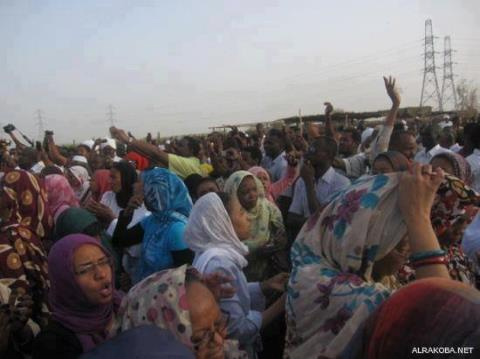
Anyone following the twitter hashtag #SudanRevolts in recent days must be stunned by the shocking lack of coverage in the mainstream media. The protests have been escalating since June 17 when female students at the University of Khartoum began demonstrating against the regime’s austerity measures, which are increasing the prices of basic commodities and removing fuel subsidies. The dissent has quickly spread to other universities and communities.

There’s no doubt that Sudan’s dictator is in trouble. He faces international economic sanctions and a mounting US$2.5 billion budget deficit following the secession of South Sudan last year. What’s more, he is also “fighting expensive, devastating, and unpopular wars in Darfur (in the west), Blue Nile, Southern Kordofan, and the Nuba Mountains (on the border with South Sudan)” (UN Dispatch). So what next?

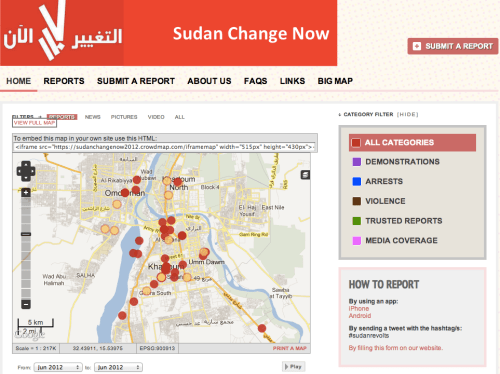
Enter Sudan Change Now, a Sudanese political movement with a clear mandate: peaceful but total democratic change. They seek to “defeat the present power of darkness using all necessary tools of peace resistance to achieve political stability and social peace.” The movement is thus “working on creating a common front that incorporates all victims of the current regime to ensure a unified and effective course of action to overthrow it.” Here are some important videos they have captured of the protests.

According to GlobalVoices, “The Sudanese online community believe that media coverage was an integral part of the revolutions in Egypt and Tunisia, and are therefore demanding the same for Sudan.” The political movement Sudan Change Now is thus turning to crisis mapping to cast more light on the civil resistance efforts in the Sudan:

https://sudanchangenow2012.crowdmap.com

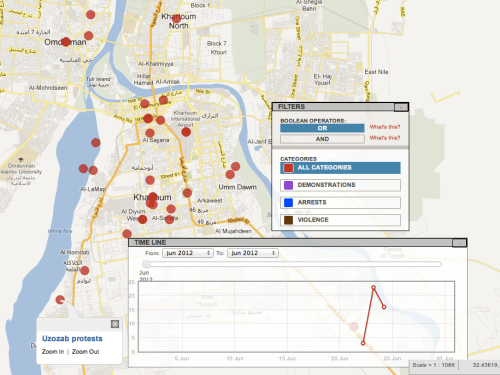
The crisis map includes over 50 individual reports (all added in the past 24 hours) ranging from female protestors confronting armed guards to Sudanese security forces using tear gas to break up demonstrations. There are also reports of detained activists and journalists. These reports come from twitter while more recent incidents are sourced from the little mainstream media coverage that currently exists. The live map is being updated several times a day.

As my colleague Carol Gallo reminds us, “The University of Khartoum was also the birthplace of the movement that led to the overthrow of the military government in 1964.” Symbols and anniversaries are important features of civil resistance. For example, Sudan’s current ruling party came to power on June 30th, 1989. So protestors including those with Sudan Change Now are gearing up for some major demonstrations this Wednesday.

This is not the first crisis map of protests in Khartoum. In January 2011, activists launched this crisis map. I hope that protestors engaged in current civil resistance efforts take note of the lessons learned from last year’s #Jan30 demonstrations. For my doctoral dissertation, I compared the use of crisis maps by Egyptian and Sudanese activists in 2010. If I had to boil down the findings into three key words, these would be: unity, preparedness, creativity.

Unity is absolutely instrumental in civil resistance. As for preparedness, nothing should be left to chance. Prepare and plan the sequence of civil resistance efforts (along with likely reactions) and remember that protests come at the end. The ground-work must first be laid with other civil resistance tactics and thence escalated. Finally, creativity is essential, so here are some tactics that may provide some ideas. They include both traditional tactics and technology-enabled ones like digital crisis maps.

NB: I understand that the security risks of using the Ushahidi mapping platform have been indirectly communicated to the activists.

Civil Resistance 2.0: A New Database on Non-Violent Guerrilla Warfare

[Cross-posted from Meta-Activism.org]

Gene Sharp pioneered the study of nonviolent civil resistance. Some argue that his books were instrumental to the success of activists in a number of revolutions over the past 20 years ranging from the overthrow of Milosevic to ousting of Mubarak. Civil resistance has often been referred to as “nonviolent guerrilla warfare” and Sharp’s manual on “The Methods of Nonviolent Action,” for example, includes a list of 198 methods that activists can use to actively disrupt a repressive regime. These methods are divided into three sections: nonviolent protest and persuasion, noncooperation, and nonviolent intervention.

While Sharp’s 198 are still as relevant today as they were some 40 years ago, the technology space has changed radically. In Sharp’s “Dictionary of Power and Struggle: Language of Civil Resistance in Conflicts” published in 2012, Gene writes that “a multitude of additional methods will be invented in the future that have characteristics of the three classes of methods: nonviolent protest and persuasion, noncooperation, and nonviolent intervention.” About four years ago, I began to think about how technology could extend Sharp’s methods and possibly generate entirely new methods as well. This blog post was my first attempt at thinking this through and while it was my intention to develop the ideas further for my dissertation, my academic focus shifted somewhat.

With the PhD out of the way, my colleague Mary Joyce suggested we launch a research project to explore how Sharp’s methods can and are being extended as a result of information and communication technologies (ICTs). The time was ripe for this kind of research so we spent the past few months building a database of civil resistance methods 2.0 based on Sharp’s original list. We also consulted a number of experts in the field to help us populate this online database. We decided not to restrict the focus of this research  to ICTs only–i.e., any type of technology qualifies, such as drones, for example.

This database will be an ongoing initiative and certainly a live document since we’ll be crowdsourcing further input. In laying the foundations for this database, we’ve realized once again just how important creativity is when thinking about civil resistance. Advances in technology and increasing access to technology provides fertile ground for the kind of creativity that is key to making civil resistance successful.

We invite you to contribute your creativity to this database and share the link (bit.ly/CivRes20) widely with your own networks. We’ve added some content, but there is still a long way to go. Please share any clever uses of technology that you’ve come across that have or could be applied to civil resistance by adding them.

Our goal is to provide activists with a go-to resource where they can browse through lists of technology-assisted methods to inform their own efforts. In the future, we envision taking the database a step further by considering what sequencing of said methods are most effective.

Building Egypt 2.0: When Institutions Fail, Crowdsourcing Surges

I recently presented at Where 2.0 and had the chance to catch Adel Youssef’s excellent talk on “How Location Based Services is Used to Build Egypt 2.0.” He shared some important gems on digital activism. For example, while Facebook allowed Egyptians to “like” a protest event or say they were headed to the streets, check-in’s were a more powerful way to recruit others because they let your friends know that you were actively in the location and actually protesting. In other words, activists were not checking into a place per se, but rather creating an event and checking into that to encourage people to participate in said event.

Adel also shared some interesting insights on how location-aware mobile tech-nologies are being used to build a new Egypt. “After the revolution, the police force just disappeared, there is no police; and there is no traffic control. But this drove more crowdsourced traffic control, crowdsourced police, crowdsourced services. And this has been happening in the last year alone. Crowdsourcing revolution. But not a revolution to overthrow a tyrant but a revolution to build a developed country. […] People going to clean the streets, planting trees, repainting the streets. And they are feeling ownership of their campaign.”

Adel shared several other crowdsourcing initiatives in his talk, from OneYad (matching volunteers) and Zabatak (monitoring corruption) to EntaFeen (check-in’s for good), Bey2Ollak and Wasalny (both addressing the problem of road traffic). I’m excited by all this innovation happening elsewhere than Silicon Valley and hope these platforms will go mainstream beyond the region in the near future. Indeed, I just signed up for the OneYad beta because I really think this kind of tool could be used in the West.

Adel: “We see a lot of crowdsourced networks built after the revolution because we need to build the country and we want to do this bottom-up, want to do it by the people, you want to empower the people.” The point, for Adel, is to go “from social networking to social working” and thus fill the gaps in services that institutions are failing to provide. This reminded me of Tunisian Ambassador Mohamed Salah Tekaya’s remarks last year: “During the Arab Spring, we have seen the power of Twitter and Facebook… Now we need to use the power of LinkedIn.”

Crowdsourcing Humanitarian Convoys in Libya

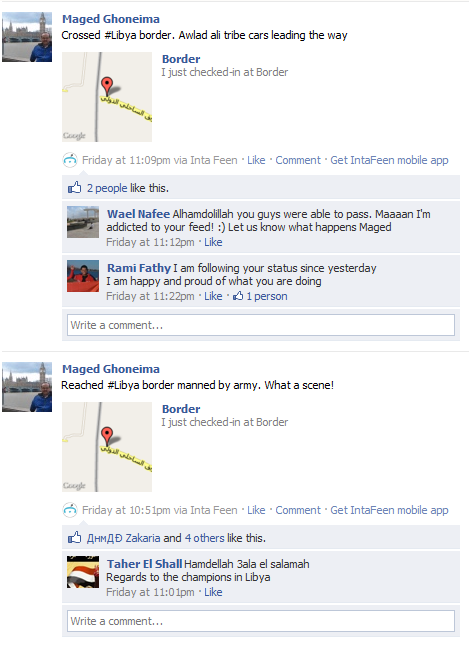
Many activists in Egypt donated food and medical supplies to support the Libyan revolution in early 2011. As a result, volunteers set up and coordinated humanitarian convoys from major Egyptian cities to Tripoli. But these convoys faced two major problems. First, volunteers needed to know where the convoys were in order to communicate this to Libyan revolutionists so they could wait for the fleet at the border and escort them to Tripoli. Second, because these volunteers were headed into a war zone, their friends and family wanted to keep track of them to make sure they were safe. The solution? IntaFeen.com.

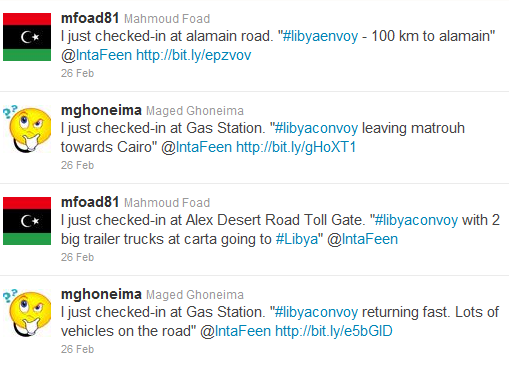
Inta feen? means “where are you?” in Arabic and IntaFeen.com is a mobile check-in service like Foursquare but localized for the Arab World. Convoy drivers used IntaFeen to check-in at different stops along the way to Tripoli to provide regular updates on the situation. This is how volunteers back in Egypt who coordinated the convoy kept track of their progress and communicated updates in real-time to their Libyan counterparts. Volunteers who went along with the convoys also used IntaFeen and their check-in’s would also get posted on Twitter and Facebook, allowing families and friends in Egypt to track their whereabouts.

Al Amain Road is a highway between Alexandria and Tripoli. These tweets and check-in’s acted as a DIY fleet management system for volunteers and activists.

The use of IntaFeen combined with Facebook and Twitter also created an interesting side-effect in terms of social media marketing to promote activism. The sharing of these updates within and across various social networks galvanized more Egyptians to volunteer their time and resulted in more convoys.

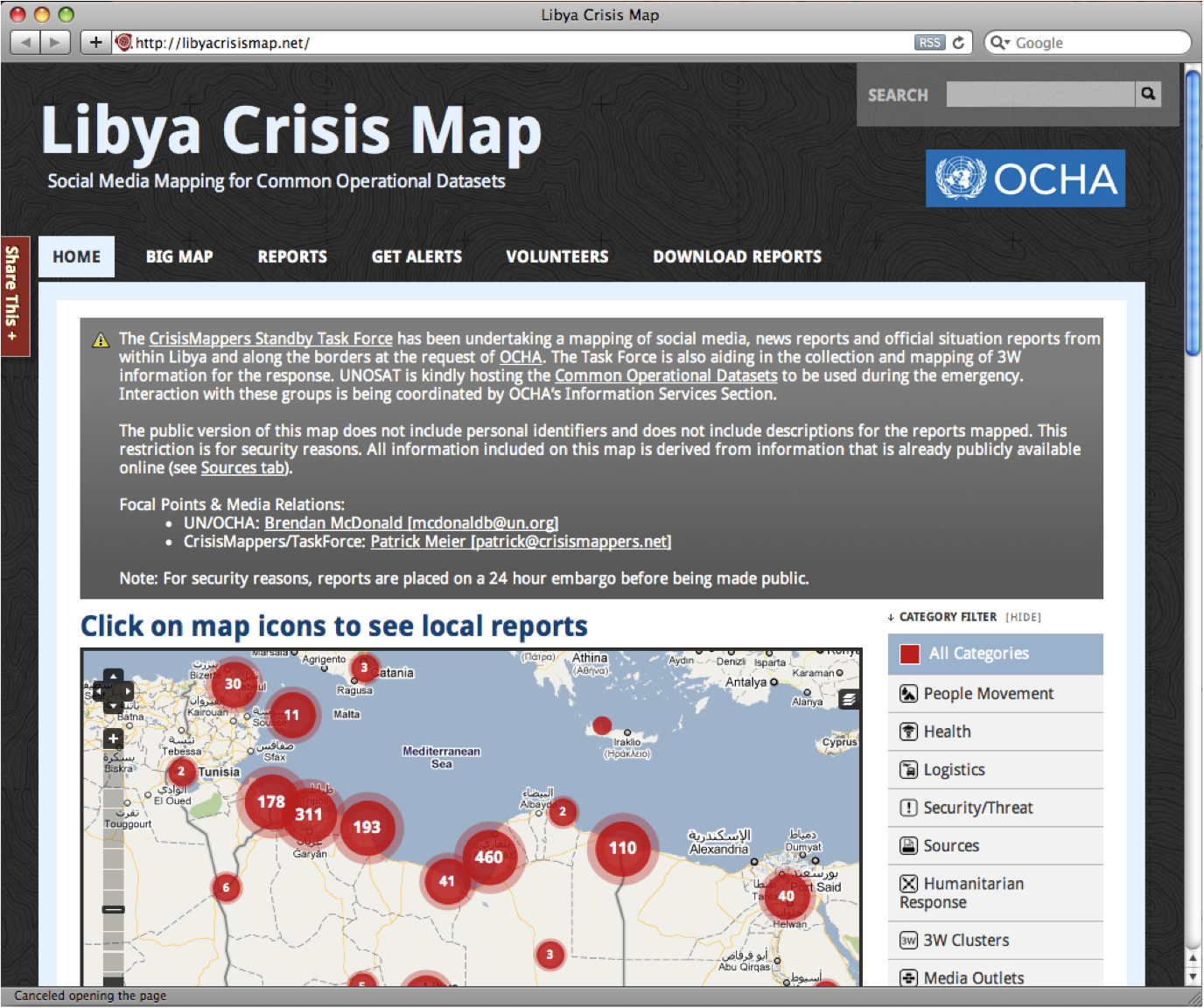
I wonder whether these activists knew about another crowdsourced volunteer project taking place at exactly the same time in support of the UN’s humanitarian relief operations: Libya Crisis Map. Much of the content added to the map was sourced from social media. Could the #LibyaConvoy project have benefited from the real-time situational awareness provided by the Libya Crisis Map?

Will we see more convergence between volunteer-run crisis maps and volunteer-run humanitarian response in the near future?

Big thanks to Adel Youssef from IntaFeen.com who spoke about this fascinating project (and Ushahidi) at Where 2.0 this week. More information on #Libya Convoy is available here. See also my earlier blog posts on the use of check-in’s for activism and disaster response.

On Rumors, Repression and Digital Disruption in China: Opening Pandora’s Inbox of Truthiness?

The Economist recently published a brilliant piece on China entitled: “The Power of Microblogs: Zombie Followers and Fake Re-Tweets.” BBC News followed with an equally excellent article: “Damaging Coup Rumors Ricochet Across China.” Combined, these articles reveal just how profound the digital disruption in China is likely to be now that Pandora’s Inbox has been opened.

Credit: The Economist

The Economist article opens with an insightful historical comparison:

“In the year 15AD, during the short-lived Xin dynasty, a rumor spread that a yellow dragon, a symbol of the emperor, had inauspiciously crashed into a temple in the mountains of central China and died. Ten thousand people rushed to the site. The emperor Wang Mang, aggrieved by such seditious gossip, ordered arrests and interrogations to quash the rumor, but never found the source. He was dethroned and killed eight years later, and Han-dynasty rule was restored.”

“The next ruler, Emperor Guangwu, took a different approach, studying rumors as a barometer of public sentiment, according to a recent book Rumors in the Han Dynasty by Lu Zongli, a historian. Guangwu’s government compiled a ‘Rumors Report’, cataloguing people’s complaints about local officials, and making assessments that were passed to the emperor. The early Eastern Han dynasty became known for officials who were less corrupt and more attuned to the people.”

In present day China, a popular pastime among 250+ million Chinese users of microblogging platforms is to “spread news and rumors, both true and false, that challenge the official script of government officials and state-propaganda organs.” In Domination and the Arts of Resistance: Hidden Transcripts, James Scott distinguishes between public and hidden transcripts. The former describes the open, public discourse that take place between dominators and oppressed while hidden transcripts relate to the critique of power that “goes on offstage”, which the power elites cannot decode. Scott writes that when the oppressed classes publicize this “hidden transcript”, (the truthiness?) they become con-scious of its common status. Borrowing from Juergen Habermas (as interpreted by Clay Shirky), those who take on the tools of open expression become a public, and a synchronized public increasingly constrains undemocratic rulers while ex-panding the rights of that public. The result in China? “It is hard to overestimate how much the arrival of [microblogging platforms] has changed the dynamic between rulers and ruled over the past two years” (The Economist).

Chinese authorities have responded to this threat in two predictable ways, one repeating the ill-fated actions of the Xin Dynasty and the other reflecting the more open spirit of Emperor Guangwu. In the latter case, authorities are turning to microblogs as a “listening post” for public opinion and also as a publishing platform. Indeed, “government agencies, party organs and individual officials have set up more than 50,000 weibo accounts [Chinese equivalent of Twitter]” (The Economist). In the former case, the regime has sought to “combat rumors harshly and to tighten controls over the microblogs and their users, censoring posts and closely monitoring troublemakers.” The UK Guardian reports that China is now “taking the toughest steps yet against major microblogs and detain-ing six people for spreading rumors of a coup amid Beijing’s most serious political crisis for years.”

Beijing’s attempt to regulate microblogging companies by requiring users to sign up with their real names is unlikely to be decisive, however. “No matter how it is enforced, user verification seems unlikely to deter the spread of rumors and information that has so concerned authorities” (The Economist). To be sure, companies are already selling fake verification services for a small fee. Besides, verifying accounts for millions of users is simply too time-consuming and hence costly. Even Twitter gave up their verified account service a while back. The task of countering rumors is even more of a Quixotic dream.

Property tycoon Zhang Xin, who has more than 3 million followers, wrote: “What is the best way to stop ‘rumors’? It is transparency and openness. The more speech is discouraged, the more rumors there will be” (UK Guardian).

This may in part explains why Chinese authorities have shifted their approach to one of engagement as evidenced by those 50,000 new weibo accounts. With this second reaction, however, Beijing is possibly passing the point of no return. “This degree of online engagement can be awkward for authorities used to a comfortable buffer from public opinion,” writes The Economist. This is an understatement; Pandora’s (In)box is now open and the “hidden transcript” is cloaked no longer. The critique of power is decoded and elites are “forced” to devise a public reply as a result of this shared awareness lest they lose legitimacy vis-a-vis the broader population. But the regime doesn’t even have a “customer service” mechanism in place to deal with distributed and potentially high-volume complaints. Censorship is easy compared to engagement.
Recall the “Rumors Report” compiled by Emperor Guangwu’s government to catalogue people’s complaints about local officials. How will these 50,000 new weibo users deal with such complaints now that the report can be crowdsourced, especially given that fact that China’s “Internet users have become increasingly bold in their willingness to discuss current affairs and even sensitive political news […]” (UK Guardian).

As I have argued in my dissertation, repressive regimes can react to real (or perceived)  threats posed by “liberation technologies” by either cracking down and further centralizing control and/or by taking on the same strategies as digital activists, which at times requires less centralization. Either way, they’re taking the first step on a slippery slope. By acknowledging the problem of rumors so publicly, the regime is actually calling more attention to how disruptive these simple speculations can be—the classic Streisand effect.

“By falsely packaging lies and speculation as ‘truth’ and ‘existence’, online rumours undermine the morale of the public, and, if out of control, they will seriously disturb the public order and affect social stability,” said a commentary in the People’s Daily, the official Communist party newspaper. (UK Guardian).

Practically speaking, how will those 50,000 new weibo users coordinate their efforts to counter rumors and spread state propaganda? “We have a saying among us: you only need to move your lips to start a rumor, but you need to run until your legs are broken to refute one,” says an employee of a state media outlet (The Economist). How will these new weibo users synchronize collective action in near real-time to counter rumors when any delay is likely to be interpreted as evidence of further guilt? Will they know how to respond to myriads of questions being bombarded at them in real-time by hundreds of thousands of Chinese microbloggers? This may lead to high-pressure situations that are rife for mistakes and errors, particularly if these government officials are new to microblogging. Indeed, If just one of these state-microbloggers slips, that slip could go viral with a retweet tsunami. Any retreat by authorities from this distributed engagement strategy will only lead to more rumors.

The rumors of the coup d’état continue to ricochet across China, gaining remarkable traction far and wide. Chinese microblogs were also alight last week with talk of corruption and power struggles within the highest ranks of the party, which may have fueled the rumor of an overthrow. This is damaging to China’s Communist Party which “likes to portray itself as unified and in control,” particularly as it prepares for it’s once-in-a-decade leadership shuffle. “The problem for China’s Communist Party is that it has no effective way of refuting such talk. There are no official spokesmen who will go on the record, no sources briefing the media on the background. Did it happen? Nobody knows. So the rumors swirl” (BBC News). Even the official media, which is “often found waiting for political guidance, can be slow and unresponsive.”

So if Chinese authorities and state media aren’t even equipped (beyond plain old censorship) to respond to national rumors of vis-a-vis an event as important as a coup (can it possibly get more important than that?), then how in the world will they deal with the undercurrent of rumors that continue to fill Chinese microblogs now that these can have 50,000 new targets online? Moreover, “many in China are now so cynical about the level of censorship that they will not believe what comes from the party’s mouthpieces even if it is true. Instead they will give credence to half-truths or fabrications on the web,” which is “corrosive for the party’s authority” (BBC News). This is a serious problem for China’s Communist elite who are obsessed with the task of projecting an image of total unity and stability.

In contrast, speculators on Chinese microblogging platforms don’t need a highly coordinated strategy to spread conspiracies. They are not handicapped by the centralization and collective action problem that Chinese authorities face; after all, it is clearly far easier to spread a rumor than to debunk one. As noted by The Economist, those spreading rumors have “at their disposal armies of zombie followers and fake re-tweets as well as marketing companies, which help draw attention to rumors until they are spread by a respected user with many real followers, such as a celebrity.” But there’s more at stake here than mere rumors. In fact, as noted by The Economist, the core of the problem has less to do with hunting down rumors of yellow dragons than with “the truth that they reflect: a nervous public. In the age of weibo, it may be that the wisps of truth prove more problematic for authorities than the clouds of falsehood.”

Fascinating epilogues:

China’s censorship can never defeat the internet
China’s censors tested by microbloggers who keep one step ahead of state media