Category Archives: Crisis Mapping

Amplifying Somali Voices Using SMS and a Live Map

Update: http://irevolution.net/2011/12/08/somaliaspeaks

I recently had the pleasure to meet with Al-Jazeera’s Social Media Team in Doha, Qatar. It was immediately clear that they were also interested in partnering on a joint project in Somalia when I suggested a few ideas. Several weeks later, this project is almost ready to launch. The purpose of this initiative is to let Somalis speak for themselves and to amplify those voices in the international media.

As Al-Jazeera has noted, Somalia is quickly slipping from global media attention. With Somalia out of the headline news, however, advocacy and lobbying groups will find it increasingly difficult to place pressure on policymakers and humanitarian organiza-tions to scale their intervention in this major crisis. This project therefore offers a direct and innovative way to keep Somalia in the international news. The project described below is the product of a novel collaborative effort between Al-Jazeera, Ushahidi, Souktel and Crowdflower in direct partnership with the Somali Diaspora.

The project will “interview” ordinary Somalis in Somalia and let them speak for themselves in the international media space. Interview questions drafted by Al-Jazeera will be broadcast via SMS by Souktel to 10% of their existing 50,000+ subscribers in the country. The interview questions will also invite Somalis to share in which town they are based. (Note that we are reviewing the security protocols for this). The Somali Diaspora will then translate and geolocate incoming text messages from Somali to English using a customized Crowdflower plugin. The processed messages will then be pushed (in both Somali and English) to a live Ushahidi map. Al-Jazeera will promote the live map across their main-stream and social media channels. Mapped SMS’s will each have a comments section for viewers and readers to share their thoughts. Al-Jazeera will then select the most compelling responses and text these back to the original senders in Somalia. This approach is replicable and scalable given that the partners and technologies are largely in place already.

In sum, the purpose of this project is to increase global media attention on Somalia by letting Somali voices take center stage—voices that are otherwise not heard in the international, mainstream media. If journalists are not going to speak about Somalia, then lets invite Somalis speak to the world themselves. The project will highlight these voices on a live, public map for the world to engage in a global conversation with the people of Somalia, a conversation in which Somalis and the Diaspora are themselves at the centerfold.

If you want to help out with this initiative, we’re looking for Somali-English speakers to translate and map the incoming text messages. It’s important that volunteers are familiar with the location of many cities, towns, etc., in Somalia in order to map the SMS’s. If you have the skills and time, then please add your name, email address and short bio here—would be great to have you on the team!


Microtasking Advocacy and Humanitarian Response in Somalia

I’ve been working on bridging the gap between the technology innovation sector and the humanitarian & human rights communities for years now. One area that holds great promise is the use of microtasking for advocacy and humanitarian response. So I’d like to share two projects I’m spearheading with the support of several key colleagues. I hope these pilot projects will further demonstrate the value of mainstreaming microtasking. Both initiatives are focused on Somalia.

The first pilot project plans to leverage Souktel‘s large SMS subscriber base in Somalia to render local Somali voices and opinions more visibile in the mainstream media. This initiative combines the efforts of a Somali celebrity, members of the Somali Diaspora, a major international news organization, Ushahidi and CrowdFlower. In order to translate, categorize and geolocate incoming text messages, I reached out to my colleagues at CrowdFlower, a San Francisco-based company specializing in microtasking.

I had catalyzed a partnership with Crowdflower during the PakReport deploy-ment last year and wanted to repeat this successful collaboration for Somalia. To my delight, the team at Crowdflower was equally interested in contri-buting to this initiative. So we’ve started to customize a Crowdflower plugin for Somalia. This interface will allow members of the Somali Diaspora to use a web-based platform to translate, categorize and geolocate incoming SMS’s from the Horn of Africa. The text messages processed by the Diaspora will then be published on a public Ushahidi map.

Our international media partner will help promote this initiative and invite comments in response to the content shared via SMS. The media group will then select the most compelling replies and share these (via SMS) with the authors of the original text messages in Somalia.  The purpose of this project is to catalyze more media and world attention on Somalia, which is slowly slipping from the news. We hope that the content and resulting interaction will generate the kind of near real-time information that advocacy groups and the Diaspora can leverage in their lobbying efforts.

The second pilot project is a partnership between the Standby Volunteer Task Force (SBTF), UNHCR, DigitalGlobe and Tomnod. The purpose of this project, is to build on this earlier trial run and microtask the tagging of informal shelters in a certain region of the country to identify where IDPs are located and also esti-mate the total IDP population size. The microtasking part of this project is possible thanks to the Tomnod platform, which I’ve already blogged about in the context of this recent Syria project. The project will use a more specialized rule-set and feature-key developed with UNHCR to maximize data quality.

We are also partnering with the European Commission’s Joint Research Center (JRC) on this UNCHR project. The JRC team will run their automated shelter-detection algorithms on the same set of satellite images. The goal is to compare and triangulate crowdsource methods with automated approaches to satellite imagery analysis.

There are several advantages to using microtasking solutions for advocacy and humanitarian purposes. The first is that the tasks can easily be streamlined and distributed far and wide. Secondly, this approach to microtasking is highly scalable, rapid and easily modifiable. Finally, microtasking allows for quality control via triangulation, accountability and statistical analysis. For example, only when two volunteers translate an incoming text message from Somalia in a similar way does that text message get pushed to an Ushahidi map of local Somali voices. The same kind of triangulation can be applied to the categorization and geolocation of text messages, and indeed shelters in satellite imagery.

Microtasking is no silver bullet for advocacy and humanitarian response. But it is an important new tool in the tool box that can provide substantial support in times of crisis, especially when leveraged with other traditional approaches. I really hope the two projects described above take off. In the meantime, feel free to browse through my earlier blog posts below for further information on related applications of microtasking:

·  Combining Crowdsourced Satellite Imagery Analysis with Crisis Reporting
·  OpenStreetMap’s Microtasking Platform for Satellite Imagery Tracing
·  Crowdsourcing Satellite Imagery Analysis for Somalia
· Crowdsourcing the Analysis of Satellite Imagery for Disaster Response
· Wanted for Pakistan: A Turksourcing Plugin for Crisis Mapping
· Using Massive Multiplayer Games to Turksource Crisis Information
· From Netsourcing to Crowdsourcing to Turksourcing Crisis Information
· Using Mechanical Turk to Crowdsource Humanitarian Response


Crisis Mapping Analysis of London Riots 2011

My colleague Adam White from GroupShot just shared an interesting location analysis study of the recent London riots. The study was carried out by the group Space Syntax and is available here (PDF). The purpose of the study was to test whether the overly complex spatial layout of large post-war housing estates has “an effect on social patterns, often leading to social malaise and anti-social behavior.” While the study’s methods are interesting, I’m concerned about some of the underlying socio-economic assumptions that buttress the analysis.

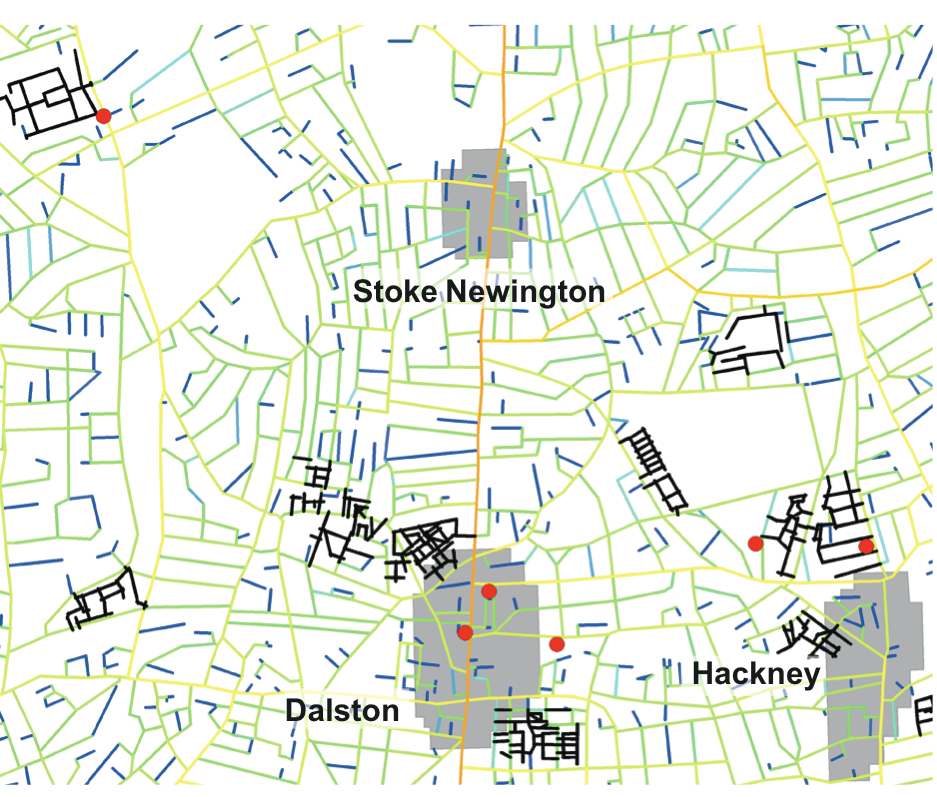
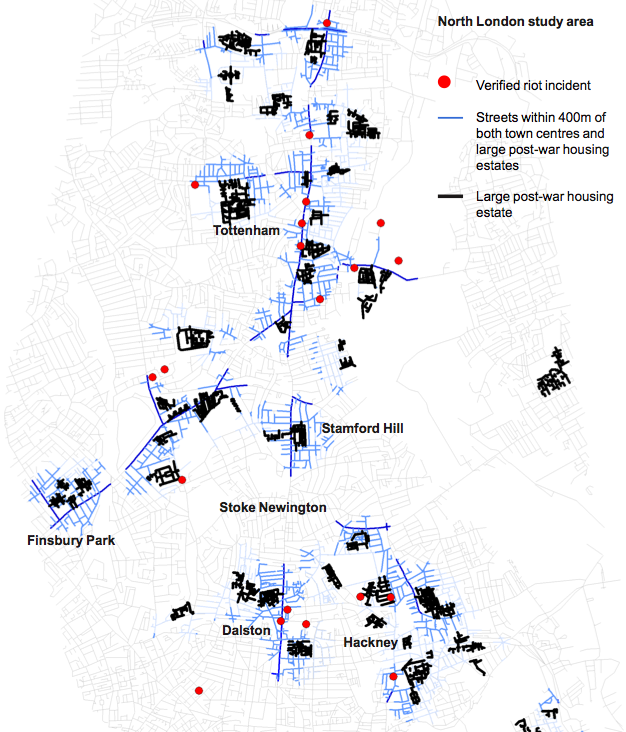
According to the study, 84% of verified incidents in north London and 96% in south London took place within a five minute walk—400 meters—of both: 1) An established town centre, and 2) a large post-war housing estate. Meanwhile, local centres without large post-war estates nearby were unaffected.

The study makes some interesting assumptions, e.g., “most post-war housing estates have been designed in such a way that they create over-complex, and as a result, under-used spaces. These spaces are populated by large groups of unsupervised children and teenagers, where peer socialisation can occur between them without the influence of adults. This pattern of activity, and the segregation of user groups, is not found in non-estate street networks. Our analysis of court records shows that the majority of convicted rioters in the study areas live on large post-war housing estates.”

The reason I’m uncomfortable with the above has to do with the implied solution, i.e., simplify the complex spaces and bring more social traffic to under-utilized areas. This will ensure that children and teenagers are more supervised and prevent peer socialization from taking place without the influence of adults. In other words, simply replace the “hardware” so the “social software” won’t have any more bugs. Snap, if only Mubarak could have hacked Tahrir Square before the revolution. Sarcasm aside, there were some real and legitimate grievances that motivated some of the protestors in England (and Egypt), which this study doesn’t address.

The next version of the analysis is supposed to include socio-economic data to understand the relationship between deprivation and rioting, which in my mind should have come first. But better late than never. In the meantime, here is a post on the tactical use of technology for nonviolent protests with a reference to London: “Maps, Activism and Technology: Check-In’s with a Purpose.”

The Horn of Africa and the Crisis Mapping Community

“… the Horn of Africa famine and the associated crises gravely affecting millions of people has not animated the crisis-mapping community and its online platforms to the extent of post-Haiti or, more recently, following the 2011 earthquake in Japan.”

I’m somewhat concerned by the phrasing of this statement, which comes from this recent article published by ICT4Peace. Perhaps the author is simply unaware of the repeated offers made by the crisis mapping community to provide crisis mapping solutions, mobile information collection platforms, short codes, call center services, etc., to several humanitarian organizations including UN OCHA, UNDP and WFP over the past three months.

In the case of OCHA, the team in Somalia replied that they had everything under control. In terms of UNDP, the colleagues we spoke with simply did/do not have the capacity, time or skill-set to leverage new crisis mapping solutions to improve their situational awareness or better communicate with disaster affected comm-unities. And WFP explained that lack of access rather than information was the most pressing challenge they were facing (at least two months ago), an issue echoed by two other humanitarian organizations.

This excellent report by Internews details the complete humanitarian tech-nology failure in Dadaab refugee camp and underscores how limited and behind some humanitarian organizations still are vis-a-vis the prioritization of “new” in-formation and communication technologies (ICTs) to improve humanitarian response and the lives of refugees in crisis situations. These organizations require support and core funding to “upgrade”. Throwing crisis mapping technologies at the problem is not going to solve many problems if the under-lying humanitarian mechanisms are not in place to leverage these solutions.

This is not a criticism of humanitarian organizations but rather hard reality. I’ve had numerous conversations with both technology and humanitarian colleagues over the past three months about how to reach for low hanging fruits and catalyze quick-wins with even the most minimal ICT interventions. But as is often the case, the humanitarian community is understandably overwhelmed and genu-inely trying to do the best they can given the very difficult circumstances. Indeed, Somalia presents a host of obvious challenges and risks that were not present in either Haiti or Japan. (Incidentally, only a fraction of the crisis mapping commu-nity was involved in Japan compared to overall efforts in Somalia).

Perhaps ICT4Peace is also unaware that some colleagues and I spent many long days and nights in August and September preparing the launch of a live crisis map for Somalia, which ESRI, Google, Nethope and several other groups provided critical input on. See my blog post on this initiative here. But the project was torpedoed by a humanitarian organization that was worried about the conse-quences of empowering the Somali Diaspora, i.e., that they would become more critical of the US government’s perceived inaction as a result of the information they collected—a consequence I personally would have championed as an indica-tor of success.

Maybe ICT4Peace is also unaware that no humanitarian organization formally requested the activation of the Standby Volunteer Task Force (SBTF) in August. That said, the SBTF did engage in this pilot project to crowdsource the geo-tagging of shelters in Somalia in September as a simple trial run. Since then, the SBTF has officially partnered with UNHCR and the Joint Research Center (JRC) to geo-tag IDP camps in specific regions in Somalia next month. Digital Globe is a formal partner in this project, as is Tomnod. Incidentally, JRC is co-hosting this year’s International Conference of Crisis Mappers (ICCM 2011).

ICT4Peace is perhaps also not aware of a joint project between Ushahidi and UN OCHA Kenya to provide crisis mapping support, or of recent conversations with Al Jazeera, Souktel, the Virgin Group, K’naan, PopTech, CeaseFire, PeaceTXT, GSMA, DevSeed and others on implementing crisis mapping and SMS solutions for Somalia. In addition, the Humanitarian Open Street Map Team (HOT) has been busy improving the data for Somalia and the only reason they haven’t been able to go full throttles forward is because of data licensing issues beyond their control. Colleagues from the Harvard Humanitarian Initiative (HHI) have also been offering their help where and when they can.

In sum, to say that the crisis mapping community has not been as “animated” in response to the crisis in the Horn is misleading and rather unfortunate given that ICT4Peace is co-hosting this year’s International Conference of Crisis Mappers (ICCM 2011). All ICT4Peace had to do was to send one simple email to the CrisisMappers.net membership to get all the above information (and likely more). Just because these efforts are not captured on CNN or on the front pages of the UN Chronicle does not mean that there haven’t been numerous ongoing efforts behind the scenes by dozens of different partners and members of the crisis mapping community.

I would therefore not be so quick to dismiss the perceived inaction of this comm-unity. I would also not make an automatic assumption that crisis mapping platforms and mobile technology solutions will always be “easy” or feasible to deploy in every context, especially if this is attempted reactively in the middle of a complex humanitarian crisis. Both Haiti and Japan provided permissive envi-ronments, unlike recent crisis mapping projects in Libya, Egypt and the Sudan which present serious security challenges. Finally, if direct offers of support by the crisis mapping community are not leveraged by field-based humanitarian organizations, then how exactly is said crisis mapping community supposed to be more animated?

Tracking Population Movements using Mobile Phones and Crisis Mapping: A Post-Earthquake Geospatial Study in Haiti

I’ve been meaning to blog about this project since it was featured on BBC last month: “Mobile Phones Help to Target Disaster Aid, says Study.” I’ve since had the good fortune of meeting Linus Bengtsson and Xin Lu, the two lead authors of this study (PDF), at a recent strategy meeting organized by GSMA. The authors are now launching “Flowminder” in affiliation with the Karolinska Institutet in Stockholm to replicate their excellent work beyond Haiti. If “Flowminder” sounds familiar, you may be thinking of Hans Rosling’s “Gapminder” which also came out of the Karolinska Institutet. Flowminder’s mission: “Providing priceless information for free for the benefit of those who need it the most.”

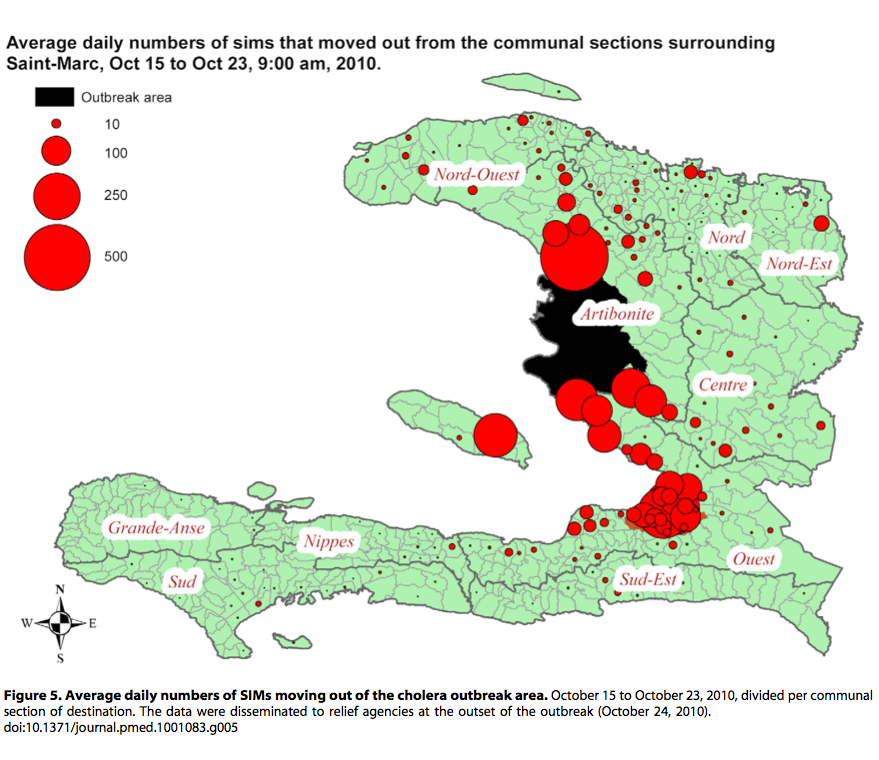
As the authors note, “population movements following disasters can cause important increases in morbidity and mortality.” That is why the UN sought to develop early warning systems for refugee flows during the 1980’s and 1990’s. These largely didn’t pan out; forecasting is not a trivial challenge. Nowcasting, however, may be easier. That said, “no rapid and accurate method exists to track population movements after disasters.” So the authors used “position data of SIM cards from the largest mobile phone company in Haiti (Digicel) to estimate the magnitude and trends of population movements following the Haiti 2010 earthquake and cholera outbreak.”

The geographic locations of SIM cards were determined by the location of the mobile phone towers that SIM cards were connecting to when calling. The authors followed the daily positions of 1.9 million SIM cards for 42 days prior to the earthquake and 158 days following the quake. The results of the analysis reveal that an estimated 20% of the population in Port-au-Prince left the city within three weeks of the earthquake. These findings corresponded well with of a large, retrospective population based survey carried out by the UN.

“To demonstrate feasibility of rapid estimates and to identify areas at potentially increased risk of outbreaks,” the authors “produced reports on SIM card move-ments from a cholera outbreak area at its immediate onset and within 12 hours of receiving data.” This latter analysis tracked close to 140,000 SIM cards over an 8 day period. In sum, the “results suggest that estimates of population movements during disasters and outbreaks can be delivered rapidly and with potentially high validity in areas with high mobile phone use.”

I’m really keen to see the Flowminder team continue their important work in and beyond Haiti. I’ve invited them to present at the International Conference of Crisis Mappers (ICCM 2011) in Geneva next month and hope they’ll be able to join us. I’m interested to explore the possibilities of combining this type of data and analysis with crowdsourced crisis information and satellite imagery analysis. In addition, mobile phone data can also be used to estimate the hardest hit areas after a disaster. For more on this, please see my previous blog post entitled “Analyzing Call Dynamics to Assess the Impact of Earthquakes” and this post on using mobile phone data to assess the impact of building damage in Haiti.

Detecting Emerging Conflicts with Web Mining and Crisis Mapping

My colleague Christopher Ahlberg, CEO of Recorded Future, recently got in touch to share some exciting news. We had discussed our shared interests a while back at Harvard University. It was clear then that his ideas and existing technologies were very closely aligned to those we were pursuing with Ushahidi’s Swift River platform. I’m thrilled that he has been able to accomplish a lot since we last spoke. His exciting update is captured in this excellent co-authored study entitled “Detecting Emergent Conflicts Through Web Mining and Visualization” which is available here as a PDF.

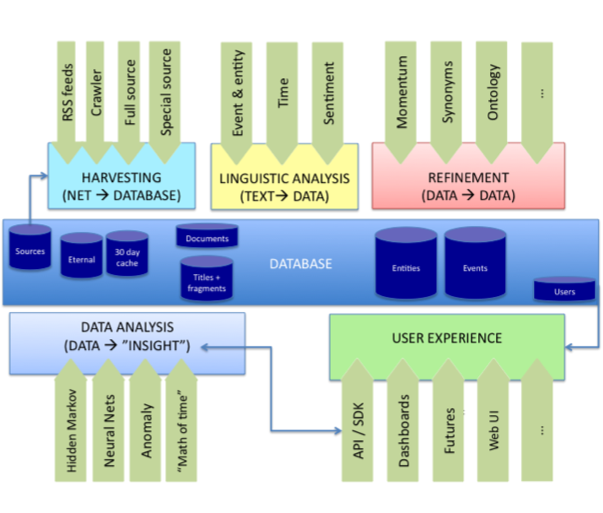
The study combines almost all of my core interests: crisis mapping, conflict early warning, conflict analysis, digital activism, pattern recognition, natural language processing, machine learning, data visualization, etc. The study describes a semi-automatic system which automatically collects information from pre-specified sources and then applies linguistic analysis to user-specified extract events and entities, i.e., structured data for quantitative analysis.

Natural Language Processing (NLP) and event-data extraction applied to crisis monitoring and analysis is of course nothing new. Back in 2004-2005, I worked for a company that was at the cutting edge of this field vis-a-vis conflict early warning. (The company subsequently joined the Integrated Conflict Early Warning System (ICEWS) consortium supported by DARPA). Just a year later, Larry Brilliant told TED 2006 how the Global Public Health Information Net-work (GPHIN) had leveraged NLP and machine learning to detect an outbreak of SARS 3 months before the WHO. I blogged about this, Global Incident Map, European Media Monitor (EMM), HavariaHealthMap and Crimson Hexagon back in 2008. Most recently, my colleague Kalev Leetaru showed how applying NLP to historical data could have predicted the Arab Spring. Each of these initiatives represents an important effort in leveraging NLP and machine learning for early detection of events of interest.

The RecordedFuture system works as follows. A user first selects a set of data sources (websites, RSS feeds, etc) and determines the rate at which to update the data. Next, the user chooses one or several existing “extractors” to find specific entities and events (or constructs a new type). Finally, a taxonomy is selected to specify exactly how the data is to be grouped. The data is then automatically harvested and passed through a linguistics analyzer which extracts useful information such as event types, names, dates, and places. Finally, the reports are clustered and visualized on a crisis map, in this case using an Ushahidi platform. This allows for all kinds of other datasets to be imported, compared and analyzed, such as high resolution satellite imagery and crowdsourced data.

A key feature of the RecordedFuture system is that extracts and estimates the time for the event described rather than the publication time of the newspaper article parsed, for example. As such, the harvested data can include both historic and future events.
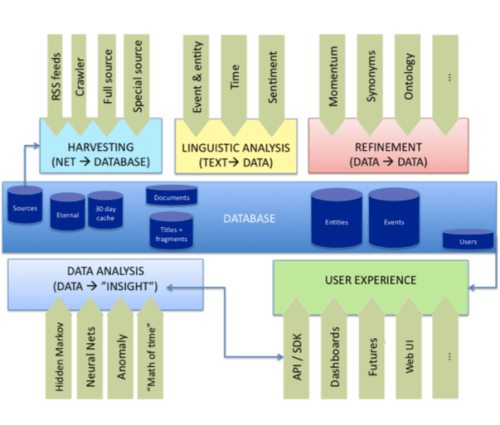
In sum, the RecordedFuture system is composed of the following five features as described in the study:

1. Harvesting: a process in which text documents are retrieved from various sources and stored in the database. The documents are stored for long-term if permitted by terms of use and IPR legislation, otherwise they are only stored temporarily for the needed analysis.

2. Linguistic analysis: the process in which the retrieved texts are analyzed in order to extract entities, events, time and location, etc. In contrast to other components, the linguistic analysis is language dependent.

3. Refinement: additional information can be obtained in this process by synonym detection, ontology analysis, and sentiment analysis.

4. Data analysis: application of statistical and AI-based models such as Hidden Markov Models (HMMs) and Artificial Neural Networks (ANNs) to generate predictions about the future and detect anomalies in the data.

5. User experience: a web interface for ordinary users to interact with, and an API for interfacing to other systems.

The authors ran a pilot that “manually” integrated the RecordedFuture system with the Ushahidi platform. The result is depicted in the figure below. In the future, the authors plan to automate the creation of reports on the Ushahidi platform via the RecordedFuture system. Intriguingly, the authors chose to focus on protest events to demo their Ushahidi-coupled system. Why is this intriguing? Because my dissertation analyzed whether access to new information and communication technologies (ICTs) are statistically significant predictors of protest events in repressive states. Moreover, the protest data I used in my econometric analysis came from an automated NLP algorithm that parsed Reuters Newswires.
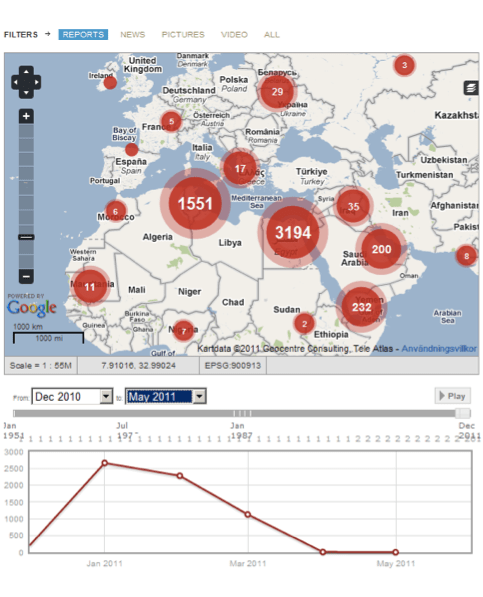
Using RecordedFuture, the authors extracted some 6,000 protest event-data for Quarter 1 of 2011. These events were identified and harvested using a “trained protest extractor” constructed using the system’s event extractor frame-work. Note that many of the 6,000 events are duplicates because they are the same events but reported by different forces. Not surprisingly, Christopher and team plan to develop a duplicate detection algorithm that will also double as a triangulation & veracity scoring feature. I would be particularly interested to see them do this kind of triangulation and validation of crowdsourced data on the fly.

Below are the protest events picked up by RecordedFuture for both Tunisia and Egypt. From these two figures, it is possible to see how the Tunisian protests preceded those in Egypt.
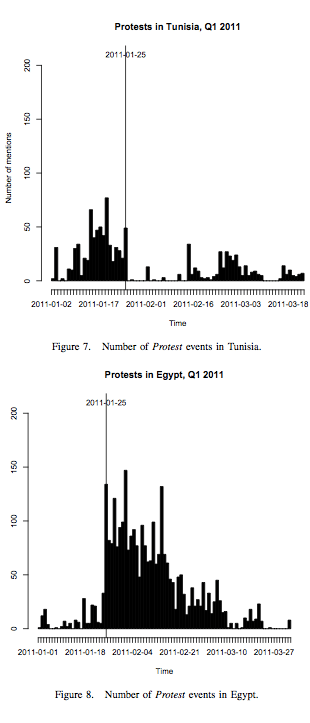
The authors argue that if the platform had been set up earlier this year, a user would have seen the sudden rise in the number of protests in Egypt. However, the authors acknowledge that their data is a function of media interest and attention—the same issue I had with my dissertation. One way to overcome this challenge might be by complementing the harvested reports with crowdsourced data from social media and Crowdmap.

In the future, the authors plan to have the system auto-detect major changes in trends and to add support for the analysis of media in languages beyond English. They also plan to test the reliability and accuracy of their conflict early warning algorithm by comparing their forecasts of historical data with existing conflict data sets. I have several ideas of my own about next steps and look forward to speaking with Christopher’s team about ways to collaborate.


Crisis Mapping the Opening Battle of the Sino-French War

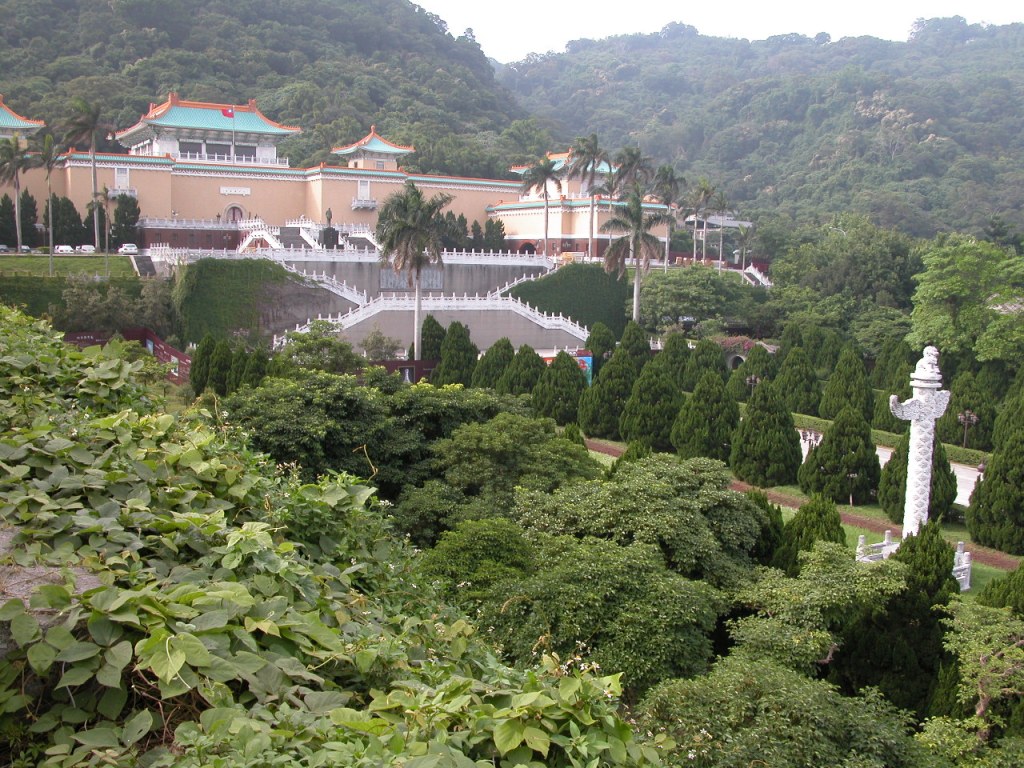
I only had a few hours to explore Taipei last week and thus chose to visit the highly recommended National Place Museum just outside the city. I was well impressed with the Museum’s use of technology, from table-sized “iPads” to 3D virtual reality displays of ancient artifacts. But it was a small and nondescript 127-year-old crisis map that truly stole the show for me.

The crisis map depicts the Battle of Fuzhou (Foochow) also known as the Battle of the Pagoda Anchorage, named for a remarkable Chinese pagoda, the Luoxingta (羅星塔), which still stands on a hill above the harbor today. The battle, which took place in August 1884, was the opening engagement of the Sino-French War which lasted for a year and a half.

Admiral Amédée Courbet, in command of the French squadran, had noticed that the Chinese ships anchored near the harbor swung with the tide and thus decided to plan his attack just before high tide at 2 p.m. on the afternoon of Saturday, August 23, 1884, when he hoped the Chinese ships would have “swung away from the French ships and would be presenting their vulnerable sterns to the attackers.” Courbet’s strategy worked, “virtually destroying the Fujian Fleet, one of China’s four regional fleets.”

I took a picture of the Chinese crisis map on display in Taipei (see below), which is apparently the first copy to make it on the Internet. The caption in English on the bottom right reads: “Diagram of engagement between the French and Chinese naval fleets at Mawei, French warships attack during the afternoon low tide. Chinese vessels anchored at the bows, now face the French astern, unable to use the powerful bow cannons, resulting in the total sinking of the Ch’ing  Fuzhou (Foochow) Naval Fleet, August 23, 1884.”

I was so intrigued and surprised to find this crisis map that I followed up with some online research. The Wikipedia article on the battle was an absolute treasure trove of information and pictures. Take for example, the French version of the crisis map below.

Both maps appear to be more or less at the same scale but only the French includes distance bar (0-500 meters). The French map is also more detailed (history is written by the victors?) but the Chinese one makes more use of color-coding. To get a better sense of what the “battle field” and ships looked liked, check out the following pictures.

The above was painted in the 19th century. The painting below depicts the bombing of the Fuzhou Arsenal on the following day, August 24th.

Contrast the above French version with the Chinese lithograph of the battle below and the Japanese depiction that follows.

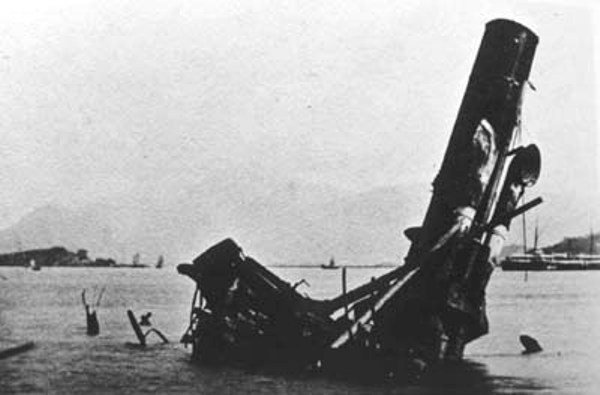
The picture below shows the Chinese fleet the night before the French attack. The two following pictures depict the result, the sunken Chinese ships.


Curious to know what the area looks like today? The Wikipedia article also provided a number of pictures.

Know of other crisis maps from hundreds of years ago? If so, please feel free to share in the comments section below. Thanks!

Theorizing Ushahidi: An Academic Treatise

[This is an excerpt taken from Chapter 1 of my dissertation]

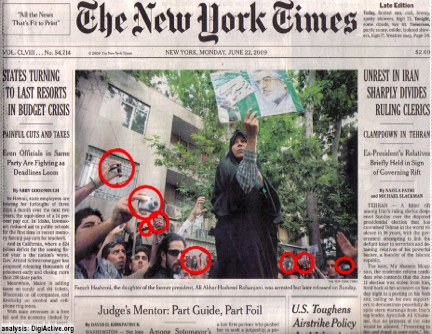
Activists are not only turning to social media to document unfolding events, they are increasingly mapping these events for the world to bear witness. We’ve seen this happen in Tunisia, Egypt, Libya, Syria, Yemen and beyond. My colleague Alexey Sidorenko describes this new phenomenon as a “mapping reflex.” When student activists from Khartoum got in touch earlier this year, they specifically asked for a map, one that would display their pro-democracy protests and the government crackdown. Why? They wanted the world to see that the Arab Spring extended to the Sudan.

The Ushahidi platform is increasingly used to map information generated by crowds in near-real time like the picture depicted above. Why is this important? Because live public maps can help synchronize shared awareness, an important catalyzing factor of social movements, according to Jürgen Habermas. Recall Habermas’s treatise that “those who take on the tools of open expression become a public, and the presence of a synchronized public increasingly constrains un-democratic rulers while expanding the right of that public.”

Sophisticated political maps have been around for hundreds of years. But the maps of yesteryear, like the books of old, were created and controlled by the few. While history used to be written by the victors, today, journalists like my colleague Anand Giridharadas from the New York Times are asking whether the triangulated crisis map will become the new first draft of history. In the field of geography and cartography, some refer to this new wave of democratized map-making as “neo-geography.” But this new type of geography is not only radically different from traditional approaches because it is user-generated and more par-ticipatory; the fact that today’s dynamic maps can also be updated and shared in near real-time opens up an entire new world of possibilities and responses.

Having a real time map is almost as good as having your own helicopter. A live map provides immediate situational awareness, a third dimension and additional perspective on events unfolding in time and space. Moreover, creating a map catalyzes conversations between activists, raises questions about geographic patterns or new incidents, and leads to more questions regarding the status quo in a repressive environment. To be sure, mass media alone does not change people’s minds.  Recall that political change is a two-step process, with the second—social step—being where political opinions are formed (Katz and Lazarsfeld 1955). “This is the step in which the Internet in general, and social media in particular, can make a difference” (Shirky 2010). In addition, the collaboration that takes place when creating a live map can also reinforce weak and strong ties, both of which are important for civil resistance.

The Ushahidi platform enables a form of live-mapped “sousveillance,” which refers to the recording of an activity using portable personal technologies. In many respects, however, the use of Ushahidi goes beyond sousveillance in that it generates the possibility of “dataveillance” and a possible reversal of Bentham’s panopticon. “With postmodernity, the panopticon has been informationalized; what once was organized around hierarchical observation is now organized through decoding and recoding of information” (Lyon 2006). In Seeing Like a State, James Scott argues eloquently that this process of decoding and recoding was for centuries the sole privilege of the State. In contrast, the Ushahidi platform provides a participatory digital canvas for the public decoding, recoding of information and synchronization of said information. In other words, the platform serves to democratize dataveillance by crowdsourcing what was once the exclusive realm of the “security-informational complex.”

In Domination and the Arts of Resistance: Hidden Transcripts published in 1990, James Scott distinguishes between public and hidden transcripts. The former describes the open, public interactions that take place between domina-tors and oppressed while hidden transcripts relate to the critique of power that “goes on offstage” and which the power elites cannot decode. This hidden transcript is comprised of the second step, social conversations, that Katz and Lazarsfeld (1955) argue ultimately change political behavior. Scott writes that when the oppressed classes publicize this “hidden transcript”, they become conscious of its common status. Borrowing from Habermas, the oppressed thereby become a public and more importantly a synchronized public. In many ways, the Ushahidi platform is a vehicle by which the hidden transcript is collectively published and used to create shared awareness—thereby threatening to alter the balance of power between the oppressors and oppressed.

The new dynamics that are enabled by “liberation technologies” like Ushahidi may enable a different form of democracy, one which arising from “the inability of electoral/representative politics to keep it promises [has thus] led to the development of indirect forms of democracy” (Rosanvallon 2008). More specifically, Rosanvallon indentifies three channels whereby civil society can hold the state accountable not just during elections but also between elections and independent of their results. “The first refers to the various means whereby citizens (or, more accurately, organizations of citizens) are able to monitor and publicize the behavior of elected and appointed rulers; the second to their capacity to mobilize resistance to specific policies, either before or after they have been selected; the third to the trend toward ‘juridification’ of politics  [cf. dataveillance] when individuals or social groups use the courts and, especially, jury trials to bring delinquent politicians to judgment” (Schmitter 2008, PDF).

These three phases correspond surprisingly well with the three waves of Ushahidi uses witnessed over the past three years. The first wave was reactive and documentary focused. The second was more pro-active and focused on action beyond documentation while the third seeks to capitalize on the first two to complete the rebalancing of power. Perhaps this final wave is the teleological purpose of the Ushahidi platform or What Technology Wants as per Kevin Kelly’s treatise. However, this third wave, the trend toward the “juridificaiton” of democracy bolstered by crowdsourced evidence that is live-mapped on a public Ushahidi platform, is today more a timid ripple than a tsunami of change reversing the all-seeing “panopticon”. A considerable amount of learning-by-doing remains to be done by those who wish to use the Ushahidi platform for impact beyond the first two phases of Rosanvallon’s democracy.

Real Time LRA Crisis Map Tracks Mass Atrocities in Central Africa

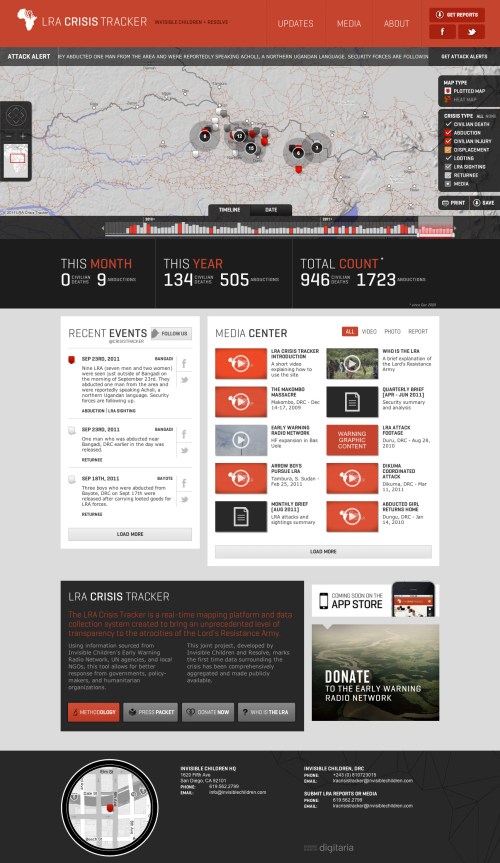
My colleagues at Resolve and Invisible Children have just launched their very impressive Crisis Map of LRA Attacks in Central Africa. The LRA, or Lord’s Resistance Army, is a brutal rebel group responsible for widespread mass atrocities, most of which go completely unreported because the killings and kidnappings happen in remote areas. This crisis map has been a long time in the making so I want to sincerely congratulate Michael Poffenberger, Sean Poole, Adam Finck, Kenneth Transier and the entire team for the stellar job they’ve done with this project. The LRA Crisis Tracker is an  important milestone for the fields of crisis mapping and early warning.

The Crisis Tracker team did an excellent job putting together a detailed code book (PDF) for this crisis map, a critical piece of any crisis mapping and conflict early warning project that is all too-often ignored or rushed by most. The reports mapped on Crisis Tracker come from Invisible Children’s local Early Warning Radio Network, UN agencies and local NGOs. Invisible Children’s radio network also provides local communities with the ability to receive warnings of LRA activity and alert local security forces to LRA violence.

When I sat down with Resolve’s Kenneth Transier earlier this month, he noted that the majority of the reports depicted on their LRA crisis map represent new and original information. He also noted that they currently have 22 months of solid data, with historical and real-time data entry on-going. You can download the data here. Note that the public version of this data does not include the most sensitive information for security reasons.

The Crisis Tracker team also provide monthly and quarterly security briefs, analyzing the latest data they’ve collected for trends and patterns. This project is by far the most accurate, up-to-date and comprehensive source of information on LRA atrocities, which the partners hope will improve efforts to protect vulnerable communities in the region. Indeed, the team has joined forces with a number of community-run protection organizations in Central Africa who hope to benefit from the team’s regular crisis reports.

The project is also innovative because of the technology being used. Michael got in touch about a year ago to learn more about the Ushahidi platform and after a series of conversations decided that they needed more features than were currently available from Ushahidi, especially on the data visualization side. So I put them in touch with my colleagues at Development Seed. Ultimately, the team partnered with a company called Digitaria which used the backend of a Sales-force platform and a customized content management system to publish the in-formation to the crisis map. This an important contribution to the field of crisis mapping and I do hope that Digitaria share their technology with other groups. Indeed, the fact that new crisis mapping technologies are surfacing is a healthy sign that the field is maturing and evolving.

In the meantime, I’m speaking with Michael about next steps on the conflict early warning and especially response side. This project has the potential to become a successful people-centered conflict early response initiative as long as the team focuses seriously on conflict preparedness and implement an number of other best practices from fourth generation conflict early warning systems.

This project is definitely worth keeping an eye on. I’ve invited Crisis Tracker to present at the 2011 International Conference of Crisis Mappers in Geneva in November (ICCM 2011). I do hope they’ll be able to participate. In the meantime, you can follow the team and their updates via twitter at @crisistracker. The Crisis Tracker iPhone and iPad apps and should be out soon.

Augmented Reality for Crisis Mapping and Humanitarian Response

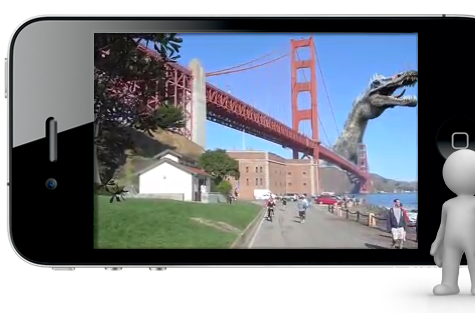
Could we leverage Augmented Reality (AR) apps for Crisis Mapping? I’ve been thinking about this question for a while but finally decided to experiment after bumping into Autonomy here at the IPI World Congress in Taipei. The company has a free AR app called Aurasma, which basically lets the user create their own AR action. So I gave it a spin, figuring that if people could animate the odd T-Rex splish-splashing in the Bay Area, there might also be some humanitarian applications worth exploring.

Autonomy’s AR app is available for the iPhone, iPad and the Android. What is especially neat is that you can cache the AR data and therefore use the app off-line, always a plus for crisis response. I experimented by using: (1) the amazing Humanitarian OpenStreetMap animated video of Haiti, (2) Internews’s excellent humanitarian technology report on Dadaab (a must read), and (3), a printout of WalkingPapers for some location in California.

I had to use an iPhone and iPad at the same time to film the AR in action, so apologies in advance for the less than smooth panning. In this first video, I point the iPad’s camera to a screenshot print-out of the OpenStreetMap (OSM) video, the cover of Internews’s report and a paper-based map from WalkingPapers. For the OSM screenshot, I superimposed the video animation. I added a dynamic visualization of an Ushahidi platform for Somalia on the front page of the Internews report and added AR red dots to the WalkingPapers handout.

The OSM video animation in AR is a little wobbly but comes out much nicer on this video which demo’s the iPhone app.

The Aurasma app was easy to use and the Autonomy Marketing Executive I spoke to said he’d be happy to support humanitarian applications of the platform. One idea would be to visualize MapAction GIS products in the field with an AR layer for crowdsourced data, for example. In other words, the hard copy maps could serve as informative base maps on top of which dynamic event-data could be visualized (and updated) via the Aurasma app. A related idea: visualize projected weather forecasts on top of a hard copy map of flood prone areas. Of course, the same types of visualizations could be done from a GIS platform but I’m thinking about mobile, rapid and off-line options for humanitarian professionals not conversant in GIS.

How would you apply AR to crisis mapping? Is AR even useful for humanitarian response or yet another unnecessary gadget? Feel free to share your thoughts in the comments section below. (As for fans of David Suarez’s book, The Daemon, yes, this brings us one step closer to Matthew Sobol’s vision).