Category Archives: Crisis Mapping

Analyzing Satellite Imagery of the Somali Crisis Using Crowdsourcing

 Update: results of satellite imagery analysis available here.

You gotta love Twitter. Just two hours after I tweeted the above—in reference to this project—a colleague of mine from the UN who just got back from the Horn of Africa called me up: “Saw your tweet, what’s going on?” The last thing I wanted to was talk about the über frustrating day I’d just had. So he said, “Hey, listen, I’ve got an idea.” He reminded me of this blog post I had written a year ago on “Crowdsourcing the Analysis of Satellite for Disaster Response” and said, “Why not try this for Somalia? We could definitely use that kind of information.” I quickly forgot about my frustrating day.

Here’s the plan. He talks to UNOSAT and Google about acquiring high-resolution satellite imagery for those geographic areas for which they need more information on. A colleague of mine in San Diego just launched his own company to develop mechanical turk & micro tasking solutions for disaster response. He takes this satellite imagery and cuts it into say 50×50 kilometers square images for micro-tasking purposes.

We then develop a web-based interface where volunteers from the Standby Volunteer Task Force (SBTF) sign in and get one high resolution 50×50 km image displayed to them at a time. For each image, they answer the question: “Are there any human shelters discernible in this picture? [Yes/No].” If yes, what would you approximate the population of that shelter to be? [1-20; 21-50; 50-100; 100+].” Additional questions could be added. Note that we’d provide them with guidelines on how to identify human shelters and estimate population figures.

No shelters discernible in this image

Each 50×50 image would get rated by at least 3 volunteers for data triangulation and quality assurance purposes. That is, if 3 volunteers each tag an image as depicting a shelter (or more than one shelter) and each of the 3 volunteers approximate the same population range, then that image would get automatically pushed to an Ushahidi map, automatically turned into a geo-tagged incident report and automatically categorized by the population estimate. One could then filter by population range on the Ushahidi map and click on those reports to see the actual image.

If satellite imagery licensing is an issue, then said images need not be pushed to the Ushahidi map. Only the report including the location of where a shelter has been spotted would be mapped along with the associated population estimate. The satellite imagery would never be released in full, only small bits and pieces of that imagery would be shared with a trusted network of SBTF volunteers. In other words, the 50×50 images could not be reconstituted and patched together because volunteers would not get contiguous 50×50 images. Moreover, volunteers would sign a code of conduct whereby they pledge not to share any of the imagery with anyone else. Because we track which volunteers see which 50×50 images, we could easily trace any leaked 50×50 image back to the volunteer responsible.

Note that for security reasons, we could make the Ushahidi map password protected and have a public version of the map with very limited spatial resolution so that the location of individual shelters would not be discernible.

I’d love to get feedback on this idea from iRevolution readers, so if you have thoughts (including constructive criticisms), please do share in the comments section below.

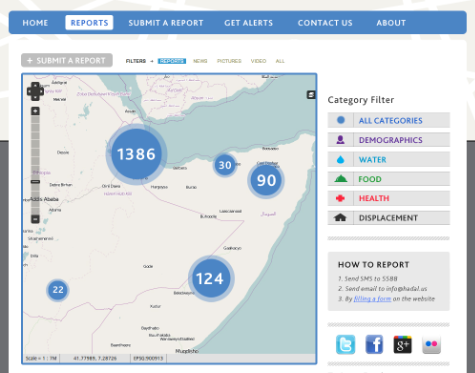
Crisis Mapping Somalia with the Diaspora

The state of Minnesota is home to the largest population of Somalis in North America. Like any Diaspora, the estimated 25,000 Somalis who live there ar closely linked to family members back home. They make thousands of phone calls every week to numerous different locations across Somalia. So why not make the Somali Diaspora a key partner in the humanitarian response taking place half-way across the world?

In Haiti, Mission 4636 was launched to crowdsource micro needs assessments from the disaster affected population via SMS. The project could not have happened without hundreds of volunteers from the Haitian Diaspora who translated and geo-referenced the incoming text messages. There’s no doubt that Diasporas can play a pivotal role in humanitarian response but they are typically ignored by large humanitarian organizations. This is why I’m excited to be part of an initiative that plans to partner with key members of the Diaspora to create a live crisis map of Somalia.

This is a mock-up for illustration only

The project is still in very early stages so there’s not much to show right now but I’m hopeful that the stars will align next week so we can formally launch the initiative. The basic game plan is as follows:

  • A short survey of some 10 questions is being drafted by public health professionals with experience in humanitarian response. These questions will try to capture the most essential indicators. More questions are be added at a later stage.
  • Humanitarian colleagues who have been working with the Somali Diaspora in Minnesota for years are now in the process of recruiting trusted members of the community.
  • These trusted members of the Diaspora will participate in a training this weekend on basic survey and interview methods. The training will also provide them with a hands-on introduction to the Ushahidi platform where they’ll  enter the survey results.
  • If everything goes well, these community members will each make several phone calls to friends and relatives back home next week. They’ll ask the questions from the survey and add the answers to the Ushahidi map. Elders in the community will fill out a paper-based form for other colleagues to enter online.
  • Trusted members of the Diaspora will continue to survey contacts back home on a weekly basis. New survey questions are likely to be added based on feedback from other humanitarian organizations. Surveys may also be carried out every other day or even on a daily basis for some of the questions.

If the pilot is successful, then colleagues in Minnesota may recruit additional trusted members of the community to participate in this live crisis mapping effort. There’s a lot more to the project including several subsequent phases but we’re still at the early stages so who knows where this will go. But yes, we’re thinking through the security implications, verification issues, data visualization features, necessary analytics, etc. If all goes well, there’ll be a lot more information to share next week in which case I’ll add more info here and also post an update on the Ushahidi blog.

Mobile Technologies for Conflict Management

“Mobile Technologies for Conflict Management: Online Dispute Resolution, Governance, Participation” is the title of a new book edited by Marta Poblet. I recently met Marta in Vienna, Austria during the UN Expert Meeting on Croudsource Mapping organized by UN SPIDER. I’m excited that her book has just launched. The chapters are is divided into 3 sections: Disruptive Applications of Mobile Technologies; Towards a Mobile ODR; and Mobile Technologies: New Challenges for Governance, Privacy and Security.

The book includes chapters by several colleagues of mine like Mike Best on “Mobile Phones in Conflict Stressed Environments”, Ken Banks on “Appropriate Mobile Technologies,” Oscar Salazar and Jorge Soto on “How to Crowdsource Election Monitoring in 30 Days,” Jacok Korenblum and Bieta Andemariam on “How Souktel Uses SMS Technology to Empower and Aid in Conflict-Affected Communities,” and Emily Jacobi on “Burma: A Modern Anomaly.”

My colleagues Jessica Heinzelman, Rachel Brown and myself also contributed one of the chapters. I include the introduction below.

I had long wanted to collaborate on a peer-reviewed chapter in which I could combine my earlier study of conflict resolution theory with my experience in conflict early warning and crisis mapping. See also this earlier blog post on “Crowdsourcing for Peace Mapping.”  I’ve been a big fan of Will Ury’s approach ever since coming across his work while at Columbia University back in 2003. Little did I know then that I’d be co-authoring this book chapter with two new stellar colleagues. Rachel has taken much of this thinking and applied it to the real world in her phenomenal project called Sisi ni Amni, or “We Are Peace.” You can follow them on Twitter. Jessica now serves on their Advisory Board.

Google+ for Crowdsourcing Crisis Information, Crisis Mapping and Disaster Response

Facebook is increasingly used to crowdsource crisis information and response, as is Twitter. So is it just a matter of time until we see similar use cases with Google+? Another question I have is whether such uses cases will simply reflect more of the same or whether we’ll see new, unexpected applications and dynamics? Of course, it may be premature to entertain the role that Google+ might play in disaster response just days after it’s private beta launch, but the company seems fully committed to making  this new venture succeed. Entertain-ing how Google+ (G+) might be used as a humanitarian technology thus seems worthwhile.

The fact that G+ is open and searchable is probably one of the starkest differences with the walled-garden that is Facebook; that, and their Data Liberation policy. This will make activity on G+ relatively easier to find—Google is the King of Search, after all. This openness will render serendipity and synergies more likely.

The much talked about “Circles” feature is also very appealing for the kind of organic and collaborative crowdsourcing work that we see emerging following a crisis. Think about these “Circles” not only as networks but also as “honeycombs” for “flash” projects—i.e., short-term and temporary—very much along the lines that Skype is used for live collaborative crisis mapping operations.

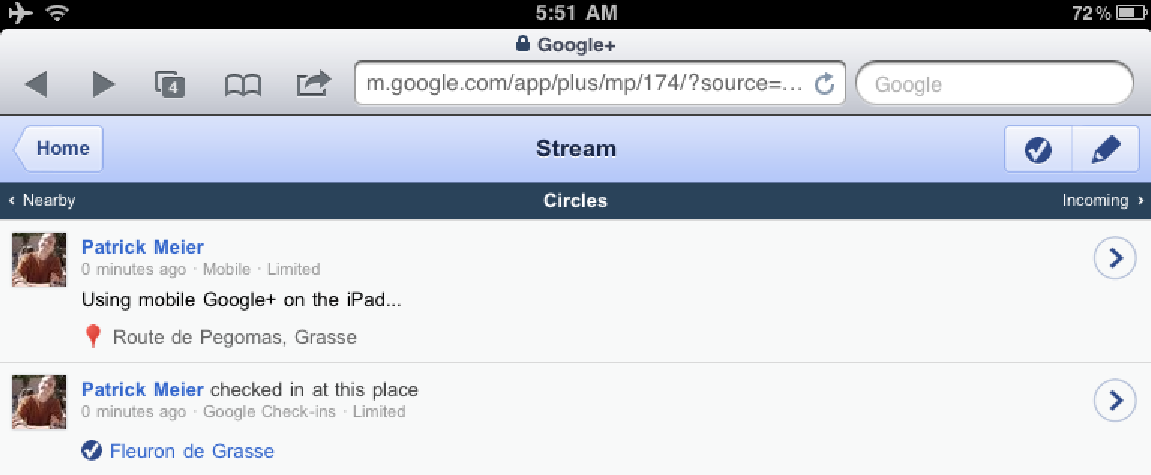
Google+’s new Hangout feature could also be used instead of Skype chat and video, with the advantage of having multi-person video-conferencing. With a little more work, the Sparks feature could facilitate media monitoring—an important component of live crisis mapping. And then there’s Google+ mobile, which is accessible on most phones with a browser and already includes a “check-in” feature as well as geo-referenced status updates. The native app for the Android is already available and the iPhone app is coming soon.

Clicking on my status update above, produces the Google Maps page below. What’s particularly telling about this is how “underwhelming” the use of Google Maps currently is within G+.  There’s no doubt this will change dramatically as G+ evolves. The Google+ team has noted that they already have dozens of new features ready to be rolled out in the coming months. So expect G+ to make full use of Google’s formidable presence on the Geo Web—think MapMaker+ and Earth Engine+. This could be a big plus for live crowdsourced crisis mapping, especially of the multimedia kind.

One stark difference with Facebook’s status updates and check-in’s is that G+ allows you to decide which Circles (or networks of contacts) to share your updates and check-in’s with. This is an important difference that could allow for more efficient information sharing in near real-time. You could set up your Circles as different teams, perhaps even along UN Cluster lines.

As the G+ mobile website reveals, the team will also be integrating SMS, which is definitely key for crisis response. I imagine there will also be a way to connect your Twitter feed with Google+ in the near future. This will make G+ even more compelling as a mobile humanitarian technology platform. In addition, I expect there are also plans to integrate Google News, Google Reader, Google Groups, Google Docs and Google Translate with G+. GMail, YouTube and Picasa are already integrated.

One feature that will be important for humanitarian applications is offline functionality. Google Reader and GMail already have this feature (Google Gears), which I imagine could be added to G+’s Stream and perhaps eventually with Google Maps? In addition, if Google can provide customizable uses of G+, then this could also make the new platform more compelling for humanitarian organizations, e.g., if OCHA could have their own G+ (“iG+”) by customizing and branding their G+ interface; much like the flexibility afforded by the Ning platform. One first step in that direction might be to offer a range of “themes” for G+, just like Google does with GMail.

Finally, the ability to develop third party apps for G+ could be a big win. Think of a G+ store (in contrast to an App Store). I’d love to see a G+ app for Ushahidi and OSM, for example.

If successful, G+ could be the best example of “What Technology Wants” to date. G+ is convergence technology par excellence. It is a hub that connects many of Google’s excellent products and from the looks of it, the G+ team is just getting warmed up with the converging.

I’d love to hear from others who are also brainstorming about possible applications of Google+ in the humanitarian space. Am I off on any of the ideas above? What am I missing? Maybe we could set up a Google+ 4 Disaster Response Circle and get on Hangout to brainstorm together?

A List of Completely Wrong Assumptions About Technology Use in Emerging Economies

I’ve spent the past week at the iLab in Liberia and got what I came for: an updated reality check on the limitations of technology adoption in developing countries. Below are some of the assumptions that I took for granted. They’re perfectly obvious in hindsight and I’m annoyed at myself for not having realized their obviousness sooner. I’d be very interested in hearing from others about these and reading their lists. This need not be limited to one particular sector like ICT for Development (ICT4D) or Mobile Health (mHealth). Many of these assumptions have repercussions across multiple disciplines.

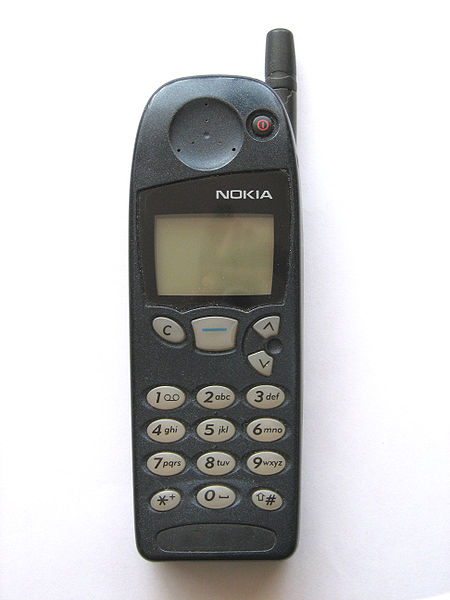
The following examples come from conversations with my colleague Kate Cummings who directs Ushahidi Liberia and the iLab here in Monrovia. She and her truly outstanding team—Kpetermeni Siakor, Carter Draper, Luther Jeke and Anthony Kamah—spearheaded a number of excellent training workshops over the past few days. At one point we began discussing the reasons for the limited use of SMS in Liberia. There are the usual and obvious reasons. But the one hurdle I had not expected to hear was Nokia’s predictive text functionality. This feature is incredibly helpful since the mobile phone basically guesses which words you’re trying to write so you don’t have to type every single letter.

But as soon as she pointed out how confusing this can be, I immediately understood what she meant. If I had never seen or been warned about this feature before, I’d honestly think the phone was broken. It would really be impossible to type with. I’d get frustrated and give up (the tiny screen further adds to the frustration). And if I was new to mobile phones, it wouldn’t be obvious how to switch that feature off either. (There are several tutorials online on how to use the predictive text feature and how to turn it off, which clearly proves they’re not intuitive).

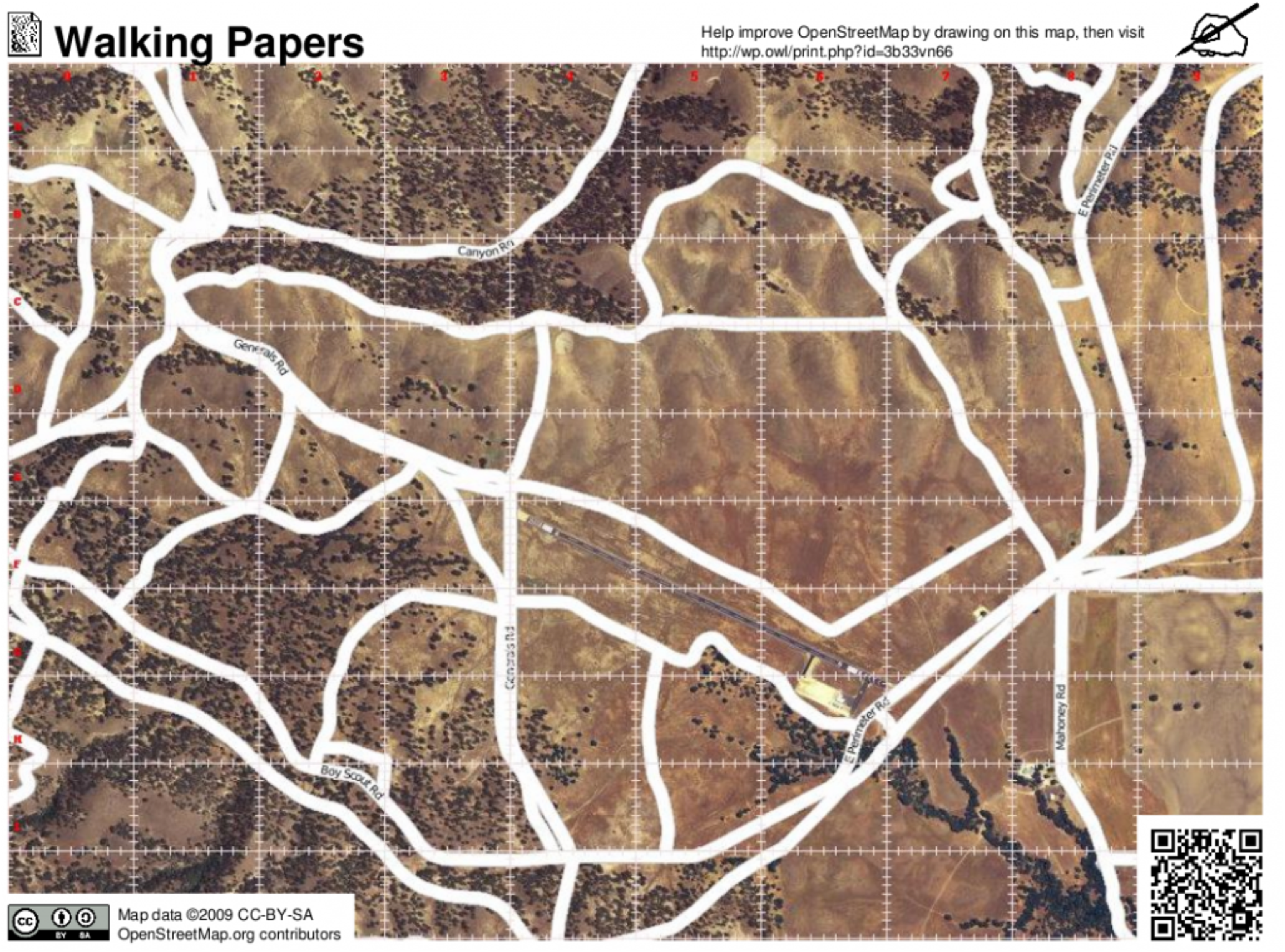
In one of the training workshops we just had, I was explaining what Walking Papers was about and how it might be useful in Liberia. So I showed the example below and continued talking. But Kate jumped in and asked participants: “What do you see in this picture? Do you see the trees, the little roads?” She pointed at the features as she described the individual shapes. This is when it dawned on me that there is absolutely nothing inherently intuitive about satellite images. Most people on this planet have not been on an airplane or a tall building. So why would a bird’s eye view of their village be anything remotely recognizable? I really kicked myself on that one. So I’ll write it again: there is nothing intuitive about satellite imagery. Nor is there anything intuitive about GPS and the existence of a latitude and longitude coordinate system.

Kate went on to explain that this kind of picture is what you would see if you were flying high like a bird. That was the way I should have introduced the image but I had taken it completely for granted that satellite imagery was self-explanatory when it simply isn’t. In further conversations with Kate, she explained that they too had made that assumption early on when trying to introduce the in’s and out’s of the Ushahidi platform. They quickly realized that they had to rethink their approach and decided to provide introductory courses on Google Maps instead.

More wrong assumptions revealed themselves during the workshpos. For example, the “+” and “-” markers on Google Map are not intuitive either nor is the concept of zooming in and out. How are you supposed to understand that pressing these buttons still shows the same map but at a different scale and not an entirely different picture instead? Again, when I took a moment to think about this, I realized how completely confusing that could be. And again I kicked myself. But contrast this to an entirely different setting, San Francisco, where some friends recently told me how their five year old went up to a framed picture in their living room and started pinching at it with his fingers, the exact same gestures one would use on an iPhone to zoom in and out of a picture. “Broken, broken” is all the five year old said after that disappointing experience.

The final example actually comes from Haiti where my colleague Chrissy Martin is one of the main drivers behind the Digicel Group’s mobile banking efforts in the country. There were of course a number of expected challenges on the road to launching Haiti’s first successful mobile banking service, TchoTcho Mobile. The hurdle that I had not expected, however, had to do with the pin code. To use the service, you would enter your own personal pin number on your mobile phone in order to access your account. Seems perfectly straight forward. But it really isn’t.

The concept of a pin number is one that many of us take completely for granted. But the idea is often foreign to many would-be users of mobile banking services and not just in Haiti. Think about it: all one has to do to access all my money is to simply enter four numbers on my phone. That does genuinely sound crazy to me at a certain level. Granted, if you guess the pin wrong three times, the phone gets blocked and you have to call TchoTcho’s customer service. But still, I can understand the initial hesitation that many users had. When I asked Chrissy how they overcame the hurdle, her answer was simply this: training. It takes time for users to begin trusting a completely new technology.

So those are some of the assumptions I’ve gotten wrong. I’d be grateful if readers could share theirs as there must be plenty of other assumptions I’m making which don’t fit reality. Incidentally, I realize that emerging economies vary widely in technology diffusion and adoption—not to mention sub-nationally as well. This is why having the iLab in Liberia is so important. Identifying which assumptions are wrong in more challenging environments is really important if our goal is to use technology to help contribute meaningfully to a community’s empowerment, development and independence.

Passing the I’m-Not-Gaddafi Test: Authenticating Identity During Crisis Mapping Operations

I’ve found myself telling this story so often in response to various questions that it really should be a blog post. The story begins with the launch of the Libya Crisis Map a few months ago at the request of the UN. After the first 10 days of deploying the live map, the UN asked us to continue for another two weeks. When I write “us” here, I mean the Standby Volunteer Task Force (SBTF), which is designed for short-term rapid crisis mapping support, not long term deploy-ments. So we needed to recruit additional volunteers to continue mapping the Libya crisis. And this is where the I’m-not-Gaddafi test comes in.

To do our live crisis mapping work, SBTF volunteers generally need password access to whatever mapping platform we happen to be using. This has typically been the Ushahidi platform. Giving out passwords to several dozen volunteers in almost as many countries requires trust. Password access means one could start sabotaging the platform, e.g., deleting reports, creating fake ones, etc. So when we began recruiting 200+ new volunteers to sustain our crisis mapping efforts in Libya, we needed a way to vet these new recruits, particularly since we were dealing with a political conflict. So we set up an I’m-not-Gaddafi test by using this Google Form:

So we placed the burden of proof on our (very patient) volunteers. Here’s a quick summary of the key items we used in our “grading” to authenticate volunteers’ identity:

Email address: Professional or academic email addresses were preferred and received a more favorable “score”.

Twitter handle: The great thing about Twitter is you can read through weeks’ worth of someone’s Twitter stream. I personally used this feature several times to determine whether any political tweets revealed a pro-Gaddafi attitude.

Facebook page: Given that posing as someone else or a fictitious person on Facebook violates their terms of service, having the link to an applicant’s Facebook page was considered a plus.

LinkedIn profile: This was a particularly useful piece of evidence given that the majority of people on LinkedIn are professionals.

Personal/Professional blog or website: This was also a great to way to authenticate an individual’s identity. We also encouraged applicants to share links to anything they had published which was available online.

For every application, we had two or more of us from the core team go through the responses. In order to sign off a new volunteer as vetted, two people had to write down “Yes” with their name. We would give priority to the most complete applications. I would say that 80% of the 200+ applications we received were able to be signed off on without requiring additional information. We did follow ups via email for the remaining 20%, the majority of whom provided us with extra info that enabled us to validate their identity. One individual even sent us a copy of his official ID. There may have been a handful who didn’t reply to our requests for additional information.

This entire vetting process appears to have worked, but it was extremely laborious and time-consuming. I personally spent hours and hours going through more than 100 applications. We definitely need to come up with a different system in the future. So I’ve been exploring some possible solutions—such as social authentication—with a number of groups and I hope to provide an update next month which will make all our lives a lot easier, not to mention give us more dedicated mapping time. There’s also the need to improve the Ushahidi platform to make it more like Wikipedia, i.e., where contributions can be tracked and logged. I think combining both approaches—identity authentication and tracking—may be the way to go.

Identifying Strategic Protest Routes for Civil Resistance: An Analysis of Optimal Approaches to Tahrir Square

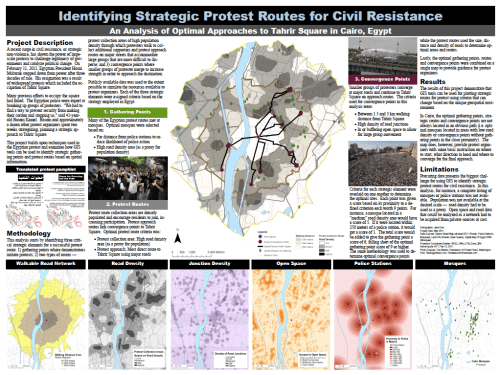
My colleague Jessica recently won the Tufts GIS Poster Expo with her excellent poster on civil resistance. She used GIS data to analyze optimal approaches to Tahrir Square in Cairo. According to Jessica, many previous efforts to occupy the square had failed. So Egyptian activists spent two weeks brainstorming the best strategies to approach Tahrir Square.

Out of curiosity, Jessica began to wonder whether the use of GIS data and spatial analysis might shed some light on possible protest routes. She began her analysis by  identifying three critical strategic elements for a successful protest route:

“1) Gathering points where demonstrators initiate protests; 2) two types of routes—protest collection areas of high population density through which protesters walk to collect additional supporters and protest approach routes on major streets that accommodate large groups that are more difficult to disperse; and 3) convergence points where smaller groups of protester merge to increase strength in order to approach the destination.”

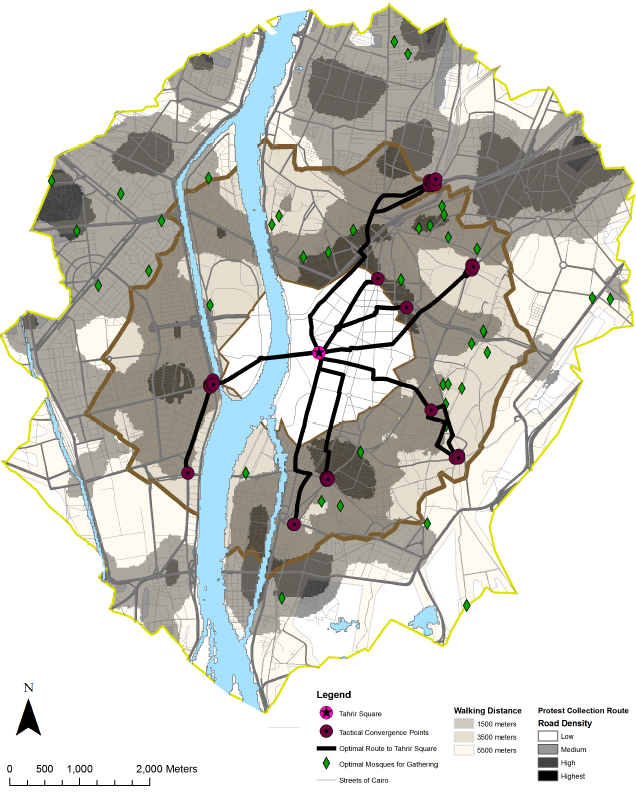
For her analysis, Jessica took gathering points and convergence points into consideration. For example, many Egyptian activist met at Mosques. So she selected optimal Mosques based on their distance to police stations (the farther the better) and high road density area “as a proxy for population density.” In terms of convergence points, smaller groups of protestors converged on major roads and intersections. The criteria that Jessica used to select these points were: distance to Tahrir Square, high density of road junctions and open space to allow for large group movement. She also took into account protest route collection areas. These tend to be “densely populated and encourage residents to join, increasing participation.” So Jessica selected these based on high road density and most direct route to Tahrir Square using major roads.

Overlaying the data and using GIS analysis on each strategic element yields the following optimal routes to Tahrir:

Jessica writes that “the results of this project demonstrate that GIS tools can be used for plotting strategic routes for protest using criteria that can change based on the unique geospatial environment. In Cairo, the optimal gathering points, strategic routes and convergence points are not always located in an obvious path (i.e. optimal mosques located in areas with low road density or convergence points without gathering points in the close proximity). The map does, however, provide protest organizers with some basic instruction on where to start, what direction to head and where to converge for the final approach.”

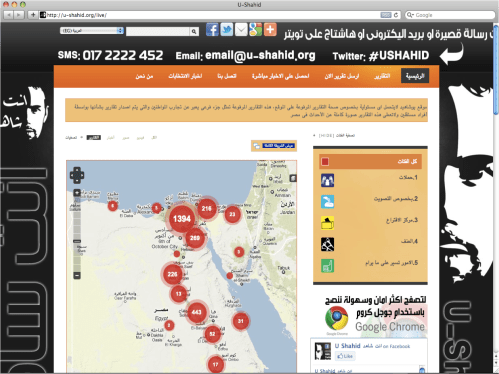
She does also acknowledge some of the limitations of the study owing to lack of high-resolution spatial data. I would add temporal data since civil resistance is fluid and changes, which requires rapid adaptation and re-strategizing. If her analysis could be combined with real time information coming from crowdsourced data such as U-Shahid, then I think this could be quite powerful.

For more on the civil resistance tactics used in Egypt during the revolution, please see this blog post.

Seeking the Trustworthy Tweet: Can “Tweetsourcing” Ever Fit the Needs of Humanitarian Organizations?

Can microblogged data fit the information needs of humanitarian organizations? This is the question asked by a group of academics at Pennsylvania State University’s College of Information Sciences and Technology. Their study (PDF) is an important contribution to the discourse on humanitarian technology and crisis information. The applied research provides key insights based on a series of interviews with humanitarian professionals. While I largely agree with the majority of the arguments presented in this study, I do have questions regarding the framing of the problem and some of the assertions made.

The authors note that “despite the evidence of strong value to those experiencing the disaster and those seeking information concerning the disaster, there has been very little uptake of message data by large-scale, international humanitarian relief organizations.” This is because real-time message data is “deemed as unverifiable and untrustworthy, and it has not been incorporated into established mechanisms for organizational decision-making.” To this end, “committing to the mobilization of valuable and time sensitive relief supplies and personnel, based on what may turn out be illegitimate claims, has been perceived to be too great a risk.” Thus far, the authors argue, “no mechanisms have been fashioned for harvesting microblogged data from the public in a manner, which facilitates organizational decisions.”

I don’t think this latter assertion is entirely true if one looks at the use of Twitter by the private sector. Take for example the services offered by Crimson Hexagon, which I blogged about 3 years ago. This successful start-up launched by Gary King out of Harvard University provides companies with real-time sentiment analysis of brand perceptions in the Twittersphere precisely to help inform their decision making. Another example is Storyful, which harvests data from authenticated Twitter users to provide highly curated, real-time information via microblogging. Given that the humanitarian community lags behind in the use and adoption of new technologies, it behooves us to look at those sectors that are ahead of the curve to better understand the opportunities that do exist.

Since the study principally focused on Twitter, I’m surprised that the authors did not reference the empirical study that came out last year on the behavior of Twitter users after the 8.8 magnitude earthquake in Chile. The study shows that about 95% of tweets related to confirmed reports validated that information. In contrast only 0.03% of tweets denied the validity of these true cases. Interestingly, the results also show  that “the number of tweets that deny information becomes much larger when the information corresponds to a false rumor.” In fact, about 50% of tweets will deny the validity of false reports. This means it may very well be posible to detect rumors by using aggregate analysis on tweets.

On framing, I believe the focus on microblogging and Twitter in particular misses the bigger picture which ultimately is about the methodology of crowdsourcing rather than the technology. To be sure, the study by Penn State could just as well have been titled “Seeking the Trustworthy SMS.” I think this important research on microblogging would be stronger if this distinction were made and the resulting analysis tied more closely to the ongoing debate on crowdsourcing crisis information that began during the response to Haiti’s earthquake in 2010.

Also, as was noted during the Red Cross Summit in 2010, more than two-thirds of respondents to a survey noted that they would expect a response within an hour if they posted a need for help on a social media platform (and not just Twitter) during a crisis. So whether humanitarian organizations like it or not, crowdsourced social media information cannot be ignored.

The authors carried out a series of insightful interviews with about a dozen international humanitarian organizations to try and better understand the hesitation around the use of Twitter for humanitarian response. As noted earlier, however, it is not Twitter per se that is a concern but the underlying methodology of crowdsourcing.

As expected, interviewees noted that they prioritize the veracity of information over the speed of communication. “I don’t think speed is necessarily the number one tool that an emergency operator needs to use.” Another interviewee opined that “It might be hard to trust the data. I mean, I don’t think you can make major decisions based on a couple of tweets, on one or two tweets.” What’s interesting about this latter comment is that it implies that only one channel of information, Twitter, is to be used in decision-making, which is a false argument and one that nobody I know has ever made.

Either way, the trade-off between speed and accuracy is a well known one. As mentioned in this blog post from 2009, information is perishable and accuracy is often a luxury in the first few hours and days following a major disaster. As the authors for the study rightly note, “uncertainty is ‘always expected, if sometimes crippling’ (Benini, 1997) for NGOs involved in humanitarian relief.” Ultimately, the question posed by the authors of the Penn study can be boiled down to this: is some information better than no information if it cannot be immediately verified? In my opinion, yes. If you have some information, then at least you can investigate it’s veracity which may lead to action. I also believe that from this philosophical point of view, the answer would still be yes.

Based on the interviews, the authors found that organizations engaged in immediate emergency response were less likely to make use of Twitter (or crowdsourced information) as a channel for information. As one interviewee put it, “Lives are on the line. Every moment counts. We have it down to a science. We know what information we need and we get in and get it…” In contrast, those organizations engaged in subsequent phases of disaster response were thought more likely to make use of crowdsourced data.

I’m not entirely convinced by this: “We know what information we need and we get in and get it…”. Yes, humanitarian organizations typically know but whether they get it, and in time, is certainly not a given. Just look at the humanitarian responses to Haiti and Libya, for example. Organizations may very well be “unwilling to trade data assurance, veracity and authenticity for speed,” but sometimes this mindset will mean having absolutely no information. This is why OCHA asked the Standby Volunteer Taskforce to provide them with a live crowdsourced social media may of Libya. In Haiti, while the UN is not thought to have used crowdsourced SMS data from Mission 4636, other responders like the Marine Corps did.

Still, according to one interviewee, “fast is good, but bad information fast can kill people. It’s got to be good, and maybe fast too.” This assumes that no information doesn’t kill people. Also good information that is late, can also kill people. As one of the interviewees admitted when using traditional methods, “it can be quite slow before all that [information] trickles through all the layers to get to us.” The authors of the study also noted that, “Many [interviewees] were frustrated with how slow the traditional methods of gathering post-disaster data had remained despite the growing ubiquity of smart phones and high quality connectivity and power worldwide.”

On a side note, I found the following comment during the interviews especially revealing: “When we do needs assessments, we drive around and we look with our eyes and we talk to people and we assess what’s on the ground and that’s how we make our evaluations.” One of the common criticisms leveled against the use of crowdsourced information is that it isn’t representative. But then again, driving around, checking things out and chatting with people is hardly going to yield a representative sample either.

One of the main findings from this research has to do with a problem in attitude on the part of humanitarian organizations. “Each of the interviewees stated that their organization did not have the organizational will to try out new technolo-gies. Most expressed this as a lack of resources, support, leadership and interest to adopt new technologies.” As one interview noted, “We tried to get the president and CEO both to use Twitter. We failed abysmally, so they’re not– they almost never use it.” Interestingly, “most of the respondents admitted that many of their technological changes were motivated by the demands of their donors. At this point in time their donors have not demanded that these organizations make use of microblogged data. The subjects believed they would need to wait until this occurred for real change to begin.”

For me the lack of will has less to do with available resources and limited capacity and far more to do with a generational gap. When today’s young professionals in the humanitarian space work their way up to more executive positions, we’ll  see a significant change in attitude within these organizations. I’m thinking in particular of the many dozens of core volunteers who played a pivotal role in the crisis mapping operations in Haiti, Chile, Pakistan, Russia and most recently Libya. And when attitude changes, resources can be reallocated and new priorities can be rationalized.

What’s interesting about these interviews is that despite all the concerns and criticisms of crowdsourced Twitter data, all interviewees still see microblogged data as a “vast trove of potentially useful information concerning a disaster zone.” One of the professionals interviewed said, “Yes! Yes! Because that would – again, it would tell us what resources are already in the ground, what resources are still needed, who has the right staff, what we could provide. I mean, it would just – it would give you so much more real-time data, so that as we’re putting our plans together we can react based on what is already known as opposed to getting there and discovering, oh, they don’t really need medical supplies. What they really need is construction supplies or whatever.”

Another professional stated that, “Twitter data could potentially be used the same way… for crisis mapping. When an emergency happens there are so many things going on in the ground, and an emergency response is simply prioritization, taking care of the most important things first and knowing what those are. The difficult thing is that things change so quickly. So being able to gather information quickly…. <with Twitter> There’s enormous power.”

The authors propose three possible future directions. The first is bounded microblogging, which I have long referred to as “bounded crowdsourcing.” It doesn’t make sense to focus on the technology instead of the methodology because at the heart of the issue are the methods for information collection. In “bounded crowdsourcing,” membership is “controlled to only those vetted by a particular organization or community.” This is the approach taken by Storyful, for example. One interviewee acknowledge that “Twitter might be useful right after a disaster, but only if the person doing the Tweeting was from <NGO name removed>, you know, our own people. I guess if our own people were sending us back Tweets about the situation it could help.”

Bounded crowdsourcing overcomes the challenge of authentication and verification but obviously with a tradeoff in the volume of data collected “if an additional means were not created to enable new members through an automatic authentication system, to the bounded microblogging community.” However, the authors feel that bounded crowdsourcing environments “undermine the value of the system” since “the power of the medium lies in the fact that people, out of their own volition, make localized observations and that organizations could harness that multitude of data. The bounded environment argument neutralizes that, so in effect, at that point, when you have a group of people vetted to join a trusted circle, the data does not scale, because that pool by necessity would be small.”

That said, I believe the authors are spot on when they write that “Bounded environments might be a way of introducing Twitter into the humanitarian centric organizational discourse, as a starting point, because these organizations, as seen from the evidence presented above, are not likely to initially embrace the medium. Bounded environments could hence demonstrate the potential for Twitter to move beyond the PR and Communications departments.”

The second possible future direction is to treat crowdsourced data is ambient, “contextual information rather than instrumental information, (i.e., factual in nature).” This grassroots information could be considered as an “add-on to traditional, trusted institutional lines of information gathering.” As one interviewee noted, “Usually information exists. The question is the context doesn’t exist…. that’s really what I see as the biggest value [of crowdsourced information] and why would you use that in the future is creating the context…”.

The authors rightly suggest that “that adding contextual information through microblogged data may alleviate some of the uncertainty during the time of disaster. Since the microblogged data would not be the single data source upon which decisions would be made, the standards for authentication and security could be less stringent. This solution would offer the organization rich contextual data, while reducing the need for absolute data authentication, reducing the need for the organization to structurally change, and reducing the need for significant resources.” This is exactly how I consider and treat crowdsourced data.

The third and final forward-looking solution is computational. The authors “believe better computational models will eventually deduce informational snippets with acceptable levels of trust.” They refer to Ushahidi’s SwiftRiver project as an example.

In sum, this study is an important contribution to the discourse. The challenges around using crowdsourced crisis information are well known. If I come across as optimistic, it is for two reasons. First, I do think a lot can be done to address the challenges. Second, I do believe that attitudes in the humanitarian sector will continue to change.

Analyzing the Libya Crisis Map Data in 3D (Video)

I first blogged about GeoTime exactly two years ago in a blog post entitled “GeoTime: Crisis Mapping in 3D.” The rationale for visualizing geospatial data in 3D very much resonates with me and in my opinion becomes particularly compelling when analyzing crisis mapping data.

This is why I invited my GeoTime colleague Adeel Khamisa to present their platform at the first International Conference on Crisis Mapping (ICCM 2009). Adeel used the Ushahidi-Haiti data to demonstrate the added value of using a 3D approach, which you can watch in the short video below.

Earlier this year, I asked Adeel whether he might be interested in analyzing the Libya Crisis Map data using GeoTime. He was indeed curious and kindly produced the short video below on his preliminary findings.

The above visual overview of the Libya data is really worth watching. I hope that fellow Crisis Mappers will consider making more use of GeoTime in their projects. The platform really is ideal for Crisis Mapping Analysis.

How Egyptian Activists Kept Their Ushahidi Project Alive Under Mubarak

This is my second blog post on the U-Shahid project in Egypt. The first one analyzed 2,000+ reports mapped on the Ushahidi platform during the country’s recent Parliamentary Elections. Egypt is one of my dissertation case studies and in this blog post I summarize some initial findings based on a series of interviews I had several Egyptian activists who were part of the U-Shahid project.

The Egyptian government began asking questions about U-Shahid well before the project was even launched. They found out about the project by tapping phone lines and emails. Once the project was launched, the Egyptian Ministry of the Interior continued to shadow the project in several ways. They requested copies of all meeting agendas and a list of names for everyone who was trained on the Ushahidi platform, for example.

In order to remain operational, the Egyptian activists spearheading the U-Shahid project said that they “stressed the technical aspect of the project, and remained fully open and transparent about our work. We gave Egyptian National Security a dedicated username and password [to access the Ushahidi platform], one that we could control and monitor [their actions]. This gave them a false sense of control, we could restore anything they deleted.” That said, one activist recounted how “there were attempts by the government to overload our website with many fake reports […] but we were on it and we were able to delete them. This happened a minute or two every three hours or so, attacks, overload, but eventually they gave up.”

When asked why the regime had not shut down the platform given the potential threat that U-Shahid represented, one blogger explained that “many of the activists who began using Ushahidi had many followers on Facebook and Twitter, they also had the attention of the international media, which could create unwanted attention on the regime’s actions.” This same blogger also noted that many of the activists who collaborated on the U-Shahid project were “connected with people in the US Congress, directors of international human rights NGOs, and so on.” Perhaps the Mubarak Regime was concerned that cracking down on the U-Shahid project would backfire.

In any case, the activists “did a lot of scenario building, considered many ‘what if’ situations. The fact that we were so well prepared is why they [the regime] could not touch us. We tried to connect all the data on Facebook and Twitter so that if they closed our Ushahidi map, we would move to a new domain name and let all our followers know. We also had a large database of SMS numbers, which would allow us to text our followers with information on the new website. Finally, we had a fully trained team in Lebanon ready to take over the project if we were completely shut down.”

“We were well prepared,” added another blogger, “we knew they could not arrest all of us on the day of the election, and just in case, we trained a group in Lebanon who could take over all operations if we were stopped.” According to one activist, “using this mapping technology provided a way to collect and recruit a lot of activists, and not just any activists, but more effective ones. This actually created a headache for the regime because a growing number of digital activists became interested in using the Ushahidi platform.” Another interviewee added that the technology acted as a “magnet” for activists. One activist also remarked that “they [the government] don’t understand how we work; we can learn very fast but the government has many rules and processes, they have to write up reports, submit them for approval, and allocate funding to acquire technology. But for us, we don’t need permission. If we want to use Tor, we simply use Tor.”

Another explained that their project’s credibility came from the realization by many that they were simply focused on “getting the facts out without agenda. We were both transparent and moderate, with no political or party affiliation, and we emphasized that our goal was to try and make the election process transparent.” In sum, said another activist, “we let people decide for themselves whether the content mapped on Ushahidi was good or not.” Another activist argued that the use of the Ushahidi platform “created more transparency around the elections, allowing easier access than in any previous election.” More specifically, “in previous elections and before the existence of Ushahidi, many NGOs made reports of election irregularities, but these were rarely shared publicly with policy maker or even with other NGOs. And even after the elections had taken place, it was very difficult to access these repots. But the Ushahidi [platform] is open and online, allowing anyone to access any of the information mapped in near real-time.”

Still it is really challenging to fully assess the potential political impact (if any) the U-Shahid project had–something the activists are very aware of. One can only investigate so much for so long. One activist noted that “next time we use the Ushahidi platform, this year for the presidential elections, we will be sure to track the reports submitted to the judicial courts and compare them with those we collect. We also plan to better advertise our project with lawyers and political candidates so that they can use our reports including videos and photos in court and for trials.”

What I’m particularly pleased about in addition all the learning that has taken place is the fact that the U-Shahid project spawned off a number of *copy cats during the elections and new maps are being launched almost every other month in Egypt now. The project also increased the number of Egyptian who participated in directly monitoring their own elections. Lastly, I’m excited that the Egyptians who spearheaded the U-Shahid project are now training activists in Tunisia and other Arab countries. They have acquired a wealth of practical knowledge and experience in using the platform in authoritarian environments, and now they’re sharing all this hard-won expertise.

There’s a lot more to share from the interviews, and I hope to do so in future posts. I also plan to blog about the findings from my case study of the Sudan.