Tag Archives: Twitter

Crowdsourcing Humanitarian Convoys in Libya

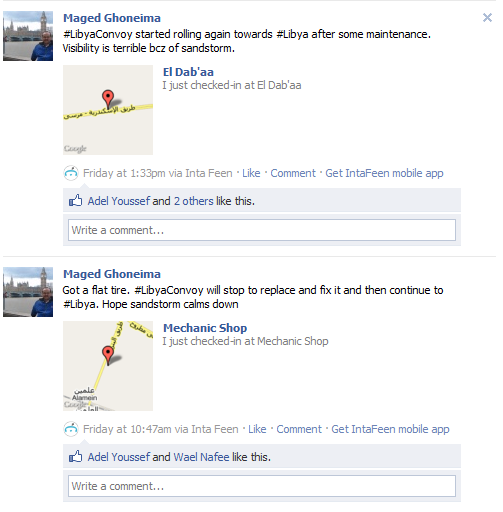
Many activists in Egypt donated food and medical supplies to support the Libyan revolution in early 2011. As a result, volunteers set up and coordinated humanitarian convoys from major Egyptian cities to Tripoli. But these convoys faced two major problems. First, volunteers needed to know where the convoys were in order to communicate this to Libyan revolutionists so they could wait for the fleet at the border and escort them to Tripoli. Second, because these volunteers were headed into a war zone, their friends and family wanted to keep track of them to make sure they were safe. The solution? IntaFeen.com.

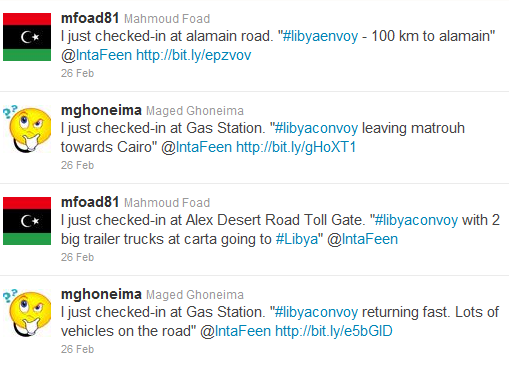
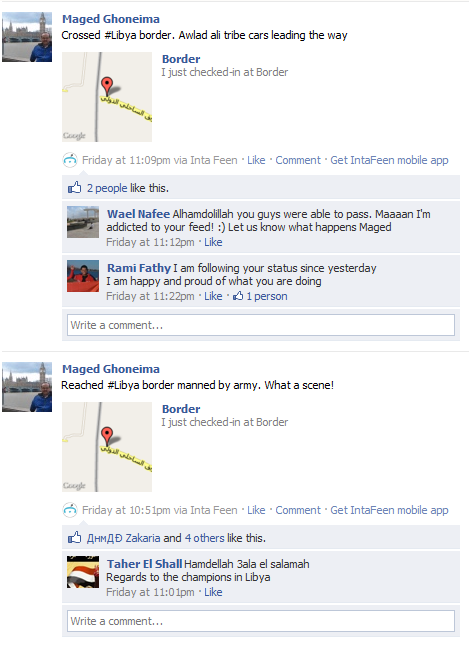
Inta feen? means “where are you?” in Arabic and IntaFeen.com is a mobile check-in service like Foursquare but localized for the Arab World. Convoy drivers used IntaFeen to check-in at different stops along the way to Tripoli to provide regular updates on the situation. This is how volunteers back in Egypt who coordinated the convoy kept track of their progress and communicated updates in real-time to their Libyan counterparts. Volunteers who went along with the convoys also used IntaFeen and their check-in’s would also get posted on Twitter and Facebook, allowing families and friends in Egypt to track their whereabouts.

Al Amain Road is a highway between Alexandria and Tripoli. These tweets and check-in’s acted as a DIY fleet management system for volunteers and activists.

The use of IntaFeen combined with Facebook and Twitter also created an interesting side-effect in terms of social media marketing to promote activism. The sharing of these updates within and across various social networks galvanized more Egyptians to volunteer their time and resulted in more convoys.

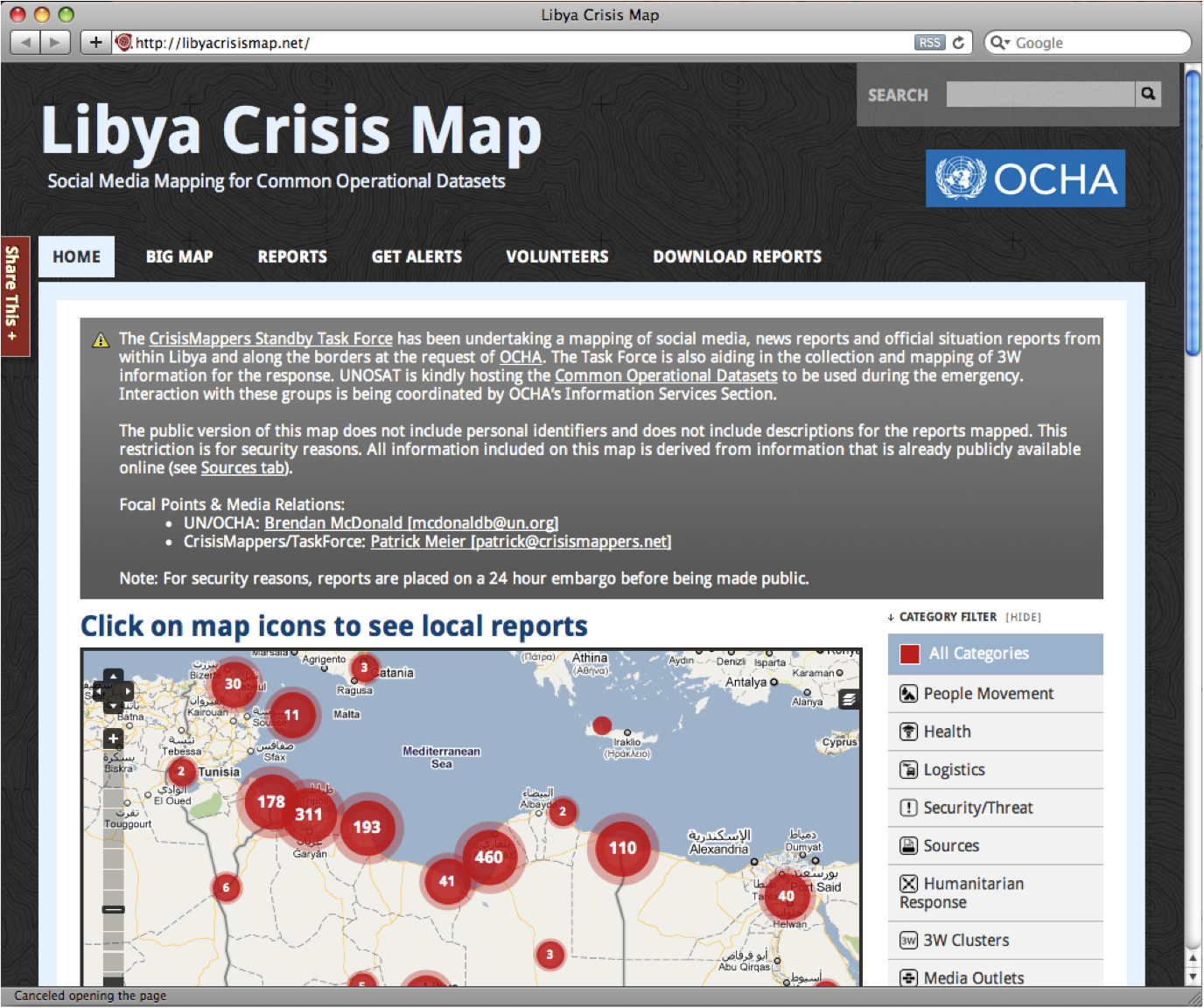
I wonder whether these activists knew about another crowdsourced volunteer project taking place at exactly the same time in support of the UN’s humanitarian relief operations: Libya Crisis Map. Much of the content added to the map was sourced from social media. Could the #LibyaConvoy project have benefited from the real-time situational awareness provided by the Libya Crisis Map?

Will we see more convergence between volunteer-run crisis maps and volunteer-run humanitarian response in the near future?

Big thanks to Adel Youssef from IntaFeen.com who spoke about this fascinating project (and Ushahidi) at Where 2.0 this week. More information on #Libya Convoy is available here. See also my earlier blog posts on the use of check-in’s for activism and disaster response.

On Rumors, Repression and Digital Disruption in China: Opening Pandora’s Inbox of Truthiness?

The Economist recently published a brilliant piece on China entitled: “The Power of Microblogs: Zombie Followers and Fake Re-Tweets.” BBC News followed with an equally excellent article: “Damaging Coup Rumors Ricochet Across China.” Combined, these articles reveal just how profound the digital disruption in China is likely to be now that Pandora’s Inbox has been opened.

Credit: The Economist

The Economist article opens with an insightful historical comparison:

“In the year 15AD, during the short-lived Xin dynasty, a rumor spread that a yellow dragon, a symbol of the emperor, had inauspiciously crashed into a temple in the mountains of central China and died. Ten thousand people rushed to the site. The emperor Wang Mang, aggrieved by such seditious gossip, ordered arrests and interrogations to quash the rumor, but never found the source. He was dethroned and killed eight years later, and Han-dynasty rule was restored.”

“The next ruler, Emperor Guangwu, took a different approach, studying rumors as a barometer of public sentiment, according to a recent book Rumors in the Han Dynasty by Lu Zongli, a historian. Guangwu’s government compiled a ‘Rumors Report’, cataloguing people’s complaints about local officials, and making assessments that were passed to the emperor. The early Eastern Han dynasty became known for officials who were less corrupt and more attuned to the people.”

In present day China, a popular pastime among 250+ million Chinese users of microblogging platforms is to “spread news and rumors, both true and false, that challenge the official script of government officials and state-propaganda organs.” In Domination and the Arts of Resistance: Hidden Transcripts, James Scott distinguishes between public and hidden transcripts. The former describes the open, public discourse that take place between dominators and oppressed while hidden transcripts relate to the critique of power that “goes on offstage”, which the power elites cannot decode. Scott writes that when the oppressed classes publicize this “hidden transcript”, (the truthiness?) they become con-scious of its common status. Borrowing from Juergen Habermas (as interpreted by Clay Shirky), those who take on the tools of open expression become a public, and a synchronized public increasingly constrains undemocratic rulers while ex-panding the rights of that public. The result in China? “It is hard to overestimate how much the arrival of [microblogging platforms] has changed the dynamic between rulers and ruled over the past two years” (The Economist).

Chinese authorities have responded to this threat in two predictable ways, one repeating the ill-fated actions of the Xin Dynasty and the other reflecting the more open spirit of Emperor Guangwu. In the latter case, authorities are turning to microblogs as a “listening post” for public opinion and also as a publishing platform. Indeed, “government agencies, party organs and individual officials have set up more than 50,000 weibo accounts [Chinese equivalent of Twitter]” (The Economist). In the former case, the regime has sought to “combat rumors harshly and to tighten controls over the microblogs and their users, censoring posts and closely monitoring troublemakers.” The UK Guardian reports that China is now “taking the toughest steps yet against major microblogs and detain-ing six people for spreading rumors of a coup amid Beijing’s most serious political crisis for years.”

Beijing’s attempt to regulate microblogging companies by requiring users to sign up with their real names is unlikely to be decisive, however. “No matter how it is enforced, user verification seems unlikely to deter the spread of rumors and information that has so concerned authorities” (The Economist). To be sure, companies are already selling fake verification services for a small fee. Besides, verifying accounts for millions of users is simply too time-consuming and hence costly. Even Twitter gave up their verified account service a while back. The task of countering rumors is even more of a Quixotic dream.

Property tycoon Zhang Xin, who has more than 3 million followers, wrote: “What is the best way to stop ‘rumors’? It is transparency and openness. The more speech is discouraged, the more rumors there will be” (UK Guardian).

This may in part explains why Chinese authorities have shifted their approach to one of engagement as evidenced by those 50,000 new weibo accounts. With this second reaction, however, Beijing is possibly passing the point of no return. “This degree of online engagement can be awkward for authorities used to a comfortable buffer from public opinion,” writes The Economist. This is an understatement; Pandora’s (In)box is now open and the “hidden transcript” is cloaked no longer. The critique of power is decoded and elites are “forced” to devise a public reply as a result of this shared awareness lest they lose legitimacy vis-a-vis the broader population. But the regime doesn’t even have a “customer service” mechanism in place to deal with distributed and potentially high-volume complaints. Censorship is easy compared to engagement.

Recall the “Rumors Report” compiled by Emperor Guangwu’s government to catalogue people’s complaints about local officials. How will these 50,000 new weibo users deal with such complaints now that the report can be crowdsourced, especially given that fact that China’s “Internet users have become increasingly bold in their willingness to discuss current affairs and even sensitive political news […]” (UK Guardian).

As I have argued in my dissertation, repressive regimes can react to real (or perceived)  threats posed by “liberation technologies” by either cracking down and further centralizing control and/or by taking on the same strategies as digital activists, which at times requires less centralization. Either way, they’re taking the first step on a slippery slope. By acknowledging the problem of rumors so publicly, the regime is actually calling more attention to how disruptive these simple speculations can be—the classic Streisand effect.

“By falsely packaging lies and speculation as ‘truth’ and ‘existence’, online rumours undermine the morale of the public, and, if out of control, they will seriously disturb the public order and affect social stability,” said a commentary in the People’s Daily, the official Communist party newspaper. (UK Guardian).

Practically speaking, how will those 50,000 new weibo users coordinate their efforts to counter rumors and spread state propaganda? “We have a saying among us: you only need to move your lips to start a rumor, but you need to run until your legs are broken to refute one,” says an employee of a state media outlet (The Economist). How will these new weibo users synchronize collective action in near real-time to counter rumors when any delay is likely to be interpreted as evidence of further guilt? Will they know how to respond to myriads of questions being bombarded at them in real-time by hundreds of thousands of Chinese microbloggers? This may lead to high-pressure situations that are rife for mistakes and errors, particularly if these government officials are new to microblogging. Indeed, If just one of these state-microbloggers slips, that slip could go viral with a retweet tsunami. Any retreat by authorities from this distributed engagement strategy will only lead to more rumors.

The rumors of the coup d’état continue to ricochet across China, gaining remarkable traction far and wide. Chinese microblogs were also alight last week with talk of corruption and power struggles within the highest ranks of the party, which may have fueled the rumor of an overthrow. This is damaging to China’s Communist Party which “likes to portray itself as unified and in control,” particularly as it prepares for it’s once-in-a-decade leadership shuffle. “The problem for China’s Communist Party is that it has no effective way of refuting such talk. There are no official spokesmen who will go on the record, no sources briefing the media on the background. Did it happen? Nobody knows. So the rumors swirl” (BBC News). Even the official media, which is “often found waiting for political guidance, can be slow and unresponsive.”

So if Chinese authorities and state media aren’t even equipped (beyond plain old censorship) to respond to national rumors of vis-a-vis an event as important as a coup (can it possibly get more important than that?), then how in the world will they deal with the undercurrent of rumors that continue to fill Chinese microblogs now that these can have 50,000 new targets online? Moreover, “many in China are now so cynical about the level of censorship that they will not believe what comes from the party’s mouthpieces even if it is true. Instead they will give credence to half-truths or fabrications on the web,” which is “corrosive for the party’s authority” (BBC News). This is a serious problem for China’s Communist elite who are obsessed with the task of projecting an image of total unity and stability.

In contrast, speculators on Chinese microblogging platforms don’t need a highly coordinated strategy to spread conspiracies. They are not handicapped by the centralization and collective action problem that Chinese authorities face; after all, it is clearly far easier to spread a rumor than to debunk one. As noted by The Economist, those spreading rumors have “at their disposal armies of zombie followers and fake re-tweets as well as marketing companies, which help draw attention to rumors until they are spread by a respected user with many real followers, such as a celebrity.” But there’s more at stake here than mere rumors. In fact, as noted by The Economist, the core of the problem has less to do with hunting down rumors of yellow dragons than with “the truth that they reflect: a nervous public. In the age of weibo, it may be that the wisps of truth prove more problematic for authorities than the clouds of falsehood.”

Fascinating epilogues:

China’s censorship can never defeat the internet
China’s censors tested by microbloggers who keep one step ahead of state media

Twitter, Crises and Early Detection: Why “Small Data” Still Matters

My colleagues John Brownstein and Rumi Chunara at Harvard Univer-sity’s HealthMap project are continuing to break new ground in the field of Digital Disease Detection. Using data obtained from tweets and online news, the team was able to identify a cholera outbreak in Haiti weeks before health officials acknowledged the problem publicly. Meanwhile, my colleagues from UN Global Pulse partnered with Crimson Hexagon to forecast food prices in Indonesia by carrying out sentiment analysis of tweets. I had actually written this blog post on Crimson Hexagon four years ago to explore how the platform could be used for early warning purposes, so I’m thrilled to see this potential realized.

There is a lot that intrigues me about the work that HealthMap and Global Pulse are doing. But one point that really struck me vis-a-vis the former is just how little data was necessary to identify the outbreak. To be sure, not many Haitians are on Twitter and my impression is that most humanitarians have not really taken to Twitter either (I’m not sure about the Haitian Diaspora). This would suggest that accurate, early detection is possible even without Big Data; even with “Small Data” that is neither representative or indeed verified. (Inter-estingly, Rumi notes that the Haiti dataset is actually larger than datasets typically used for this kind of study).

In related news, a recent peer-reviewed study by the European Commi-ssion found that the spatial distribution of crowdsourced text messages (SMS) following the earthquake in Haiti were strongly correlated with building damage. Again, the dataset of text messages was relatively small. And again, this data was neither collected using random sampling (i.e., it was crowdsourced) nor was it verified for accuracy. Yet the analysis of this small dataset still yielded some particularly interesting findings that have important implications for rapid damage detection in post-emergency contexts.

While I’m no expert in econometrics, what these studies suggests to me is that detecting change-over–time is ultimately more critical than having a large-N dataset, let alone one that is obtained via random sampling or even vetted for quality control purposes. That doesn’t mean that the latter factors are not important, it simply means that the outcome of the analysis is relatively less sensitive to these specific variables. Changes in the baseline volume/location of tweets on a given topic appears to be strongly correlated with offline dynamics.

What are the implications for crowdsourced crisis maps and disaster response? Could similar statistical analyses be carried out on Crowdmap data, for example? How small can a dataset be and still yield actionable findings like those mentioned in this blog post?

Trails of Trustworthiness in Real-Time Streams

Real-time information channels like Twitter, Facebook and Google have created cascades of information that are becoming increasingly challenging to navigate. “Smart-filters” alone are not the solution since they won’t necessarily help us determine the quality and trustworthiness of the information we receive. I’ve been studying this challenge ever since the idea behind SwiftRiver first emerged several years ago now.

I was thus thrilled to come across a short paper on “Trails of Trustworthiness in Real-Time Streams” which describes a start-up project that aims to provide users with a “system that can maintain trails of trustworthiness propagated through real-time information channels,” which will “enable its educated users to evaluate its provenance, its credibility and the independence of the multiple sources that may provide this information.” The authors, Panagiotis Metaxas and Eni Mustafaraj, kindly cite my paper on “Information Forensics” and also reference SwiftRiver in their conclusion.

The paper argues that studying the tactics that propagandists employ in real life can provide insights and even predict the tricks employed by Web spammers.

“To prove the strength of this relationship between propagandistic and spamming techniques, […] we show that one can, in fact, use anti-propagandistic techniques to discover Web spamming networks. In particular, we demonstrate that when starting from an initial untrustworthy site, backwards propagation of distrust (looking at the graph defined by links pointing to to an untrustworthy site) is a successful approach to finding clusters of spamming, untrustworthy sites. This approach was inspired by the social behavior associated with distrust: in society, recognition of an untrustworthy entity (person, institution, idea, etc) is reason to question the trust- worthiness of those who recommend it. Other entities that are found to strongly support untrustworthy entities become less trustworthy themselves. As in society, distrust is also propagated backwards on the Web graph.”

The authors document that today’s Web spammers are using increasingly sophisticated tricks.

“In cases where there are high stakes, Web spammers’ influence may have important consequences for a whole country. For example, in the 2006 Congressional elections, activists using Google bombs orchestrated an effort to game search engines so that they present information in the search results that was unfavorable to 50 targeted candidates. While this was an operation conducted in the open, spammers prefer to work in secrecy so that their actions are not revealed. So,  revealed and documented the first Twitter bomb, which tried to influence the Massachusetts special elections, show- ing how an Iowa-based political group, hiding its affiliation and profile, was able to serve misinformation a day before the election to more than 60,000 Twitter users that were follow- ing the elections. Very recently we saw an increase in political cybersquatting, a phenomenon we reported in [28]. And even more recently, […] we discovered the existence of Pre-fabricated Twitter factories, an effort to provide collaborators pre-compiled tweets that will attack members of the Media while avoiding detection of automatic spam algorithms from Twitter.

The theoretical foundations for a trustworthiness system:

“Our concept of trustworthiness comes from the epistemology of knowledge. When we believe that some piece of information is trustworthy (e.g., true, or mostly true), we do so for intrinsic and/or extrinsic reasons. Intrinsic reasons are those that we acknowledge because they agree with our own prior experience or belief. Extrinsic reasons are those that we accept because we trust the conveyor of the information. If we have limited information about the conveyor of information, we look for a combination of independent sources that may support the information we receive (e.g., we employ “triangulation” of the information paths). In the design of our system we aim to automatize as much as possible the process of determining the reasons that support the information we receive.”

“We define as trustworthy, information that is deemed reliable enough (i.e., with some probability) to justify action by the receiver in the future. In other words, trustworthiness is observable through actions.”

“The overall trustworthiness of the information we receive is determined by a linear combination of (a) the reputation RZ of the original sender Z, (b) the credibility we associate with the contents of the message itself C(m), and (c) characteristics of the path that the message used to reach us.”

“To compute the trustworthiness of each message from scratch is clearly a huge task. But the research that has been done so far justifies optimism in creating a semi-automatic, personalized tool that will help its users make sense of the information they receive. Clearly, no such system exists right now, but components of our system do exist in some of the popular [real-time information channels]. For a testing and evaluation of our system we plan to use primarily Twitter, but also real-time Google results and Facebook.”

In order to provide trails of trustworthiness in real-time streams, the authors plan to address the following challenges:

•  “Establishment of new metrics that will help evaluate the trustworthiness of information people receive, especially from real-time sources, which may demand immediate attention and action. […] we show that coverage of a wider range of opinions, along with independence of results’ provenance, can enhance the quality of organic search results. We plan to extend this work in the area of real-time information so that it does not rely on post-processing procedures that evaluate quality, but on real-time algorithms that maintain a trail of trustworthiness for every piece of information the user receives.”

• “Monitor the evolving ways in which information reaches users, in particular citizens near election time.”

•  “Establish a personalizable model that captures the parameters involved in the determination of trustworthiness of in- formation in real-time information channels, such as Twitter, extending the work of measuring quality in more static information channels, and by applying machine learning and data mining algorithms. To implement this task, we will design online algorithms that support the determination of quality via the maintenance of trails of trustworthiness that each piece of information carries with it, either explicitly or implicitly. Of particular importance, is that these algorithms should help maintain privacy for the user’s trusting network.”

• “Design algorithms that can detect attacks on [real-time information channels]. For example we can automatically detect bursts of activity re- lated to a subject, source, or non-independent sources. We have already made progress in this area. Recently, we advised and provided data to a group of researchers at Indiana University to help them implement “truthy”, a site that monitors bursty activity on Twitter.  We plan to advance, fine-tune and automate this process. In particular, we will develop algorithms that calculate the trust in an information trail based on a score that is affected by the influence and trustworthiness of the informants.”

In conclusion, the authors “mention that in a month from this writing, Ushahidi […] plans to release SwiftRiver, a platform that ‘enables the filtering and verification of real-time data from channels like Twitter, SMS, Email and RSS feeds’. Several of the features of Swift River seem similar to what we propose, though a major difference appears to be that our design is personalization at the individual user level.”

Indeed, having been involved in SwiftRiver research since early 2009 and currently testing the private beta, there are important similarities and some differences. But one such difference is not personalization. Indeed, Swift allows full personalization at the individual user level.

Another is that we’re hoping to go beyond just text-based information with Swift, i.e., we hope to pull in pictures and video footage (in addition to Tweets, RSS feeds, email, SMS, etc) in order to cross-validate information across media, which we expect will make the falsification of crowdsourced information more challenging, as I argue here. In any case, I very much hope that the system being developed by the authors will be free and open source so that integration might be possible.

A copy of the paper is available here (PDF). I hope to meet the authors at the Berkman Center’s “Truth in Digital Media Symposium” and highly recommend the wiki they’ve put together with additional resources. I’ve added the majority of my research on verification of crowdsourced information to that wiki, such as my 20-page study on “Information Forensics: Five Case Studies on How to Verify Crowdsourced Information from Social Media.”

Information Forensics: Five Case Studies on How to Verify Crowdsourced Information from Social Media

My 20+ page study on verifying crowdsourced information is now publicly available here as a PDF and here as an open Google Doc for comments. I very much welcome constructive feedback from iRevolution readers so I can improve the piece before it gets published in an edited book next year.

Abstract

False information can cost lives. But no information can also cost lives, especially in a crisis zone. Indeed, information is perishable so the potential value of information must be weighed against the urgency of the situation. Correct information that arrives too late is useless. Crowdsourced information can provide rapid situational awareness, especially when added to a live crisis map. But information in the social media space may not be reliable or immediately verifiable. This may explain why humanitarian (and news) organizations are often reluctant to leverage crowdsourced crisis maps. Many believe that verifying crowdsourced information is either too challenging or impossible. The purpose of this paper is to demonstrate that concrete strategies do exist for the verification of geo-referenced crowdsourced social media information. The study first provides a brief introduction to crisis mapping and argues that crowdsourcing is simply non-probability sampling. Next, five case studies comprising various efforts to verify social media are analyzed to demonstrate how different verification strategies work. The five case studies are: Andy Carvin and Twitter; Kyrgyzstan and Skype; BBC’s User-Generated Content Hub; the Standby Volunteer Task Force (SBTF); and U-Shahid in Egypt. The final section concludes the study with specific recommendations.

Update: See also this link and my other posts on Information Forensics.

Passing the I’m-Not-Gaddafi Test: Authenticating Identity During Crisis Mapping Operations

I’ve found myself telling this story so often in response to various questions that it really should be a blog post. The story begins with the launch of the Libya Crisis Map a few months ago at the request of the UN. After the first 10 days of deploying the live map, the UN asked us to continue for another two weeks. When I write “us” here, I mean the Standby Volunteer Task Force (SBTF), which is designed for short-term rapid crisis mapping support, not long term deploy-ments. So we needed to recruit additional volunteers to continue mapping the Libya crisis. And this is where the I’m-not-Gaddafi test comes in.

To do our live crisis mapping work, SBTF volunteers generally need password access to whatever mapping platform we happen to be using. This has typically been the Ushahidi platform. Giving out passwords to several dozen volunteers in almost as many countries requires trust. Password access means one could start sabotaging the platform, e.g., deleting reports, creating fake ones, etc. So when we began recruiting 200+ new volunteers to sustain our crisis mapping efforts in Libya, we needed a way to vet these new recruits, particularly since we were dealing with a political conflict. So we set up an I’m-not-Gaddafi test by using this Google Form:

So we placed the burden of proof on our (very patient) volunteers. Here’s a quick summary of the key items we used in our “grading” to authenticate volunteers’ identity:

Email address: Professional or academic email addresses were preferred and received a more favorable “score”.

Twitter handle: The great thing about Twitter is you can read through weeks’ worth of someone’s Twitter stream. I personally used this feature several times to determine whether any political tweets revealed a pro-Gaddafi attitude.

Facebook page: Given that posing as someone else or a fictitious person on Facebook violates their terms of service, having the link to an applicant’s Facebook page was considered a plus.

LinkedIn profile: This was a particularly useful piece of evidence given that the majority of people on LinkedIn are professionals.

Personal/Professional blog or website: This was also a great to way to authenticate an individual’s identity. We also encouraged applicants to share links to anything they had published which was available online.

For every application, we had two or more of us from the core team go through the responses. In order to sign off a new volunteer as vetted, two people had to write down “Yes” with their name. We would give priority to the most complete applications. I would say that 80% of the 200+ applications we received were able to be signed off on without requiring additional information. We did follow ups via email for the remaining 20%, the majority of whom provided us with extra info that enabled us to validate their identity. One individual even sent us a copy of his official ID. There may have been a handful who didn’t reply to our requests for additional information.

This entire vetting process appears to have worked, but it was extremely laborious and time-consuming. I personally spent hours and hours going through more than 100 applications. We definitely need to come up with a different system in the future. So I’ve been exploring some possible solutions—such as social authentication—with a number of groups and I hope to provide an update next month which will make all our lives a lot easier, not to mention give us more dedicated mapping time. There’s also the need to improve the Ushahidi platform to make it more like Wikipedia, i.e., where contributions can be tracked and logged. I think combining both approaches—identity authentication and tracking—may be the way to go.

Seeking the Trustworthy Tweet: Can “Tweetsourcing” Ever Fit the Needs of Humanitarian Organizations?

Can microblogged data fit the information needs of humanitarian organizations? This is the question asked by a group of academics at Pennsylvania State University’s College of Information Sciences and Technology. Their study (PDF) is an important contribution to the discourse on humanitarian technology and crisis information. The applied research provides key insights based on a series of interviews with humanitarian professionals. While I largely agree with the majority of the arguments presented in this study, I do have questions regarding the framing of the problem and some of the assertions made.

The authors note that “despite the evidence of strong value to those experiencing the disaster and those seeking information concerning the disaster, there has been very little uptake of message data by large-scale, international humanitarian relief organizations.” This is because real-time message data is “deemed as unverifiable and untrustworthy, and it has not been incorporated into established mechanisms for organizational decision-making.” To this end, “committing to the mobilization of valuable and time sensitive relief supplies and personnel, based on what may turn out be illegitimate claims, has been perceived to be too great a risk.” Thus far, the authors argue, “no mechanisms have been fashioned for harvesting microblogged data from the public in a manner, which facilitates organizational decisions.”

I don’t think this latter assertion is entirely true if one looks at the use of Twitter by the private sector. Take for example the services offered by Crimson Hexagon, which I blogged about 3 years ago. This successful start-up launched by Gary King out of Harvard University provides companies with real-time sentiment analysis of brand perceptions in the Twittersphere precisely to help inform their decision making. Another example is Storyful, which harvests data from authenticated Twitter users to provide highly curated, real-time information via microblogging. Given that the humanitarian community lags behind in the use and adoption of new technologies, it behooves us to look at those sectors that are ahead of the curve to better understand the opportunities that do exist.

Since the study principally focused on Twitter, I’m surprised that the authors did not reference the empirical study that came out last year on the behavior of Twitter users after the 8.8 magnitude earthquake in Chile. The study shows that about 95% of tweets related to confirmed reports validated that information. In contrast only 0.03% of tweets denied the validity of these true cases. Interestingly, the results also show  that “the number of tweets that deny information becomes much larger when the information corresponds to a false rumor.” In fact, about 50% of tweets will deny the validity of false reports. This means it may very well be posible to detect rumors by using aggregate analysis on tweets.

On framing, I believe the focus on microblogging and Twitter in particular misses the bigger picture which ultimately is about the methodology of crowdsourcing rather than the technology. To be sure, the study by Penn State could just as well have been titled “Seeking the Trustworthy SMS.” I think this important research on microblogging would be stronger if this distinction were made and the resulting analysis tied more closely to the ongoing debate on crowdsourcing crisis information that began during the response to Haiti’s earthquake in 2010.

Also, as was noted during the Red Cross Summit in 2010, more than two-thirds of respondents to a survey noted that they would expect a response within an hour if they posted a need for help on a social media platform (and not just Twitter) during a crisis. So whether humanitarian organizations like it or not, crowdsourced social media information cannot be ignored.

The authors carried out a series of insightful interviews with about a dozen international humanitarian organizations to try and better understand the hesitation around the use of Twitter for humanitarian response. As noted earlier, however, it is not Twitter per se that is a concern but the underlying methodology of crowdsourcing.

As expected, interviewees noted that they prioritize the veracity of information over the speed of communication. “I don’t think speed is necessarily the number one tool that an emergency operator needs to use.” Another interviewee opined that “It might be hard to trust the data. I mean, I don’t think you can make major decisions based on a couple of tweets, on one or two tweets.” What’s interesting about this latter comment is that it implies that only one channel of information, Twitter, is to be used in decision-making, which is a false argument and one that nobody I know has ever made.

Either way, the trade-off between speed and accuracy is a well known one. As mentioned in this blog post from 2009, information is perishable and accuracy is often a luxury in the first few hours and days following a major disaster. As the authors for the study rightly note, “uncertainty is ‘always expected, if sometimes crippling’ (Benini, 1997) for NGOs involved in humanitarian relief.” Ultimately, the question posed by the authors of the Penn study can be boiled down to this: is some information better than no information if it cannot be immediately verified? In my opinion, yes. If you have some information, then at least you can investigate it’s veracity which may lead to action. I also believe that from this philosophical point of view, the answer would still be yes.

Based on the interviews, the authors found that organizations engaged in immediate emergency response were less likely to make use of Twitter (or crowdsourced information) as a channel for information. As one interviewee put it, “Lives are on the line. Every moment counts. We have it down to a science. We know what information we need and we get in and get it…” In contrast, those organizations engaged in subsequent phases of disaster response were thought more likely to make use of crowdsourced data.

I’m not entirely convinced by this: “We know what information we need and we get in and get it…”. Yes, humanitarian organizations typically know but whether they get it, and in time, is certainly not a given. Just look at the humanitarian responses to Haiti and Libya, for example. Organizations may very well be “unwilling to trade data assurance, veracity and authenticity for speed,” but sometimes this mindset will mean having absolutely no information. This is why OCHA asked the Standby Volunteer Taskforce to provide them with a live crowdsourced social media may of Libya. In Haiti, while the UN is not thought to have used crowdsourced SMS data from Mission 4636, other responders like the Marine Corps did.

Still, according to one interviewee, “fast is good, but bad information fast can kill people. It’s got to be good, and maybe fast too.” This assumes that no information doesn’t kill people. Also good information that is late, can also kill people. As one of the interviewees admitted when using traditional methods, “it can be quite slow before all that [information] trickles through all the layers to get to us.” The authors of the study also noted that, “Many [interviewees] were frustrated with how slow the traditional methods of gathering post-disaster data had remained despite the growing ubiquity of smart phones and high quality connectivity and power worldwide.”

On a side note, I found the following comment during the interviews especially revealing: “When we do needs assessments, we drive around and we look with our eyes and we talk to people and we assess what’s on the ground and that’s how we make our evaluations.” One of the common criticisms leveled against the use of crowdsourced information is that it isn’t representative. But then again, driving around, checking things out and chatting with people is hardly going to yield a representative sample either.

One of the main findings from this research has to do with a problem in attitude on the part of humanitarian organizations. “Each of the interviewees stated that their organization did not have the organizational will to try out new technolo-gies. Most expressed this as a lack of resources, support, leadership and interest to adopt new technologies.” As one interview noted, “We tried to get the president and CEO both to use Twitter. We failed abysmally, so they’re not– they almost never use it.” Interestingly, “most of the respondents admitted that many of their technological changes were motivated by the demands of their donors. At this point in time their donors have not demanded that these organizations make use of microblogged data. The subjects believed they would need to wait until this occurred for real change to begin.”

For me the lack of will has less to do with available resources and limited capacity and far more to do with a generational gap. When today’s young professionals in the humanitarian space work their way up to more executive positions, we’ll  see a significant change in attitude within these organizations. I’m thinking in particular of the many dozens of core volunteers who played a pivotal role in the crisis mapping operations in Haiti, Chile, Pakistan, Russia and most recently Libya. And when attitude changes, resources can be reallocated and new priorities can be rationalized.

What’s interesting about these interviews is that despite all the concerns and criticisms of crowdsourced Twitter data, all interviewees still see microblogged data as a “vast trove of potentially useful information concerning a disaster zone.” One of the professionals interviewed said, “Yes! Yes! Because that would – again, it would tell us what resources are already in the ground, what resources are still needed, who has the right staff, what we could provide. I mean, it would just – it would give you so much more real-time data, so that as we’re putting our plans together we can react based on what is already known as opposed to getting there and discovering, oh, they don’t really need medical supplies. What they really need is construction supplies or whatever.”

Another professional stated that, “Twitter data could potentially be used the same way… for crisis mapping. When an emergency happens there are so many things going on in the ground, and an emergency response is simply prioritization, taking care of the most important things first and knowing what those are. The difficult thing is that things change so quickly. So being able to gather information quickly…. <with Twitter> There’s enormous power.”

The authors propose three possible future directions. The first is bounded microblogging, which I have long referred to as “bounded crowdsourcing.” It doesn’t make sense to focus on the technology instead of the methodology because at the heart of the issue are the methods for information collection. In “bounded crowdsourcing,” membership is “controlled to only those vetted by a particular organization or community.” This is the approach taken by Storyful, for example. One interviewee acknowledge that “Twitter might be useful right after a disaster, but only if the person doing the Tweeting was from <NGO name removed>, you know, our own people. I guess if our own people were sending us back Tweets about the situation it could help.”

Bounded crowdsourcing overcomes the challenge of authentication and verification but obviously with a tradeoff in the volume of data collected “if an additional means were not created to enable new members through an automatic authentication system, to the bounded microblogging community.” However, the authors feel that bounded crowdsourcing environments “undermine the value of the system” since “the power of the medium lies in the fact that people, out of their own volition, make localized observations and that organizations could harness that multitude of data. The bounded environment argument neutralizes that, so in effect, at that point, when you have a group of people vetted to join a trusted circle, the data does not scale, because that pool by necessity would be small.”

That said, I believe the authors are spot on when they write that “Bounded environments might be a way of introducing Twitter into the humanitarian centric organizational discourse, as a starting point, because these organizations, as seen from the evidence presented above, are not likely to initially embrace the medium. Bounded environments could hence demonstrate the potential for Twitter to move beyond the PR and Communications departments.”

The second possible future direction is to treat crowdsourced data is ambient, “contextual information rather than instrumental information, (i.e., factual in nature).” This grassroots information could be considered as an “add-on to traditional, trusted institutional lines of information gathering.” As one interviewee noted, “Usually information exists. The question is the context doesn’t exist…. that’s really what I see as the biggest value [of crowdsourced information] and why would you use that in the future is creating the context…”.

The authors rightly suggest that “that adding contextual information through microblogged data may alleviate some of the uncertainty during the time of disaster. Since the microblogged data would not be the single data source upon which decisions would be made, the standards for authentication and security could be less stringent. This solution would offer the organization rich contextual data, while reducing the need for absolute data authentication, reducing the need for the organization to structurally change, and reducing the need for significant resources.” This is exactly how I consider and treat crowdsourced data.

The third and final forward-looking solution is computational. The authors “believe better computational models will eventually deduce informational snippets with acceptable levels of trust.” They refer to Ushahidi’s SwiftRiver project as an example.

In sum, this study is an important contribution to the discourse. The challenges around using crowdsourced crisis information are well known. If I come across as optimistic, it is for two reasons. First, I do think a lot can be done to address the challenges. Second, I do believe that attitudes in the humanitarian sector will continue to change.


Analyzing the Veracity of Tweets during a Major Crisis

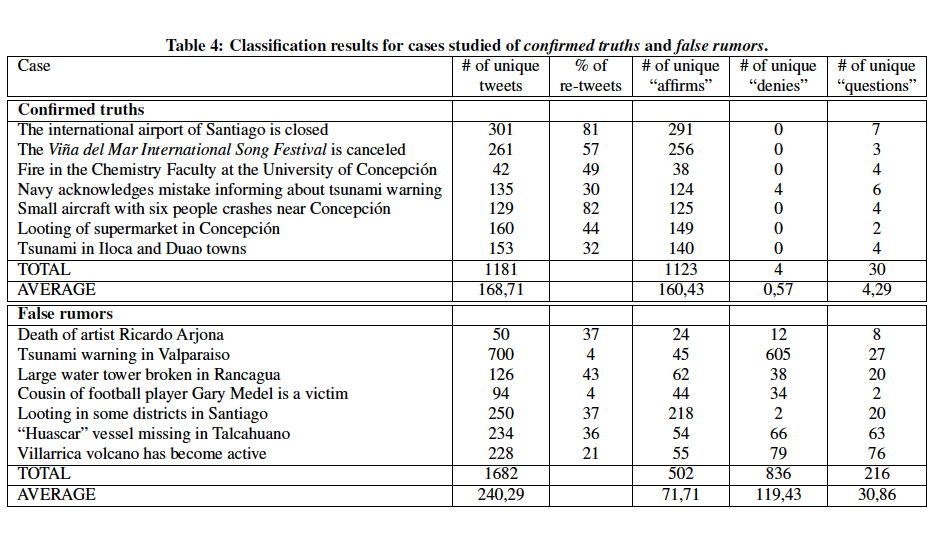
A research team at Yahoo recently completed an empirical study (PDF) on the behavior of Twitter users after the 8.8 magnitude earthquake in Chile. The study was based on 4,727,524 indexed tweets, about 20% of which were replies to other tweets. What is particularly interesting about this study is that the team also analyzed the spread of false rumors and confirmed news that were disseminated on Twitter.

The authors “manually selected some relevant cases of valid news items, which were confirmed at some point by reliable sources.” In addition, they “manually selected important cases of baseless rumors which emerged during the crisis (confirmed to be false at some point).” Their goal was to determine whether users interacted differently when faced with valid news vs false rumors.

The study shows that about 95% of tweets related to confirmed reports validated that information. In contrast only 0.03% of tweets denied the validity of these true cases. Interestingly, the results also show  that “the number of tweets that deny information becomes much larger when the information corresponds to a false rumor.” In fact, about 50% of tweets will deny the validity of false reports. The table below lists the full results.

The authors conclude that “the propagation of tweets that correspond to rumors differs from tweets that spread news because rumors tend to be questioned more than news by the Twitter community. Notice that this fact suggests that the Twitter community works like a collaborative filter of information. This result suggests also a very promising research line: it could posible to detect rumors by using aggregate analysis on tweets.”

I think these findings are particularly important for projects like *Swift River, which try to validate crowdsourced crisis information in real-time. I would also be interested to see a similar study on tweets around the Haitian earthquake to explore whether this “collaborative filter” dynamic is an emergent phenomena in this complex systems or simply an artifact of something else.

Interested in learning more about “information forensics”? See this link and the articles below:

The Crowdsourcing Detective: Crisis, Deception and Intrigue in the Twittersphere

My colleague Anahi Ayala recently started a blog called “Diary of a Crisis Mapper.” I highly recommend it. Her latest blog post on Ushahidi-Chile relates some intriguing detective work that all started with the following tweet:

The Tweet was mapped on Ushahidi-Chile. You’ll note in the discussion forum part of this report that a volunteer (Annette) updated the alert by adding that the person had been rescued. She did this after seeing a Tweet from @biodome10 saying that he had been rescued. This is when I emailed Anahi (on February 27th) to ask whether she could try and confirm this case.

It turns out the person behind the Twitter handle @biodome10 was pretending to be Gerry Fraley, a journalist with the Dallas Morning News. Biodome10 even used Gerry Fraley’s own profile picture on their Twitter profile. It also turns out that @biodome10 has a history of disseminating false information. But this first Tweet set in motion an intriguing series of events.

Someone in Chile saw the Tweet and actually called the police to report that a person was trapped under a building at that address. Anahi did some online detective work and found out that “the police decided to send 3 trucks from the fire dept, 30 cops from the rescue department, and the chief of Security in person to the address to save the person in question (see James’s blog on this, and also reported from @criverap from Twitter).”

Anahi followed this lead further:

It was Saturday night in Santiago and even if there had been one of the worst earthquake of the last 25 years, life was still going on. So it was for Dinamarca Pedro and Vargas Elba, a couple that was celebrating that night its 39 wedding anniversary. Of course, there was not much to celebrate, so at 11pm Pedro and Elba were preparing to go to bed. They lived in Lautaro 1712, Santiago, Chile.

When the door was open by force by police, carabineros and detectives, with the chief of Security in person leading the operation, the couple almost had a heart attack. No person to rescue, only an old couple which is going to remember its 39 anniversary for the rest of its life! (reported on Las Ultima Noticias Newspaper on the 1st of March 2010).

That’s not all, @biodome10 sent out a second false Tweet the following day, which was also mapped on Ushahidi-Chile:

Again the police mobilized to the location after seeing the Tweet on Twitter. When they arrived at the scene, there were no collapsed buildings in that part of the city, so they promptly left. This time though, the Tweet actually ended up on hundreds of t-shirts as part of a fund raising campaign for the Red Cross.

As Anahi writes:

Both those tweets were false. Now we know that because we know that Biodome10 was posting false information. But the Chilean police didn’t have the time and the resources to verify this information. They had priorities: go and save people as quickly as possible. They wasted time two times following both those twitter messages, while they could have been use this time to save other people in danger. Biodome10 was not only playing with social networks and Twitter, he was playing with people’s life.

At the same time, though, Anahi notes that she was able to do all her detective work right from her laptop by just accessing the web:

[…] crowd sourcing verification of information works. I have been able to find all those information just by sitting on my desk in NYC/Boston. Others have done investigations for me. I have been just collecting people’s tweets, read their blogs, and put together all the information. The fact that different people, from different parts of the world have been investigating by themselves this issue, has given me the possibility to find out that Biodome10 was a liar, independently from his identity and to be sure that the two reports we posted on our Ushahidi map were actually false.

To this end, Anahi advises groups that crowdsource crisis information to set up a verification team that can use crowdsourcing to verify information. This is precisely the principle behind Swift River, using crowdsourcing and natural language processing to crowdsource the filter. As Anahi remarks, “Crowd sourcing verification of information in this case worked. True, it was too late, especially for the police dept in Santiago, but next time we all will be ready.”

Hopefully they’ll be ready and using Swift River since the point of Swift River is to help groups validate information in near real-time. In fact, had Swift River been used during Chile, those two Tweets by @biodome10 would have received the lowest scores because there was only one “witness” reporting the incidents. Of course, Swift River is not a silver bullet as I have already elaborated on here. But we must be careful not to despair because of two false Tweets. They represent 0.0016% of all the reports mapped on Ushahidi-Chile, and they were subsequently verified.

As Dave Warner noted at a panel on USIP Mobile Phones and Afghanistan last week, “Snipers in Afghanistan use roads. Does that mean we should go and tear up all the roads?” Of course not.

I have 3 take-aways from these anecdotes:

  1. I wouldn’t be surprised if there were grounds to take legal action against @biodome10. This should send a signal to others who want to play with people’s lives during disasters.
  2. The Tweets were verifiable by anyone with an Internet connection, the main challenge was time not verifiability.
  3. Both Tweets could have been verified more quickly by others on site had they gotten wind of the information. They could easily have gone down the street and taken a picture showing that there was a wedding anniversary at the first location and intact buildings at the second. They could prove the date by including a picture of the day’s newspaper in the photographs.

In sum, I’m still of the opinion that greater connectivity can lead to greater self-correction. The detective work can be crowdsourced, my dear Watson.

Patrick Philippe Meier

Twitter in Iran: Where I disagree with Will Heaven vs Josh Shahryar

Will Heaven of the Daily Telegraph and EA‘s Josh Shahryar have been engaged in a battle of words on the role of Twitter in Iran. I think the battle has now drawn to a close. Given the popularity of my previous post on “Where I disagree with Morozov and Shirky on Digital Activism,” I thought I’d continue the series, which also helps me keep track of my notes for my dissertation.

————

It all started on December 29th when Will published this article in the Daily Telegraph:

Iran and Twitter: the fatal folly of the online revolutionaries

Which he followed up with this blog post, still on the Daily Telegraph:

Iran’s brutal regime won’t be toppled by Twitter and the niceties of social media

This provoked the following response from Josh (the page may be down):

Twitter Revolution 101: Get Your Facts Right

Will in turn replied to Josh’s post with one of his own:

My response to Twitterati: stop putting Iranian lives at risk

Finally, unless I’ve missed another exchange, Josh posted this closing response yesterday:

Iran & Twitter: Last Words on The Hell of Heaven

————

I copied and pasted this lengthy exchange in a Word document (available here) and did a word count. The debate generated over 7,500 words. That’s about 12 pages, single-space of font-size 10 text. I’ve re-read this document several times and I’m not quite sure what the debate ultimately amounts to. They both make very good points but neither is willing to concede that.

In my opinion, the contentious exchange stems from the use of the word “revolution” and the subsequent arms-race of anecdotes that all too often causes more confusion than clarity. When Will uses the term, “there has been no revolution in Iran,” he implies a political revolution whereas Josh—on several occasions—clearly states that he’s talking about a revolution in information dissemination: “That Revolution is about awareness, not provoking a political revolt or helping it directly.”

In any case, here are my individual comments on their exchange.

My Response to Will

Will: It’s deluded to think that “hashtags”, “Tweets” and “Twibbons” have threatened the regime for a second.

Really? Then why would the regime or sympathetic elements within Iran try to shut it down?

Will: Here’s the other thing “social media experts” will forget to tell you: dictatorships across the world now use their own tools to hunt down online protesters.

I would like to challenge Will to find one “social media expert” who forgets that digital repression is real. Please see my previous blog post on this.

Will: And it is foolish to think that their use [Tor, Freebase] guarantees safety: if the Revolutionary Guard were to find someone using the software, the consequences would be dire.

Both Will and Josh are fixated on technology at the expense of tactics. I think they’d find this guide on how to communicate securely in repressive environments of interest. There needs to be more cross-fertilization between civil resistance strategies and digital activism tactics. See this post for more.

And before either fault me for making the above guide public, all the information in said-guide is already public and available online. Repressive regimes may very well be aware of most of the tactics and technologies used, but just like chess, this doesn’t mean one side can defeat the other at every game.

Will: When you consider the danger posed to Iranians by online participation – compared with what online participation has achieved – the overall result is hardly tangible, and certainly not worth the risks which have been undertaken.

True, perhaps, but a little too passive a statement for my tastes. Those risks are not static, they can be reduced; hence the guide. And hence the need for more education and training in digital activism around the world. See Tactical Tech‘s excellent work in this area, for example.

One other point that Will overlooks (understandably since he doesn’t live in the US) is the stunning shift in perception that took place in the minds of Americans when viewing Iran’s post-election protests. Prior to the elections, the word Iran would generally evoke the following: “Nuclear weapons”, “Kill the Great Satan”, etc. But after young Iranians took to the streets and the protests were documented on Twitter, Facebook and Flickr, many Americans finally realized that “the other” was perhaps not that different. The shift in mindset was huge.

My Response to Josh

I largely agree with Josh’s take on the role of Twitter in Iran although I see why it’s easy for Will to carefully select one or two arguments and push back. In any case, I do take issue with this comment:

Josh: The fact that Iranians are dying is not the fault of Westerners. It is not even a fault. It is a sacrifice that Iranians must make to gain their freedom.

The Responsibility to Protect (R2P) suggests that state sovereignty is contingent on a state protecting it’s citizens. A regime that kills some 400 citizens in response to street protests should hardly have the right to remain sovereign. There should be a Chapter 7 UN mandate with 20,000 observers in Iran to prevent any more violence. Realistically though, I don’t know what the solution to this crisis is, but I do feel that we’re all responsible for the bloodshed.

I definitely disagree with Josh’s implication that revolutions require death and destruction. “Be smart, don’t be dead” is what I tell political activists. There are very good reasons why nonviolent action is called “A Force More Powerful.” Digital activists really need to get up to speed on nonviolent civil resistance tactics and strategies just as the latter need to get up to speed on how to communicate more securely in repressive environments.

Patrick Philippe Meier