Category Archives: Crowdsourcing

Opening Keynote Address at CrisisMappers 2013

Screen Shot 2013-11-18 at 1.58.07 AM

Welcome to Kenya, or as we say here, Karibu! This is a special ICCM for me. I grew up in Nairobi; in fact our school bus would pass right by the UN every day. So karibu, welcome to this beautiful country (and continent) that has taught me so much about life. Take “Crowdsourcing,” for example. Crowdsourcing is just a new term for the old African saying “It takes a village.” And it took some hard-working villagers to bring us all here. First, my outstanding organizing committee went way, way above and beyond to organize this village gathering. Second, our village of sponsors made it possible for us to invite you all to Nairobi for this Fifth Annual, International Conference of CrisisMappers (ICCM).

I see many new faces, which is really super, so by way of introduction, my name is Patrick and I develop free and open source next generation humanitarian technologies with an outstanding team of scientists at the Qatar Computing Research Institute (QCRI), one of this year’s co-sponsors.

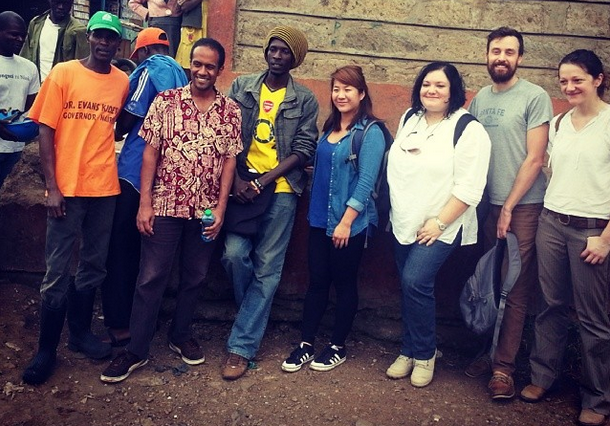
We’ve already had an exciting two-days of pre-conference site visits with our friends from Sisi ni Amani and our co-host Spatial Collective. ICCM participants observed first-hand how GIS, mobile technology and communication projects operate in informal settlements, covering a wide range of topics that include governance, civic education and peacebuilding. In addition, our friend Heather Leson from the Open Knowledge Foundation (OKF) coordinated an excellent set of trainings at the iHub yesterday. So a big thank you to Heather, Sisi ni Amani and Spatial Collective for these outstanding pre-conference events.
Screen Shot 2013-11-19 at 10.48.30 AM

This is my 5th year giving opening remarks at ICCM, so some of you will know from previous years that I often take this moment to reflect on the past 12 months. But just reflecting on the past 12 days alone requires it’s own separate ICCM. I’m referring, of course, to the humanitarian and digital humanitarian response to the devastating Typhoon in the Philippines. This response, which is still ongoing, is unparalleled in terms of the level of collaboration between members of the Digital Humanitarian Network (DHN) and formal humanitarian organizations like UN OCHA and WFP. All of these organizations, both formal and digital, are also members of the CrisisMapper Network.
Screen Shot 2013-11-18 at 2.07.59 AM

The Digital Humanitarian Network, or DHN, serves as the official interface between formal humanitarian organizations and global networks of tech-savvy digital volunteers. These digital volunteers provide humanitarian organizations with the skill and surge capacity they often need to make timely sense of “Big (Crisis) Data” during major disasters. By Big Crisis Data, I mean social media content and satellite imagery, for example. This overflow of such information generated during disasters can be as paralyzing to humanitarian response as the absence of information. And making sense of this overflow in response to Yolanda has required all hands on deck—i.e., an unprecedented level of collaboration between many members of the DHN.

So I’d like to share with you 2 initial observations from this digital humanitarian response to Yolanda; just 2 points that may be signs of things to come. Local Digital Villages and World Wide (good) Will.
Screen Shot 2013-11-18 at 2.09.42 AM

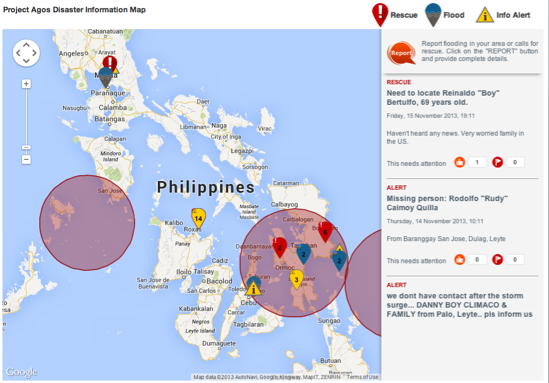
First, there were numerous local digital humanitarians on the ground in the Philippines. These digitally-savvy Filipinos were rapidly self-organizing and launching crisis maps well before any of us outside the Philippines had time to blink. One such group is Rappler, for example.
Screen Shot 2013-11-18 at 2.10.37 AM

We (the DHN) reached out to them early on, sharing both our data and volunteers. Remember that “Crowdsourcing” is just a new word for the old African saying that “it takes a village…” and sometimes, it takes a digital village to support humanitarian efforts on the ground. And Rappler is hardly the only local digital community that mobilizing in response to Yolanda, there are dozens of digital villages spearheading similar initiatives across the country.

The rise of local digital villages means that the distant future (or maybe not too distant future) of humanitarian operations may become less about the formal “brick-and-mortar” humanitarian organizations and, yes, also less about the Digital Humanitarian Network. Disaster response is and has always have been about local communities self-organizing and now local digital communities self-organizing. The majority of lives saved during disasters is attributed to this local agency, not international, external relief. Furthermore, these local digital villages are increasingly the source of humanitarian innovation, so we should pay close attention; we have a lot to learn from these digital villages. Naturally, they too are learning a lot from us.

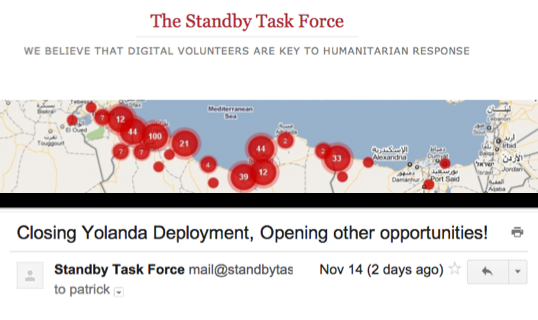
The second point that struck me occurred when the Standby Volunteer Task Force (SBTF) completed its deployment of MicroMappers on behalf of OCHA. The response from several SBTF volunteers was rather pointed—some were disappointed that the deployment had closed; others were downright upset. What happened next was very interesting; you see, these volunteers simply kept going, they used (hacked) the SBTF Skype Chat for Yolanda (which already had over 160 members) to self-organize and support other digital humanitarian efforts that were still ongoing. So the SBTF Team sent an email to it’s 1,000+ volunteers with the following subject header: “Closing Yolanda Deployment, Opening Other Opportunities!”
Screen Shot 2013-11-18 at 2.11.28 AM

The email provided a list of the most promising ongoing digital volunteer opportunities for the Typhoon response and encouraged volunteers to support whatever efforts they were most drawn to. This second reveals that a “World Wide (good) Will” exists. People care. This is good! Until recently, when disasters struck in faraway lands, we would watch the news on television wishing we could somehow help. That private wish—that innate human emotion—would perhaps translate into a donation. Today, not only can you donate cash to support those affected by disasters, you can also donate a few minutes of your time to support the relief efforts on the ground thanks to new humanitarian technologies and platforms. In other words, you, me, all of us can now translate our private wishes into direct, online public action, which can support those working in disaster-affected areas including local digital villages.
Screen Shot 2013-11-18 at 2.12.21 AM

This surge of World Wide (good) Will explains why SBTF volunteers wanted to continue volunteering for as long as they wished even if our formal digital humanitarian network had phased out operations. And this is beautiful. We should not seek to limit or control this global goodwill or play the professional versus amateur card too quickly. Besides, who are we kidding? We couldn’t control this flood of goodwill even if we wanted to. But, we can embrace this goodwill and channel it. People care, they want to offer their time to help others thousands of miles away. This is beautiful and the kind of world I want to live in. To paraphrase the philosopher Hannah Arendt, the greatest harm in the world is caused not by evil but apathy. So we should cherish the digital goodwill that springs during disasters. This spring is the digital equivalent of mutual aid, of self-help. The global village of digital Good Samaritans is growing.

At the same time, this goodwill, this precious human emotion and the precious time it freely offers can cause more harm than good if it is not channeled responsibly. When international volunteers poor into disaster areas wanting to help, their goodwill can have the opposite effect, especially when they are inexperienced. This is also true of digital volunteers flooding in to help online.

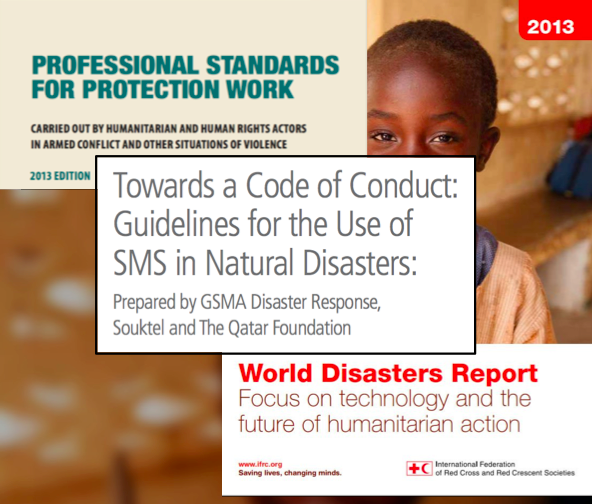
We in the CrisisMappers community have the luxury of having learned a lot about digital humanitarian response since the Haiti Earthquake; we have learned important lessons about data privacy and protection, codes of conduct, the critical information needs of humanitarian organizations and disaster-affected populations, standardizing operating procedures, and so on. Indeed we now (for the first time) have data protection protocols that address crowdsourcing, social media and digital volunteers thanks to our colleagues at the ICRC. We also have an official code of conduct on the use of SMS for disaster response thanks to our colleagues at GSMA. This year’s World Disaster Report (WDR 2013) also emphasizes the responsible use of next generation humanitarian technologies and the crisis data they manage.
Screen Shot 2013-11-18 at 2.13.03 AM

Now, this doesn’t mean that we the formal (digital) humanitarian sector have figured it all out—far from it. This simply means that we’ve learned a few important and difficult lessons along the way. Unlike newcomers to the digital humanitarian space, we have the benefit of several years of hard experience to draw on when deploying for disasters like Typhoon Yolanda. While sharing these lessons and disseminating them as widely as possible is obviously a must, it is simply not good enough. Guidebooks and guidelines just won’t cut it. We also need to channel the global spring of digital goodwill and distribute it to avoid  “flash floods” of goodwill. So what might these goodwill channels look like? Well they already exist in the form of the Digital Humanitarian Network—more specifically the members of the DHN.

These are the channels that focus digital goodwill in support of the humanitarian organizations that physically deploy to disasters. These channels operate using best practices, codes of conduct, protocols, etc., and can be held accountable. At the same time, however, these channels also block the upsurge of goodwill from new digital volunteers—those outside our digital villages. How? Our channels block this World Wide (good) Will by requiring technical expertise to engage with us and/or  by requiring an inordinate amount of time commitment. So we should not be surprised if the “World Wide (Good) Will” circumvents our channels altogether, and in so doing causes more harm than good during disasters. Our channels are blocking their engagement and preventing them from joining our digital villages. Clearly we need different channels to focus the World Wide (Good) Will.
Screen Shot 2013-11-18 at 2.14.21 AM

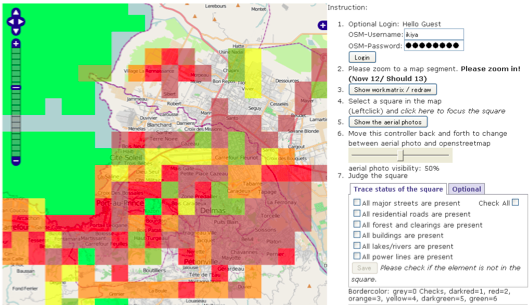
Our friends at Humanitarian OpenStreetMap already figured this out two years ago when they set up their microtasking server, making it easier for less tech-savvy volunteers to engage. We need to democratize our humanitarian technologies to responsibly channel the huge surplus global goodwill that exists online. This explains why my team and I at QCRI are developing MicroMappers and why we deployed the platform in response to OCHA’s request within hours of Typhoon Yolanda making landfall in the Philippines.
Screen Shot 2013-11-18 at 2.15.21 AM

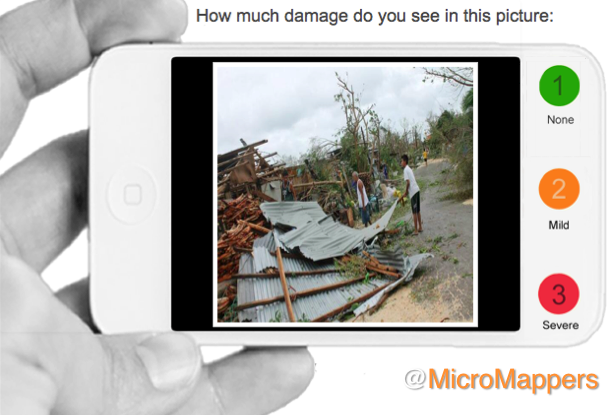
This digital humanitarian operation was definitely far from perfect, but it was super simple to use and channeled 208 hours of global goodwill in just a matter days. Those are 208 hours that did not cause harm. We had volunteers from dozens of countries around the world and from all ages and walks of life offering their time on MicroMappers. OCHA, which had requested this support, channeled the resulting data to their teams on the ground in the Philippines.

These digital volunteers all cared and took the time to try and help others thousands of miles away. The same is true of the remarkable digital volunteers supporting the Humanitarian OpenStreetMap efforts. This is the kind of world I want to live in; the world in which humanitarian technologies harvest the global goodwill and channels it to make a difference to those affected by disasters.

Screen Shot 2013-11-18 at 2.09.42 AM

So these are two important trends I see moving forward, the rise of well-organized, local digital humanitarian groups, like Rappler, and the rise of World Wide (Good) Will. We must learn from the former, from the local digital villages, and when asked, we should support them as best we can. We should also channel, even amplify the World Wide (Good) Will by democratizing humanitarian technologies and embracing new ways to engage those who want to make a difference. Again, Crowdsourcing is simply a new term for the old African proverb, that it takes a village. Let us not close the doors to that village.

So on this note, I thank *you* for participating in ICCM and for being a global village that cares, both on and offline. Big thanks as well to our current team of sponsors for caring about this community and making sure that our village does continue to meet in person every year. And now for the next 3 days, we have an amazing line-up of speakers, panelists & technologies for you. So please use these days to plot, partner and disrupt. And always remember: be tough on ideas, but gentle on people.

Thanks again, and keep caring.
Early Results of MicroMappers Response to Typhoon Yolanda (Updated)

We have completed our digital humanitarian operation in the Philippines after five continuous days with MicroMappers. Many, many thanks to all volunteers from all around the world who donated their time by clicking on tweets and images coming from the Philippines. Our UN OCHA colleagues have confirmed that the results are being shared widely with their teams in the field and with other humanitarian organizations on the ground. More here.

ImageClicker

In terms of preliminary figures (to be confirmed):

  • Tweets collected during first 48 hours of landfall = ~230,000
  • Tweets automatically filtered for relevancy/uniqueness = ~55,000
  • Tweets clicked using the TweetClicker = ~ 30,000
  • Relevant tweets triangulated using TweetClicker = ~3,800
  • Triangulated tweets published on live Crisis Map = ~600
  • Total clicks on TweetClicker = ~ 90,000
  • Images clicked using the ImageClicker = ~ 5,000
  • Relevant images triangulated using TweetClicker = ~1,200
  • Triangulated images published on live Crisis Map = ~180
  • Total clicks on ImageClicker = ~15,000
  • Total clicks on MicroMappers (Image + Tweet Clickers) = ~105,000

Since each single tweet and image uploaded to the Clickers was clicked on by (at least) three individual volunteers for quality control purposes, the number of clicks is three times the total number of tweets and images uploaded to the respective clickers. In sum, digital humanitarian volunteers have clocked a grand total of ~105,000 clicks to support humanitarian operations in the Philippines.

While the media has largely focused on the technology angle of our digital humanitarian operation, the human story is for me the more powerful message. This operation succeeded because people cared. Those ~105,000 clicks did not magically happen. Each and every single one of them was clocked by humans, not machines. At one point, we had over 300 digital volunteers from the world over clicking away at the same time on the TweetClicker and more than 200 on the ImageClicker. This kind of active engagement by total strangers—good “digital Samaritans”—explains why I find the human angle of this story to be the most inspiring outcome of MicroMappers. “Crowdsourcing” is just a new term for the old saying “it takes a village,” and sometimes it takes a digital village to support humanitarian efforts on the ground.

Until recently, when disasters struck in faraway lands, we would watch the news on television wishing we could somehow help. That private wish—that innate human emotion—would perhaps translate into a donation. Today, not only can you donate cash to support those affected by disasters, you can also donate a few minutes of your time to support the operational humanitarian response on the ground by simply clicking on MicroMappers. In other words, you can translate your private wish into direct, online public action, which in turn translates into supporting offline collective action in the disaster-affected areas.

Clicking is so simple that anyone with Internet access can help. We had high schoolers in Qatar clicking away, fire officers in Belgium, graduate students in Boston, a retired couple in Kenya and young Filipinos clicking away. They all cared and took the time to try and help others, often from thousands of miles away. That is the kind of world I want to live in. So if you share this vision, then feel free to join the MicroMapper list-serve.

Yolanda TweetClicker4

Considering that MicroMappers is still very much under development, we are all pleased with the results. There were of course many challenges; the most serious was the CrowdCrafting server which hosts our Clickers. Unfortunately, that server was not able to handle the load and traffic generated by digital volunteers. So their server crashed twice and also slowed our Clickers to a complete stop at least a dozen times during the past five days. At times, it would take 10-15 seconds for a new tweet or image to load, which was frustrating. We were also limited by the number of tweets and images we could upload at any given time, usually ~1,500 at most. Any larger load would seriously slow down the Clickers. So it is rather remarkable that digital volunteers managed to clock more than 100,000 clicks given the repeated interruptions. 

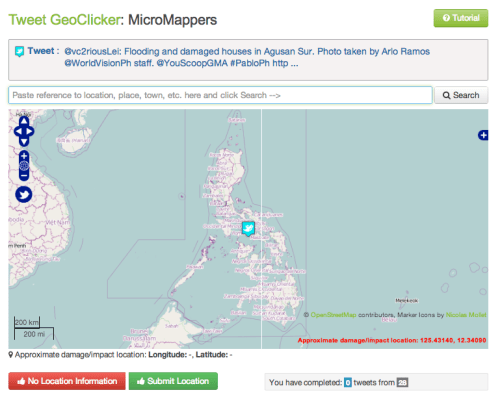
Besides the server issue, the other main bottleneck was the geo-location of the ~30,000 tweets and ~5,000 images tagged using the Clickers. We do have a Tweet and Image GeoClicker but these were not slated to launch until next week at CrisisMappers 2013, which meant they weren’t ready for prime time. We’ll be sure to launch them soon. Once they are operational, we’ll be able to automatically push triangulated tweets and images from the Tweet and Image Clickers directly to the corresponding GeoClickers so volunteers can also aid humanitarian organizations by mapping important tweets and images directly.

There’s a lot more that we’ve learned throughout the past 5 days and much room for improvement. We have a long list of excellent suggestions and feedback from volunteers and partners that we’ll be going through starting tomorrow. The most important next step is to get a more powerful server that can handle a lot more load and traffic. We’re already taking action on that. I have no doubt that our clicks would have doubled without the server constraints.

For now, though, BIG thanks to the SBTF Team and in particular Jus McKinnon, the QCRI et al team, in particular Ji Lucas, Hemant Purohit and Andrew Ilyas for putting in very, very long hours, day in and day out on top of their full-time jobs and studies. And finally, BIG thanks to the World Wide Crowd, to all you who cared enough to click and support the relief operations in the Philippines. You are the heroes of this story.

bio

Live Crisis Map of Disaster Damage Reported on Social Media

Update: See early results of MicroMappers deployment here

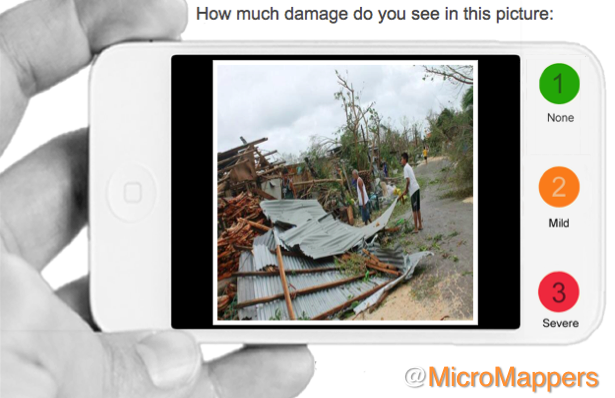
Digital humanitarian volunteers have been busing tagging images posted to social media in the aftermath of Typhoon Yolanda. More specifically, they’ve been using the new MicroMappers ImageClicker to rate the level of damage they see in each image. Thus far, they have clicked over 7,000 images. Those that are tagged as “Mild” and “Severe” damage are then geolocated by members of the Standby Volunteer Task Force (SBTF) who have partnered with GISCorps and ESRI to create this live Crisis Map of the disaster damage tagged using the ImageClicker. The map takes a few second to load, so please be patient.

YolandaPH Crisis Map 1

The more pictures are clicked using the ImageClicker, the more populated this crisis map will become. So please help out if you have a few seconds to spare—that’s really all it takes to click an image. If there are no picture left to click or the system is temporarily offline, then please come back a while later as we’re uploading images around the clock. And feel free to join our list-serve in the meantime if you wish to be notified when humanitarian organizations need your help in the future. No prior experience or training necessary. Anyone who knows how to use a computer mouse can become a digital humanitarian.

The SBTF, GISCorps and ESRI are members of the Digital Humanitarian Network (DHN), which my colleague Andrej Verity and I co-founded last year. The DHN serves as the official interface for direct collaboration between traditional “brick-and-mortar” humanitarian organizations and highly skilled digital volunteer networks. The SBTF Yolanda Team, spearheaded by my colleague Justine Mackinnon, for example, has also produced this map based on the triangulated results of the TweetClicker:

YolandaPH Crisis Map 2
There’s a lot of hype around the use of new technologies and social media for disaster response. So I want to be clear that our digital humanitarian operations in the Philippines have not been perfect. This means  that we’re learning (a lot) by doing (a lot). Such is the nature of innovation. We don’t have the luxury of locking ourselves up in a lab for a year to build the ultimate humanitarian technology platform. This means we have to work extra, extra hard when deploying new platforms during major disasters—because not only do we do our very best to carry out Plan A, but we often have to carry out  Plans B and C in parallel just in case Plan A doesn’t pan out. Perhaps Samuel Beckett summed it up best: “Ever tried. Ever failed. No matter. Try Again. Fail again. Fail better.”

bio

Typhoon Yolanda: UN Needs Your Help Tagging Crisis Tweets for Disaster Response (Updated)

Final Update 14 [Nov 13th @ 4pm London]: Thank you for clicking to support the UN’s relief operations in the Philippines! We have now completed our mission as digital humanitarian volunteers. The early results of our collective online efforts are described here. Thank you for caring and clicking. Feel free to join our list-serve if you want to be notified when humanitarian organizations need your help again during the next disaster—which we really hope won’t be for a long, long time. In the meantime, our hearts and prayers go out to those affected by this devastating Typhoon.

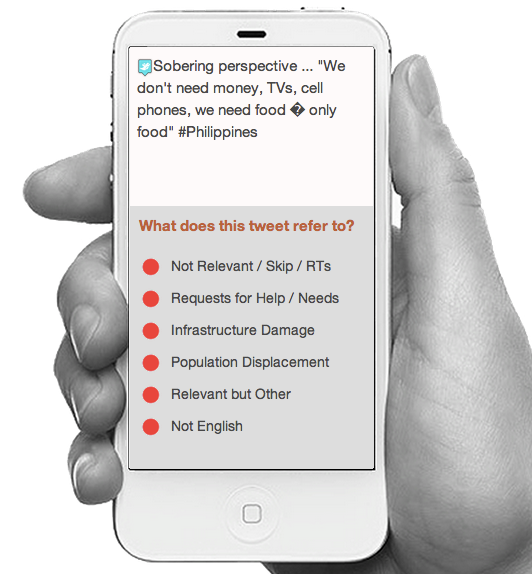
The United Nations Office for the Coordination of Humanitarian Affairs (OCHA) just activated the Digital Humanitarian Network (DHN) in response to Typhoon Yolanda, which has already been described as possibly one of the strongest Category 5 storms in history. The Standby Volunteer Task Force (SBTF) was thus activated by the DHN to carry out a rapid needs & damage assessment by tagging reports posted to social media. So Ji Lucas and I at QCRI (+ Hemant & Andrew) and Justine Mackinnon from SBTF have launched MicroMappers to microtask the tagging of tweets & images. We need all the help we can get given the volume we’ve collected (and are continuing to collect). This is where you come in!

TweetClicker_PH2

You don’t need any prior experience or training, nor do you need to create an account or even login to use the MicroMappers TweetClicker. If you can read and use a computer mouse, then you’re all set to be a Digital Humanitarian! Just click here to get started. Every tweet will get tagged by 3 different volunteers (to ensure quality control) and those tweets that get identical tags will be shared with our UN colleagues in the Philippines. All this and more is explained in the link above, which will give you a quick intro so you can get started right away. Our UN colleagues need these tags to better understand who needs help and what areas have been affected.

ImageClicker YolandaPH

It only takes 3 seconds to tag a tweet or image, so if that’s all the time you have then that’s plenty! And better yet, if you also share this link with family, friends, colleagues etc., and invite them to tag along. We’ll soon be launching We have also launched the ImageClicker to tag images by level of damage. So please stay tuned. What we need is the World Wide Crowd to mobilize in support of those affected by this devastating disaster. So please spread the word. And keep in mind that this is only the second time we’re using MicroMappers, so we know it is not (yet) perfect : ) Thank you!

bio

p.s. If you wish to receive an alert next time MicroMappers is activated for disaster response, then please join the MicroMappers list-serve here. Thanks!

Previous updates:

Update 1: If you notice that all the tweets (tasks) have been completed, then please check back in 1/2 hour as we’re uploading more tweets on the fly. Thanks!

Update 2: Thanks for all your help! We are getting lots of traffic, so the Clicker is responding very slowly right now. We’re working on improving speed, thanks for your patience!

Update 3: We collected 182,000+ tweets on Friday from 5am-7pm (local time) and have automatically filtered this down to 35,175 tweets based on relevancy and uniqueness. These 35K tweets are being uploaded to the TweetClicker a few thousand tweets at a time. We’ll be repeating all this for just one more day tomorrow (Saturday). Thanks for your continued support!

Update 4: We/you have clicked through all of Friday’s 35K tweets and currently clicking through today’s 28,202 tweets, which we are about 75% of the way through. Many thanks for tagging along with us, please keep up the top class clicking, we’re almost there! (Sunday, 1pm NY time)

Update 5: Thanks for all your help! We’ll be uploading more tweets tomorrow (Monday, November 11th). To be notified, simply join this list-serve. Thanks again! [updated post on Sunday, November 10th at 5.30pm New York]

Update 6: We’ve uploaded more tweets! This is the final stretch, thanks for helping us on this last sprint of clicks!  Feel free to join our list-serve if you want to be notified when new tweets are available, many thanks! If the system says all tweets have been completed, please check again in 1/2hr as we are uploading new tweets around the clock. [updated Monday, November 11th at 9am London]

Update 7 [Nov 11th @ 1pm London]We’ve just launched the ImageClicker to support the UN’s relief efforts. So please join us in tagging images to provide rapid damage assessments to our humanitarian partners. Our TweetClicker is still in need of your clicks too. If the Clickers are slow, then kindly be patient. If all the tasks are done, please come back in 1/2hr as we’re uploading content to both clickers around the clock. Thanks for caring and helping the relief efforts. An update on the overall digital humanitarian effort is available here.

Update 8 [Nov 11th @ 6.30pm NY]We’ll be uploading more tweets and images to the TweetClicker & ImageClicker by 7am London on Nov 12th. Thank you very much for supporting these digital humanitarian efforts, the results of which are displayed here. Feel free to join our list-serve if you want to be notified when the Clickers have been fed!

Update 9 [Nov 12th @ 6.30am London]: We’ve fed both our TweetClicker and ImageClicker with new tweets and images. So please join us in clicking away to provide our UN partners with the situational awareness they need to coordinate their important relief efforts on the ground. The results of all our clicks are displayed here. Thank you for helping and for caring. If the Clickers or empty or offline temporarily, please check back again soon for more clicks.
Update 10 [Nov 12th @ 10am New York]: Were continuing to feed both our TweetClicker and ImageClicker with new tweets and images. So please join us in clicking away to provide our UN partners with the situational awareness they need to coordinate their important relief efforts on the ground. The results of all our clicks are displayed here. Thank you for helping and for caring. If the Clickers or empty or offline temporarily, please check back again soon for more clicks. Try different browsers if the tweets/images are not showing up.
Update 11 [Nov 12th @ 5pm New York]: Only one more day to go! We’ll be feeding our TweetClicker and ImageClicker with new tweets and images by 7am London on the 13th. We will phase out operations by 2pm London, so this is the final sprint. The results of all our clicks are displayed here. Thank you for helping and for caring. If the Clickers are empty or offline temporarily, please check back again soon for more clicks. Try different browsers if the tweets/images are not showing up.
Update 12 [Nov 13th @ 9am London]: This is the last stretch, Clickers! We’ve fed our TweetClicker and ImageClicker with new tweets and images. We’ll be refilling them until 2pm London (10pm Manila) and phasing out shortly thereafter. Given that MicroMappers is still under development, we are pleased that this deployment went so well considering. The results of all our clicks are displayed here. Thank you for helping and for caring. If the Clickers are empty or offline temporarily, please check back again soon for more clicks. Try different browsers if the tweets/images are not showing up.
Update 13 [Nov 13th @ 11am London]: Just 3 hours left! Our UN OCHA colleagues have just asked us to prioritize the ImageClicker, so please focus on that Clicker. We’ll be refilling the ImageClicker until 2pm London (10pm Manila) and phasing out shortly thereafter. Given that MicroMappers is still under development, we are pleased that this deployment went so well considering. The results of all our clicks are displayed here. Thank you for helping and for caring. If the ImageClicker is empty or offline temporarily, please check back again soon for more clicks. Try different browsers if images are not showing up.

Social Media, Disaster Response and the Streetlight Effect

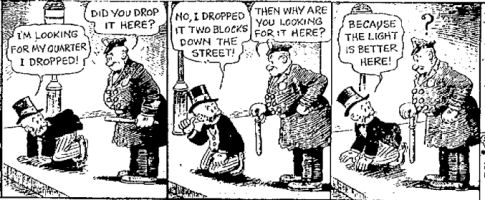
A police officer sees a man searching for his coin under a streetlight. After helping for several minutes, the exasperated officer asks if the man is sure that he lost his coin there. The man says “No, I lost them in the park a few blocks down the street.” The incredulous officer asks why he’s searching under the streetlight. The man replies, “Well this is where the light is.”[1] This parable describes the “streetlight effect,” the observational bias that results from using the easiest way to collect information. The streetlight effect is an important criticisms leveled against the use of social media for emergency management. This certainly is a valid concern but one that needs to be placed into context.

muttjeff01
I had the honor of speaking on a UN panel with Hans Rosling in New York last year. During the Q&A, Hans showed Member States a map of cell phone coverage in the Democratic Republic of the Congo (DRC). The map was striking. Barely 10% of the country seemed to have coverage. This one map shut down the entire conversation about the value of mobile technology for data collection during disasters. Now, what Hans didn’t show was a map of the DRC’s population distribution, which reveals that the majority of the country’s population lives in urban areas; areas that have cell phone coverage. Hans’s map was also static and thus did not convey the fact that the number cell phone subscribers increased by roughly 50% in the year leading up to the panel and ~50% again the year after.

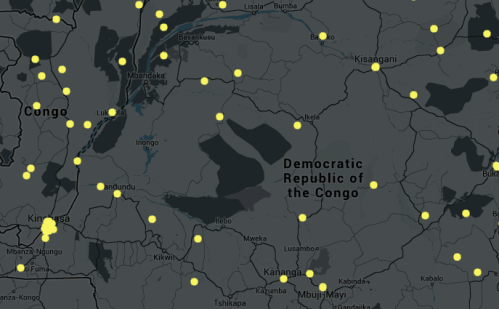
Of course, the number of social media users in the DRC is far, far lower than the country’s 12.4 million unique cell phone subscribers. The map below, for example, shows the location of Twitter users over a 10 day period in October 2013. Now keep in mind that only 2% of users actually geo-tag their tweets. Also, as my colleague Kalev Leetaru recently discovered, the correlation between the location of Twitter users and access to electricity is very high, which means that every place on Earth that is electrified has a high probability of having some level of Twitter activity. Furthermore, Twitter was only launched 7 years ago compared to the first cell phone, which was built 30 years ago. So these are still early days for Twitter. But that doesn’t change the fact that there is clearly very little Twitter traffic in the DRC today. And just like the man in the parable above, we only have access to answers where an “electrified tweet” exists (if we restrict ourselves to the Twitter streetlight).

DRC twitter map 2

But this begs the following question, which is almost always overlooked: too little traffic for what? This study by Harvard colleagues, for example, found that Twitter was faster (and as accurate) as official sources at detecting the start and early progress of Cholera after the 2010 earthquake. And yet, the corresponding Twitter map of Haiti does not show significantly more activity than the DRC map over the same 10-day period. Keep in mind there were far fewer Twitter users in Haiti four years ago (i.e., before the earthquake). Other researchers have recently shown that “micro-crises” can also be detected via Twitter even though said crises elicit very few tweets by definition. More on that here.

Haiti twitter map

But why limit ourselves to the Twitter streetlight? Only a handful of “puzzle pieces” in our Haiti jigsaw may be tweets, but that doesn’t mean they can’t complement other pieces taken from traditional datasets and even other social media channels. Remember that there are five times more Facebook users than Twitter users. In certain contexts, however, social media may be of zero added value. I’ve reiterated this point again in recent talks at the Council on Foreign Relation and the UN. Social media is forming a new “nervous system” for our planet, but one that is still very young, even premature in places and certainly imperfect in representation. Then again, so was 911 in the 1970’s and 1980’s as explained here. In any event, focusing on more developed parts of the system (like Indonesia’s Twitter footprint below) makes more sense for some questions, as does complementing this new nervous system with other more mature data sources such mainstream media via as GDELT as advocated here.

Indonesia twitter map2

The Twitter map of the Manila area below is also the result of 10-day traffic. While “only” ~12 million Filipinos (13% of the country) lives in Manila, it behoves us to remember that urban populations across the world are booming. In just over 2,000 days, more than half of the population in the world’s developing regions will be living in urban areas according to the UN. Meanwhile, the rural population of developing countries will decline by half-a-billion in coming decades. At the same time, these rural populations will also grow a larger social media footprint since mobile phone penetration rates already stand at 89% in developing countries according to the latest ITU study (PDF). With Google and Facebook making it their (for-profit) mission to connect those off the digital grid, it is only a matter of time until very rural communities get online and click on ads.

Manila twitter map

The radical increase in population density means that urban areas will become even more vulnerable to major disasters (hence the Rockefeller Foundation’s program on 100 Resilience Cities). To be sure, as Rousseau noted in a letter to Voltaire after the massive 1756 Portugal Earthquake, “an earthquake occurring in wilderness would not be important to society.” In other words, disaster risk is a function of population density. At the same time, however, a denser population also means more proverbial streetlights. But just as we don’t need a high density of streetlights to find our way at night, we hardly need everyone to be on social media for tweets and Instagram pictures to shed some light during disasters and facilitate self-organized disaster response at the grassroots level.

Credit: Heidi RYDER Photography

My good friend Jaroslav Valůch recounted a recent conversation he had with an old fireman in a very small town in Eastern Europe who had never heard of Twitter, Facebook or crowdsourcing. The old man said: “During crisis, for us, the firemen, it is like having a dark house where only some rooms are lit (i.e., information from mayors and other official local sources in villages and cities affected). What you do [with social media and crowdsourcing], is that you are lighting up more rooms for us. So don’t worry, it is enough.”

No doubt Hans Rosling will show another dramatic map if I happen to sit on another panel with him. But this time I’ll offer context so that instead of ending the discussion, his map will hopefully catalyze a more informed debate. In any event, I suspect (and hope that) Hans won’t be the only one objecting to my optimism in this blog post. So as always, I welcome feedback from iRevolution readers. And as my colleague Andrew Zolli is fond of reminding folks at PopTech:

“Be tough on ideas, gentle on people.”

bio

Automatically Identifying Eyewitness Reporters on Twitter During Disasters

My colleague Kate Starbird recently shared a very neat study entitled “Learning from the Crowd: Collaborative Filtering Techniques for Identifying On-the-Ground Twitterers during Mass Disruptions” (PDF). As she and her co-authors rightly argue, “most Twitter activity during mass disruption events is generated by the remote crowd.” So can we use advanced computing to rapidly identify Twitter users who are reporting from ground zero? The answer is yes.

twitter-disaster-test

An important indicator of whether or not a Twitter user is reporting from the scene of a crisis is the number of times they are retweeted. During the Egyptian revolution in early 2011, “nearly 30% of highly retweeted Twitter users were physically present at those protest events.” Kate et al. drew on this insight to study tweets posted during the Occupy Wall Street (OWS) protests in September 2011. The authors manually analyzed a sample of more than 2,300 Twitter users to determine which were tweeting from the protests. They found that 4.5% of Twitter users in their sample were actually onsite. Using this dataset as training data, Kate et al. were able to develop a classifier that can automatically identify Twitter users reporting from the protests with an accuracy of just shy of 70%. I expect that more training data could very well help increase this accuracy score. 

In any event, “the information resulting from this or any filtering technique must be further combined with human judgment to assess its accuracy.” As the authors rightly note, “this ‘limitation’ fits well within an information space that is witnessing the rise of digital volunteer communities who monitor multiple data sources, including social media, looking to identify and amplify new information coming from the ground.” To be sure, “For volunteers like these, the use of techniques that increase the signal to noise ratio in the data has the potential to drastically reduce the amount of work they must do. The model that we have outlined does not result in perfect classification, but it does increase this signal-to-noise ratio substantially—tripling it in fact.”

I really hope that someone will leverage Kate’s important work to develop a standalone platform that automatically generates a list of Twitter users who are reporting from disaster-affected areas. This would be a very worthwhile contribution to the ecosystem of next-generation humanitarian technologies. In the meantime, perhaps QCRI’s Artificial Intelligence for Disaster Response (AIDR) platform will help digital humanitarians automatically identify tweets posted by eyewitnesses. I’m optimistic since we were able to create a machine learning classifier with an accuracy of 80%-90% for eyewitness tweets. More on this in our recent study

MOchin - talked to family

One question that remains is how to automatically identify tweets like the one above? This person is not an eyewitness but was likely on the phone with her family who are closer to the action. How do we develop a classifier to catch these “second-hand” eyewitness reports?

bio

Why Anonymity is Important for Truth and Trustworthiness Online

Philosophy Professor, Karen Frost-Arnold, has just published a highly lucid analysis of the dangers that come with Internet accountability (PDF). While the anonymity provided by social media can facilitate the spread of lies, Karen rightly argues that preventing anonymity can undermine online communities by stifling communication and spreading ignorance, thus leading to a larger volume of untrustworthy information. Her insights are instructive for those interested in information forensics and digital humanitarian action.

FN

To make her case, Karen distinguishes between error-avoidance and truth-attainment. The former seeks to avoid false beliefs while the latter seeks to attain true belief. Take mainstream and social media, for example. Some argue that the “value of traditional media surpasses that of the blogosphere […] because the traditional media are superior at filtering out false claims” since professional journalists “reduce the number of errors that might otherwise be reported and believed.” Others counter this assertion: “People who confine themselves to a filtered medium may well avoid believing falsehoods (if the filters are working well), but inevitably they will also miss out on valuable knowledge,” including many true beliefs.

Karen argues that Internet anonymity is at odds with both error-avoiding purists and truth-seeking purists. For example, “some experimental evidence indicates that anonymity in computer-mediated discussion increases the quantity and novelty of ideas shared.” In addition, anonymity provides a measure of safety. This is particularly important for digital activists and others who are vulnerable and oppressed. Without this anonymity, important knowledge may not be shared. To this end, “Removal of anonymity could deprive the community of true beliefs spread by reports from socially threatened groups. Without online anonymity, activists, citizen journalists, and members of many socially stigmatized groups are much less likely to take the risk of sharing what they know with others.”

This leads to decreased participation, which in turn undermines the diversity of online communities and their ability to detect errors. To be sure, “anonymity can enhance error-detection by enabling increased transformative criticism to weed out error and bias.” In fact, “anonymity enables such groups to share criticisms of false beliefs. These criticisms can lead community members to reject or suspend judgment on false claims.” In other words, “Blogging and tweeting are not simply means of disseminating knowledge claims; they are also means of challenging, criticizing & uncovering errors in others’ knowledge claims.” As Karen rightly notes, “The error-uncovering efficacy of such criticism is enhanced by the anonymity that facilitates participation by diverse groups who would otherwise, for fear of sanction, not join the discussion. Removing anonymity risks silencing their valuable criticisms.” In sum, “anonymity facilitates error detection as well as truth attainment.”

tl

Karen thus argues for internet norms of civility instead of barring Internet anonymity. She also outlines the many costs of enforcing the use of real-world identities online. Detecting false identities is both time and resource intensive. I experienced this first-hand during the Libya Crisis Map operation. Investigating online identities diverts time and resources away obtaining other valuable truths and detecting other important errors. Moreover, this type of investigative accountability “can have a dampening effect on internet speech as those who desire anonymity avoid making surprising claims that might raise the suspicions of potential investigators.” This curtails the sharing of valuable truths.

“To prevent the problem of disproportionate investigation of marginalized and minority users,” Karen writes that online communities “need mechanisms for checking the biases of potential investigators.” To this end, “if the question of whether some internet speech merits investigation is debated within a community, then as the diversity of that community increases, the likelihood increases that biased reasons for suspicion will be challenged.”

Karen also turns to recent research in behavioral and experimental economics, sociology and psychology for potential solutions. For example, “People appear less likely to lie when the lie only gives them a small benefit but does the recipient a great harm.” Making this possible harm more visible to would-be perpetrators may dissuade dishonest actions. Research also shows that “when people are asked to reflect on their own moral values or read a code of ethics before being tempted with an opportunity for profitable deception, they are less likely to be dishonest, even when there is no risk of dishonesty being detected.” This is precisely the rational behind my piece on crowdsourcing honesty.

Bio

See also:

  • Crowdsourcing Critical Thinking to Verify Social Media [link]
  • Truth in the Age of Social Media: A Big Data Challenge [link]

Analyzing Fake Content on Twitter During Boston Marathon Bombings

As iRevolution readers already know, the application of Information Forensics to social media is one of my primary areas of interest. So I’m always on the lookout for new and related studies, such as this one (PDF), which was just published by colleagues of mine in India. The study by Aditi Gupta et al. analyzes fake content shared on Twitter during the Boston Marathon Bombings earlier this year.

bostonstrong

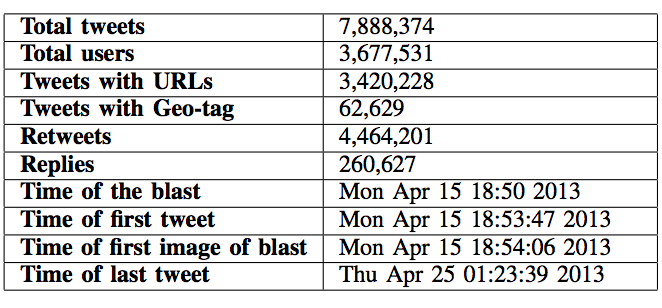
Gupta et al. collected close to 8 million unique tweets posted by 3.7 million unique users between April 15-19th, 2013. The table below provides more details. The authors found that rumors and fake content comprised 29% of the content that went viral on Twitter, while 51% of the content constituted generic opinions and comments. The remaining 20% relayed true information. Interestingly, approximately 75% of fake tweets were propagated via mobile phone devices compared to true tweets which comprised 64% of tweets posted via mobiles.

Table1 Gupta et al

The authors also found that many users with high social reputation and verified accounts were responsible for spreading the bulk of the fake content posted to Twitter. Indeed, the study shows that fake content did not travel rapidly during the first hour after the bombing. Rumors and fake information only goes viral after Twitter users with large numbers of followers start propagating the fake content. To this end, “determining whether some information is true or fake, based on only factors based on high number of followers and verified accounts is not possible in the initial hours.”

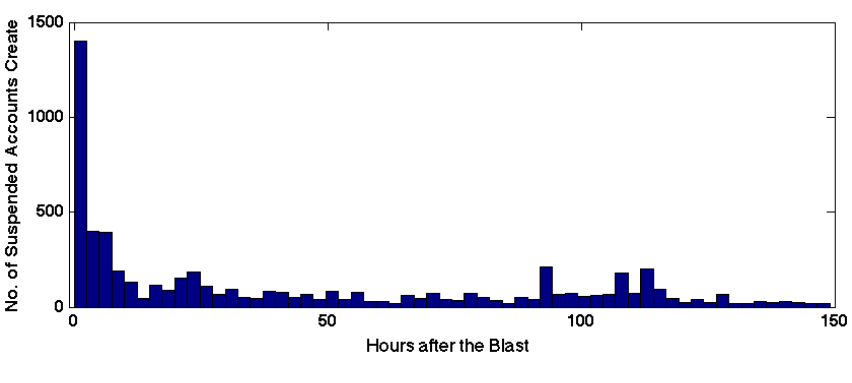
Gupta et al. also identified close to 32,000 new Twitter accounts created between April 15-19 that also posted at least one tweet about the bombings. About 20% (6,073 accounts) of these new accounts were subsequently suspended by Twitter. The authors found that 98.7% of these suspended accounts did not include the word Boston in their names and usernames. They also note that some of these deleted accounts were “quite influential” during the Boston tragedy. The figure below depicts the number of suspended Twitter accounts created in the hours and days following the blast.

Figure 2 Gupta et al

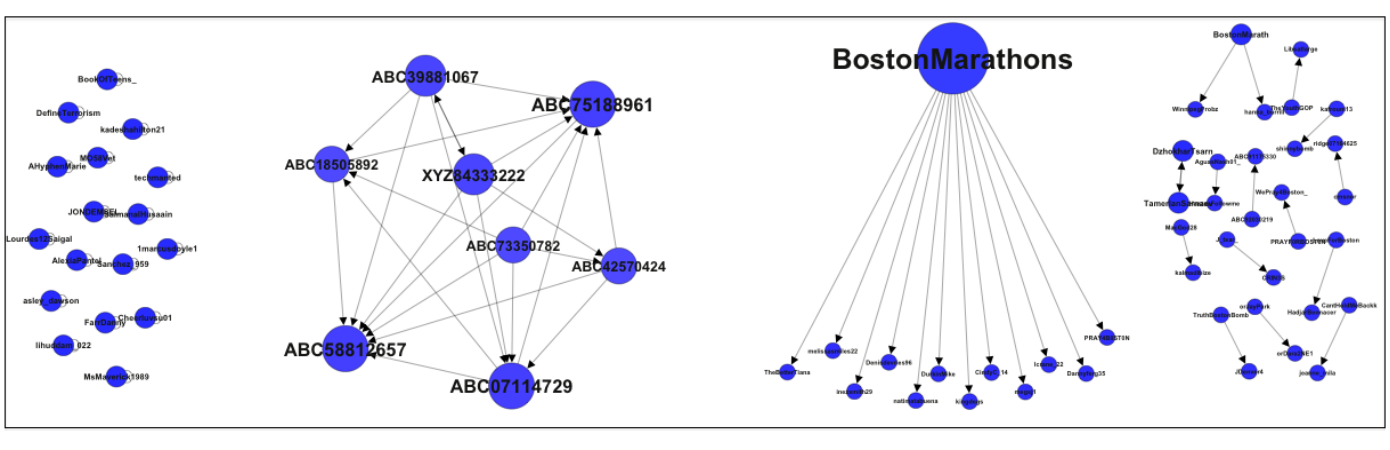
The authors also carried out some basic social network analysis of the suspended Twitter accounts. First, they removed from the analysis all suspended accounts that did not interact with each other, which left just 69 accounts. Next, they analyzed the network typology of these 69 accounts, which produced four distinct graph structures: Single Link, Closed Community, Star Typology and Self-Loops. These are displayed in the figure below (click to enlarge).

Figure 3 Gupta et al

The two most interesting graphs are the Closed Community and Star Typology graphs—the second and third graphs in the figure above.

Closed Community: Users that retweet and mention each other, forming a closed community as indicated by the high closeness centrality values produced by the social network analysis. “All these nodes have similar usernames too, all usernames have the same prefix and only numbers in the suffixes are different. This indicates that either these profiles were created by same or similar minded people for posting common propaganda posts.” Gupta et al. analyzed the content posted by these users and found that all were “tweeting the same propaganda and hate filled tweet.”

Star Typology: Easily mistakable for the authentic “BostonMarathon” Twitter account, the fake account “BostonMarathons” created plenty of confusion. Many users propagated the fake content posted by the BostonMarathons account. As the authors note, “Impersonation or creating fake profiles is a crime that results in identity theft and is punishable by law in many countries.”

The automatic detection of these network structures on Twitter may enable us to detect and counter fake content in the future. In the meantime, my colleagues and I at QCRI are collaborating with Aditi Gupta et al. to develop a “Credibility Plugin” for Twitter based on this analysis and earlier peer-reviewed research carried out by my colleague ChaTo. Stay tuned for updates.

Bio

See also:

  • Boston Bombings: Analyzing First 1,000 Seconds on Twitter [link]
  • Taking the Pulse of the Boston Bombings on Twitter [link]
  • Predicting the Credibility of Disaster Tweets Automatically [link]
  • Auto-Ranking Credibility of Tweets During Major Events [link]
  • Auto-Identifying Fake Images on Twitter During Disasters [link]
  • How to Verify Crowdsourced Information from Social Media [link]
  • Crowdsourcing Critical Thinking to Verify Social Media [link]

World Disaster Report: Next Generation Humanitarian Technology

This year’s World Disaster Report was just released this morning. I had the honor of authoring Chapter 3 on “Strengthening Humanitarian Information: The Role of Technology.” The chapter focuses on the rise of “Digital Humanitarians” and explains how “Next Generation Humanitarian Technology” is used to manage Big (Crisis) Data. The chapter complements the groundbreaking report “Humanitarianism in the Network Age” published by UN OCHA earlier this year.

The key topics addressed in the chapter include:

  • Big (Crisis) Data
  • Self-Organized Disaster Response
  • Crowdsourcing & Bounded Crowdsourcing
  • Verifying Crowdsourced Information
  • Volunteer & Technical Communities
  • Digital Humanitarians
  • Libya Crisis Map
  • Typhoon Pablo Crisis Map
  • Syria Crisis Map
  • Microtasking for Disaster Response
  • MicroMappers
  • Machine Learning for Disaster Response
  • Artificial Intelligence for Disaster Response (AIDR)
  • American Red Cross Digital Operations Center
  • Data Protection and Security
  • Policymaking for Humanitarian Technology

I’m particularly interested in getting feedback on this chapter, so feel free to pose any comments or questions you may have in the comments section below.

bio

See also:

  • What is Big (Crisis) Data? [link]
  • Humanitarianism in the Network Age [link]
  • Predicting Credibility of Disaster Tweets [link]
  • Crowdsourced Verification for Disaster Response [link]
  • MicroMappers: Microtasking for Disaster Response [link]
  • AIDR: Artificial Intelligence for Disaster Response [link]
  • Research Agenda for Next Generation Humanitarian Tech [link]

Humanitarian Crisis Computing 101

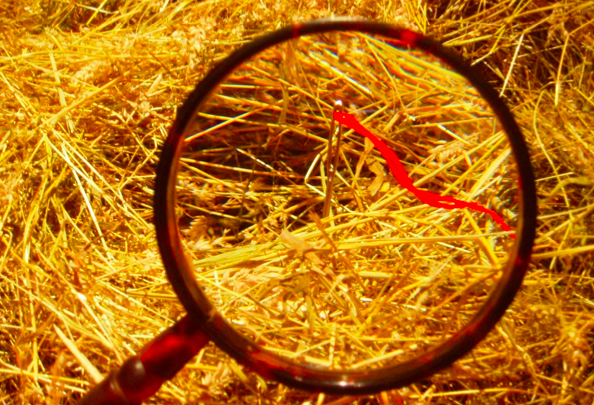
Disaster-affected communities are increasingly becoming “digital” communities. That is, they increasingly use mobile technology & social media to communicate during crises. I often refer to this user-generated content as Big (Crisis) Data. Humanitarian crisis computing seeks to rapidly identify informative, actionable and credible content in this growing stack of real-time information. The challenge is akin to finding the proverbial needle in the haystack since the vast majority of reports posted on social media is often not relevant for humanitarian response. This is largely a result of the demand versus supply problem described here.

bd0

In any event, the few “needles” of information that are relevant, can relay information that is vital and indeed-life saving for relief efforts—both traditional top-down efforts and more bottom-up grassroots efforts. When disaster strikes, we increasingly see social media traffic explode. We know there are important “pins” of relevant information hidden in this growing stack of information but how do we find them in real-time?

bd2

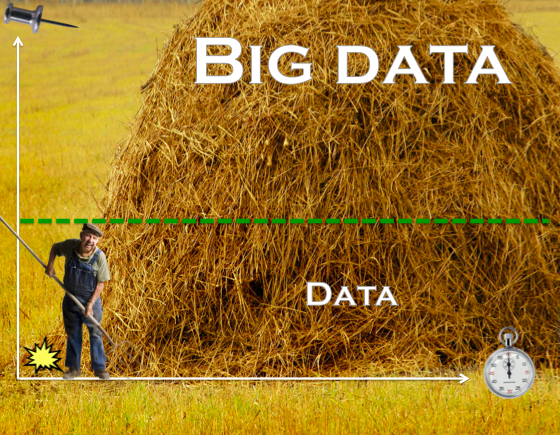
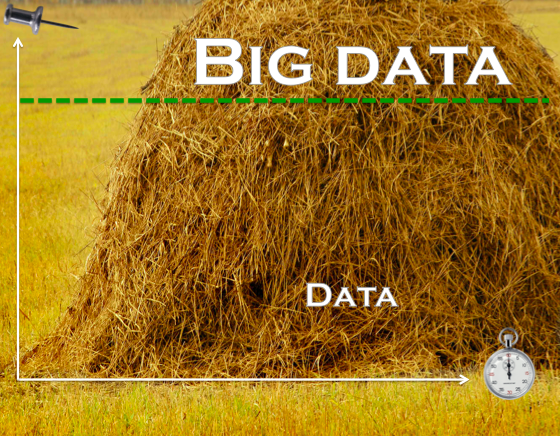
Humanitarian organizations are ill-equipped to managing the deluge of Big Crisis Data. They tend to sift through the stack of information manually, which means they aren’t able to process more than a small volume of information. This is represented by the dotted green line in the picture below. Big Data is often described as filter failure. Our manual filters cannot manage the large volume, velocity and variety of information posted on social media during disasters. So all the information above the dotted line, Big Data, is completely ignored.

bd3

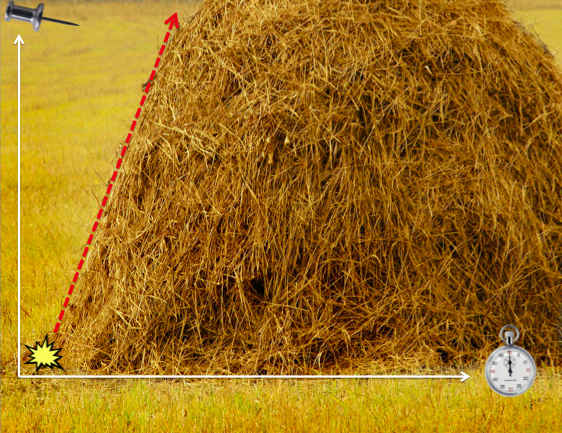
This is where Advanced Computing comes in. Advanced Computing uses Human and Machine Computing to manage Big Data and reduce filter failure, thus allowing humanitarian organizations to process a larger volume, velocity and variety of crisis information in less time. In other words, Advanced Computing helps us push the dotted green line up the information stack.

bd4

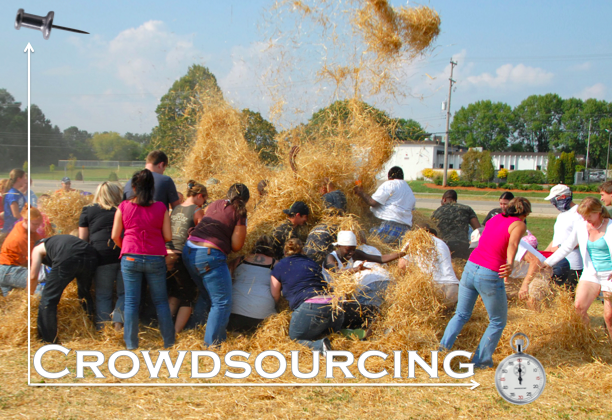
In the early days of digital humanitarian response, we used crowdsourcing to search through the haystack of user-generated content posted during disasters. Note that said content can also include text messages (SMS), like in Haiti. Crowd-sourcing crisis information is not as much fun as the picture below would suggest, however. In fact, crowdsourcing crisis information was (and can still be) quite a mess and a big pain in the haystack. Needless to say, crowdsourcing is not the best filter to make sense of Big Crisis Data.

bd5

Recently, digital humanitarians have turned to microtasking crisis information as described here and here. The UK Guardian and Wired have also written about this novel shift from crowdsourcing to microtasking.

bd6

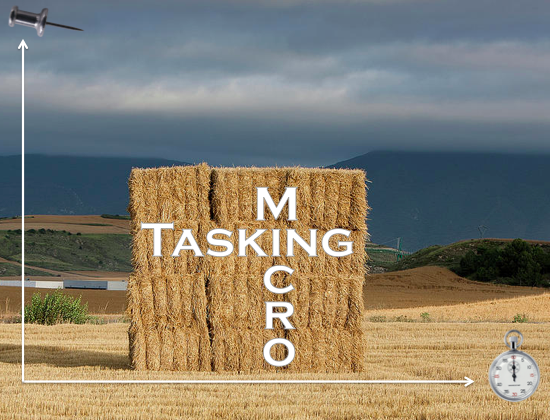
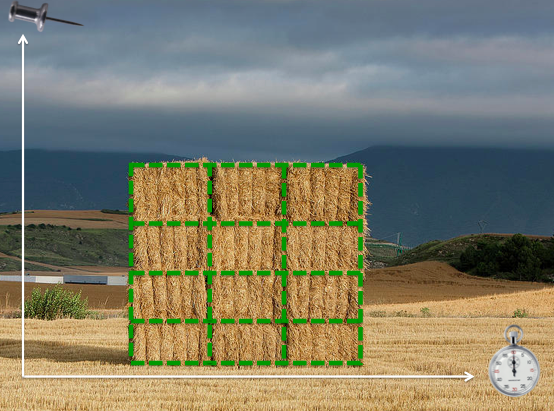
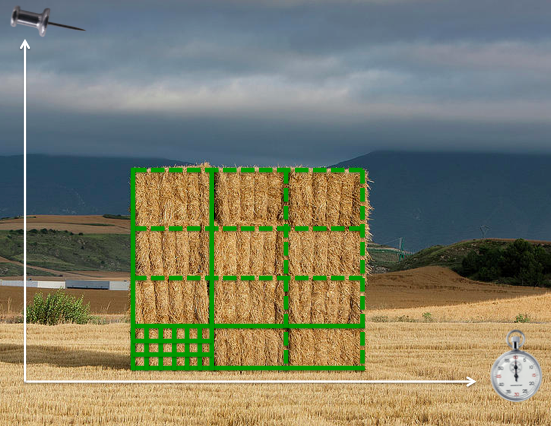
Microtasking basically turns a haystack into little blocks of stacks. Each micro-stack is then processed by one ore more digital humanitarian volunteers. Unlike crowdsourcing, a microtasking approach to filtering crisis information is highly scalable, which is why we recently launched MicroMappers.

bd7

The smaller the micro-stack, the easier the tasks and the faster that they can be carried out by a greater number of volunteers. For example, instead of having 10 people classify 10,000 tweets based on the Cluster System, microtasking makes it very easy for 1,000 people to classify 10 tweets each. The former would take hours while the latter mere minutes. In response to the recent earthquake in Pakistan, some 100 volunteers used MicroMappers to classify 30,000+ tweets in about 30 hours, for example.

bd8

Machine Computing, in contrast, uses natural language processing (NLP) and machine learning (ML) to “quantify” the haystack of user-generated content posted on social media during disasters. This enable us to automatically identify relevant “needles” of information.

bd9

An example of a Machine Learning approach to crisis computing is the Artificial Intelligence for Disaster Response (AIDR) platform. Using AIDR, users can teach the platform to automatically identify relevant information from Twitter during disasters. For example, AIDR can be used to automatically identify individual tweets that relay urgent needs from a haystack of millions of tweets.

bd11
The pictures above are taken from the slide deck I put together for a keynote address I recently gave at the Canadian Ministry of Foreign Affairs.

bio