The 2011 Thai Floods was one of the country’s worst disasters in recent history. The flooding began in July and lasted until December. Over 13 million people were affected. More than 800 were killed. The World Bank estimated $45 billion in total economic damage. This new study, “The Role of Twitter during a Natural Disaster: Case Study of 2011 Thai Flood,” analyzes how twitter was used during these major floods.
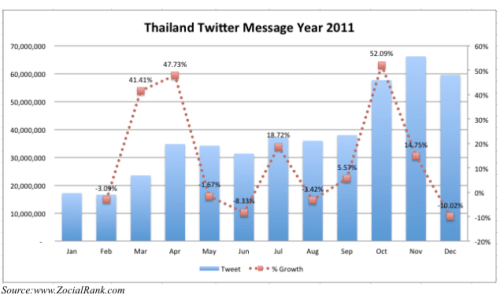
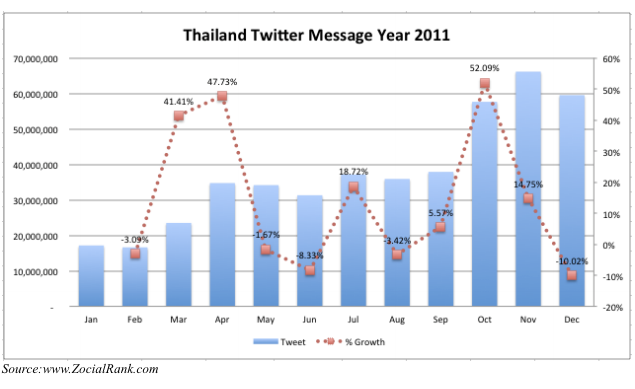
The number of tweets increase significantly in October, which is when the flooding reached parts of the Bangkok Metropolitan area. The month before (Sept-to-Oct) also a notable increase of tweets, which may “demonstrate that Thais were using Twitter to search for realtime and practical information that traditional media could not provide during the natural disaster period.”
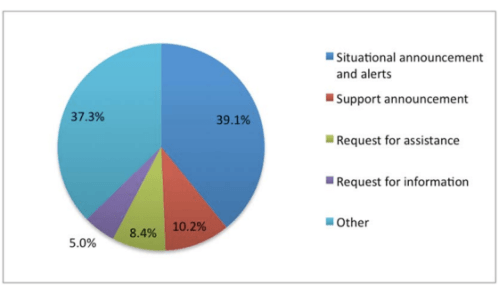
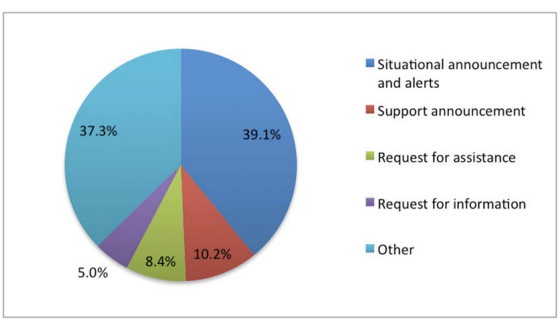
To better understand the type of information shared on Twitter during the floods, the authors analyzed 175,551 tweets that used the hashtag #thaiflood. They removed “retweets” and duplicates, yielding a dataset of 64,582 unique tweets. Using keyword analysis and a rule based approach, the authors auto-matically classified these tweets into 5 categories:
Situational Announcements and Alerts: Tweets about up-to-date situational and location-based information related to the flood such as water levels, traffic conditions and road conditions in certain areas. In addition, emergency warnings from authorities advising citizens to evacuate areas, seek shelter or take other protective measures are also included.
Support Announcements: Tweets about free parking availability, free emergency survival kits distribution and free consulting services for home repair, etc.
Requests for Assistance: Tweets requesting any types of assistance; such as food, water, medical supplies, volunteers or transportation.
Requests for Information: Tweets including general inquiries related to the flood and flood relief such as inquiries for telephone numbers of relevant authorities, regarding the current situation in specific locations and about flood damage compensation.
Other: Tweets including all other messages, such as general comments; complaints and expressions of opinions.
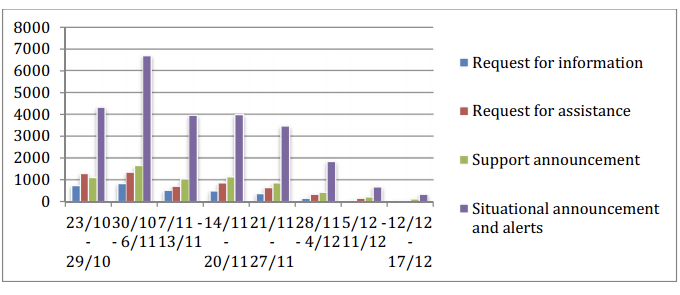
The results of this analysis are shown in the figures below. The first shows the number of tweets per each category, while the second shows the distribution of these categories over time.
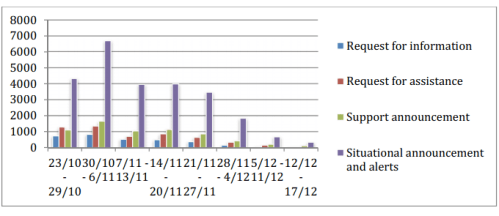
Messages posted during the first few weeks “included current water levels in certain areas and roads; announcements for free parking availability; requests for volunteers to make sandbags and pack emergency survival kits; announce-ments for evacuation in certain areas and requests for boats, food, water supplies and flood donation information. For the last few weeks when water started to recede, Tweet messages included reports on areas where water had receded, information on home cleaning andrepair and guidance regarding the process to receive flood damage compensation from the government.”
To determine the credibility of tweets, the authors identify the top 10 most re-tweeted users during the floods. They infer that the most retweeted tweets signal that the content of said tweets is perceived as credible. “The majority of these top users are flood/disaster related government or private organizations.” Siam Arsa, one of the leading volunteer networks helping flood victims in Thailand, was one of the top users ranked by retweets. The group utilizes social media on both Facebook (www.facebook.com/siamarsa) and Twitter (@siamarsa) to share information about flooding and related volunteer work.”
In conclusion, “if the government plans to implement social media as a tool for disaster response, it would be well advised to prepare some measures or pro-tocols that help officials verify incoming information and eliminate false information. The citizens should also be educated to take caution when receiving news and information via social media, and to think carefully about the potential effect before disseminating certain content.”

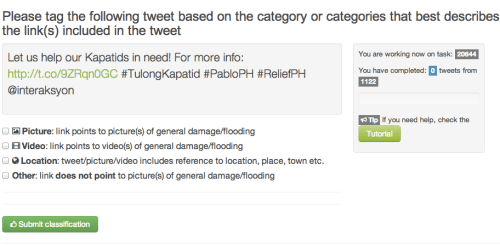
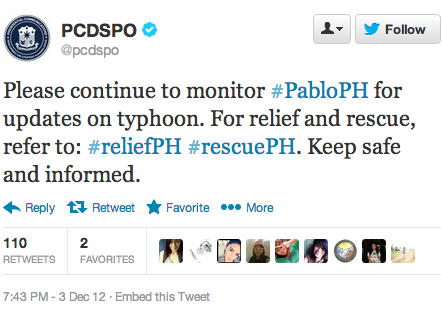
My QCRI colleagues and I are collecting tweets about Typhoon Pablo, which is making landfall in the Philippines. We’re specifically tracking tweets with one or more of the following hashtags: #PabloPh, #reliefPH and #rescuePH, which the government is publicly encouraging Filipinos to use. We hope to carry out an early analysis of these tweets to determine which ones provide situational aware-ness. The purpose of this applied action research is to ultimately develop a real-time dashboard for humanitarian response. This explains why we launched this Library of Crisis Hashtags. For further reading, please see this post on “What Percentage of Tweets Generated During a Crisis Are Relevant for Humanitarian Response?”









 iRevolutions
MAQSA: Social Analytics of User Responses to News
Designed by QCRI in partnership with MIT and Al-Jazeera, MAQSA provides an interactive topic-centric dashboard that summarizes news articles and user responses (comments, tweets, etc.) to these news items. The platform thus helps editors and publishers in newsrooms like Al-Jazeera’s better “understand user engagement and audience sentiment evolution on various topics of interest.” In addition, MAQSA “helps news consumers explore public reaction on articles relevant to a topic and refine their exploration via related entities, topics, articles and tweets.” The pilot platform currently uses Al-Jazeera data such as Op-Eds from Al-Jazeera English.
Given a topic such as “The Arab Spring,” or “Oil Spill”, the platform combines time, geography and topic to “generate a detailed activity dashboard around relevant articles. The dashboard contains an annotated comment timeline and a social graph of comments. It utilizes commenters’ locations to build maps of comment sentiment and topics by region of the world. Finally, to facilitate exploration, MAQSA provides listings of related entities, articles, and tweets. It algorithmically processes large collections of articles and tweets, and enables the dynamic specification of topics and dates for exploration.”
While others have tried to develop similar dashboards in the past, these have “not taken a topic-centric approach to viewing a collection of news articles with a focus on their user comments in the way we propose.” The team at QCRI has since added a number of exciting new features for Al-Jazeera to try out as widgets on their site. I’ll be sure to blog about these and other updates when they are officially launched. Note that other media companies (e.g., UK Guardian) will also be able to use this platform and widgets once they become public.
As always with such new initiatives, my very first thought and question is: how might we apply them in a humanitarian context? For example, perhaps MAQSA could be repurposed to do social analytics of responses from local stakeholders with respect to humanitarian news articles produced by IRIN, an award-winning humanitarian news and analysis service covering the parts of the world often under-reported, misunderstood or ignored. Perhaps an SMS component could also be added to a MAQSA-IRIN platform to facilitate this. Or perhaps there’s an application for the work that Internews carries out with local journalists and consumers of information around the world. What do you think?
Share this:
6 Comments
Posted in Humanitarian Technologies, Social Computing, Social Media
Tagged Al-Jazeera, analysis, Comments, MAQSA, MIT, news, QCRI, Tweets, Users