Tag Archives: Disaster

Enabling Crowdfunding on Twitter for Disaster Response

Twitter is increasingly used to communicate needs during crises. These needs often include requests for information and financial assistance, for example. Identifying these tweets in real-time requires the use of advanced computing and machine learning in particular. This is why my team and I at QCRI are developing the Artificial Intelligence for Disaster Response (AIDR) platform. My colleague Hemant Purohit has been working with us to develop machine learning classifiers to automatically identify and disaggregate between different types of needs. He has also developed classifiers to automatically identify twitter users offering different types of help including financial support. Our aim is to develop a “Match.com” solution to match specific needs with offers of help. What we’re missing, however, is for an easy way to post micro-donations on Twitter as a result of matching financial needs and offers.

tinyGive-logo (1)

This is where my colleague Clarence Wardell and his start-up TinyGive may come in. Geared towards nonprofits, TinyGive is the easiest way to accept donations on Twitter. Indeed, Donating via TinyGive is as simple as tweeting five words: “Hey @[organization], here’s $5! #tinygive”. I recently tried the service at a fundraiser and it really is that easy. TinyGive turns your tweet into an actual donation (and public endorsement), thus drastically reducing the high barriers that currently exist for Twitter users who wish to help others. Indeed, many of the barriers that currently exist in the mobile donation space is overcome by TinyGive.

Combining the AIDR platform with TinyGive would enable us to automatically identify those asking for financial assistance following a disaster and also automatically tweet a link to TinyGive to those offering financial assistance via Twitter. We’re not all affected the same way by disasters and those of us who are in proximity to said disaster but largely unscathed could use Twitter to quickly help those nearby with a simple micro-donation here and there. Think of it as time-critical, peer-to-peer localvesting.

At this recent White House event on humanitarian technology and innovation (which I had been invited to speak at but regrettably had prior commitments), US Chief Technology Office Todd Park talks about the need for “A crowdfunding platform for small businesses and others to receive access to capital to help rebuild after a disaster, including a rating system that encourages rebuilding efforts that improve the community.” Time-critical crowdfunding can build resilience and enable communities to bounce back (and forward) more quickly following a disaster. TinyGive may thus be able to play a role in building community resilience as well.

In the future, my hope is that platforms like TinyGive will also allow disaster-affected individuals (in addition to businesses and other organizations) to receive access to micro-donations during times of need directly via Twitter. There are of course important challenges still ahead, but the self-help, mutual-aid approach to disaster response that I’ve been promoting for years should also include crowdfunding solutions. So if you’ve heard of other examples like TinyGive applied to disaster response, please let me know via the comments section below. Thank you!

bio

Can Official Disaster Response Apps Compete with Twitter?

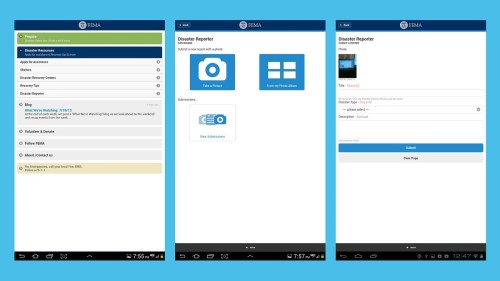
There are over half-a-billion Twitter users, with an average of 135,000 new users signing up on a daily basis (1). Can emergency management and disaster response organizations win over some Twitter users by convincing them to use their apps in addition to Twitter? For example, will FEMA’s smartphone app gain as much “market share”? The app’s new crowdsourcing feature, “Disaster Reporter,” allows users to submit geo-tagged disaster-related images, which are then added to a public crisis map. So the question is, will more images be captured via FEMA’s app or from Twitter users posting Instagram pictures?

fema_app

This question is perhaps poorly stated. While FEMA may not get millions of users to share disaster-related pictures via their app, it is absolutely critical for disaster response organizations to explicitly solicit crisis information from the crowd. See my blog post “Social Media for Emergency Management: Question of Supply and Demand” for more information on the importance demand-driven crowdsourcing. The advantage of soliciting crisis information from a smartphone app is that the sourced information is structured and thus easily machine readable. For example, the pictures taken with FEMA’s app are automatically geo-tagged, which means they can be automatically mapped if need be.

While many, many more picture may be posted on Twitter, these may be more difficult to map. The vast majority of tweets are not geo-tagged, which means more sophisticated computational solutions are necessary. Instagram pictures are geo-tagged, but this information is not publicly available. So smartphone apps are a good way to overcome these challenges. But we shouldn’t overlook the value of pictures shared on Twitter. Many can be geo-tagged, as demonstrated by the Digital Humanitarian Network’s efforts in response to Typhoon Pablo. More-over, about 40% of pictures shared on Twitter in the immediate aftermath of the Oklahoma Tornado had geographic data. In other words, while the FEMA app may have 10,000 users who submit a picture during a disaster, Twitter may have 100,000 users posting pictures. And while only 40% of the latter pictures may be geo-tagged, this would still mean 40,000 pictures compared to FEMA’s 10,000. Recall that over half-a-million Instagram pictures were posted during Hurricane Sandy alone.

The main point, however, is that FEMA could also solicit pictures via Twitter and ask eyewitnesses to simply geo-tag their tweets during disasters. They could also speak with Instagram and perhaps ask them to share geo-tag data for solicited images. These strategies would render tweets and pictures machine-readable and thus automatically mappable, just like the pictures coming from FEMA’s app. In sum, the key issue here is one of policy and the best solution is to leverage multiple platforms to crowdsource crisis information. The technical challenge is how to deal with the high volume of pictures shared in real-time across multiple platforms. This is where microtasking comes in and why MicroMappers is being developed. For tweets and images that do not contain automatically geo-tagged data, MicroMappers has a microtasking app specifically developed to crowd-source the manual tagging of images.

In sum, there are trade-offs. The good news is that we don’t have to choose one solution over the other; they are complementary. We can leverage both a dedicated smartphone app and very popular social media platforms like Twitter and Facebook to crowdsource the collection of crisis information. Either way, a demand-driven approach to soliciting relevant information will work best, both for smartphone apps and social media platforms.

Bio


The First Ever Spam Filter for Disaster Response

While spam filters provide additional layers of security to websites, they can also be used to process all kinds of information. Perhaps most famously, for example, the reCAPTCHA spam filter was used to transcribe the New York Times’ entire paper-based archives. See my previous blog post to learn how this was done and how spam filters can also be used to process information for disaster response. Given the positive response I received from humanitarian colleagues who read the blog post, I teamed up with my colleagues at QCRI to create the first ever spam filter for disaster response.

During international disasters, the humanitarian community (often lead by the UN’s Office for the Coordination of Humanitarian Affairs, OCHA) needs to carry out rapid damage assessments. Recently, these assessments have included the analysis of pictures shared on social media following a disaster. For example, OCHA activated the Digital Humanitarian Network (DHN) to collect and quickly tag pictures that capture evidence of damage in response to Typhoon Pablo in the Philippines (as described here and TEDx talk above). Some of these pictures, which were found on Twitter, were also geo-referenced by DHN volunteers. This enabled OCHA to create (over night) the unique damage assessment map below.

Typhon PABLO_Social_Media_Mapping-OCHA_A4_Portrait_6Dec2012

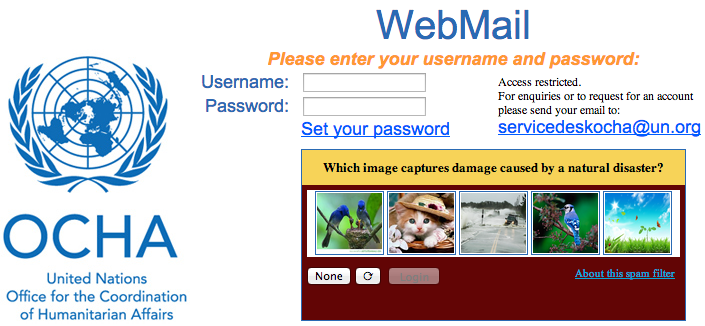
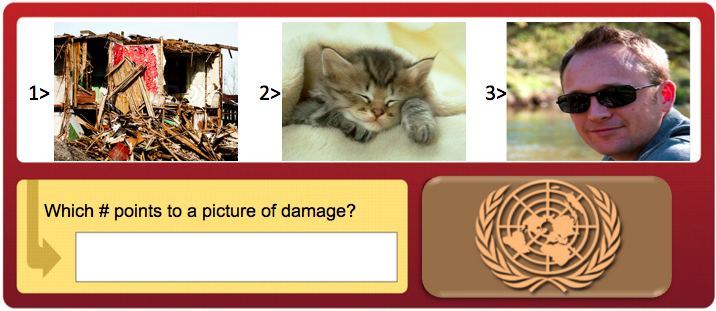
OCHA intends to activate the DHN again in future disasters to replicate this type of rapid damage assessment operation. This is where spam filters come in. The DHN often needs support to quickly tag these pictures (which may number in the tens of thousands). Adding a spam filter that requires email users to tag which image captures disaster damage not only helps OCHA and other organizations carry out a rapid damage assessment, but also increases the security of email systems at the same time. And it only takes 3 seconds to use the spam filter.

OCHA reCAPTCHA

My team and I at QCRI have thus developed a spam filter plugin that can be easily added to email login pages like OCHA’s as shown above. When the Digital Humanitarian Network requires additional hands on deck to tag pictures during disasters, this plugin can simply be switched on. My team at QCRI can easily push the images to the plugin and pull data on which images have been tagged as showing disaster damage. The process for the end user couldn’t be simpler. Enter your username and password as normal and then simply select the picture below that shows disaster damage. If there are none, then simply click on “None” and then “Login”. The spam filter uses a predictive algorithm and an existing data-base of pictures as a control mechanism to ensure that the filter cannot be gamed. On that note, feel free to test the plugin here. We’d love your feedback as we continue testing.

recpatcha2

The desired outcome? Each potential disaster picture is displayed to 3 different email account users. Only if each of the 3 users tag the same picture as capturing disaster damage does that picture get automatically forwarded to members of the Digital Humanitarian Network. To tag more pictures after logging in, users are invited to do so via MicroMappers, which launches this September in partnership with OCHA. MicroMappers enables members of the public to participate in digital disaster response efforts with a simple click of the mouse.

I would ideally like to see an innovative and forward-thinking organization like OCHA pilot the plugin for a two week feasibility test. If the results are positive and promising, then I hope OCHA and other UN agencies engaged in disaster response adopt the plugin more broadly. As mentioned in my previous blog post, the UN employs well over 40,000 people around the world. Even if “only” 10% login in one day, that’s still 4,000 images effortlessly tagged for use by OCHA and others during their disaster relief operations. Again, this plugin would only be used in response to major disasters when the most help is needed. We’ll be making the code for this plugin freely available and open source.

Please do get in touch if you’d like to invite your organization to participate in this innovative humanitarian technology project. You can support disaster response efforts around the world by simply logging into your email account, web portal, or Intranet!

bio

TEDx: Microtasking for Disaster Response

My TEDx talk on Digital Humanitarians presented at TEDxTraverseCity. I’ve automatically forwarded the above video to a short 4 minute section of the talk in which I highlight how the Digital Humanitarian Network (DHN) used micro-tasking to support the UN Office for the Coordination of Humanitarian Affairs (OCHA) in response to Typhoon Pablo in the Philippines. See this blog post to learn more about the operation. As a result of this innovative use of micro-tasking, my team and I at QCRI are collaborating with UN OCHA colleagues to launch MicroMappers—a dedicated set of microtasking apps specifically designed for disaster response. These will go live in September 2013.


bio


Disaster Response Plugin for Online Games

The Internet Response League (IRL) was recently launched for online gamers to participate in supporting disaster response operations. A quick introduction to IRL is available here. Humanitarian organizations are increasingly turning to online volunteers to filter through social media reports (e.g. tweets, Instagram photos) posted during disasters. Online gamers already spend millions of hours online every day and could easily volunteer some of their time to process crisis information without ever having to leave the games they’re playing.

A message like this would greet you upon logging in. (Screenshot is from World of Warcraft and has been altered)

Lets take World of Warcraft, for example. If a gamer has opted in to receive disaster alerts, they’d see screens like the one above when logging in or like the one below whilst playing a game.

In game notification should have settings so as to not annoy players. (Screenshot is from World of Warcraft and has been altered)

If a gamer accepts the invitation to join the Internet Response League, they’d see the “Disaster Tagging” screen below. There they’d tag as many pictures as wish by clicking on the level of disaster damage they see in each photo. Naturally, gamers can exit the disaster tagging area at any time to return directly to their game.

A rough concept of what the tagging screen may look like. (Screenshot is from World of Warcraft and has been altered)

Each picture would be tagged by at least 3 gamers in order to ensure the accuracy of the tagging. That is, if 3 volunteers tag the same image as “Severe”, then we can be reasonably assured that the picture does indeed show infrastructure damage. These pictures would then be sent back to IRL and shared with humanitarian organizations for rapid damage assessment analysis. There are already precedents for this type of disaster response tagging. Last year, the UN asked volunteers to tag images shared on Twitter after a devastating Typhoon hit the Philippines. More specifically, they asked them to tag images that captured the damage caused by the Typhoon. You can learn more about this humanitarian response operation here.

IRL is now looking to develop a disaster response plugin like the one described above. This way, gaming companies will have an easily embeddable plugin that they can insert into their gaming environments. For more on this plugin and the latest updates on IRL, please visit the IRL website here. We’re actively looking for feedback and welcome collaborators and partnerships.

Bio

Acknowledgements: Screenshots created by my colleague Peter Mosur who is the co-founder of the IRL.

Why the Share Economy is Important for Disaster Response and Resilience

A unique and detailed survey funded by the Rockefeller Foundation confirms the important role that social and community bonds play vis-à-vis disaster resilience. The new study, which focuses on resilience and social capital in the wake of Hurricane Sandy, reveals how disaster-affected communities self-organized, “with reports of many people sharing access to power, food and water, and providing shelter.” This mutual aid was primarily coordinated face-to-face. This may not always be possible, however. So the “Share Economy” can also play an important role in coordinating self-help during disasters.

In a share economy, “asset owners use digital clearinghouses to capitalize the unused capacity of things they already have, and consumers rent from their peers rather than rent or buy from a company” (1). During disasters, these asset owners can use the same digital clearinghouses to offer what they have at no cost. For example, over 1,400 kindhearted New Yorkers offered free housing to people heavily affected by the hurricane. They did this using AirBnB, as shown in the short video above. Meanwhile, on the West Coast, the City of San Francisco has just lunched a partnership with BayShare, a sharing economy advocacy group in the Bay Area. The partnership’s goal is to “harness the power of sharing to ensure the best response to future disasters in San Francisco” (2).

fon wifi sharing

While share economy platforms like AirBnB are still relatively new, many believe that “the share economy is a real trend and not some small blip (3). So it may be worth taking an inventory of share platforms out there that are likely to be useful for disaster response. Here’s a short list:

  • AirBnBA global travel rental platform with accommodations in 192 countries. This service has already been used for disaster response as described above.
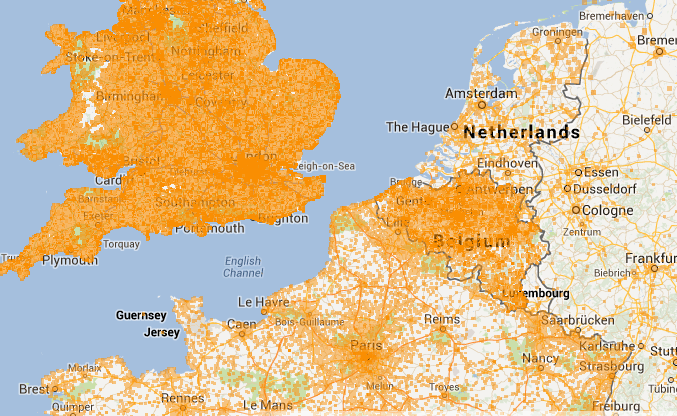
  • FonEnables people to share some of their home Wi-Fi  in exchange for getting free Wi-Fi from 8 million people in Fon’s network. Access to information is always key during & after disasters. The map above  displays a subset of all Fon users in that part of Europe.
  • LendingClub: A cheaper service than credit cards for borrowers. Also provides better interest rates than savings accounts for investors. Access to liquidity is often necessary after a disaster.
  • LiquidSpaceProvides high quality temporary workspaces and office rentals. These can be rented by the hour and by the day.  Dedicated spaces are key for coordinating disaster response.
  • Lyft: An is on-demand ride-sharing smartphone app for cheaper, safer rides. This service could be used to transport people and supplies following a disaster. Similar to Sidecar.
  • RelayRides:  A car sharing marketplace where participants can rent out their own cars. Like Lyft, RelayRides could be used to transport goods and people. Similar to Getaround. Also, ParkingPanda is the parking equivalent.
  • TaskRabbit: Get your deliveries and errands completed easily & quickly by trusted individuals in your neighborhood. This service could be used to run quick errands following disasters. Similar to Zaarly, a marketplace that helps you discover and hire local services. 
  • Yerdle: An “eBay” for sharing items with your friends. This could be used to provide basic supplies to disaster-affected neighborhoods. Similar to SnapGood, which also allows for temporary sharing.

Feel free to add more examples via the comments section below if you know of other sharing economy platforms that could be helpful during disasters.

While these share tools don’t necessary reinforce bonding social capital since face-to-face interactions are not required, they do stand to increase levels of bridging social capital. The former refers to social capital within existing social networks while the latter refers to “cooperative connections with people from different walks of life,” and is often considered “more valuable than ‘bonding social capital'” (3). Bridging social capital is “closely related to thin trust, as opposed to the bonding social capital of thick trust” (4). Platforms that facilitate the sharing economy provide reassurance vis-à-vis the thin trust since they tend to vet participants. This extra reassurance can go a long way during disasters and may thus facilitate mutual-aid at a distance.

 bio

Automatically Identifying Fake Images Shared on Twitter During Disasters

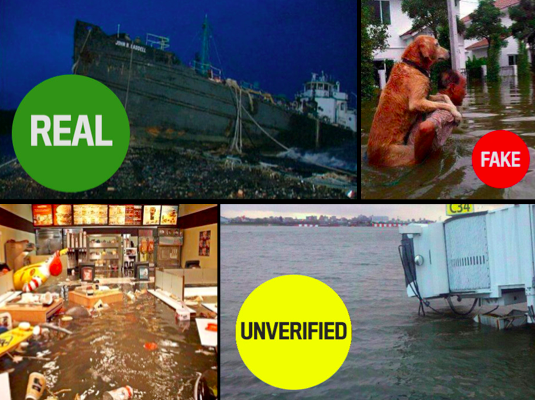
Artificial Intelligence (AI) can be used to automatically predict the credibility of tweets generated during disasters. AI can also be used to automatically rank the credibility of tweets posted during major events. Aditi Gupta et al. applied these same information forensics techniques to automatically identify fake images posted on Twitter during Hurricane Sandy. Using a decision tree classifier, the authors were able to predict which images were fake with an accuracy of 97%. Their analysis also revealed retweets accounted for 86% of all tweets linking to fake images. In addition, their results showed that 90% of these retweets were posted by just 30 Twitter users.

Fake Images

The authors collected the URLs of fake images shared during the hurricane by drawing on the UK Guardian’s list and other sources. They compared these links with 622,860 tweets that contained links and the words “Sandy” & “hurricane” posted between October 20th and November 1st, 2012. Just over 10,300 of these tweets and retweets contained links to URLs of fake images while close to 5,800 tweets and retweets pointed to real images. Of the ~10,300 tweets linking to fake images, 84% (or 9,000) of these were retweets. Interestingly, these retweets spike about 12 hours after the original tweets are posted. This spike is driven by just 30 Twitter users. Furthermore, the vast majority of retweets weren’t made by Twitter followers but rather by those following certain hashtags. 

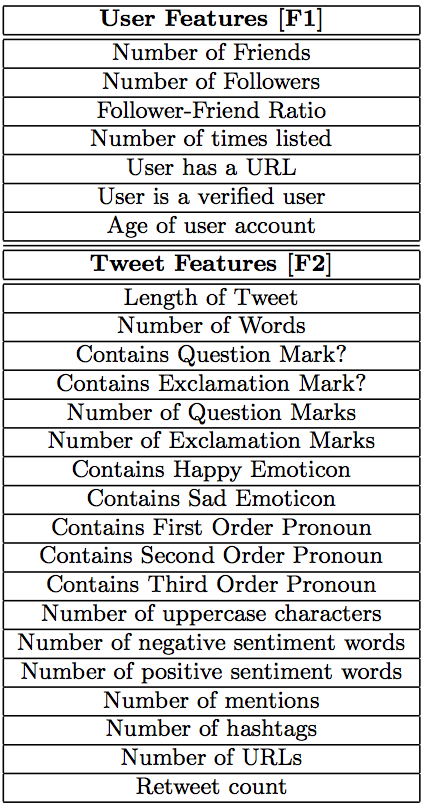
Gupta et al. also studied the profiles of users who tweeted or retweeted fake images  (User Features) and also the content of their tweets (Tweet Features) to determine whether these features (listed below) might be predictive of whether a tweet posts to a fake image. Their decision tree classifier achieved an accuracy of over 90%, which is remarkable. But the authors note that this high accuracy score is due to “the similar nature of many tweets since since a lot of tweets are retweets of other tweets in our dataset.” In any event, their analysis also reveals that Tweet-based Features (such as length of tweet, number of uppercase letters, etc.), were far more accurate in predicting whether or not a tweeted image was fake than User-based Features (such as number of friends, followers, etc.). One feature that was overlooked, however, is gender.

Information Forensics

In conclusion, “content and property analysis of tweets can help us in identifying real image URLs being shared on Twitter with a high accuracy.” These results reinforce the proof that machine computing and automated techniques can be used for information forensics as applied to images shared on social media. In terms of future work, the authors Aditi Gupta, Hemank Lamba, Ponnurangam Kumaraguru and Anupam Joshi plan to “conduct a larger study with more events for identification of fake images and news propagation.” They also hope to expand their study to include the detection of “rumors and other malicious content spread during real world events apart from images.” Lastly, they “would like to develop a browser plug-in that can detect fake images being shared on Twitter in real-time.” There full paper is available here.

Needless to say, all of this is music to my ears. Such a plugin could be added to our Artificial Intelligence for Disaster Response (AIDR) platform, not to mention our Verily platform, which seeks to crowdsource the verification of social media reports (including images and videos) during disasters. What I also really value about the authors’ approach is how pragmatic they are with their findings. That is, by noting their interest in developing a browser plugin, they are applying their data science expertise for social good. As per my previous blog post, this focus on social impact is particularly rare. So we need more data scientists like Aditi Gupta et al. This is why I was already in touch with Aditi last year given her research on automatically ranking the credibility of tweets. I’ve just reached out to her again to explore ways to collaborate with her and her team.

bio

What is Big (Crisis) Data?

What does Big Data mean in the context of disaster response? Big (Crisis) Data refers to the relatively large volumevelocity and variety of digital information that may improve sense making and situational awareness during disasters. This is often referred to the 3 V’s of Big Data.

Screen Shot 2013-06-26 at 7.49.49 PM

Volume refers to the amount of data (20 million tweets were posted during Hurricane Sandy) while Velocity refers to the speed at which that data is generated (over 2,000 tweets per second were generated following the Japan Earthquake & Tsunami). Variety refers to the variety of data generated, e.g., Numerical (GPS coordinates), Textual (SMS), Audio (phone calls), Photographic (satellite Imagery) and Video-graphic (YouTube). Sources of Big Crisis Data thus include both public and private sources such images posted as social media (Instagram) on the one hand, and emails or phone calls (Call Record Data) on the other. Big Crisis Data also relates to both raw data (the text of individual Facebook updates) as well as meta-data (the time and place those updates were posted, for example).

Ultimately, Big Data describe datasets that are too large to be effectively and quickly computed on your average desktop or laptop. In other words, Big Data is relative to the computing power—the filters—at your finger tips (along with the skills necessary to apply that computing power). Put differently, Big Data is “Big” because of filter failure. If we had more powerful filters, said “Big” Data would be easier to manage. As mentioned in previous blog posts, these filters can be created using Human Computing (crowdsourcing, microtasking) and/or Machine Computing (natural language processing, machine learning, etc.).

BigData1

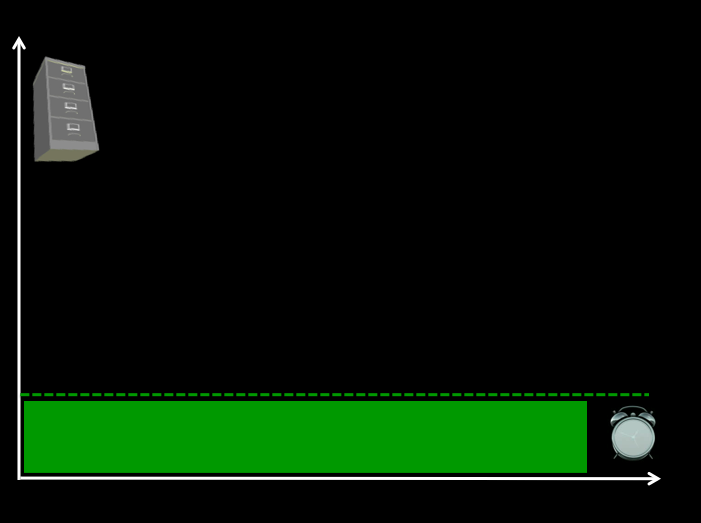
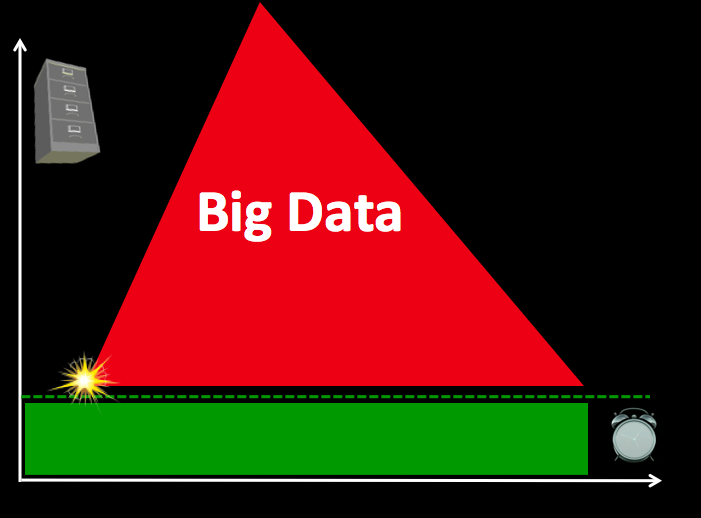
Take the above graph, for example. The horizontal axis represents time while the vertical one represents volume of information. On a good day, i.e., when there are no major disasters, the Digital Operations Center of the American Red Cross monitors and manually reads about 5,000 tweets. This “steady state” volume and velocity of data is represented by the green area. The dotted line just above denotes an organization’s (or individual’s) capacity to manage a given volume, velocity and variety of data. When disaster strikes, that capacity is stretched and often overwhelmed. More than 3 million tweets were posted during the first 48 hours after the Category 5 Tornado devastated Moore, Oklahoma, for example. What happens next is depicted in the graph below.

BigData 2

Humanitarian and emergency management organizations often lack the internal surge capacity to manage the rapid increase in data generated during disasters. This Big Crisis Data is represented by the red area. But the dotted line can be raised. One way to do so is by building better filters (using Human and/or Machine Computing). Real world examples of Human and Machine Computing used for disaster response are highlighted here and here respectively.

BigData 3

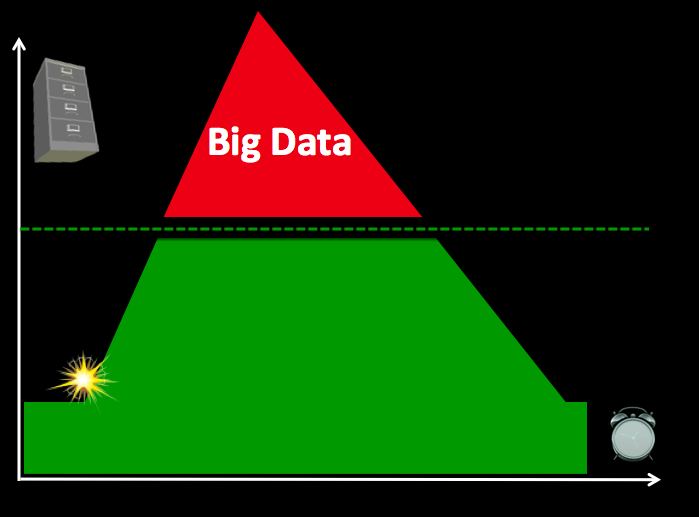
A second way to shift the dotted line is with enlightened leadership. An example is the Filipino Government’s actions during the recent Typhoon. More on policy here. Both strategies (advanced computing & strategic policies) are necessary to raise that dotted line in a consistent manner.

Bio

See also:

  • Big Data for Disaster Response: A List of Wrong Assumptions [Link]

Using Crowdring for Disaster Response?

35 million missed calls.

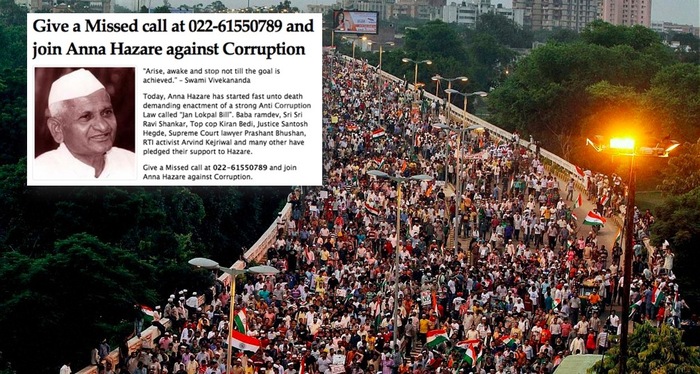
That’s the number of calls that 75-year old social justice leader Anna Hazare received from people across India who supported his efforts to fight corruption. Two weeks earlier, he had invited India to join his movement by making “missed calls” to a local number. Missed calls, known as beeping or flashing, are calls that are intentionally dropped after ringing. The advantage of making missed call is that neither the caller or recipient is charged. This tactic is particularly common in emerging economies to avoid paying for air time or SMS. To build on this pioneering work, Anna and his team are developing a mobile petition tool called Crowdring, which turns a free “missed call” into a signature on a petition.

crowdring_pic

Communicating with disaster-affected communities is key for effective disaster response. Crowdring could be used to poll disaster affected communities. The service could also be used in combination with local community radio stations. The latter would broadcast a series of yes or no questions; ringing once would signify yes, twice would mean no. Some questions that come to mind:

  1. Do you have enough drinking water? 
  2. Are humanitarian organizations doing a good job?
  3. Is someone in your household displaying symptoms of cholera?

By receiving these calls, humanitarians would automatically be able to create a database of phone numbers with associated poll results. This means they could text them right back for more information or to arrange an in person meeting. You can learn more about Crowdring in this short video below.

bio

How ReCAPTCHA Can Be Used for Disaster Response

We’ve all seen prompts like this:

recaptcha_pic

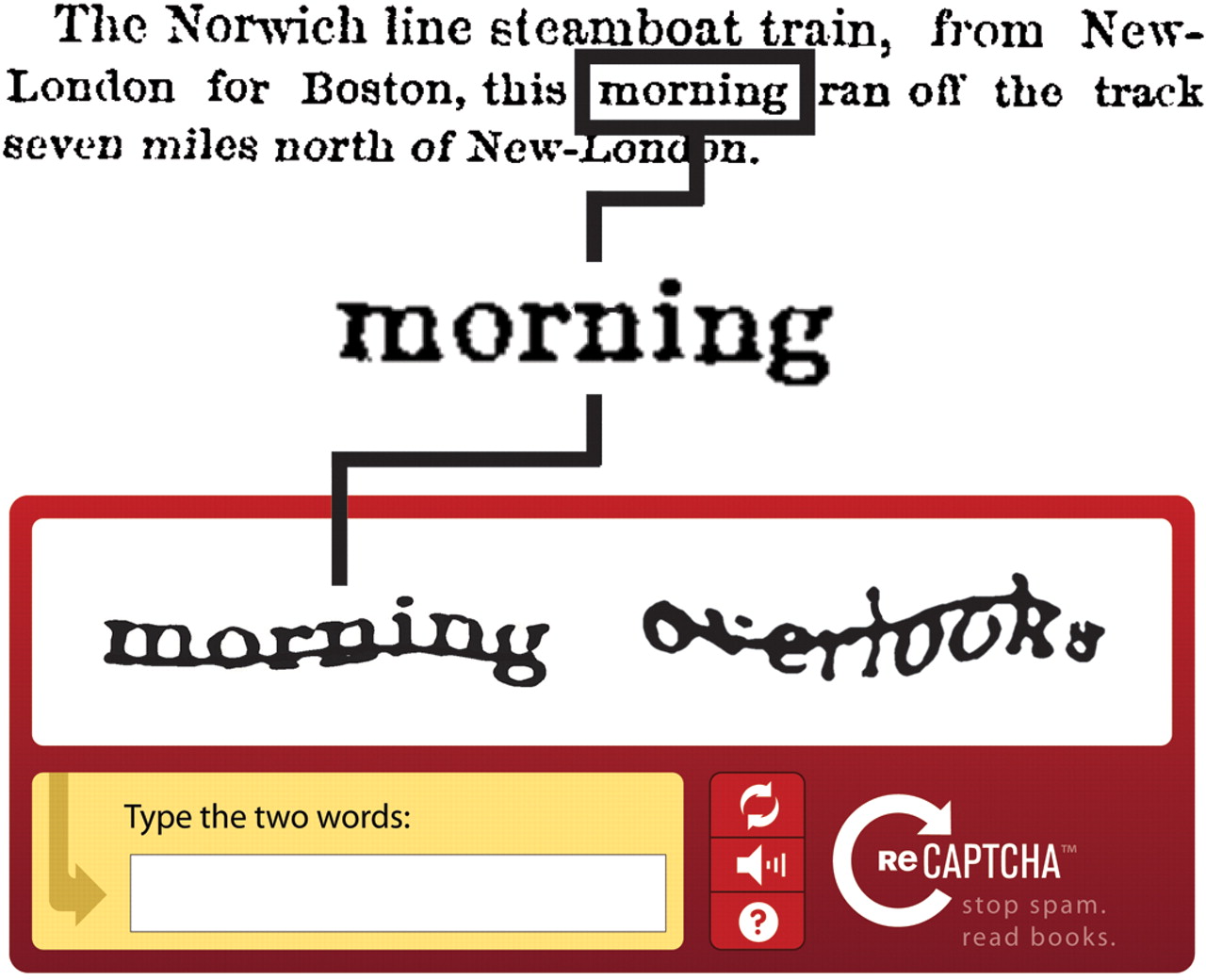
More than 100 million of these ReCAPTCHAs get filled out every day on sites like Facebook, Twitter and CNN. Google uses them to simultaneously filter out spam and digitize Google Books and archives of the New York Times. For example:

recaptcha_pic2

So what’s the connection to disaster response? In early 2010, I blogged about using massive multiplayer games to tag crisis information and asked: What is the game equivalent of reCAPTCHA for tagging crisis information? (Big thanks to friend and colleague Albert Lin for reminding me of this recently). Well, the game equivalent is perhaps the Internet Response League (IRL). But what if we simply used ReCPATCHA itself for disaster response?

Humanitarian organizations like the American Red Cross regularly monitor Twitter for disaster-related information. But they are often overwhelmed with millions of tweets during major events. While my team and I at QCRI are developing automated solutions to manage this Big (Crisis) Data, we could also  use the ReCAPTCHA methodology. For example, our automated classifiers can tell us with a certain level of accuracy whether a tweet is disaster-related, whether it refers to infrastructure damage, urgent needs, etc. If the classifier is not sure—say the tweet is scored as having a 50% chance of being related to infrastructure damage—then we could automatically post it to our version of ReCAPCHA (see below). Perhaps a list of 3 tweets could be posted with the user prompted to tag which one of the 3 is damage-related. (The other two tweets could come from a separate database of random tweets).

ReCaptcha_pic3

There are reportedly 44,000 United Nations employees around the globe. World Vision also employs over 40,000, the International Committee of the Red Cross (ICRC) has more than 12,000 employees while Oxfam has about 7,000. That’s 100,000 people right there who probably log onto their work emails at least once a day. Why not insert a ReCaptcha when they log in? We could also add  ReCAPTCHAs to these organizations’ Intranets & portals like Virtual OSOCC. On a related note, Google recently added images from Google Street View to ReCAPTCHAS. So we could automatically collect images shared on social media during disasters and post them to our own disaster response ReCAPTCHAs:

Image ReCAPTCHA

In sum, as humanitarians log into their emails multiple times a day, they’d be asked to tag which tweets and/or pictures relate to on ongoing disaster. Last year, we tagged tweets and images in support of the UN’s disaster response efforts in the Philippines following Typhoon Pablo. Adding a customized ReCAPTCHA for disaster response would help us tap a much wider audience of “volunteers”, which would mean an even more rapid turn around time for damage assessments following major disasters.

Bio