Enabling Crowdfunding on Twitter for Disaster Response

Twitter is increasingly used to communicate needs during crises. These needs often include requests for information and financial assistance, for example. Identifying these tweets in real-time requires the use of advanced computing and machine learning in particular. This is why my team and I at QCRI are developing the Artificial Intelligence for Disaster Response (AIDR) platform. My colleague Hemant Purohit has been working with us to develop machine learning classifiers to automatically identify and disaggregate between different types of needs. He has also developed classifiers to automatically identify twitter users offering different types of help including financial support. Our aim is to develop a “Match.com” solution to match specific needs with offers of help. What we’re missing, however, is for an easy way to post micro-donations on Twitter as a result of matching financial needs and offers.

tinyGive-logo (1)

This is where my colleague Clarence Wardell and his start-up TinyGive may come in. Geared towards nonprofits, TinyGive is the easiest way to accept donations on Twitter. Indeed, Donating via TinyGive is as simple as tweeting five words: “Hey @[organization], here’s $5! #tinygive”. I recently tried the service at a fundraiser and it really is that easy. TinyGive turns your tweet into an actual donation (and public endorsement), thus drastically reducing the high barriers that currently exist for Twitter users who wish to help others. Indeed, many of the barriers that currently exist in the mobile donation space is overcome by TinyGive.

Combining the AIDR platform with TinyGive would enable us to automatically identify those asking for financial assistance following a disaster and also automatically tweet a link to TinyGive to those offering financial assistance via Twitter. We’re not all affected the same way by disasters and those of us who are in proximity to said disaster but largely unscathed could use Twitter to quickly help those nearby with a simple micro-donation here and there. Think of it as time-critical, peer-to-peer localvesting.

At this recent White House event on humanitarian technology and innovation (which I had been invited to speak at but regrettably had prior commitments), US Chief Technology Office Todd Park talks about the need for “A crowdfunding platform for small businesses and others to receive access to capital to help rebuild after a disaster, including a rating system that encourages rebuilding efforts that improve the community.” Time-critical crowdfunding can build resilience and enable communities to bounce back (and forward) more quickly following a disaster. TinyGive may thus be able to play a role in building community resilience as well.

In the future, my hope is that platforms like TinyGive will also allow disaster-affected individuals (in addition to businesses and other organizations) to receive access to micro-donations during times of need directly via Twitter. There are of course important challenges still ahead, but the self-help, mutual-aid approach to disaster response that I’ve been promoting for years should also include crowdfunding solutions. So if you’ve heard of other examples like TinyGive applied to disaster response, please let me know via the comments section below. Thank you!

bio

#NoShare: A Personal Twist on Data Privacy

Countless computers worldwide automatically fingerprint our use of social media around the clock without our knowledge or consent. So we’re left with the following choice: stay digital and face the Eye of Sauron, or excommunicate ourselves from social media and face digital isolation from society. I’d chose the latter were it not for the life-saving role that social media can play during disasters. So what if there were a third way? An alternative that enabled us to use social media without being fed to the machines. Imagine if the choice were ours. My PopRock Fellows (PopTech & Rockefeller Foundation) and I are pondering this question within the context of ethical community-driven resilience in the era Big Data.

privacy_image

One result of this pondering is the notion of #noshare or #ns hashtag. We propose using this hashtag on anything that we don’t want sensed and turned into fodder for the machines. This could include Facebook updates, tweets, emails, SMS, post cards, cars, buildings and even our physical selves. Buildings, for example, are increasingly captured by cameras on orbiting satellites and also by high-resolution cameras fixed to cars used for Google Streetview.

The #noshare hashtag is a humble attempt at regaining some agency over the machines—and yes the corporations and governments using said machines. To this end, #noshare is a social hack that seeks to make a public statement and establish a new norm: the right to be social without being sensed or exploited without our knowledge or consent. While traditional privacy may be dead, most of us know the difference between right and wrong. This may foster positive social pressure to respect the use of #noshare.

Think of #ns hashtag as drawing a line in the sand. When you post a public tweet and want that tweet to serve the single purpose of read-only by humans, then add #noshare. This tag simply signals the public sphere that your tweet is for human consumption only, and not to be used by machines; not for download, retweet, copying, analysis, sensing, modeling or prediction. Your use of #noshare regardless of the medium represents your public vote for trust & privacy; a vote for tuning this hashtag into a widespread social norm.

Screen Shot 2013-09-15 at 5.24.57 AM

Of course, this #noshare norm is not enforceable in a traditional sense. This means that one could search for, collect and analyze all tweets with the #noshare or #ns hashtag. We’re well aware of this “Barbara Streisand effect” and there’s nothing we can do about it just yet. But the point is to draw a normative line in the sand, to create a public and social norm that provokes strong public disapproval when people violate the #ns principle. What if this could become a social norm? What if positive social pressure could make it unacceptable to violate this norm? Could this create a deterrence effect?

Either way, the line between right and wrong would be rendered publicly explicit. There would thus be no excuse: any analysis, sensing, copying, etc., of #ns tweets would be the result of a human decision to willingly violate the public norm. This social hack would make it very easy for corporations and governments to command their data mining algorithms to ignore all our digital fingerprints that use the #ns hashtag. Crossing the #noshare line would thus provide basis for social action against the owners of the machines in question. Social pressure is favorable to norm creation. Could #ns eventually become part of a Creative Commons type license?

Obviously, #ns tagged content does not mean that content should not be made public. Contented tagged with #ns is meant to be public, but only for the human public and not for computers to store and analyze. The point is simple: we want the option of being our public digital selves without being mined, sensed and analyzed by machines without our knowledge and consent. In sum, #noshare is an awareness raising initiative that seeks to educate the public about our increasingly sensed environment. Indeed, Big Data = Big Sensing.

We suggest that #ns may return a sense of moral control to individuals, a sense of trust and local agency. These are important elements for social capital and resilience, for ethical, community-driven resilience. If this norm gains traction, we may be able to code this norm into social media platforms. In sum, sensing is not bad; sensing of social media during disasters can save lives. But the decision of whether or not to be sensed should be the decision of the individual.

My PopRock Fellows and I are looking for feedback on this proposal. We’re aware of some of the pitfalls, but are we missing anything? Are there ways to strengthen this campaign? Please let us know in the comments section below. Thank you!

Bio

Acknowledgements: Many thanks to PopRock Fellows Gustavo, Amy, Kate, Claudia and Jer for their valuable feedback on earlier versions of this post. 

Data Protection: This Tweet Will Self-Destruct In…

The permanence of social media such as tweets presents an important challenge for data protection and privacy. This is particularly true when social media is used to communicate during crises. Indeed, social media users tend to volunteer personal identifying information during disasters that they otherwise would not share, such as phone numbers and home addresses. They typically share this sensitive information to offer help or seek assistance. What if we could limit the visibility of these messages after their initial use?

Twitter self destruct

Enter TwitterSpirit and Efemr, which enable users to schedule their tweets for automatic deletion after a specified period of time using hashtags like #1m, #2h or #3d. According to Wired, using these services will (in some cases) also delete retweets. That said, tweets with #time hashtags can always be copied manually in any number of ways, so the self-destruction is not total. Nevertheless, their visibility can still be reduced by using TwitterSpirit and Efemr. Lastly, the use of these hashtags also sends a social signal that these tweets are intended to have limited temporal use.

bio

Note: My fellow PopTech and Rockefeller Foundation Fellows and I have been thinking of related solutions, which we plan to blog about shortly. Hence my interest in Spirit & Efemr, which I stumbled upon by chance just now.

New! Humanitarian Computing Library

The field of “Humanitarian Computing” applies Human Computing and Machine Computing to address major information-based challengers in the humanitarian space. Human Computing refers to crowdsourcing and microtasking, which is also referred to as crowd computing. In contrast, Machine Computing draws on natural language processing and machine learning, amongst other disciplines. The Next Generation Humanitarian Technologies we are prototyping at QCRI are powered by Humanitarian Computing research and development (R&D).

Screen Shot 2013-09-04 at 3.00.05 AM

My QCRI colleagues and I  just launched the first ever Humanitarian Computing Library which is publicly available here. The purpose of this library, or wiki, is to consolidate existing and future research that relate to Humanitarian Computing in order to support the development of next generation humanitarian tech. The repository currently holds over 500 publications that span topics such as Crisis Management, Trust and Security, Software and Tools, Geographical Analysis and Crowdsourcing. These publications are largely drawn from (but not limited to) peer-reviewed papers submitted at leading conferences around the world. We invite you to add your own research on humanitarian computing to this growing collection of resources.

Many thanks to my colleague ChaTo (project lead) and QCRI interns Rahma and Nada from Qatar University for spearheading this important project. And a special mention to student Rachid who also helped.

bio

Yes, But Resilience for Whom?

I sense a little bit of history repeating, and not the good kind. About ten years ago, I was deeply involved in the field of conflict early warning and response. Eventually, I realized that the systems we were designing and implementing excluded at-risk communities even though the rhetoric had me believe they were instrumented to protect them. The truth is that these information systems were purely extractive and ultimately did little else than fill the pockets of academics who were hired as consultants to develop these early warning systems.

Future_PredictiveCoding

The prevailing belief amongst these academics was (and still is) that large datasets and advanced quantitative methodologies can predict the escalation of political tensions and thus impede violence. To be sure, “these systems have been developed in advanced environments where the intention is to gather data so as to predict events in distant places. This leads to a division of labor between those who ‘predict’ and those ‘predicted’ upon” (Cited Meier 2008, PDF).

Those who predict assume their sophisticated remote sensing systems will enable them to forecast and thus prevent impending conflict. Those predicted upon don’t even know these systems exist. The sum result? Conflict early warning systems have failed miserably at forecasting anything, let alone catalyzing preventive action or empowering local communities to get out of harm’s way. Conflict prevention is inherently political, and “political will is not an icon on your computer screen” (Cited in Meier 2013).

In Toward a Rational Society (1970), the German philosopher Jürgen Habermas describes “the colonization of the public sphere through the use of instrumental technical rationality. In this sphere, complex social problems are reduced to technical questions, effectively removing the plurality of contending perspectives” (Cited in Meier 2006, PDF). This instrumentalization of society depoliticized complex social problems like conflict and resilience into terms that are susceptible to technical solutions formulated by external experts. The participation of local communities thus becomes totally unnecessary to produce and deliver these technical solutions. To be sure, the colonization of the public sphere crowds out both local knowledge and participation.

We run this risk of repeating these mistakes with respect the discourse on community resilience. While we speak of community resilience, we gravitate towards the instrumentalization of communities using Big Data, which is largely conceived as a technical challenge of real-time data sensing and optimization. This external, top-down approach bars local participation. The depoliticization of resilience also hides the fact that “every act of measurement is an act marked by the play of powerful relations” (Cited Meier 2013b). To make matters worse, these measurements are almost always taken without the subjects knowing, let alone their consent. And so we create the division between those who sense and those sensed upon, thereby fully excluding the latter, all in the name of building community resilience.

Bio

Acknowledgements: I raised the question “Resilience for whom?” during the PopTech and Rockefeller Foundation workshop on “Big Data & Community Resilience.” I am thus grateful to the organizers and fellows for informing my thinking and the motivation for this post.

Big Data, Disaster Resilience and Lord of the Rings

The Shire is a local community of Hobbits seemingly disconnected from the systemic changes taking place in Middle Earth. They are a quiet, self-sufficient community with high levels of social capital. Hobbits are not interested in “Big Data”; their world is populated by “Small Data” and gentle action. This doesn’t stop the “Eye of Sauron” from sensing this small harmless hamlet, however. During Gandalf’s visit, the Hobbits learn that all is not well in the world outside the Shire. The changing climate, deforestation and land degradation is wholly unnatural and ultimately threatens their own way of life.

shire2

Gandalf leads a small band of Hobbits (bonding social capital) out of the Shire to join forces with other peoples of Middle Earth (bridging social capital) in what he calls “The Fellowship of the Ring” (resilience in diversity). Together, they must overcome personal & collective adversity and travel to Mordor to destroy the one ring that rules them all. Only then will Sauron’s “All Seeing Eye” cease sensing and oppressing the world of Middle Earth.

fellowship

I’m definitely no expert on J. R. R Tolken or The Lord of the Rings, but I’ve found that literature and indeed mythology often hold up important mirrors to our modern societies and remind us that the perils we face may not be entirely new. This implies that cautionary tales of the past may still bear some relevance today. The hero’s journey speaks to the human condition, and mythology serves as a evidence of human resilience. These narratives carry deep truths about the human condition, our shortcomings and redeeming qualities. Mythologies, analogies and metaphors help us make sense of our world; we ignore them at our own risk.

This is why I’ve employed the metaphor of the Shire (local communities) and Big Data (Eye of Sauron) during recent conversations on Big Data and Community Resilience. There’s been push-back of late against Big Data, with many promoting the notion of Small Data. “For many problems and questions, small data in itself is enough” (1). Yes, for specific problems: locally disconnected problems. But we live in an increasingly interdependent and connected world with coupled systems that run the risk of experiencing synchronous failure and collapse. Our sensors cannot be purely local since the resilience of our communities is no longer mostly place-based. This is where the rings come in.

eye_of_sauron

Frodo’s ring allows him to sense change well beyond the Shire and at the same time mask his local presence. But using the ring allows him to be sensed and hunted by Sauron. The same is true of Google and social media platforms like Facebook. We have no ways to opt out from being sensed if we wish to use these platforms. Community-generated content, our digital fingerprints, belong to the Great Eye, not to the Shire. This excellent piece on the Political Economy of Twitter clearly demonstrates that an elite few control user-generated content. The true owners of social media data are the platform providers, not the end users. In sum, “only corporate actors and regulators—who possess both the intellectual and financial resources to succeed in this race—can afford to participate,” which means “that the emerging data market will be shaped according to their interests.” Of course, the scandal surrounding PRISM makes Sauron’s “All Seeing Eye” even more palpable.

So when we say that we have more data than ever before in human history, it behooves us to ask “Who is we? And to what end?” Does the Shire have access to greater data than ever before thanks to Sauron? Hardly. Is this data used by Sauron to support community resilience? Fat chance. Local communities are excluded; they are observers, unwilling participants in a centralized system that ultimately undermines trust and their own resilience. Hobbits deserve the right not to be sensed. This should be a non-negotiable. They also deserve the right to own and manage their own “Small Data” themselves; that is, data generated by the community, for the community. We need respectful, people-centered data protection protocols like those developed by Open Paths. Community resilience ought to be ethical community resilience.

To be sure, we need to place individual data-sharing decisions in the hands of individuals rather than external parties. In addition to Open Paths, Creative Commons is an excellent example of what is possible. Why not extend that framework to personal and social media data? Why not include a temporal element to these licenses, as hinted in this blog post last year. That is, something like SnapChat where the user decides for herself how long the data should be accessible and usable. Well it turns out that these discussions and related conversations are taking place thanks to my fellow PopTech and Rockefeller Foundation Fellows. Stay tuned for updates. The ideas presented above are the result of our joint brainstorming sessions, and certainly not my ideas alone (but I take full blame for The Lord of the Rings analogy given my limited knowledge of said books!).

In closing, a final reference to The Lord of the Rings: Gandalf (who is a translational leader) didn’t empower the Hobbits, he took them on a journey that built on their existing capacities for resilience. That is, we cannot empower others, we can only provide them with the means to empower themselves. In sum, “Not all those who wander are lost.”

bio

ps. I’m hoping my talented fellows Kate Crawford, Gustavo Faleiros, Amy Luers, Claudia Perlich and Jer Thorp will chime in, improve my Lord of the Rings analogy and post comments in full Elvish script.

Making All Voices Count Using SMS and Advanced Computing

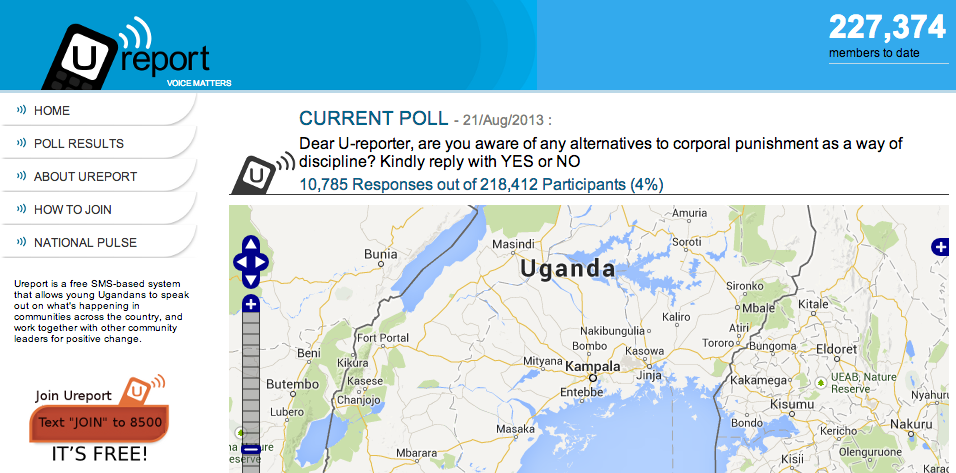
Local communities in Uganda send UNICEF some 10,000 text messages (SMS) every week. These messages reflect the voices of Ugandan youths who use UNICEF’s U-report SMS platform to share their views on a range of social issues. Some messages are responses to polls created by UNICEF while others are unsolicited reports of problems that youths witness in their communities. About 40% of text messages received by UNICEF require an SMS reply providing advice or an answer to a question while 7% of messages require immediate action. Over 220,000 young people in Uganda have enrolled in U-report, with 200 to 1,000 new users joining on daily basis. UNICEF doesn’t have months or the staff to manually analyze this high volume and velocity of incoming text messages. This is where advanced computing comes in.

UNICEF U-report

IBM recently partnered with UNICEF Uganda to develop an automated system to classify incoming text messages. (If this sounds familiar to iRevolution readers it is because my team and I at QCRI are developing a similar platform called Artificial Intelligence for Disaster Response, or AIDR. While our system is first and foremost geared towards classifying tweets, it can also be used to filter large volumes of SMS). The automated platform classifies incoming text messages into one (or more) of the following categories: water, health & nutrition, orphans & vulnerable children, violence against children, education, employment, social policy, emergency, u-report, energy, family & relationships, irrelevant and poll.

IBM analysis

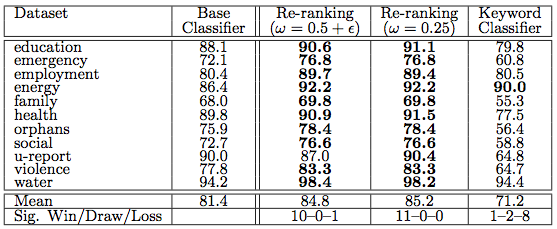
IBM created machine learning classifiers that are 40% more accurate than a keyword based approach for automate classification. The predictive quality of the individual classifiers ranged from a low of 69.8% for family & relationships and a high of 98.4 for water-related issues. See full list of results in table above. Note that the IBM platform is limited to English-based text messages but the team is looking to provide multi-lingual support in the future.

UNICEF is using this system to automatically route classified tweets to the appropriate departments. For example, UNICEF recently received a surge of text messages about nodding disease and responded by sending out a series of mass SMS’s to communities living in the affected region. These text messages provided information on how to recognize symptoms and ways to get treated. The feedback loop also includes government agencies and ministries. Indeed, all Members of Parliament and Chief Administrative Officers receive SMS updates based on the automated classification platform.

U-report is now being deployed in Zambia, South Sudan, Yemen, Democratic Republic of Congo, Zimbabwe and Burundi. I plan to get in touch with the team at IBM to learn more about these deployments and explore where we at QCRI may be able to help given our related work on AIDR. In the meantime, many thanks to my colleague Claudia Perlich for pointing me to this project. To learn more about IBM’s automated system, please see this paper (PDF).

bio

Can Official Disaster Response Apps Compete with Twitter?

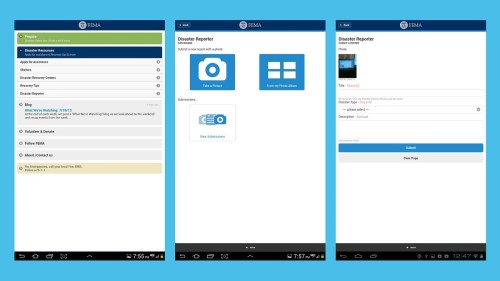
There are over half-a-billion Twitter users, with an average of 135,000 new users signing up on a daily basis (1). Can emergency management and disaster response organizations win over some Twitter users by convincing them to use their apps in addition to Twitter? For example, will FEMA’s smartphone app gain as much “market share”? The app’s new crowdsourcing feature, “Disaster Reporter,” allows users to submit geo-tagged disaster-related images, which are then added to a public crisis map. So the question is, will more images be captured via FEMA’s app or from Twitter users posting Instagram pictures?

fema_app

This question is perhaps poorly stated. While FEMA may not get millions of users to share disaster-related pictures via their app, it is absolutely critical for disaster response organizations to explicitly solicit crisis information from the crowd. See my blog post “Social Media for Emergency Management: Question of Supply and Demand” for more information on the importance demand-driven crowdsourcing. The advantage of soliciting crisis information from a smartphone app is that the sourced information is structured and thus easily machine readable. For example, the pictures taken with FEMA’s app are automatically geo-tagged, which means they can be automatically mapped if need be.

While many, many more picture may be posted on Twitter, these may be more difficult to map. The vast majority of tweets are not geo-tagged, which means more sophisticated computational solutions are necessary. Instagram pictures are geo-tagged, but this information is not publicly available. So smartphone apps are a good way to overcome these challenges. But we shouldn’t overlook the value of pictures shared on Twitter. Many can be geo-tagged, as demonstrated by the Digital Humanitarian Network’s efforts in response to Typhoon Pablo. More-over, about 40% of pictures shared on Twitter in the immediate aftermath of the Oklahoma Tornado had geographic data. In other words, while the FEMA app may have 10,000 users who submit a picture during a disaster, Twitter may have 100,000 users posting pictures. And while only 40% of the latter pictures may be geo-tagged, this would still mean 40,000 pictures compared to FEMA’s 10,000. Recall that over half-a-million Instagram pictures were posted during Hurricane Sandy alone.

The main point, however, is that FEMA could also solicit pictures via Twitter and ask eyewitnesses to simply geo-tag their tweets during disasters. They could also speak with Instagram and perhaps ask them to share geo-tag data for solicited images. These strategies would render tweets and pictures machine-readable and thus automatically mappable, just like the pictures coming from FEMA’s app. In sum, the key issue here is one of policy and the best solution is to leverage multiple platforms to crowdsource crisis information. The technical challenge is how to deal with the high volume of pictures shared in real-time across multiple platforms. This is where microtasking comes in and why MicroMappers is being developed. For tweets and images that do not contain automatically geo-tagged data, MicroMappers has a microtasking app specifically developed to crowd-source the manual tagging of images.

In sum, there are trade-offs. The good news is that we don’t have to choose one solution over the other; they are complementary. We can leverage both a dedicated smartphone app and very popular social media platforms like Twitter and Facebook to crowdsource the collection of crisis information. Either way, a demand-driven approach to soliciting relevant information will work best, both for smartphone apps and social media platforms.

Bio


Taking the Pulse of the Boston Marathon Bombings on Twitter

Social media networks are evolving a new nervous system for our planet. These real-time networks provide immediate feedback loops when media-rich societies experience a shock. My colleague Todd Mostak recently shared the tweet map below with me which depicts tweets referring to “marathon” (in red) shortly after the bombs went off during Boston’s marathon. The green dots represent all the other tweets posted at the time. Click on the map to enlarge. (It is always difficult to write about data visualizations of violent events because they don’t capture the human suffering, thus seemingly minimizing the tragic events).

Credit: Todd Mostak

Visualizing a social system at this scale gives a sense that we’re looking at a living, breathing organism, one that has just been wounded. This impression is even more stark in the dynamic visualization captured in the video below.

This an excerpt of Todd’s longer video, available here. Note that this data visualization uses less than 3% of all posted tweets because 97%+ of tweets are not geo-tagged. So we’re not even seeing the full nervous system in action. For more analysis of tweets during the marathon, see this blog post entitled “Boston Marathon Explosions: Analyzing First 1,000 Seconds on Twitter.”

bio

Radical Visualization of Photos Posted to Instagram During Hurricane Sandy

Sandy Instagram Pictures

This data visualization (click to enlarge) displays more than 23,500 photos taken in Brooklyn and posted to Instagram during Hurricane Sandy. A picture’s distance from the center (radius) corresponds to its mean hue while a picture’s position along the perimeter (angle) corresponds to the time that picture was taken. “Note the demarcation line that reveals the moment of a power outage in the area and indicates the intensity of the shared experience (dramatic decrease in the number of photos, and their darker colors to the right of the line)” (1).

Sandy Instagram 2

Click here to interact with the data visualization. The research methods behind this visualization are described here along with other stunning visuals.

bio