The permanence of social media such as tweets presents an important challenge for data protection and privacy. This is particularly true when social media is used to communicate during crises. Indeed, social media users tend to volunteer personal identifying information during disasters that they otherwise would not share, such as phone numbers and home addresses. They typically share this sensitive information to offer help or seek assistance. What if we could limit the visibility of these messages after their initial use?
Enter TwitterSpirit and Efemr, which enable users to schedule their tweets for automatic deletion after a specified period of time using hashtags like #1m, #2h or #3d. According to Wired, using these services will (in some cases) also delete retweets. That said, tweets with #time hashtags can always be copied manually in any number of ways, so the self-destruction is not total. Nevertheless, their visibility can still be reduced by using TwitterSpirit and Efemr. Lastly, the use of these hashtags also sends a social signal that these tweets are intended to have limited temporal use.
Note: My fellow PopTech and Rockefeller Foundation Fellows and I have been thinking of related solutions, which we plan to blog about shortly. Hence my interest in Spirit & Efemr, which I stumbled upon by chance just now.
The field of “Humanitarian Computing” applies Human Computing and Machine Computing to address major information-based challengers in the humanitarian space. Human Computing refers to crowdsourcing and microtasking, which is also referred to as crowd computing. In contrast, Machine Computing draws on natural language processing and machine learning, amongst other disciplines. The Next Generation Humanitarian Technologies we are prototyping at QCRI are powered by Humanitarian Computing research and development (R&D).
My QCRI colleagues and I just launched the first ever Humanitarian Computing Library which is publicly available here. The purpose of this library, or wiki, is to consolidate existing and future research that relate to Humanitarian Computing in order to support the development of next generation humanitarian tech. The repository currently holds over 500 publications that span topics such as Crisis Management, Trust and Security, Software and Tools, Geographical Analysis and Crowdsourcing. These publications are largely drawn from (but not limited to) peer-reviewed papers submitted at leading conferences around the world. We invite you to add your own research on humanitarian computing to this growing collection of resources.
Many thanks to my colleague ChaTo (project lead) and QCRI interns Rahma and Nada from Qatar University for spearheading this important project. And a special mention to student Rachid who also helped.
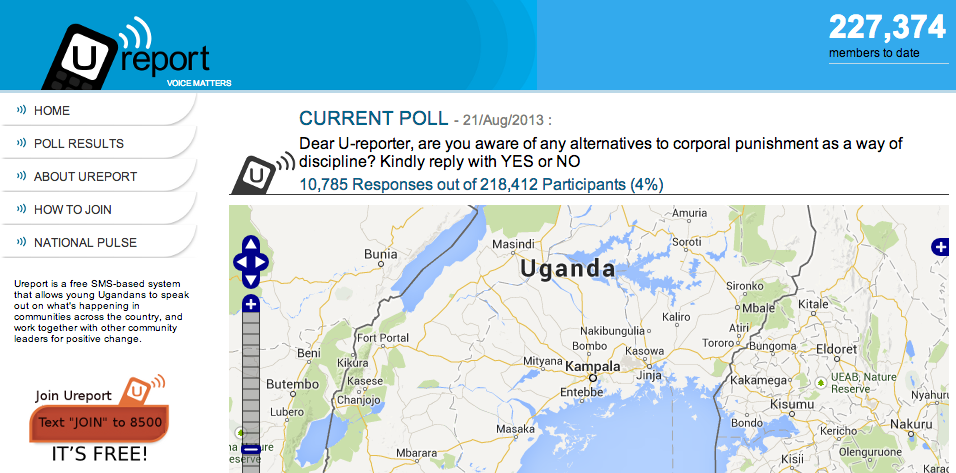
Local communities in Uganda send UNICEF some 10,000 text messages (SMS) every week. These messages reflect the voices of Ugandan youths who use UNICEF’s U-report SMS platform to share their views on a range of social issues. Some messages are responses to polls created by UNICEF while others are unsolicited reports of problems that youths witness in their communities. About 40% of text messages received by UNICEF require an SMS reply providing advice or an answer to a question while 7% of messages require immediate action. Over 220,000 young people in Uganda have enrolled in U-report, with 200 to 1,000 new users joining on daily basis. UNICEF doesn’t have months or the staff to manually analyze this high volume and velocity of incoming text messages. This is where advanced computing comes in.
IBM recently partnered with UNICEF Uganda to develop an automated system to classify incoming text messages. (If this sounds familiar to iRevolution readers it is because my team and I at QCRI are developing a similar platform called Artificial Intelligence for Disaster Response, or AIDR. While our system is first and foremost geared towards classifying tweets, it can also be used to filter large volumes of SMS). The automated platform classifies incoming text messages into one (or more) of the following categories: water, health & nutrition, orphans & vulnerable children, violence against children, education, employment, social policy, emergency, u-report, energy, family & relationships, irrelevant and poll.
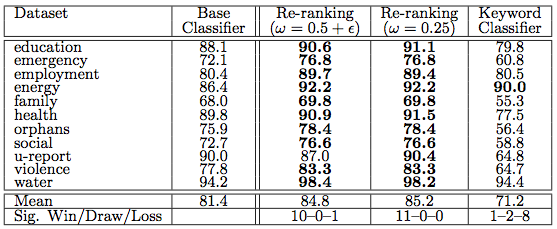
IBM created machine learning classifiers that are 40% more accurate than a keyword based approach for automate classification. The predictive quality of the individual classifiers ranged from a low of 69.8% for family & relationships and a high of 98.4 for water-related issues. See full list of results in table above. Note that the IBM platform is limited to English-based text messages but the team is looking to provide multi-lingual support in the future.
UNICEF is using this system to automatically route classified tweets to the appropriate departments. For example, UNICEF recently received a surge of text messages about nodding disease and responded by sending out a series of mass SMS’s to communities living in the affected region. These text messages provided information on how to recognize symptoms and ways to get treated. The feedback loop also includes government agencies and ministries. Indeed, all Members of Parliament and Chief Administrative Officers receive SMS updates based on the automated classification platform.
U-report is now being deployed in Zambia, South Sudan, Yemen, Democratic Republic of Congo, Zimbabwe and Burundi. I plan to get in touch with the team at IBM to learn more about these deployments and explore where we at QCRI may be able to help given our related work on AIDR. In the meantime, many thanks to my colleague Claudia Perlich for pointing me to this project. To learn more about IBM’s automated system, please see this paper (PDF).
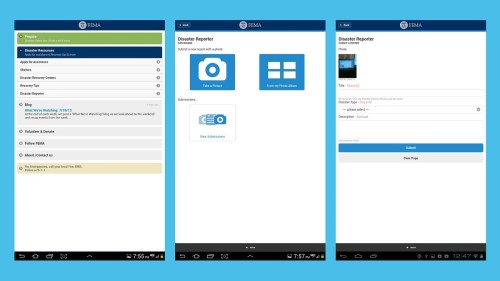
There are over half-a-billion Twitter users, with an average of 135,000 new users signing up on a daily basis (1). Can emergency management and disaster response organizations win over some Twitter users by convincing them to use their apps in addition to Twitter? For example, will FEMA’s smartphone app gain as much “market share”? The app’s new crowdsourcing feature, “Disaster Reporter,” allows users to submit geo-tagged disaster-related images, which are then added to a public crisis map. So the question is, will more images be captured via FEMA’s app or from Twitter users posting Instagram pictures?
This question is perhaps poorly stated. While FEMA may not get millions of users to share disaster-related pictures via their app, it is absolutely critical for disaster response organizations to explicitly solicit crisis information from the crowd. See my blog post “Social Media for Emergency Management: Question of Supply and Demand” for more information on the importance demand-driven crowdsourcing. The advantage of soliciting crisis information from a smartphone app is that the sourced information is structured and thus easily machine readable. For example, the pictures taken with FEMA’s app are automatically geo-tagged, which means they can be automatically mapped if need be.
While many, many more picture may be posted on Twitter, these may be more difficult to map. The vast majority of tweets are not geo-tagged, which means more sophisticated computational solutions are necessary. Instagram pictures are geo-tagged, but this information is not publicly available. So smartphone apps are a good way to overcome these challenges. But we shouldn’t overlook the value of pictures shared on Twitter. Many can be geo-tagged, as demonstrated by the Digital Humanitarian Network’s efforts in response to Typhoon Pablo. More-over, about 40% of pictures shared on Twitter in the immediate aftermath of the Oklahoma Tornado had geographic data. In other words, while the FEMA app may have 10,000 users who submit a picture during a disaster, Twitter may have 100,000 users posting pictures. And while only 40% of the latter pictures may be geo-tagged, this would still mean 40,000 pictures compared to FEMA’s 10,000. Recall that over half-a-million Instagram pictures were posted during Hurricane Sandy alone.
The main point, however, is that FEMA could also solicit pictures via Twitter and ask eyewitnesses to simply geo-tag their tweets during disasters. They could also speak with Instagram and perhaps ask them to share geo-tag data for solicited images. These strategies would render tweets and pictures machine-readable and thus automatically mappable, just like the pictures coming from FEMA’s app. In sum, the key issue here is one of policy and the best solution is to leverage multiple platforms to crowdsource crisis information. The technical challenge is how to deal with the high volume of pictures shared in real-time across multiple platforms. This is where microtasking comes in and why MicroMappers is being developed. For tweets and images that do not contain automatically geo-tagged data, MicroMappers has a microtasking app specifically developed to crowd-source the manual tagging of images.
In sum, there are trade-offs. The good news is that we don’t have to choose one solution over the other; they are complementary. We can leverage both a dedicated smartphone app and very popular social media platforms like Twitter and Facebook to crowdsource the collection of crisis information. Either way, a demand-driven approach to soliciting relevant information will work best, both for smartphone apps and social media platforms.
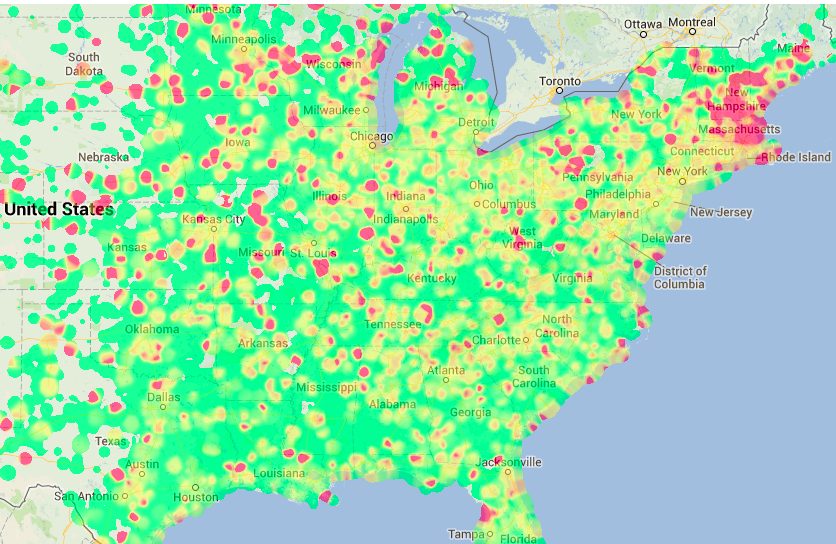
Social media networks are evolving a new nervous system for our planet. These real-time networks provide immediate feedback loops when media-rich societies experience a shock. My colleague Todd Mostak recently shared the tweet map below with me which depicts tweets referring to “marathon” (in red) shortly after the bombs went off during Boston’s marathon. The green dots represent all the other tweets posted at the time. Click on the map to enlarge. (It is always difficult to write about data visualizations of violent events because they don’t capture the human suffering, thus seemingly minimizing the tragic events).
Visualizing a social system at this scale gives a sense that we’re looking at a living, breathing organism, one that has just been wounded. This impression is even more stark in the dynamic visualization captured in the video below.
This an excerpt of Todd’s longer video, available here. Note that this data visualization uses less than 3% of all posted tweets because 97%+ of tweets are not geo-tagged. So we’re not even seeing the full nervous system in action. For more analysis of tweets during the marathon, see this blog post entitled “Boston Marathon Explosions: Analyzing First 1,000 Seconds on Twitter.”
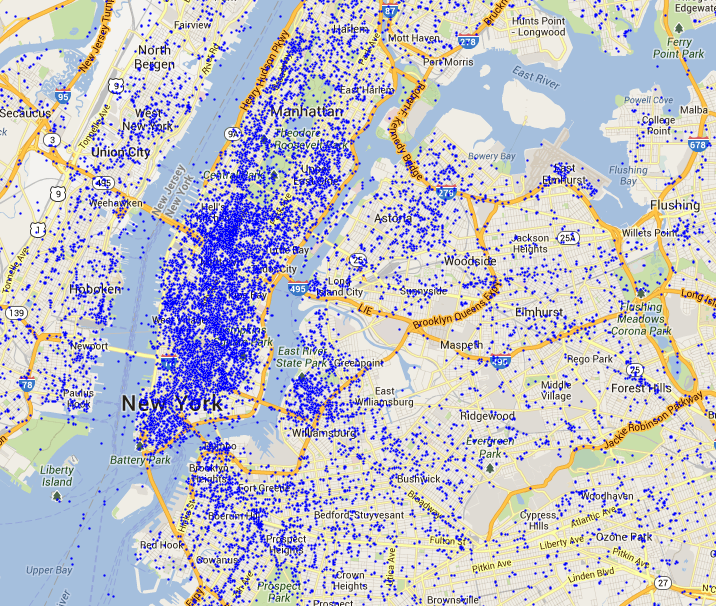
The map below depicts geo-tagged tweets posted between May 4-5, 2013 in the New York City area. Over 36,000 tweets are posted on the map (click to enlarge). Since less than 3% of all tweets are geo-tagged, the map is missing the vast majority of tweets posted in this area during those 24 hours.
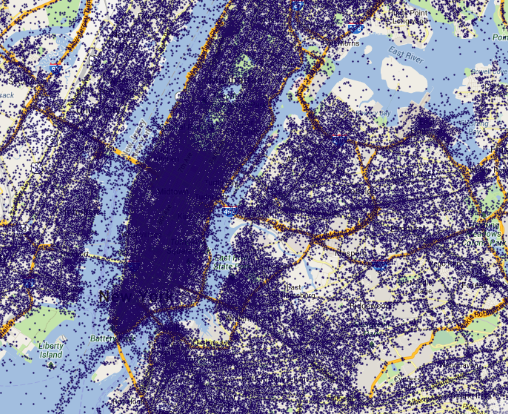
Contrast the above with the 1-month worth of tweets (April-May 2013) depicted in the map below. Again, the visualization misses the vast majority of tweets since these are not geo-tagged and thus not mappable.
These visuals are screenshots of Harvard’s Tweetmap platform, which is publicly available here. My colleague Todd Mostak is one of the main drivers behind Tweetmap, so worth sending him a quick thank you tweet! Todd is working on some exciting extensions and refinements, so stay tuned as I’ll be sure to blog about them when they go live.
While spam filters provide additional layers of security to websites, they can also be used to process all kinds of information. Perhaps most famously, for example, the reCAPTCHA spam filter was used to transcribe the New York Times’ entire paper-based archives. See my previous blog post to learn how this was done and how spam filters can also be used to process information for disaster response. Given the positive response I received from humanitarian colleagues who read the blog post, I teamed up with my colleagues at QCRI to create the first ever spam filter for disaster response.
During international disasters, the humanitarian community (often lead by the UN’s Office for the Coordination of Humanitarian Affairs, OCHA) needs to carry out rapid damage assessments. Recently, these assessments have included the analysis of pictures shared on social media following a disaster. For example, OCHA activated the Digital Humanitarian Network (DHN) to collect and quickly tag pictures that capture evidence of damage in response to Typhoon Pablo in the Philippines (as described here and TEDx talk above). Some of these pictures, which were found on Twitter, were also geo-referenced by DHN volunteers. This enabled OCHA to create (over night) the unique damage assessment map below.
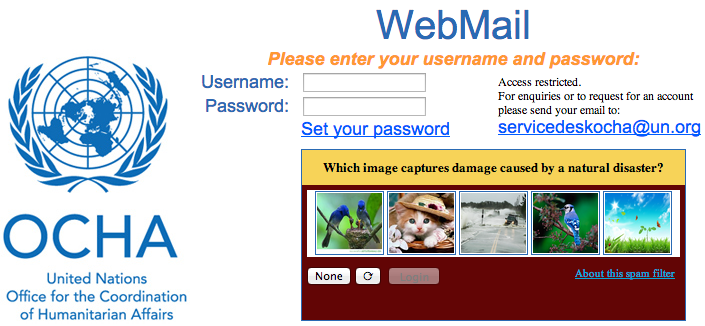
OCHA intends to activate the DHN again in future disasters to replicate this type of rapid damage assessment operation. This is where spam filters come in. The DHN often needs support to quickly tag these pictures (which may number in the tens of thousands). Adding a spam filter that requires email users to tag which image captures disaster damage not only helps OCHA and other organizations carry out a rapid damage assessment, but also increases the security of email systems at the same time. And it only takes 3 seconds to use the spam filter.
My team and I at QCRI have thus developed a spam filter plugin that can be easily added to email login pages like OCHA’s as shown above. When the Digital Humanitarian Network requires additional hands on deck to tag pictures during disasters, this plugin can simply be switched on. My team at QCRI can easily push the images to the plugin and pull data on which images have been tagged as showing disaster damage. The process for the end user couldn’t be simpler. Enter your username and password as normal and then simply select the picture below that shows disaster damage. If there are none, then simply click on “None” and then “Login”. The spam filter uses a predictive algorithm and an existing data-base of pictures as a control mechanism to ensure that the filter cannot be gamed. On that note, feel free to test the plugin here. We’d love your feedback as we continue testing.
The desired outcome? Each potential disaster picture is displayed to 3 different email account users. Only if each of the 3 users tag the same picture as capturing disaster damage does that picture get automatically forwarded to members of the Digital Humanitarian Network. To tag more pictures after logging in, users are invited to do so via MicroMappers, which launches this September in partnership with OCHA. MicroMappers enables members of the public to participate in digital disaster response efforts with a simple click of the mouse.
I would ideally like to see an innovative and forward-thinking organization like OCHA pilot the plugin for a two week feasibility test. If the results are positive and promising, then I hope OCHA and other UN agencies engaged in disaster response adopt the plugin more broadly. As mentioned in my previous blog post, the UN employs well over 40,000 people around the world. Even if “only” 10% login in one day, that’s still 4,000 images effortlessly tagged for use by OCHA and others during their disaster relief operations. Again, this plugin would only be used in response to major disasters when the most help is needed. We’ll be making the code for this plugin freely available and open source.
Please do get in touch if you’d like to invite your organization to participate in this innovative humanitarian technology project. You can support disaster response efforts around the world by simply logging into your email account, web portal, or Intranet!
Disaster responders cannot be everywhere at the same time, but the crowd is always there. The same is true for health care professionals such as critical care paramedics who work with an ambulance service. Paramedics cannot be posted everywhere. Can crowdsourcing help? This was the question posed to me by my colleague Mark who overseas the ambulance personnel for a major city.
Take Sudden Cardiac Arrest (SCA), for example. SCA’s account for an estimated 325,000 deaths each year in the US—one person every two minutes. Survival rates nationally are less than 8%. But Cardio-Pulmonary Resuscitation, or CPR, can sustain life until paramedics arrive by maintaining blood flow to the heart and brain. “Without oxygen-rich blood, permanent brain damage or death can occur in less than 8 minutes. After 10 minutes there is little chance of successful resuscitation. Even in modern urban settings the response times for professional rescuers commonly approach these time frames” (1). This explains why “effective bystander CPR, provided immediately after sudden cardiac arrest, can double or triple a person’s chance of survival” (2). In fact, close to 60% of adults in the US say they have taken CPR training (often due to school requirements) and 11% say they have used CPR in an actual emergency (3).
So why not develop a dedicated smartphone app to alert bystanders when someone nearby is suffering from a Sudden Cardiac Arrest? This is what Mark was getting at when we started this conversation back in April. Well it just so happens that such an app does exist. The PulsePoint mobile app “alerts CPR-trained bystanders to someone nearby having a sudden cardiac arrest that may require CPR. The app is activated by the local public safety communications center simultaneous with the dispatch of local fire and EMS resources” (4).
In sum, the purpose of the app is to increase survival rates by:
Reducing collapse-to-CPR times by increasing citizen awareness of cardiac events beyond a traditional “witnessed” area.
Reducing collapse-to-defibrillation times by increasing awareness of public access defibrillator (AED) locations through real-time mapping of nearby devices.
The PulsePoint approach is instructive to those of us applying technology to improve international humanitarian response. First, the app works within, not outside, existing institutions. When someone calls 911 to report a cardiac arrest, paramedics are still dispatched to the scene. At the same time, emergency operators use PulsePoint to alert registered bystanders in the area. Second, volunteers who receive an alert are provided with a map of nearby AEDs, i.e., additional “meta-data” important for rapid response. Third, training is key. Without CPR training, the “crowd” is not empowered to help. So Community Emergency Response Teams (CERTs) are important. Of course, not all needs require special expertise to be fulfilled, but preparedness still goes a long way.
My TEDx talk on Digital Humanitarians presented at TEDxTraverseCity. I’ve automatically forwarded the above video to the section on Big (false) Data and the use of time-critical crowdsourcing to verify social media reports shared during disasters. The talk describes the rationale behind the Verily platform that my team and I at QCRI are developing with our partners at the Masdar Institute of Technology (MIT) in Dubai. The purpose of Verily is to accelerate the process of verification by crowdsourcing evidence collection and critical thinking. See my colleague ChaTo’s excellent slide deck on Verily for more information.
My TEDx talk on Digital Humanitarians presented at TEDxTraverseCity. I’ve automatically forwarded the above video to a short 4 minute section of the talk in which I highlight how the Digital Humanitarian Network (DHN) used micro-tasking to support the UN Office for the Coordination of Humanitarian Affairs (OCHA) in response to Typhoon Pablo in the Philippines. See this blog post to learn more about the operation. As a result of this innovative use of micro-tasking, my team and I at QCRI are collaborating with UN OCHA colleagues to launch MicroMappers—a dedicated set of microtasking apps specifically designed for disaster response. These will go live in September 2013.
I thrive when working across disciplines, building diverse cross-cutting coalitions to create, translate and apply innovative strategies driven by shared values. This has enabled the 20+ organizations I’ve worked with, and those I’ve led, to accelerate meaningful and inclusive social impact.
Which is why I've been called a social entrepreneur and a translational leader by successful innovators. President Clinton once called me a digital pioneer, while recent colleagues describe me as kind, dedicated, values-driven, authentic, creative, ethical, and impactful.










 iRevolutions