Tag Archives: SMS

Finally, A Decision-Support Platform for SMS Use in Disaster Response

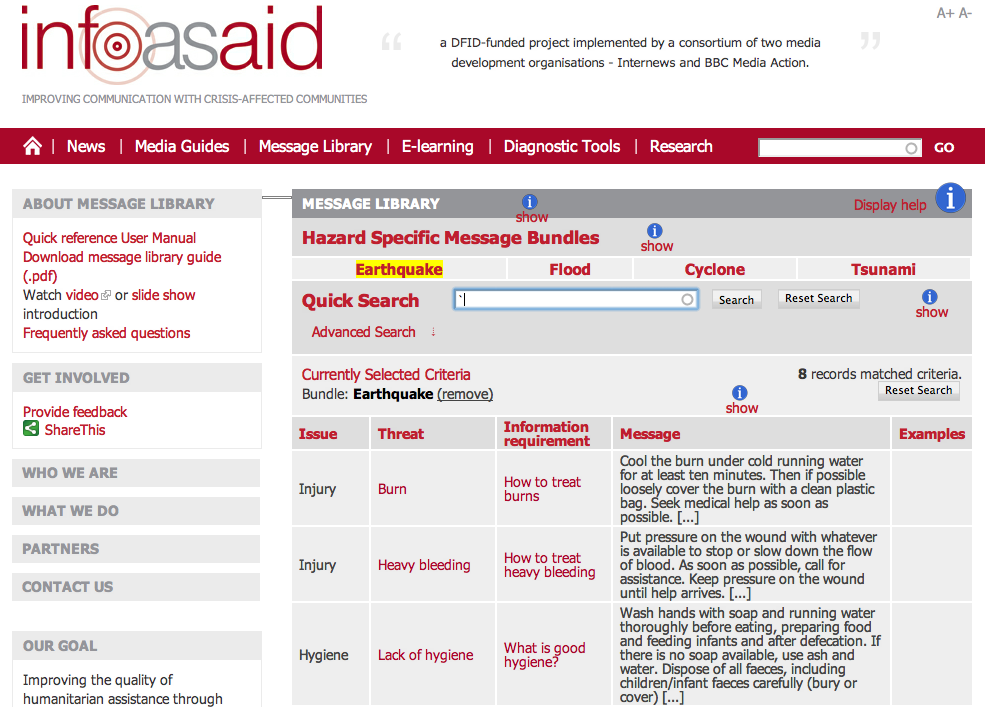
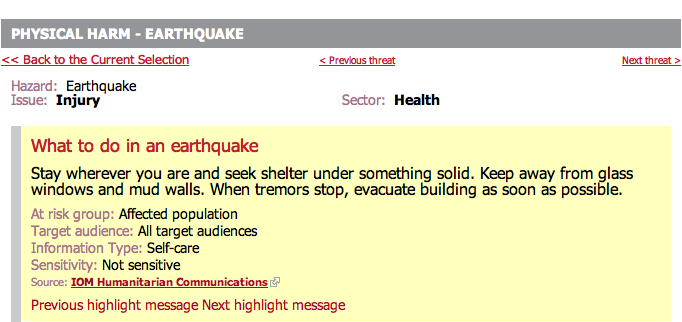
Within weeks of the 2010 Haiti Earthquake, I published this blog post entitled “How to Royally Mess Up Disaster Response in Haiti.” A month later, I published another post on “Haiti and the Tyranny of Technology.” I also called for an SMS Code of Conduct as described here. Some of the needs and shortcomings expressed in these blog posts have finally been answered by InfoAsAid‘s excellent Message Library, “an online searchable database of messages that acts as a reference for those wanting to disseminate critical information to affected populations in an emergency.”

“If used in the correct way, the library should help improve communication with crisis-affected populations.” As my colleague Anahi Ayala explains with respect to the disaster response in Haiti,

“One of the main problem that emerged was not only the need to communicate but the need for a coordinated and homogeneous message to be delivered to the affected communities. The problem was posed by the fact that as agencies and organizations were growing in number and size, all of them were trying in different ways to deliver messages to the beneficiaries of aid, with the result of many messages, sometimes contradicting each other, delivered to many people, sometimes not the right receiver for that message.”

This platform can be used for both disaster response and preparedness. In the latter case, preparedness exercises can “Involve communities to identify threats and draft appropriate messages using the message library as a reference.” Organizations can also “Pre-test the messages with different segments of society (consider differences in gender, rural/urban, education levels, age) to ensure comprehension.” In terms of disaster response, the platform can be used to disseminate information on the “scale, nature and impact of the disaster (humanitarian news); Alerts about secondary disasters such as aftershocks, landslides or flooding; Messages about how to stay safe and mitigate risk in the face of anticipated threats.”

At PeaceTXT, we’re taking a very similar approach to SMS messaging. In our case, we are developing an SMS Library specifically for the purposes of changing recipients’ behaviors and perceptions vis-a-vis peace and conflict issues in Kenya. This shift towards a culture of preparedness is really important, both for disaster response and conflict prevention. We are currently organizing a series of focus groups with local communities to develop the content of our SMS Library. We plan to review this content in August for inclusion in the library. I very much look forward to scheduling a conference call between InfoAsAid and PeaceTXT in the coming months to share lessons learned thus far in the development of our respective message libraries.

For more on InfoAsAid’s absolutely critical resource, this short video provides a very good summary, including how sensitive messages are managed and how you can contribute SMS content to this very important service. Some serious thanks and praise are in order for InfoAsAid’s work. I do hope that the team at InfoAsAid will join us at the International Crisis Mappers Conference  (ICCM 2012) to share the latest on their excellent initiatives.

Marketing Peace using SMS Mobile Advertising: A New Approach to Conflict Prevention

I was just in Kenya working on the next phase of the PeaceTXT project with my colleague Rachel Brown from Sisi ni Amani. I’m finally getting to implement an approach to conflict early warning and early response that I have been advocating for since 2006. I came close in 2008 whilst working on a conflict early and response project in Timor-Leste. But I wasn’t in Dili long enough to see the project through and the country’s limited mobile phone coverage presented an important obstacle. Long story short, I’ve been advocating for a people-centered and preparedness-based approach to conflict early warning systems for half a decade and am finally implementing one with PeaceTXT.

Conflicts are often grounded in the stories and narratives that people tell themselves and the emotions that these stories generate. Narratives shape identity and the social construct of reality—we interpret our lives through stories. These have the power to transform relationships and communities. The purpose of PeaceTXT is to leverage mobile messaging (SMS) to market peace in strategic ways and thereby generate alternative narratives. SMS reminders have been particularly effective in catalyzing behavior change in several important public health projects. In addition, marketing to the “Bottom of the Pyramid” is increasingly big business and getting more sophisticated. We believe that lessons learned from these sectors can be combined and applied to catalyze behavior  change vis-a-vis peace and conflict issues by amplifying new narratives using timely and strategically targeted SMS campaigns.

Last year, Sisi ni Amani sent the following SMS to 10,000 subscribers across Kenya: A good leader initiates and encourages peace and development among all people and is not tribal. “In a nation divided along ethnic lines, where a winner-takes-all mindset fuels rampant corruption and political violence, changing perceptions of good leadership is a daunting endeavor. And yet, according to post-campaign data, 90 percent of respondents said they changed their understanding of ‘what makes a good leader’ in response to the organization’s messaging. As one respondent commented: ‘I used to think a good leader is one who has the most votes, but now I know a good leader is one who thinks of the people who voted for him, not himself'” (NextBillion Blog Post).

PeaceTXT is about marketing peace using mobile advertising by leveraging user-generated content for said text messages. We’re in the business of selling peace for free by countering other narratives that tend to incite violent behavior. Preparedness is core to the PeaceTXT model. To be sure, local mobile-based advertising is hardly reactive or random. Indeed, billions of dollars go into marketing campaigns for a reason. To this end, we’re busy developing an agile SMS protocol that will allow us to send pre-determined customized text messages to specific groups (demographics) in targeted locations within minutes of an incident occurring. The content for said text messages will come from local communities themselves.

The next step is for Rachel and her team to organize and hold several local focus groups in July to begin generating appropriate content for text messages to de-escalate and/or counter police-community tensions, rumors and insecurity. I’ll be back in Kenya in August to review this user-generated content so we can add the text messages to our SMS protocol and customized SMS platform. I’m thrilled and can’t wait to work on this next phase.

Twitter, Crises and Early Detection: Why “Small Data” Still Matters

My colleagues John Brownstein and Rumi Chunara at Harvard Univer-sity’s HealthMap project are continuing to break new ground in the field of Digital Disease Detection. Using data obtained from tweets and online news, the team was able to identify a cholera outbreak in Haiti weeks before health officials acknowledged the problem publicly. Meanwhile, my colleagues from UN Global Pulse partnered with Crimson Hexagon to forecast food prices in Indonesia by carrying out sentiment analysis of tweets. I had actually written this blog post on Crimson Hexagon four years ago to explore how the platform could be used for early warning purposes, so I’m thrilled to see this potential realized.

There is a lot that intrigues me about the work that HealthMap and Global Pulse are doing. But one point that really struck me vis-a-vis the former is just how little data was necessary to identify the outbreak. To be sure, not many Haitians are on Twitter and my impression is that most humanitarians have not really taken to Twitter either (I’m not sure about the Haitian Diaspora). This would suggest that accurate, early detection is possible even without Big Data; even with “Small Data” that is neither representative or indeed verified. (Inter-estingly, Rumi notes that the Haiti dataset is actually larger than datasets typically used for this kind of study).

In related news, a recent peer-reviewed study by the European Commi-ssion found that the spatial distribution of crowdsourced text messages (SMS) following the earthquake in Haiti were strongly correlated with building damage. Again, the dataset of text messages was relatively small. And again, this data was neither collected using random sampling (i.e., it was crowdsourced) nor was it verified for accuracy. Yet the analysis of this small dataset still yielded some particularly interesting findings that have important implications for rapid damage detection in post-emergency contexts.

While I’m no expert in econometrics, what these studies suggests to me is that detecting change-over–time is ultimately more critical than having a large-N dataset, let alone one that is obtained via random sampling or even vetted for quality control purposes. That doesn’t mean that the latter factors are not important, it simply means that the outcome of the analysis is relatively less sensitive to these specific variables. Changes in the baseline volume/location of tweets on a given topic appears to be strongly correlated with offline dynamics.

What are the implications for crowdsourced crisis maps and disaster response? Could similar statistical analyses be carried out on Crowdmap data, for example? How small can a dataset be and still yield actionable findings like those mentioned in this blog post?

Mobile Technologies, Crisis Mapping & Disaster Response: My Talk at #MWC12

Many thanks to GSMA for their kind invitation to speak at the 2012 World Mobile Congress (MWC12) in Barcelona, Spain. GSMA is formally launching its Disaster Response Program at MWC12 with an inaugural working group. “The Disaster Response programme seeks to understand how mobile operators can most effectively support each other and improve resilience among networks in disaster scenarios, and identify how the mobile industry can best help citizens and humanitarian organisations on the ground following a crisis.” Below is the presentation I plan to give.

When disaster strikes, access to information is equally important as access to food and water. This link between information, disaster response and aid was officially recognized by the Secretary General of the International Federation of the Red Cross and Red Crescent Societies in the 2005 World Disasters Report. Since then, disaster-affected populations have become increasingly digital thanks to the widespread adoption of mobile technologies. Indeed, as a result of these mobile technologies, affected populations are increasingly able to source, share and generate a vast amount of information, which is completely transforming disaster response.

Take the case of Haiti, for example. Within 48 hours of the devastating earthquake that struck Port-au-Prince in 2010, a dedicated SMS short code was set up to crowdsource information on the urgent needs of the disaster-affected population. This would not have been possible without the partnership with Digicel Haiti since they’re the ones who provided the free SMS short code that enabled anyone in Haiti to text in their most urgent needs and location.

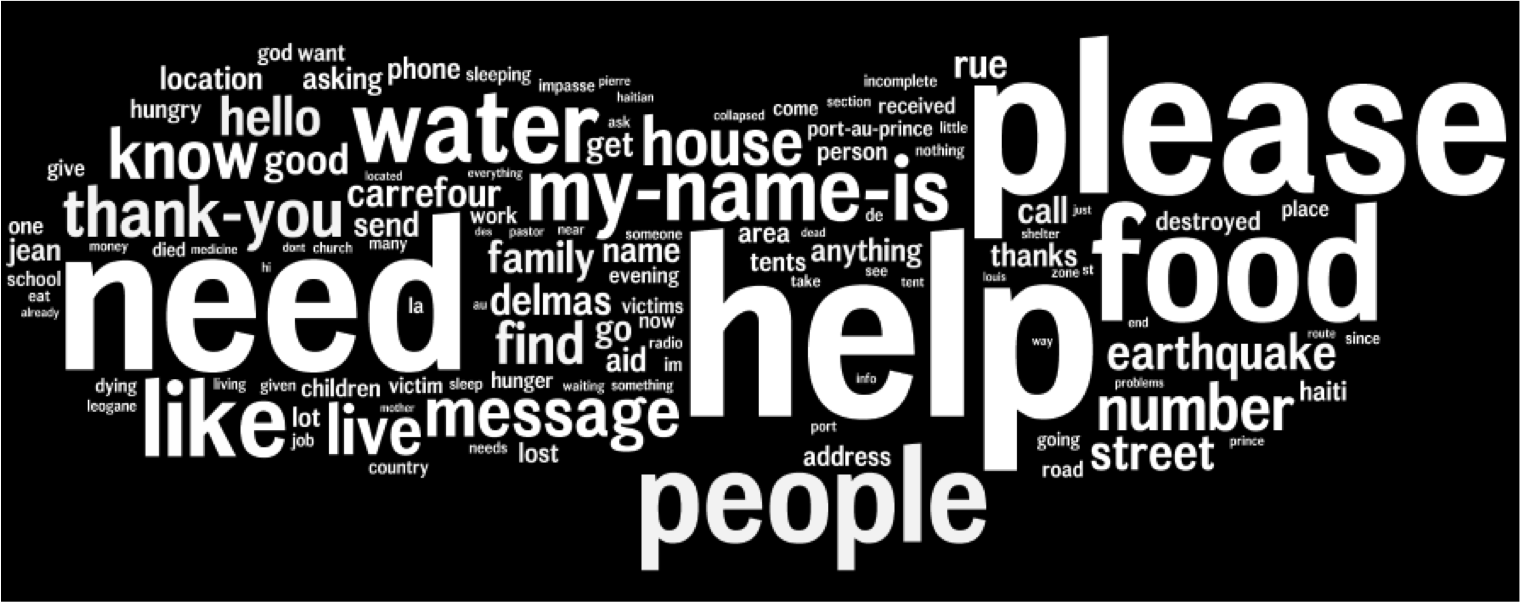
This graphic depicts the words that appeared most frequently in the text messages that were received during the first two weeks after the earthquake. Obviously, the original text messages were in Haitian Creole, so  volunteers from the Diaspora translated some 80,000 SMS’s during the entire 3-month operation. From these, the most urgent life-and-death text messages were identified and geo-located as quickly as possible.

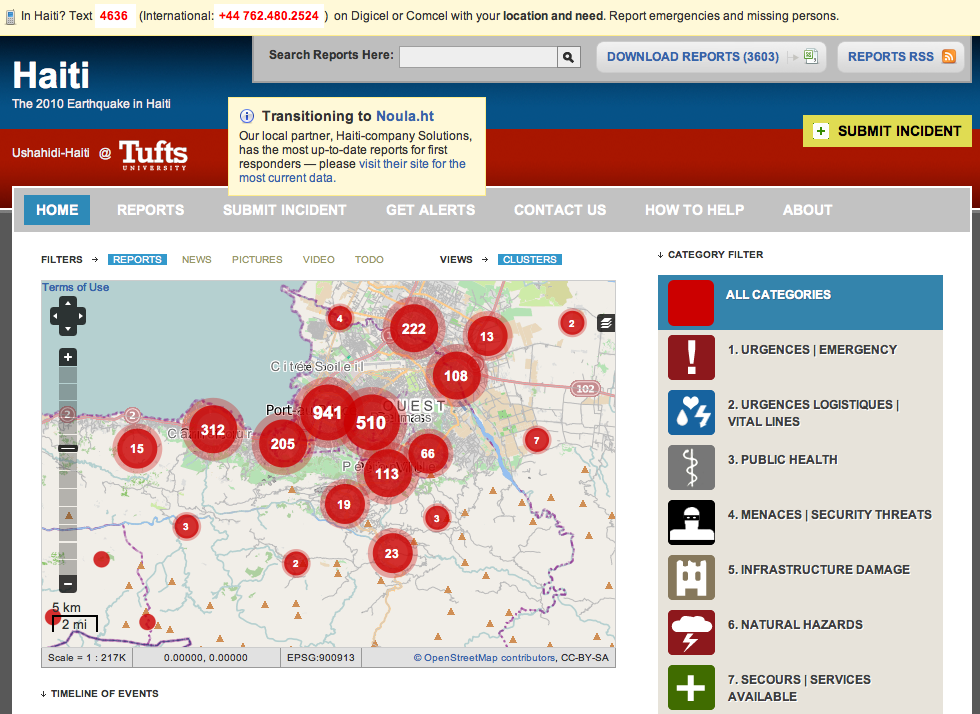
The result was a live crisis map of Haiti, which became the most comprehensive and up-to-date information available to the humanitarian community. In fact, one first-responder noted that the live map helped them save hundreds of lives during their search and rescue operations.

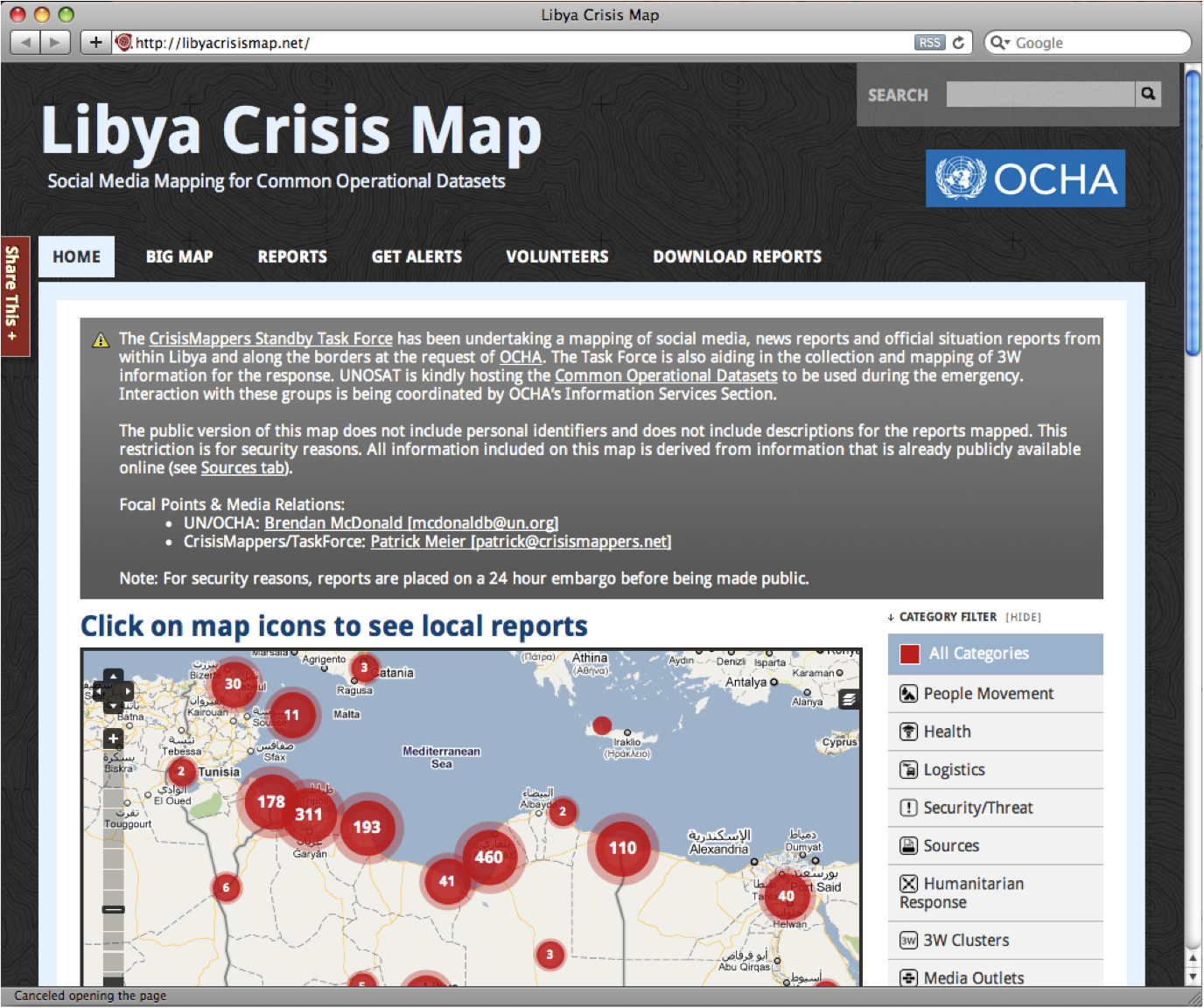
Live crisis maps are critical for disaster response because they can provide real-time situational awareness, like this official UN Crisis Map of Libya. Because the UN Office for the Coordination of Humanitarian Affairs (UN OCHA) did not have information management officers in-country when the crisis began to escalate, they turned to the crisis-affected population for real-time information on the rapidly changing situation. Indeed, a lot of local and relevant user-generated content was already being shared via Twitter, Flickr and YouTube.

The result was this crowdsourced social media map which was used not only by OCHA but also by the World Food Program and other humanitarian organiza-tions. Needless to say, the majority of the rich, multi-media content that populated this map was generated thanks to mobile technology.

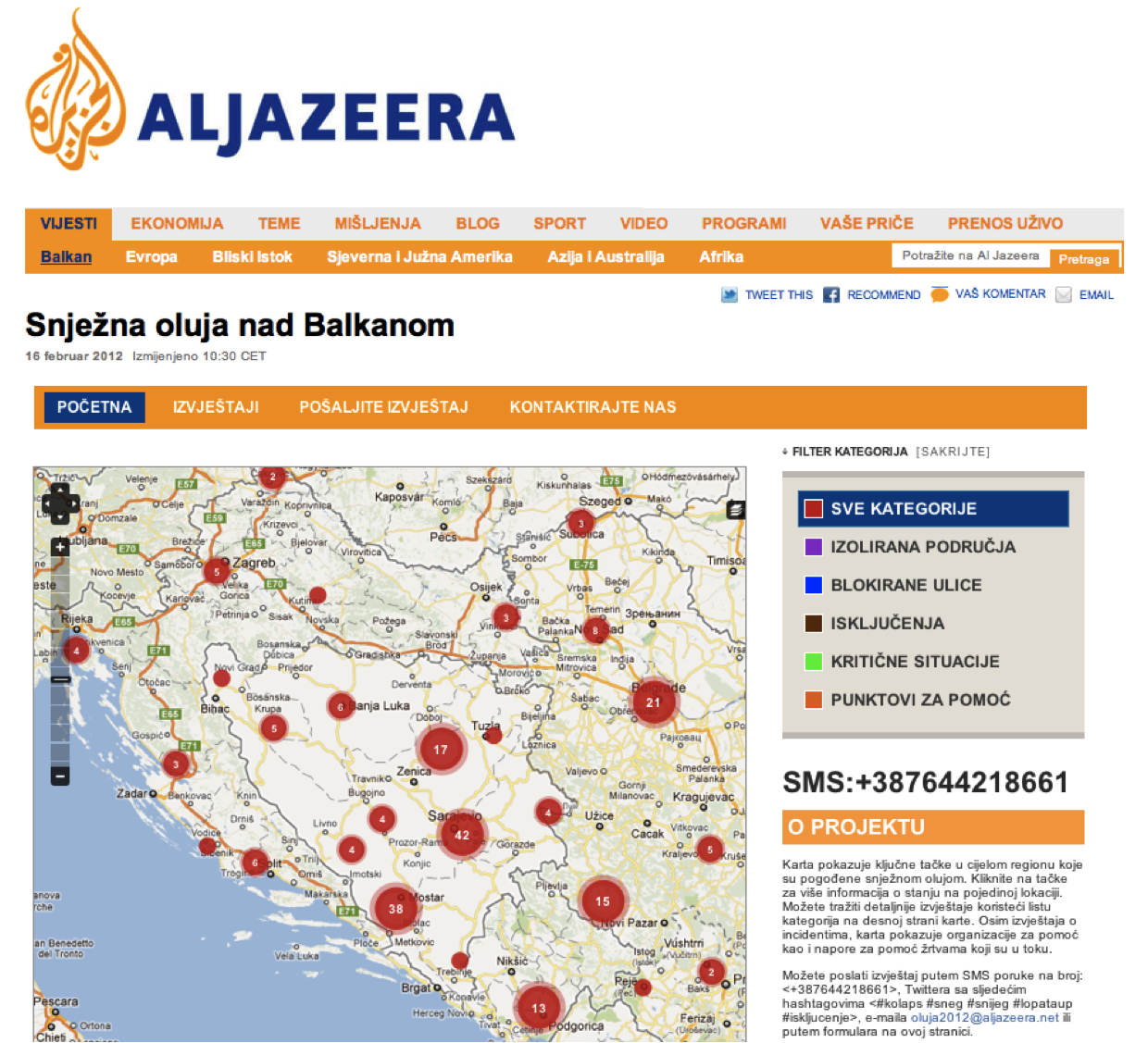
Humanitarian organizations are not the only groups using mobile technologies and crisis mapping platforms. Indeed, the mainstream media plays an instrumental role following a disaster. Their ability to widely and rapidly disseminate information to disaster affected populations is absolutely critical for disaster response. And they too are turning to live crisis maps to do this. Just a few weeks ago, Al-jazeera launched this live map to document the impact of the snowstorm emergency in the Balkans.

The map became the most viewed page on the Al-jazeera Balkans website for several weeks running, a clear testament to the demand for this type information and medium. This is actually the third time that Al-jazeera has leveraged mobile technologies for crisis mapping. Just two short months ago, we partnered with Al-jazeera to run a similar project in Somalia using an SMS short code.

There is no doubt that access to information is as important as access to food and water. In fact, sometimes information is the only help that can be made available, especially when isolated populations are cut off and beyond the reach of traditional aid. So while we talk of humanitarian aid and food relief, we also need to talk about “information aid” and “information relief”. Indeed, we have a “World Food Program” but we don’t have a “World Information Program” for communicating with disaster-affected populations.

This explains why I very much welcome and applaud the GSMA for launching their Disaster Response Program. It is perfectly clear that telecommunications companies are pivotal to the efforts just described. I thus look forward to collaborating with this new working group and hope that we’ll begin our conver-sations by addressing the pressing need and challenge to provide disaster-affected populations with free “information rations” (i.e., limited but free voice calls and SMS) in the immediate aftermath of a major disaster.

SMS for Violence Prevention: PeaceTXT International Launches in Kenya

[Cross-posted from my post on the Ushahidi blog]

One of the main reasons I’m in Nairobi this month is to launch PeaceTXT International with PopTech, Praekelt Foundation, Sisi ni Amani and several other key partners. PeaceTXT International is a spin-off from the original PeaceTXT project that several of us began working on with CeaseFire Chicago last year. I began thinking about the many possible international applications of the PeaceTXT project during our very first meeting, which is why I am thrilled and honored to be spearheading the first PeaceTXT International pilot project.

The purpose of PeaceTXT is to leverage mobile messaging to catalyze behavior change around peace and conflict issues. In the context of Chicago, the joint project with CeaseFire aims to leverage SMS reminders to interrupt gun violence in marginalized neighborhoods. Several studies in other fields of public health have already shown the massive impact that SMS reminders can have on behavior change, e.g., improving drug adherence behavior among AIDS and TB patients in Africa, Asia and South America.

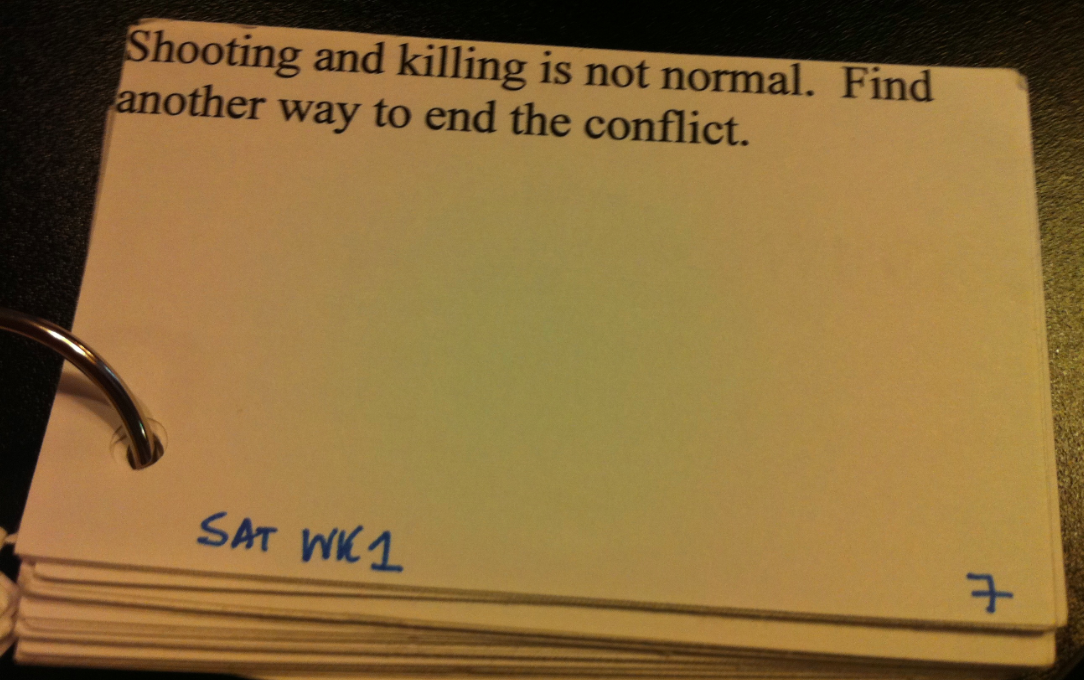
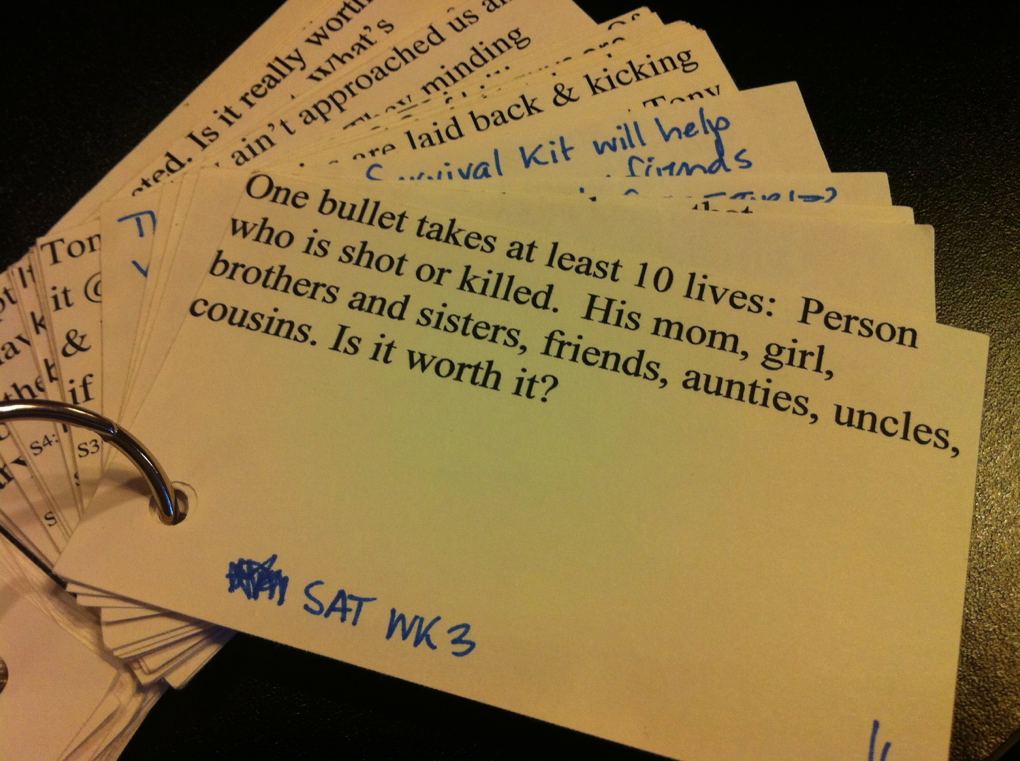
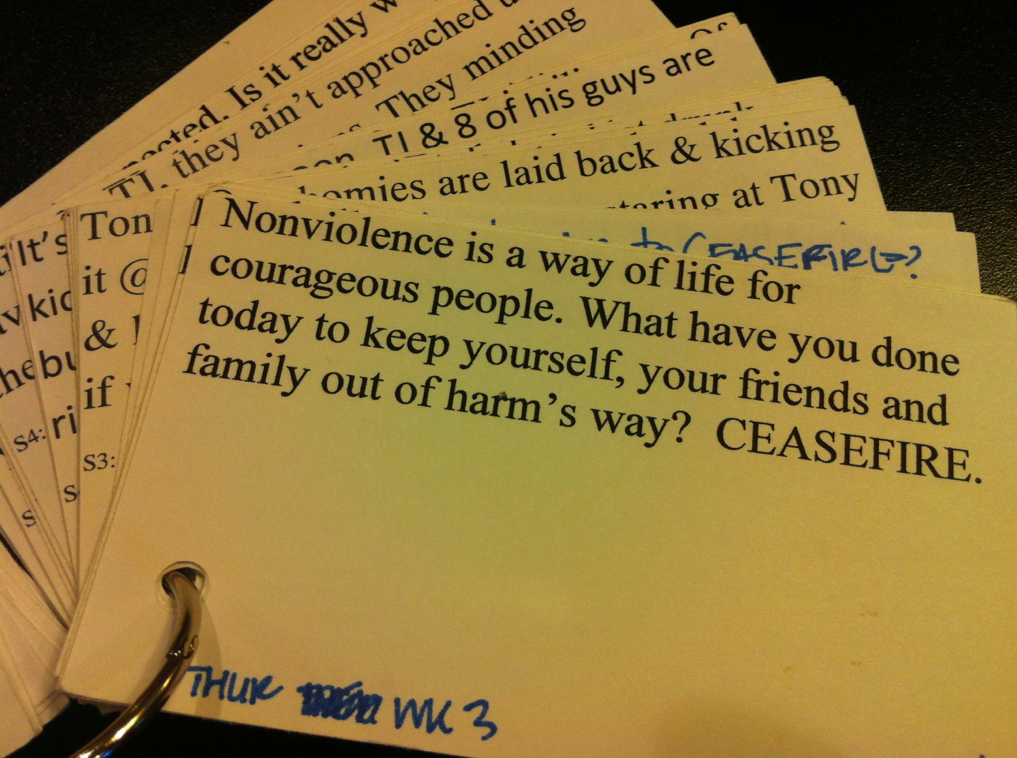
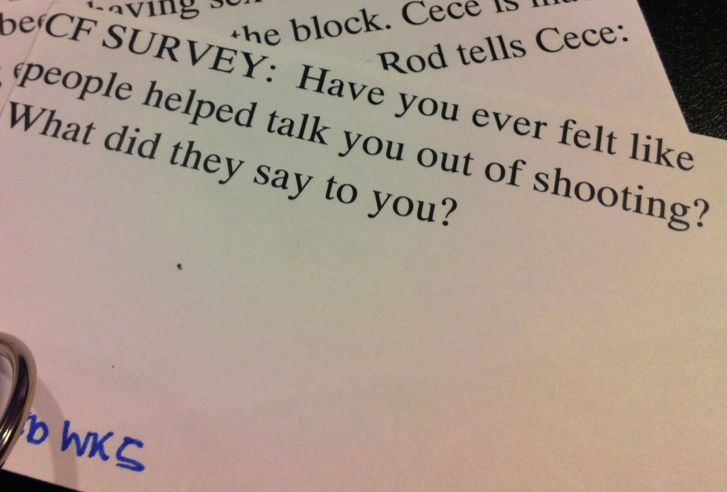
Our mobile messaging campaign in Chicago builds on another very successful one in the US: “Friends Don’t Let Friends Drink and Drive.” Inspired by this approach, the PeaceTXT Team is looking to launch a friends-don’t-let-friends-get-killed campaign. Focus groups recently conducted with high-risk individuals have resulted in rich content for several dozen reminder messages (see below) that could be disseminated via SMS. Note that CeaseFire has been directly credited for significantly reducing the number of gun-related killings in Chicago over the past 10 years. In other words, they have a successful and proven methodology; one being applied to several other cities and countries worldwide. PeaceTXT simply seeks to scale this success by introducing SMS.

These messages are user-generated in that the content was developed by high-risk individuals themselves—i.e., those most likely to get involved in gun violence. The messages are not limited to reminders. Some also prompt the community to get engaged by responding to various questions. Indeed, the project seeks to crowdsource community solutions to gun violence and thus greater participation. When high-risk individuals were asked how they’d feel if they were to receive these messages on their phones, they had the following to share: “makes me feel like no one is forgetting about me”; “message me once a day to make a difference.”

Given that both forwarding and saving text messages is very common among the population that CeaseFire works with, the team hopes that the text messages will circulate and recycle widely. Note that the project is still in prototype phase but going into implementation mode as of 2012. So we’ll have to wait and see how the project fares and what the initial impact looks like.

In the meantime, PeaceTXT is partnering with Sisi ni Amani (We are Peace) to launch its first international pilot project. Rachel Brown, who spearheads the initiative, first got in touch with me back in the Fall of 2009 whilst finishing her undergraduate studies at Tufts. Rachel was interested in crowdsourcing a peace map of Kenya, which I blogged about here shortly after our first conversation. Since then, Rachel and her team have set up the Kenyan NGO Sisi ni Amani Kenya (SnA-K) to leverage mobile technology for awareness raising and civic engagement with the aim of preventing possible violence during next year’s Presidential Elections.

SnA-K currently manages a ~10,000 member SMS subscriber list in Baba Dogo and Korogocho, Kamukunji and Narok. SnA-K’s SMS campaigns focus on voter education, community cohesion and rumor prevention. What SnA-K needs, how-ever, is the scalable SMS broadcasting technology, the type of focus that PeaceTXT brought to CeaseFire Chicago and the unique response methodology developed by the CeaseFire team. So I reached out to Rachel early on during the work in Chicago to let her know about PeaceTXT and to gain insights from her projects in Kenya. We set up regular conference calls throughout the year to keep each other informed of our respective progress and findings.

Soon enough, PopTech’s delightful Leetha Filderman asked me to put together a pitch for international applications of PeaceTXT’s work, an initiative I have “code-named” PeaceTXT International. I was absolutely thrilled when she shared the good news at PopTech 2011 that our donor, the Rita Allen Foundation, had provided us with additional funding, some of which could go towards an international pilot project. Naturally, Sisi ni Amani was a perfect fit.

So we organized a half-day brainstorming session at the iHub last week to chart the way forward on PeaceTXT Kenya. For example, what is the key behavioral change variable (like friendship in Chicago) that is most likely to succeed in Kenya? As for interrupting violence, how can the CeaseFire methodology be customized for the SnA-K context? Finally, what kind of SMS broadcasting technology do we need to have in place to provide maximum flexibility and scalability earlier rather than later? Answering these questions and implementing scalable solutions essentially forms the basis of the partnership between SnA-K and PeaceTXT (which also includes Mobile:Medic & Revolution Messaging). We have some exciting leads on next steps and will be sure to blog about them as we move forward to get feedback from the wider community.

Conflicts are often grounded in the stories and narratives that people tell themselves and the emotions that these stories generate. Narratives shape identity and the social construct of reality—we interpret our lives through stories. These have the power to transform relationships and communities. We believe the PeaceTXT model can be applied to catalyze behavior  change vis-a-vis peace and conflict issues at the community level by amplifying new narratives via SMS. There is considerable potential here and still much to learn, which is why I’m thrilled to be working with SnA, PopTech & partners on launching our first international pilot project: PeaceTXT Kenya.

Amplifying Somali Voices Using SMS and a Live Map: #SomaliaSpeaks

Somalia has been steadily slipping from global media attention over the past few months. The large scale crisis is no longer making headline news, which means that advocacy and lobbying groups are finding it increasingly difficult to place pressure on policymakers and humanitarian organizations to scale their intervention in the Horn of Africa. I recently discussed this issue with Al-jazeera’s Social Media Team whilst in Doha and pitched a project to them which has just gone live this hour.

The joint project combines the efforts of multiple partners including Al-Jazeera, Ushahidi, Souktel, Crowdflower, the African Diaspora Institute and the wider Somali Diaspora. The basis of my pitch to Al-jazeera was to let ordinary Somalis speak for themselves by using SMS to crowdsource their opinions on the unfolding crisis. My colleagues at Al-jazeera liked the idea and their editorial team proposed the following question:

Al Jazeera wants to know: how has the conflict of the last few months affected your life? Please include the name of your hometown in your response. Thank you!

So I reached out to my good friend Jacob Korenblum at Souktel. He and I had been discussing different ways we might combine our respective technologies to help in Somalia. Souktel has been working in Somalia and providing various SMS based solutions to several organizations. Jacob had previously mentioned that his team had a 50,000+ member SMS subscriber list. This proved to be key. Earlier this week, the Souktel team sent out the above question in Somali to about 5,000 of their subscribers. An effort was made to try and select geographically disbursed areas.

We’ve since received well over 2,000 text message replies and counting. In order to translate and geolocate these messages, I got in touch my colleagues Vaughn Hester and Lukas Biewald at Crowdflower in San Francisco. Crowdflower uses micro-tasking solutions to process and structure data flows. They were very keen to help and thanks to their support my Ushahidi colleagues Rob Baker and Linda Kamau were able to customize this Crowdflower plugin to translate, categorize and geo-locate incoming text messages:


They also wrote additional software so that text messages from Souktel could be automatically forwarded to the Crowdflower plugin which would then automatically push the processed SMS’s to a live Ushahidi map hosted by Al-jazeera. While the software development was moving forward, I connected  with colleagues from the Somali American Student Association who expressed an interest in supporting this project. Thanks to them and other members of the Somali Diaspora, hundreds of Somali voices were translated and shared on Al-jazeera’s public Ushahidi map of Somalia within days. But we still need lots of help. So if you speak Somali and English, then simply follow this link.

I wanted this project to serve as a two-way conversation, however, not just a one-way information flow from Somalia to the world. Every report  that gets mapped on an Ushahidi platform is linked to public discussion forum where readers can respond and share their views on said report. So I suggested that Al-jazeera invite their viewers/readers to comment on the text messages directly. The next step will be for Al-jazeera’s editorial team to select some of the most compelling and interesting comments and to text these back to the senders of the original text messages in Somalia. This two-way flow of information can be iterated and scaled given that the technologies and workflows are already in place.

In sum, the purpose of this project is to catalyze global media attention on Somalia by letting Somali voices take center stage—voices that are otherwise not heard in the international, mainstream media. If journalists are not going to speak about Somalia, then this project  invites Somalis speak to the world themselves. The project highlights  these voices on a live, public map for the world to bear witness and engage in a global conversation with people of Somalia, a conversation in which Somalis and the Diaspora are themselves at the centerfold. It is my sincere hope that advocacy and lobby group will be able to leverage the content generated by this project to redouble their efforts in response to the escalating crisis in Somalia.

I very much hope to see this type of approach used again in Somalia and elsewhere. It is fully inline with the motivations that inspired the launch of the first Ushahidi platform almost 4 years ago today: collective witnessing. Indeed, I am often reminded of what my friend Anand Giridharadas of the New York Times wrote last year vis-a-vis Ushahidi. To paraphrase:

They used to say that history is written by the victors. But today, before the victors win, if they win, there is a chance to scream out with a text message, a text message that will not vanish, a text message that will remain immortalized on a map for the world to bear witness. What would we know about what passed between Turks and Armenians, Germans and Jews, Hutus and Tutsis, if every one of them had had the chance, before the darkness, to declare for all time:

“I was here, and this is what happened to me”?

 Use #SomaliaSpeaks to witness the project on Twitter.

I want to specifically thank the following individuals who put an incredible amount of time and effort (most pro bono) to make this project happen: Robert Baker, Linda Kamau, Michael Moszczynski, Katie Highet, Jacob Korenblum, Vaughn Hester, Mohammed Dini, Hamza Haadoow, Andrew Jawitz and of course the excellent Al Jazeera team in Doha. Thank you all for going above and beyond to make this happen. 

Amplifying Somali Voices Using SMS and a Live Map

Update: http://irevolution.net/2011/12/08/somaliaspeaks

I recently had the pleasure to meet with Al-Jazeera’s Social Media Team in Doha, Qatar. It was immediately clear that they were also interested in partnering on a joint project in Somalia when I suggested a few ideas. Several weeks later, this project is almost ready to launch. The purpose of this initiative is to let Somalis speak for themselves and to amplify those voices in the international media.

As Al-Jazeera has noted, Somalia is quickly slipping from global media attention. With Somalia out of the headline news, however, advocacy and lobbying groups will find it increasingly difficult to place pressure on policymakers and humanitarian organiza-tions to scale their intervention in this major crisis. This project therefore offers a direct and innovative way to keep Somalia in the international news. The project described below is the product of a novel collaborative effort between Al-Jazeera, Ushahidi, Souktel and Crowdflower in direct partnership with the Somali Diaspora.

The project will “interview” ordinary Somalis in Somalia and let them speak for themselves in the international media space. Interview questions drafted by Al-Jazeera will be broadcast via SMS by Souktel to 10% of their existing 50,000+ subscribers in the country. The interview questions will also invite Somalis to share in which town they are based. (Note that we are reviewing the security protocols for this). The Somali Diaspora will then translate and geolocate incoming text messages from Somali to English using a customized Crowdflower plugin. The processed messages will then be pushed (in both Somali and English) to a live Ushahidi map. Al-Jazeera will promote the live map across their main-stream and social media channels. Mapped SMS’s will each have a comments section for viewers and readers to share their thoughts. Al-Jazeera will then select the most compelling responses and text these back to the original senders in Somalia. This approach is replicable and scalable given that the partners and technologies are largely in place already.

In sum, the purpose of this project is to increase global media attention on Somalia by letting Somali voices take center stage—voices that are otherwise not heard in the international, mainstream media. If journalists are not going to speak about Somalia, then lets invite Somalis speak to the world themselves. The project will highlight these voices on a live, public map for the world to engage in a global conversation with the people of Somalia, a conversation in which Somalis and the Diaspora are themselves at the centerfold.

If you want to help out with this initiative, we’re looking for Somali-English speakers to translate and map the incoming text messages. It’s important that volunteers are familiar with the location of many cities, towns, etc., in Somalia in order to map the SMS’s. If you have the skills and time, then please add your name, email address and short bio here—would be great to have you on the team!


A List of Completely Wrong Assumptions About Technology Use in Emerging Economies

I’ve spent the past week at the iLab in Liberia and got what I came for: an updated reality check on the limitations of technology adoption in developing countries. Below are some of the assumptions that I took for granted. They’re perfectly obvious in hindsight and I’m annoyed at myself for not having realized their obviousness sooner. I’d be very interested in hearing from others about these and reading their lists. This need not be limited to one particular sector like ICT for Development (ICT4D) or Mobile Health (mHealth). Many of these assumptions have repercussions across multiple disciplines.

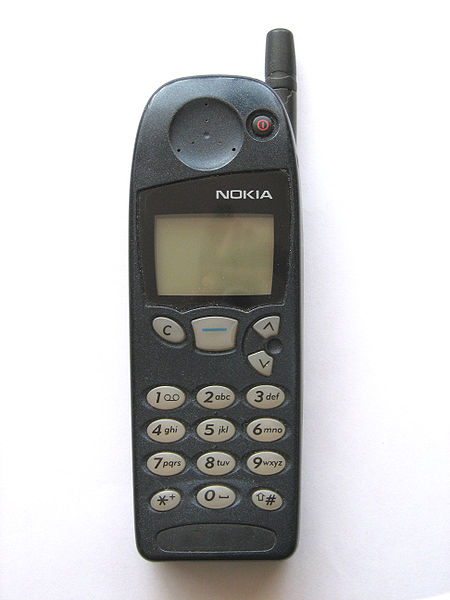
The following examples come from conversations with my colleague Kate Cummings who directs Ushahidi Liberia and the iLab here in Monrovia. She and her truly outstanding team—Kpetermeni Siakor, Carter Draper, Luther Jeke and Anthony Kamah—spearheaded a number of excellent training workshops over the past few days. At one point we began discussing the reasons for the limited use of SMS in Liberia. There are the usual and obvious reasons. But the one hurdle I had not expected to hear was Nokia’s predictive text functionality. This feature is incredibly helpful since the mobile phone basically guesses which words you’re trying to write so you don’t have to type every single letter.

But as soon as she pointed out how confusing this can be, I immediately understood what she meant. If I had never seen or been warned about this feature before, I’d honestly think the phone was broken. It would really be impossible to type with. I’d get frustrated and give up (the tiny screen further adds to the frustration). And if I was new to mobile phones, it wouldn’t be obvious how to switch that feature off either. (There are several tutorials online on how to use the predictive text feature and how to turn it off, which clearly proves they’re not intuitive).

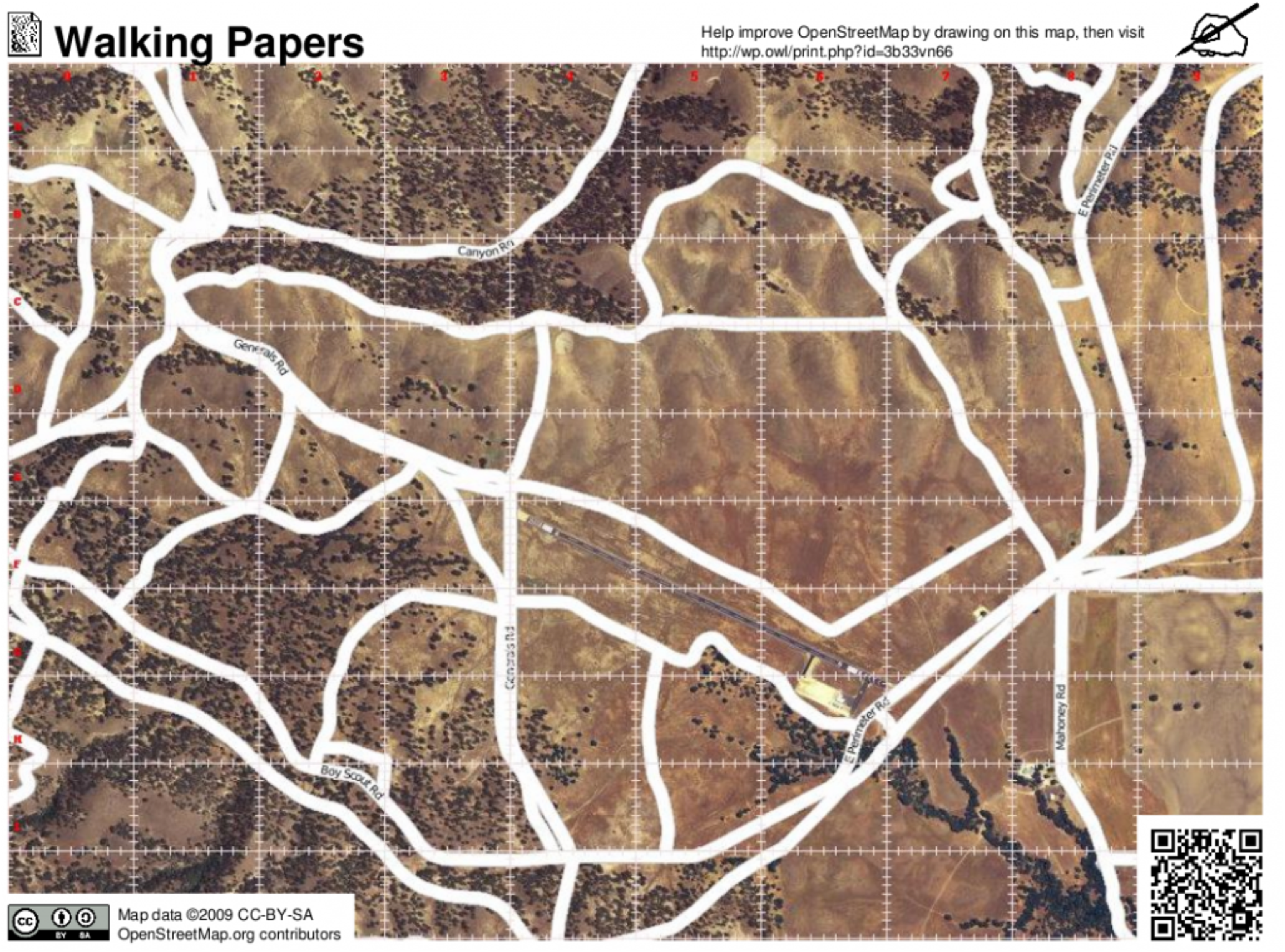
In one of the training workshops we just had, I was explaining what Walking Papers was about and how it might be useful in Liberia. So I showed the example below and continued talking. But Kate jumped in and asked participants: “What do you see in this picture? Do you see the trees, the little roads?” She pointed at the features as she described the individual shapes. This is when it dawned on me that there is absolutely nothing inherently intuitive about satellite images. Most people on this planet have not been on an airplane or a tall building. So why would a bird’s eye view of their village be anything remotely recognizable? I really kicked myself on that one. So I’ll write it again: there is nothing intuitive about satellite imagery. Nor is there anything intuitive about GPS and the existence of a latitude and longitude coordinate system.

Kate went on to explain that this kind of picture is what you would see if you were flying high like a bird. That was the way I should have introduced the image but I had taken it completely for granted that satellite imagery was self-explanatory when it simply isn’t. In further conversations with Kate, she explained that they too had made that assumption early on when trying to introduce the in’s and out’s of the Ushahidi platform. They quickly realized that they had to rethink their approach and decided to provide introductory courses on Google Maps instead.

More wrong assumptions revealed themselves during the workshpos. For example, the “+” and “-” markers on Google Map are not intuitive either nor is the concept of zooming in and out. How are you supposed to understand that pressing these buttons still shows the same map but at a different scale and not an entirely different picture instead? Again, when I took a moment to think about this, I realized how completely confusing that could be. And again I kicked myself. But contrast this to an entirely different setting, San Francisco, where some friends recently told me how their five year old went up to a framed picture in their living room and started pinching at it with his fingers, the exact same gestures one would use on an iPhone to zoom in and out of a picture. “Broken, broken” is all the five year old said after that disappointing experience.

The final example actually comes from Haiti where my colleague Chrissy Martin is one of the main drivers behind the Digicel Group’s mobile banking efforts in the country. There were of course a number of expected challenges on the road to launching Haiti’s first successful mobile banking service, TchoTcho Mobile. The hurdle that I had not expected, however, had to do with the pin code. To use the service, you would enter your own personal pin number on your mobile phone in order to access your account. Seems perfectly straight forward. But it really isn’t.

The concept of a pin number is one that many of us take completely for granted. But the idea is often foreign to many would-be users of mobile banking services and not just in Haiti. Think about it: all one has to do to access all my money is to simply enter four numbers on my phone. That does genuinely sound crazy to me at a certain level. Granted, if you guess the pin wrong three times, the phone gets blocked and you have to call TchoTcho’s customer service. But still, I can understand the initial hesitation that many users had. When I asked Chrissy how they overcame the hurdle, her answer was simply this: training. It takes time for users to begin trusting a completely new technology.

So those are some of the assumptions I’ve gotten wrong. I’d be grateful if readers could share theirs as there must be plenty of other assumptions I’m making which don’t fit reality. Incidentally, I realize that emerging economies vary widely in technology diffusion and adoption—not to mention sub-nationally as well. This is why having the iLab in Liberia is so important. Identifying which assumptions are wrong in more challenging environments is really important if our goal is to use technology to help contribute meaningfully to a community’s empowerment, development and independence.

An Open Letter to the Good People at Benetech

Dear Good People at Benetech,

We’re not quite sure why Benetech went out of their way in an effort to discredit ongoing research by the European Commission (EC) that analyzes SMS data crowdsourced during the disaster response to Haiti. Benetech’s area of expertise is in human rights (rather than disaster response), so why go after the EC’s findings, which had nothing to do with human rights?  To our fellow readers who desire context, feel free to read this blog postof mine along with these replies by Benetech’s CEO:

Issues with Crowdsourced Data Part 1
Issues with Crowdsourced Data Part 2

The short version of the debate is this: the EC’s exploratory study found that the spatial pattern of text messages from Mission 4636 in Haiti was positively correlated with building damage in Port-au-Prince. This would suggest that crowdsourced SMS data had statistical value in Haiti—in addition to their value in saving lives. But Benetech’s study shows a negative correlation. That’s basically it. If you’d like to read something a little more spicy though, do peruse this recent Fast Company article, fabulously entitled “How Benetech Slays Monsters with Megabytes and Math.” In any case, that’s the back-story.

So lets return to the Good People at Benetech. I thought I’d offer some of my humble guidance in case you feel threatened again in the future—I do hope you don’t mind and won’t take offense at my unsolicited and certainly imperfect advice. So by all means feel free to ignore everything that follows and focus on the more important work you do in the human rights space.

Next time Benetech wants to try and discredit the findings of a study in some other discipline, I recommend making sure that your own counter-findings are solid. In fact, I would suggest submitting your findings to a respected peer-reviewed journal—preferably one of the top tier scientific journals in your discipline. As you well know, after all, this really is the most objective and rigorous way to assess scientific work. Doing so would bring much more credibility to Benetech’s counter-findings than a couple blog posts.

My reasoning? Benetech prides itself (and rightly so) for carrying out some of the most advanced, cutting-edge quantitative research on patterns of human rights abuses. So if you want to discredit studies like the one carried out by the EC, I would have used this as an opportunity to publicly demonstrate the advanced expertise you have in quantitative analysis. But Benetech decided to use a simple non-spatial model to discredit the EC’s findings. Why use such a simplistic approach? Your response would have been more credible had you used statistical models for spatial point data instead. But granted, had you used more advanced models, you would have found evidence of a positive correlation. So you probably won’t want to read this next bit: a more elaborate “Tobit” correlation analysis actually shows the significance of SMS patterns as an explanatory variable in the spatial distribution of damaged buildings. Oh, and the correlation is (unfortunately) positive.

But that’s really beside the point. As my colleague Erik Hersman just wrote on the Ushahidi blog, one study alone is insufficient. What’s important is this: the last thing you want to do when trying to discredit a study in public is to come across as sloppy or as having ulterior motives (or both for that matter). Of course, you can’t control what other people think. If people find your response sloppy, then they may start asking whether the other methods you do use in your human rights analysis are properly peer-reviewed. They may start asking whether a strong empirical literature exists to back up your work and models. They may even want to know whether your expert statisticians have an accomplished track record and publish regularly in top-tier scientific journals. Other people may think you have ulterior motives and will believe this explains why you tried to discredit the EC’s preliminary findings. This doesn’t help your cause either. So it’s important to think through the implications of going public when trying to discredit someone’s research. Goodness knows I’ve made some poor calls myself on such matters in the past.

But lets take a step back for a moment. If you’re going to try and discredit research like the EC’s, please make sure you correctly represent the other side’s arguments. Skewing them or fabricating them is unlikely to make you very credible in the debate. For example, the EC study never concluded that Search and Rescue teams should only rely on SMS to save people’s lives. Furthermore, the EC study never claimed that using SMS is preferable over using established data on building density. It’s surely obvious—and you don’t need to demonstrate this statistically—to know that using a detailed map of building locations would provide a far better picture of potentially damaged buildings than crowdsourced SMS data. But what if this map is not available in a timely manner? As you may know, data layers of building density are not very common. Haiti was a good example of how difficult, expensive and time-consuming, the generation of such a detailed inventory is. The authors of the study simply wanted to test whether the SMS spatial pattern matched the damage analysis results, which it does. All they did was propose that SMS patterns could help in structuring the efforts needed for a detailed assessment, especially because SMS data can be received shortly after the event.

So to summarize, no one (I know) has ever claimed that crowdsourced data should replace established methods for information collection and analysis. This has never been an either or argument. And it won’t help your cause to turn it into a black-and-white debate because people familiar with these issues know full well that the world is more complex than the picture you are painting for them. They also know that people who take an either-or approach often do so when they have either run out of genuine arguments or had few to begin with. So none of this will make you look good. In sum, it’s important to (1) accurately reflect the other’s arguments, and (2) steer clear of creating an either-or, polarized debate. I know this isn’t easy to do, I’m guilty myself… on multiple counts.

I’ve got a few more suggestions—hope you don’t mind. They follow from the previous ones. The authors of the EC study never used their preliminary findings to extrapolate to other earthquakes, disasters or contexts. These findings were specific to the Haiti quake and the authors never claimed that their model was globally valid. So why did you extrapolate to human rights analysis when that was never the objective of the EC study? Regardless, this just doesn’t make you look good. I understand that Benetech’s focus is on human rights and not disaster response, but the EC study never sought to undermine your good work in the field of human rights. Indeed, the authors of the study hadn’t even heard of Benetech. So in the future, I would recommend not extrapolating findings from one study and assume they will hold in your own field of expertise or that they even threaten your area of expertise. That just doesn’t make any sense.

There are a few more tips I wanted to share with you. Everyone knows full well that crowdsourced data has important limitations—nobody denies this. But a number of us happen to think that some value can still be derived from crowdsourced data. Even Mr. Moreno-Ocampo, the head of the International Criminal Court (ICC), who I believe you know well, has pointed to the value of crowdsourced data from social media. In an interview with CNN last month, Mr. Moreno-Ocampo emphasized that Libya was the first time that the ICC was able to respond in real time to allegations of atrocities, partially due to social-networking sites such as Facebook. He added that, “this triggered a very quick reaction. The (United Nations) Security Council reacted in a few days; the U.N. General Assembly reacted in a few days. So, now because the court is up and running we can do this immediately,” he said. “I think Libya is a new world. How we manage the new challenge — that’s what we will see now.”

Point is, you can’t control the threats that will emerge or even prevent them, but you do control the way you decide to publicly respond to these threats. So I would recommend using your response as an opportunity to be constructive and demonstrate your good work rather than trying to discredit others and botching things up in the process.

But going back to the ICC and the bit in the Fast Company article about mathematics demonstrating the culpability of the Guatemalan government. Someone who has been following your work closely for years emailed me because they felt somewhat irked by all this. By the way, this is yet another unpleasant consequence of trying to publicly discredit others, new critics of your work will emerge. The critic in questions finds the claim a “little far fetched” re your mathematics demonstrating the culpability of the Guatemalan government. “There already was massive documented evidence of the culpability of the Guatemalan government in the mass killings of people. If there is a contribution from mathematics it is to estimate the number of victims who were never documented. So the idea is that documented cases are just a fraction of total cases and you can estimate the gap between the two. In order to do this estimation, you have to make a number of very strong assumptions, which means that the estimate may very well be unreliable anyway.”

Now, I personally think that’s not what you, Benetech, meant when you spoke with the journalist, cause goodness knows the number of errors that journalists have made writing about Haiti.

In any case, the critic had this to add: “In a court of law, this kind of estimation counts for little. In the latest trial at which Benetech presented their findings, this kind of evidence was specifically rejected. Benetech and others claim that in an earlier trial they nailed Milosevic. But Milosevic was never nailed in the first place—he died before judgment was passed and there was a definite feeling at the time that the trial wasn’t going well. In any case, in a court of law what matters are documented cases, not estimates, so this argument about estimates is really beside the point.”

Now I’m really no expert on any of these issues, so I have no opinion on this case or the statistics or the arguments involved. They may very well be completely wrong, for all I know. I’m not endorsing any of the above statements. I’m simply using them as an illustration of what might happen in the future if you don’t carefully plan your counter-argument before going public. People will take issue and try to discredit you in turn, which can be rather unpleasant.

In conclusion, I would like to remind the Good People at Benetech about what Ushahidi is and isn’t. The Ushahidi platform is not a methodology (as I have already written on iRevolution and the Ushahidi blog). The Ushahidi platform is a mapping tool. The methodology that people choose to use to collect information is entirely up to them. They can use random sampling, controlled surveys, crowdsourcing, or even the methodology used by Benetech. I wonder what the good people at Benetech would say if some of their data were to be visualized on an Ushahidi platform. Would they dismiss the crisis map altogether? And speaking of crisis maps, most Ushahidi maps are not crisis maps. The platform is used in a very wide variety of ways, even to map the best burgers in the US. Is Benetech also going to extrapolate the EC’s findings to burgers?

So to sum up, in case it’s not entirely clear, we know full well that there are important limitations to crowdsourced data in disaster response and have never said that the methodology of crowdsourcing should replace existing methodologies in the human rights space (or any other space for that matter). So please, lets not continue going in circles endlessly.

Now, where do we go from here? Well, I’ve never been a good pen pal, so don’t expect any more letters from me in response to the Good People at Benetech. I think everyone knows that a back and forth would be unproductive and largely a waste of time, not to mention an unnecessary distraction from the good work that we all try to do in the broader community to bring justice, voice and respect to marginalized communities.

Sincerely,

How To Use Technology To Counter Rumors During Crises: Anecdotes from Kyrgyzstan

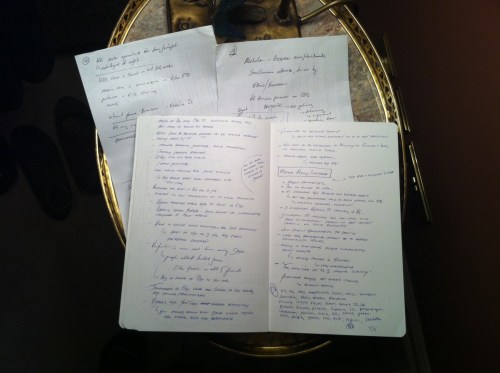
I just completed a short field mission to Kyrgyzstan with UN colleagues and I’m already looking forward to the next mission. Flipping through several dozen pages of my handwritten notes just now explains why: example after example of the astute resourcefulness and creative uses of information and communication technologies in Kyrgyzstan is inspiring. I learned heaps.

For example, one challenge that local groups faced during periods of ethnic tension and violent conflict last year was the spread of rumors, particularly via SMS. These deliberate rumors ranged from humanitarian aid being poisoned to cross border attacks carried out by a particular ethnic group. But many civil society groups were able to verify these rumors in near real-time using Skype.

When word of the conflict spread, the director of one such groups got online and invited her friends and colleagues to a dedicate Skype chat group. Within two hours, some 2,000 people across the country had joined the chat group with more knocking but the group had reached the maximum capacity allowed by Skype. (They subsequently migrated to a web-based platform to continue the real-time filtering of information from around the country).

The Skype chat was abuzz with people sharing and validating information in near real-time. When someone got wind of a rumor, they’d simply jump on Skype and ask if anyone could verify. This method proved incredibly effective. Why? Because members of this Skype group constituted a relevant, trusted and geographically distributed network. A person would only add a colleague or two to the chat if they knew who this individual was, could vouch for them and believed that they had—or could have—important information to contribute given their location and/or contacts. (This reminded me of Gmail back in the day when you only had a certain number of invites, so one tended to chose carefully how to “spend” those invites).

The degrees of separation needed to verify a rumor was close to one. In the case of the supposed border attack, one member of the chat group had a contact with the army unit guarding the border crossing in question. They called them on their cell phone and confirmed within minutes that no attack was taking place. As for the rumor about the poisoned humanitarian aid, another member of the chat found the original phone numbers from which these false SMS’s were being sent. They called a personal contact at one of the telecommunication companies and asked whether the owners of these phones were in fact texting from the place where the aid was reportedly poisoned; they weren’t. Meanwhile, another member of the chat group had himself investigated the rumor in person and confirmed that the text messages were false.

This Skype detective network proved an effective method for the early detection and response to rumors. Once a rumor was identified as such, 2,000 people could share that information with their own networks within minutes. In addition, members of this Skype group were able to ping their media contacts and have the word spread even further. In at least two cases and in two different cities, telecommunication companies also collaborated by sending out broadcast SMS to notify subscribers about the false rumors.

I wonder if this model can be further improved on and replicated. Any thoughts from iRevolution readers would be most welcome.