Category Archives: Social Media

Digital Humanitarian Response to Typhoon Pablo in Philippines

Update: Please help the UN! Tag tweets to support disaster response!

The purpose of this post is to keep notes on our efforts to date with the aim of revisiting these at a later time to write a more polished blog post on said efforts. By “Digital Humanitarian Response” I mean the process of using digital tech-nologies to aid disaster response efforts.
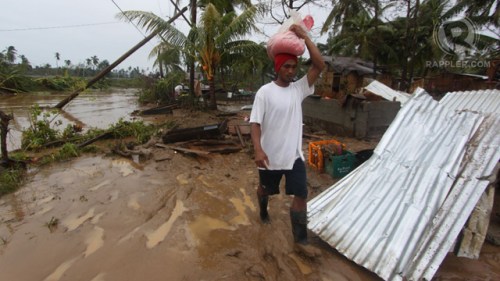
pablo-photos

My colleagues and I at QCRI have been collecting disaster related tweets on Typhoon Pablo since Monday. More specifically, we’ve been collecting those tweets with the hashtags officially endorsed by the government. There were over 13,000 relevant tweets posted on Tuesday alone. We then paid Crowdflower workers to micro-task the tagging of these hash-tagged tweets based on the following categories (click picture to zoom in):
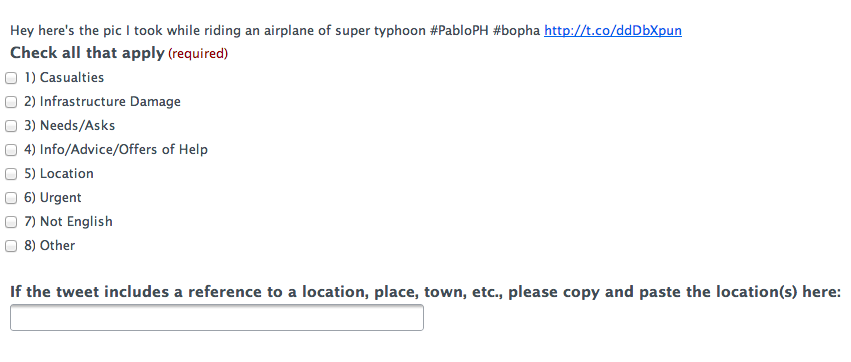
Crowdflower

Several hundred tweets were processed during the first hour. On average, about 750 tweets were processed per hour. Clearly, we’d want that number to be far higher, (hence the need to combine micro-tasking with automated algorithms, as explained in the presentation below). In any event, the micro-tasking could also be accelerated if we increased the pay to Crowdflower workers. As it is, the total cost for processing the 13,000+ tweets came to about $250.

The database of processed tweets was then shared (every couple hours) with the Standby Volunteer Task Force (SBTF). SBTF volunteers (“Mapsters”) only focused on tweets that had been geo-tagged and tagged as relevant (e.g., “Casaualties,” “Infrastructure Damage,” “Needs/Asks,” etc.) by Crowdflower workers. SBTF volunteers then mapped these tweets on a Crowdmap as part of a training exercise for new Mapsters.
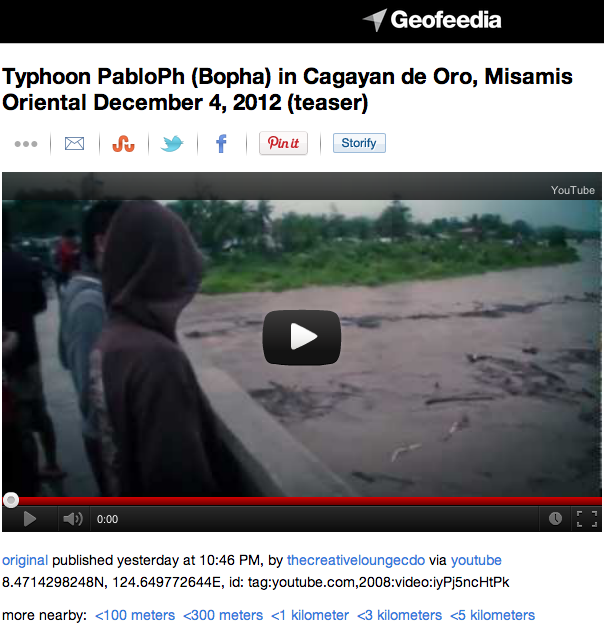
Geofeedia Pablo

We’re now talking with a humanitarian colleague in the Philippines who asked whether we can identify pictures/videos shared on social media that show damage, bridges down, flooding, etc. The catch is that these need to have a  location and time/date for them to be actionable. So I went on Geofeedia and scraped the relevant content available there (which Mapsters then added to the Crowdmap). One constraint of Geofeedia (and many other such platforms), however, is that they only map content that has been geo-tagged by users posting said content. This means we may be missing the majority of relevant content.

So my colleagues at QCRI are currently pulling all tweets posted today (Wed-nesday) and running an automated algorithm to identify tweets with URLs/links. We’ll ask Crowdflower workers to process the most recent tweets (and work backwards) by tagging those that: (1) link to pictures/video of damage/flooding, and (2) have geographic information. The plan is to have Mapsters add those tweets to the Crowdmap and to share the latter with our humanitarian colleague in the Philippines.

There are several parts of the above workflows that can (and will) be improved. I for one have already learned a lot just from the past 24 hours. But this is the subject of a future blog post as I need to get back to the work at hand.
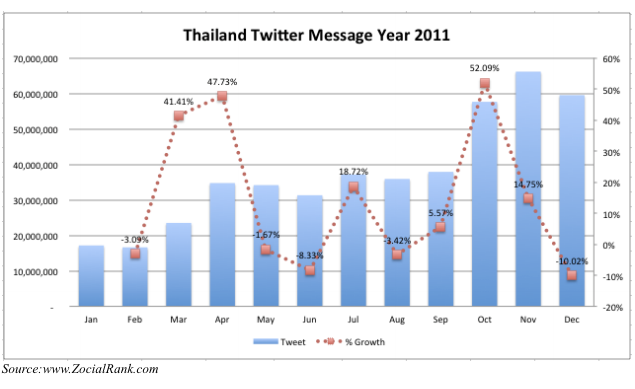
Analyzing Disaster Tweets from Major Thai Floods

The 2011 Thai Floods was one of the country’s worst disasters in recent history.  The flooding began in July and lasted until December. Over 13 million people were affected. More than 800 were killed. The World Bank estimated $45 billion in total economic damage. This new study, “The Role of Twitter during a Natural Disaster: Case Study of 2011 Thai Flood,” analyzes how twitter was used during these major floods.

The number of tweets increase significantly in October, which is when the flooding reached parts of the Bangkok Metropolitan area. The month before (Sept-to-Oct) also a notable increase of tweets, which may “demonstrate that Thais were using Twitter to search for realtime and practical information that traditional media could not provide during the natural disaster period.”

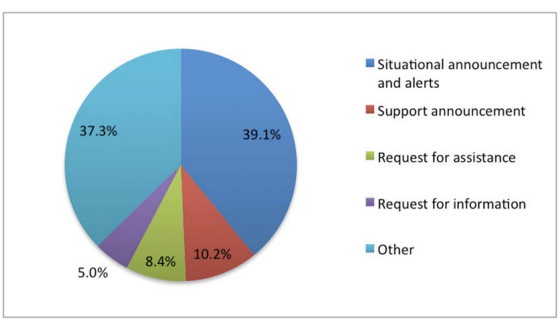
To better understand the type of information shared on Twitter during the floods, the authors analyzed 175,551 tweets that used the hashtag #thaiflood. They removed “retweets” and duplicates, yielding a dataset of 64,582 unique tweets. Using keyword analysis and a rule based approach, the authors auto-matically classified these tweets into 5 categories:

Situational Announcements and Alerts: Tweets about up-to-date situational and location-based information related to the flood such as water levels, traffic conditions and road conditions in certain areas. In addition, emergency warnings from authorities advising citizens to evacuate areas, seek shelter or take other protective measures are also included.

Support Announcements: Tweets about free parking availability, free emergency survival kits distribution and free consulting services for home repair, etc.

Requests for Assistance: Tweets requesting any types of assistance; such as food, water, medical supplies, volunteers or transportation.

Requests for Information: Tweets including general inquiries related to the flood and flood relief such as inquiries for telephone numbers of relevant authorities, regarding the current situation in specific locations and about flood damage compensation.

Other: Tweets including all other messages, such as general comments; complaints and expressions of opinions.

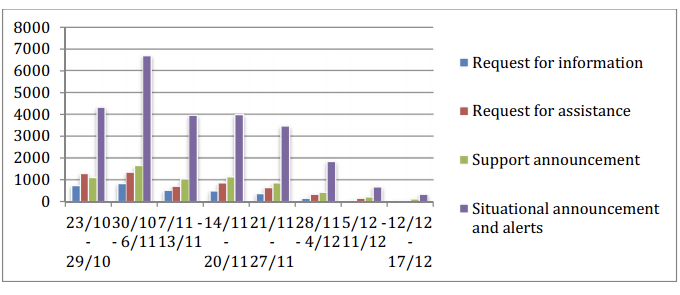
The results of this analysis are shown in the figures below. The first shows the number of tweets per each category, while the second shows the distribution of these categories over time.

Messages posted during the first few weeks “included current water levels in certain areas and roads; announcements for free parking availability; requests for volunteers to make sandbags and pack emergency survival kits; announce-ments for evacuation in certain areas and requests for boats, food, water supplies and flood donation information. For the last few weeks when water started to recede, Tweet messages included reports on areas where water had receded, information on home cleaning andrepair and guidance regarding the process to receive flood damage compensation from the government.”

To determine the credibility of tweets, the authors identify the top 10 most re-tweeted users during the floods. They infer that the most retweeted tweets signal that the content of said tweets is perceived as credible. “The majority of these top users are flood/disaster related government or private organizations.” Siam Arsa, one of the leading volunteer networks helping flood victims in Thailand, was one of the top users ranked by retweets. The group utilizes social media on both Facebook  (www.facebook.com/siamarsa) and Twitter (@siamarsa) to share information about flooding and related volunteer work.”

In conclusion, “if the government plans to implement social media as a tool for disaster response, it would be well advised to prepare some measures or pro-tocols that help officials verify incoming information and eliminate false information. The  citizens should also be educated to take caution when receiving news and information via social media, and to think carefully about the potential effect before disseminating certain content.”

Gov Twitter

My QCRI colleagues and I are collecting tweets about Typhoon Pablo, which is making landfall in the Philippines. We’re specifically tracking tweets with one or more of the following hashtags: #PabloPh, #reliefPH and #rescuePH, which the government is publicly encouraging Filipinos to use. We hope to carry out an early analysis of these tweets to determine which ones provide situational aware-ness. The purpose of this applied action research is to ultimately develop a real-time dashboard for humanitarian response. This explains why we launched this Library of Crisis Hashtags. For further reading, please see this post on “What Percentage of Tweets Generated During a Crisis Are Relevant for Humanitarian Response?”

To Tweet or Not To Tweet During a Disaster?

Yes, only a small percentage of tweets generated during a disaster are directly relevant and informative for disaster response. No, this doesn’t mean we should dismiss Twitter as a source for timely, disaster-related information. Why? Because our efforts ought to focus on how that small percentage of informative tweets can be increased. What incentives or policies can be put in place? The following tweets by the Filipino government may shed some light.

Gov Twitter Pablo

The above tweet was posted three days before Typhoon Bopha (designated Pablo locally) made landfall in the Philippines. In the tweet below, the government directly and publicly encourages Filipinos to use the #PabloPH hashtag and to follow the Philippine Atmospheric, Geophysical & Astronomical Services Admin-istration (PAGASA) twitter feed, @dost_pagasa, which has over 400,000 follow-ers and also links to this official Facebook page.

Gov Twitter

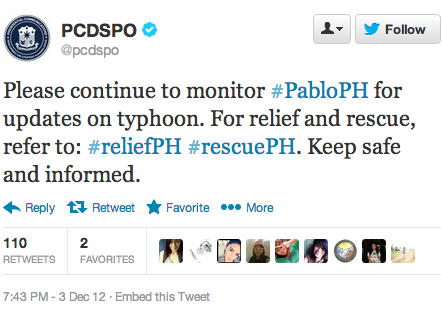
The government’s official Twitter handle (@govph) is also retweeting tweets posted by The Presidential Communications Development and Strategic Plan-ning Office (@PCDCSO). This office is the “chief message-crafting body of the Office of the President.” In one such retweet (below), the office encourages those on Twitter to use different hashtags for different purposes (relief vs rescue). This mimics the use of official emergency numbers for different needs, e.g., police, fire, Ambulance, etc.

Twitter Pablo Gov

Given this kind of enlightened disaster response leadership, one would certainly expect that the quality of tweets received will be higher than without government endorsement. My team and I at QCRI are planning to analyze these tweets to de-termine whether or not this is the case. In the meantime, I expect we’ll see more examples of self-organized disaster response efforts using these hashtags, as per the earlier floods in August, which I blogged about here: Crowdsourcing Crisis Response following the Philippine Floods. This tech-savvy self-organization dynamic is important since the government itself may be unable to follow up on every tweeted request.

Sentiment Analysis of #COP18 Tweets from the UN Climate Conference

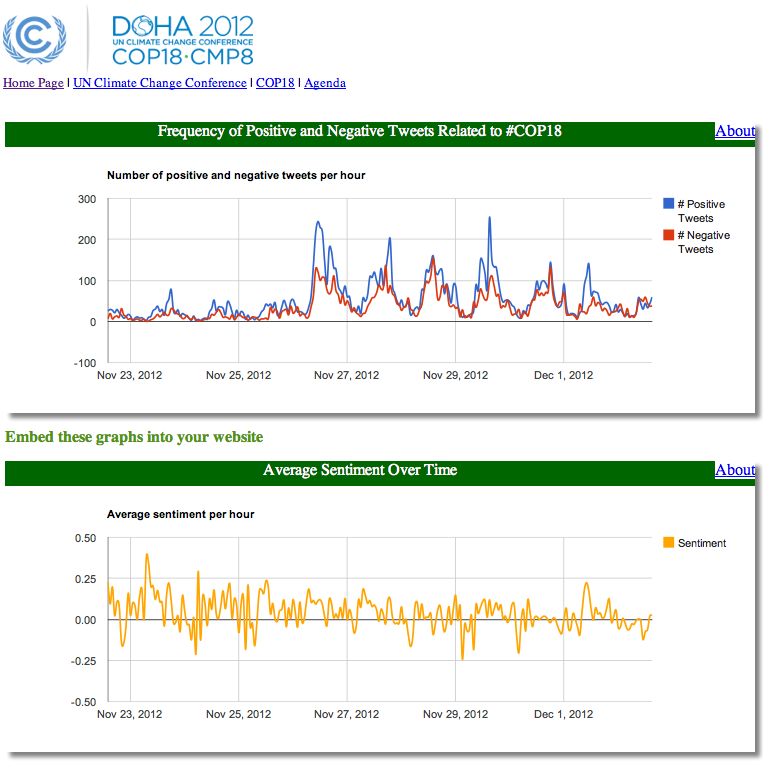
The Qatar Foundation’s Computing Research Institute (QCRI) has just launched a live sentiment analysis tool of all #COP18 tweets being posted during the United Nations (UN) Climate Change Conference in Doha, Qatar. The event kicked off on Monday, November 26th and will conclude on Friday, December 7th. While the world’s media is actively covering COP18, social media reports are equally insightful. This explains the rationale behind QCRI’s Live #COP18 Twitter Sentiment Analysis Tool.

QCRI_COP18_Sentiment_Analysis

The first timeline displays the number of positive versus negative tweets posted with the COP18 hashtag. The tweets are automatically tagged as positive or negative using the SentiStrength algorithm, which has the same level of accuracy as that of a person if s/he were to manually tag the tweets. The second timeline simply depicts the average sentiment of #COP18 tweets. Both graphs are auto-matically updated every hour. Note that tweets in all languages are analyzed, not just English-language tweets.

These timelines enable journalists, activists and others to monitor the general mood and reaction to presentations, announcements & conversations happening at the UN Climate Conference. For example, we see a major spike in positive tweets (and to a lesser extent negative tweets) between 10am-11am on November 26th. This is when the Opening Ceremony kicks off, as can be seen from the conference agenda.

Screen Shot 2012-12-01 at 9.30.25 AM

The next highest peak occurs between 6pm-7pm on the 27th, which corresponds to the opening plenary of the Ad Hoc Working Group on the Durban Platform for Enhanced Action (ADP). This group is tasked with establishing an agreement that will legally bind all parties to climate targets for the first time. The tweets are primarily positive, which may reflect a positive start to negotiations on opera-tionalizing the Durban Platform. This news article appears to support this hypo-thesis. At 2pm time on November 28th, the number of positive and negative tweets both peak at approximately the same number, 160 tweets. Twitter users may be evenly divided on a topic being discussed.

QCRI Sentiment Analysis

To find out more, simply scroll to the right of the timelines. You’ll see two twitter streams displayed. The first provides a list of selected positive and negative tweets. More specifically, the most frequently retweeted positive and negative tweets for each day are displayed. This feature enables users to understand how some tweets are driving the sentiment analyses displayed on the timelines. The second twitter stream displays the most recent tweets on the UN Conference.

If you’re interested in displaying these live graphs on your website, simply click on the “Embed link” to grab the code. The code is free, we simply ask that you credit and link to QCRI. If you analyze #COP18 tweets using these timelines, please let us know so we can benefit from your insights during this pivotal conference. The sentiment analysis dashboard was put together by QCRI’s Sofiane AbbarWalid Magdy and myself. We welcome your feedback on how to make this dashboard more useful for future conferences and events. Please note that this site was put together “overnight”; i.e., it was rushed. As such it is only an initial prototype.

Predicting the Credibility of Disaster Tweets Automatically

“Predicting Information Credibility in Time-Sensitive Social Media” is one of this year’s most interesting and important studies on “information forensics”. The analysis, co-authored by my QCRI colleague ChaTo Castello, will be published in Internet Research and should be required reading for anyone interested in the role of social media for emergency management and humanitarian response. The authors study disaster tweets and find that there are measurable differences in the way they propagate. They show that “these differences are related to the news-worthiness and credibility of the information conveyed,” a finding that en-abled them to develop an automatic and remarkably accurate way to identify credible information on Twitter.

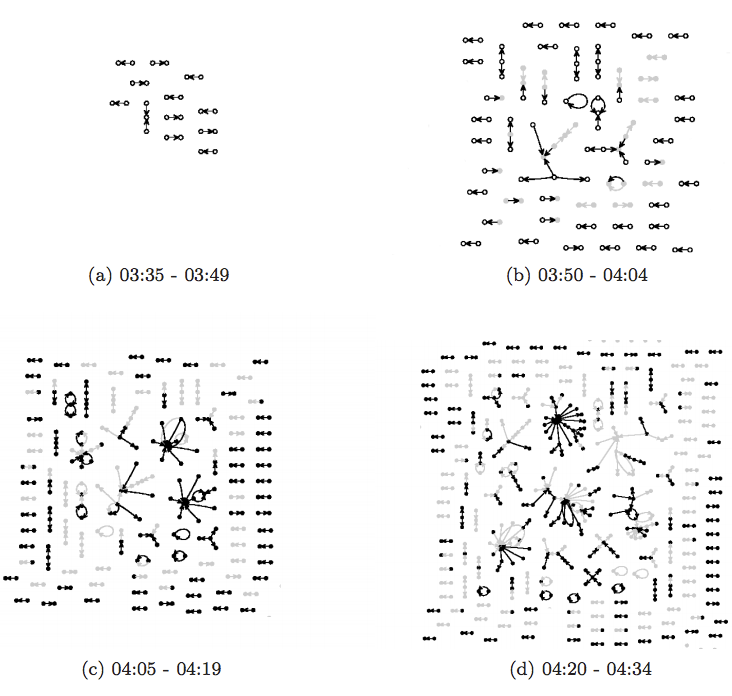
The new study builds on this previous research, which analyzed the veracity of tweets during a major disaster. The research found “a correlation between how information propagates and the credibility that is given by the social network to it. Indeed, the reflection of real-time events on social media reveals propagation patterns that surprisingly has less variability the greater a news value is.” The graphs below depict this information propagation behavior during the 2010 Chile Earthquake.

The graphs depict the re-tweet activity during the first hours following earth-quake. Grey edges depict past retweets. Some of the re-tweet graphs reveal interesting patterns even within 30-minutes of the quake. “In some cases tweet propagation takes the form of a tree. This is the case of direct quoting of infor-mation. In other cases the propagation graph presents cycles, which indicates that the information is being commented and replied, as well as passed on.” When studying false rumor propagation, the analysis reveals that “false rumors tend to be questioned much more than confirmed truths […].”

Building on these insights, the authors studied over 200,000 disaster tweets and identified 16 features that best separate credible and non-credible tweets. For example, users who spread credible tweets tend to have more followers. In addition, “credible tweets tend to include references to URLs which are included on the top-10,000 most visited domains on the Web. In general, credible tweets tend to include more URLs, and are longer than non credible tweets.” Further-more, credible tweets also tend to express negative feelings whilst non-credible tweets concentrate more on positive sentiments. Finally, question- and exclama-tion-marks tend to be associated with non-credible tweets, as are tweets that use first and third person pronouns. All 16 features are listed below.

• Average number of tweets posted by authors of the tweets on the topic in past.
• Average number of followees of authors posting these tweets.
•  Fraction of tweets having a positive sentiment.
•  Fraction of tweets having a negative sentiment.
•  Fraction of tweets containing a URL that contain most frequent URL.
•  Fraction of tweets containing a URL.
•  Fraction of URLs pointing to a domain among top 10,000 most visited ones.
•  Fraction of tweets containing a user mention.
•  Average length of the tweets.
•  Fraction of tweets containing a question mark.
•  Fraction of tweets containing an exclamation mark.
•  Fraction of tweets containing a question or an exclamation mark.
•  Fraction of tweets containing a “smiling” emoticons.
•  Fraction of tweets containing a first-person pronoun.
•  Fraction of tweets containing a third-person pronoun.
•  Maximum depth of the propagation trees.

Using natural language processing (NLP) and machine learning (ML), the authors used the insights above to develop an automatic classifier for finding credible English-language tweets. This classifier had a 86% AUC. This measure, which ranges from 0 to 1, captures the classifier’s predictive quality. When applied to Spanish-language tweets, the classifier’s AUC was still relatively high at 82%, which demonstrates the robustness of the approach.

Interested in learning more about “information forensics”? See this link and the articles below:

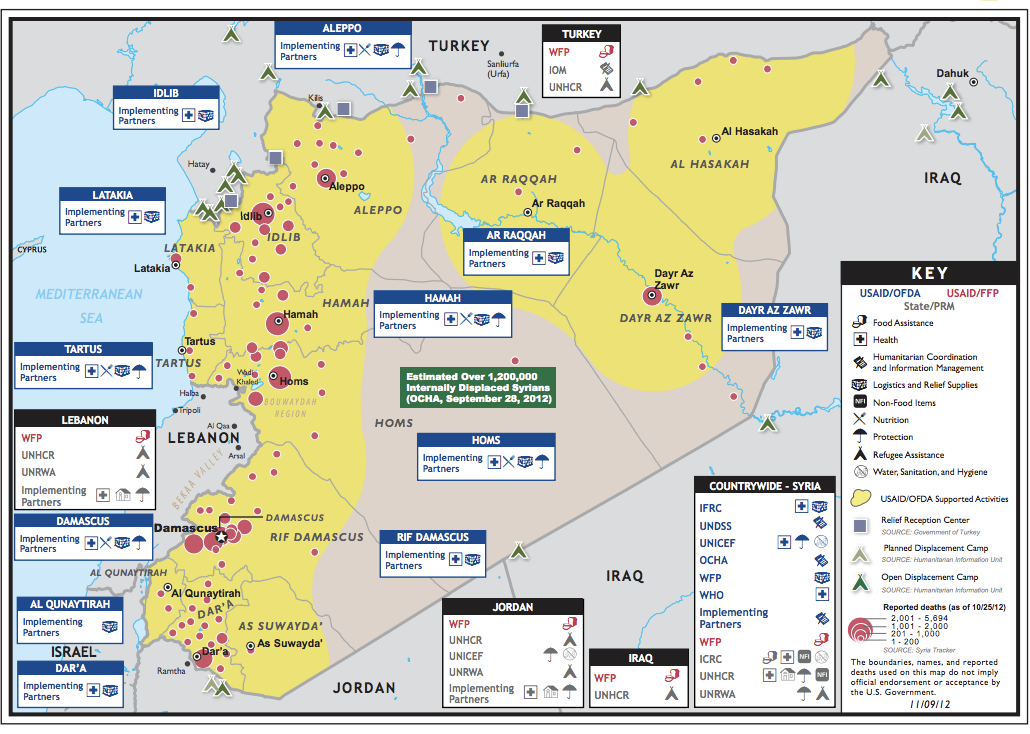
Why USAID’s Crisis Map of Syria is so Unique

While static, this crisis map includes a truly unique detail. Click on the map below to see a larger version as this may help you spot what is so striking.

For a hint, click this link. Still stumped? Look at the sources listed in the Key.


Rapidly Verifying the Credibility of Information Sources on Twitter

One of the advantages of working at QCRI is that I’m regularly exposed to peer-reviewed papers presented at top computing conferences. This is how I came across an initiative called “Seriously Rapid Source Review” or SRSR. As many iRevolution readers know, I’m very interested in information forensics as applied to crisis situations. So SRSR certainly caught my attention.

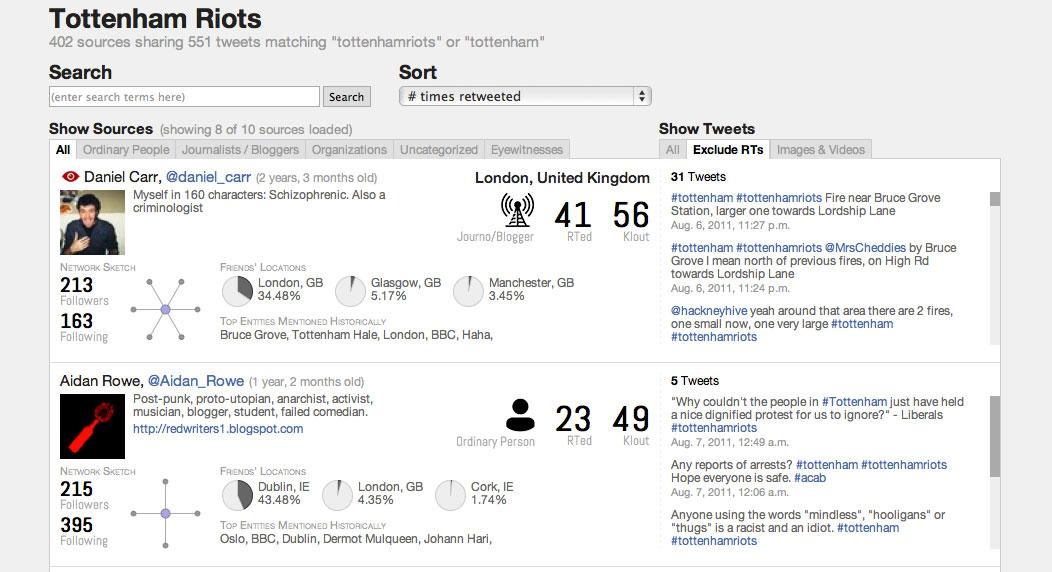
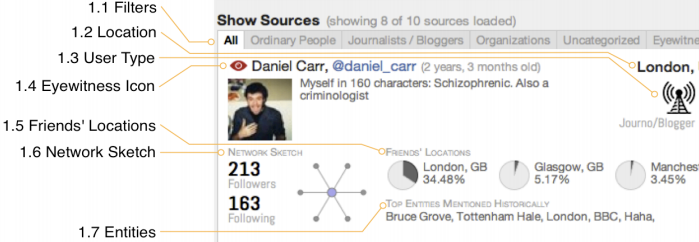
The team behind SRSR took a human centered design approach in order to integrate journalistic practices within the platform. There are four features worth noting in this respect. The first feature to note in the figure below is the automated filter function, which allows one to view tweets generated by “Ordinary People,” “Journalists/Bloggers,” “Organizations,” “Eyewitnesses” and “Uncategorized.” The second feature, Location, “shows a set of pie charts indica-ting the top three locations where the user’s Twitter contacts are located. This cue provides more location information and indicates whether the source has a ‘tie’ or other personal interest in the location of the event, an aspect of sourcing exposed through our preliminary interviews and suggested by related work.”


The third feature worth noting is the “Eyewitness” icon. The SRSR team developed the first ever automatic classifier to identify eyewitness reports shared on Twitter. My team and I at QCRI are developing a second one that focuses specifically on automatically classifying eyewitness reports during sudden-onset natural disasters. The fourth feature is “Entities,” which displays the top five entities that the user has mentioned in their tweet history. These include references to organizations, people and places, which can reveal important patterns about the twitter user in question.

Journalists participating in this applied research found the “Location” feature particularly important when assess the credibility of users on Twitter. They noted that “sources that had friends in the location of the event were more believable, indicating that showing friends’ locations can be an indicator of credibility.” One journalist shared the following: “I think if it’s someone without any friends in the region that they’re tweeting about then that’s not nearly as authoritative, whereas if I find somebody who has 50% of friends are in [the disaster area], I would immediately look at that.”

In addition, the automatic identification of “eyewitnesses” was deemed essential by journalists who participated in the SRSR study. This should not be surprising since “news organizations often use eyewitnesses to add credibility to reports by virtue of the correspondent’s on-site proximity to the event.” Indeed, “Witness-ing and reporting on what the journalist had witnessed have long been seen as quintessential acts of journalism.” To this end, “social media provides a platform where once passive witnesses can become active and share their eyewitness testimony with the world, including with journalists who may choose to amplify their report.”

In sum, SRSR could be used to accelerate the verification of social media con-tent, i.e., go beyond source verification alone. For more on SRSR, please see this computing paper (PDF), which was authored by Nicholas Diakopoulos, Munmun De Choudhury and Mor Naaman.

The Most Impressive Live Global Twitter Map, Ever?

My colleague Kalev Leetaru has just launched The Global Twitter Heartbeat Project in partnership with the Cyber Infrastructure and Geospatial Information Laboratory (CIGI) and GNIP. He shared more information on this impressive initiative with the CrisisMappers Network this morning.

According to Kalev, the project “uses an SGI super-computer to visualize the Twitter Decahose live, applying fulltext geocoding to bring the number of geo-located tweets from 1% to 25% (using a full disambiguating geocoder that uses all of the user’s available information in the Twitter stream, not just looking for mentions of major cities), tone-coding each tweet using a twitter-customized dictionary of 30,000 terms, and applying a brand-new four-stage heatmap engine (this is where the supercomputer comes in) that makes a map of the number of tweets from or about each location on earth, a second map of the average tone of all tweets for each location, a third analysis of spatial proximity (how close tweets are in an area), and a fourth map as needed for the percent of all of those tweets about a particular topic, which are then all brought together into a single heatmap that takes all of these factors into account, rather than a sequence of multiple maps.”

Kalev added that, “For the purposes of this demonstration we are processing English only, but are seeing a nearly identical spatial profile to geotagged all-languages tweets (though this will affect the tonal results).” The Twitterbeat team is running a live demo showing both a US and world map updated in realtime at Supercomputing on a PufferSphere and every few seconds on the SGI website here.”


So why did Kalev share all this with the CrisisMappers Network? Because he and his team created a rather unique crisis map composed of all tweets about Hurricane Sandy, see the YouTube video above. “[Y]ou  can see how the whole country lights up and how tweets don’t just move linearly up the coast as the storm progresses, capturing the advance impact of such a large storm and its peripheral effects across the country.” The team also did a “similar visualization of the recent US Presidential election showing the chaotic nature of political communication in the Twittersphere.”


To learn more about the project, I recommend watching Kalev’s 2-minute introductory video above.

What Percentage of Tweets Generated During a Crisis Are Relevant for Humanitarian Response?

More than half-a-million tweets were generated during the first three days of Hurricane Sandy and well over 400,000 pictures were shared via Instagram. Last year, over one million tweets were generated every five minutes on the day that Japan was struck by a devastating earthquake and tsunami. Humanitarian organi-zations are ill-equipped to manage this volume and velocity of information. In fact, the lack of analysis of this “Big Data” has spawned all kinds of suppositions about the perceived value—or lack thereof—that social media holds for emer-gency response operations. So just what percentage of tweets are relevant for humanitarian response?

One of the very few rigorous and data-driven studies that addresses this question is Dr. Sarah Vieweg‘s 2012 doctoral dissertation on “Situational Awareness in Mass Emergency: Behavioral and Linguistic Analysis of Disaster Tweets.” After manually analyzing four distinct disaster datasets, Vieweg finds that only 8% to 20% of tweets generated during a crisis provide situational awareness. This implies that the vast majority of tweets generated during a crisis have zero added value vis-à-vis humanitarian response. So critics have good reason to be skeptical about the value of social media for disaster response.

At the same time, however, even if we take Vieweg’s lower bound estimate, 8%, this means that over 40,000 tweets generated during the first 72 hours of Hurricane Sandy may very well have provided increased situational awareness. In the case of Japan, more than 100,000 tweets generated every 5 minutes may have provided additional situational awareness. This volume of relevant infor-mation is much higher and more real-time than the information available to humanitarian responders via traditional channels.

Furthermore, preliminary research by QCRI’s Crisis Computing Team show that 55.8% of 206,764 tweets generated during a major disaster last year were “Informative,” versus 22% that were “Personal” in nature. In addition, 19% of all tweets represented “Eye-Witness” accounts, 17.4% related to information about “Casualty/Damage,” 37.3% related to “Caution/Advice,” while 16.6% related to “Donations/Other Offers.” Incidentally, the tweets were automatically classified using algorithms developed by QCRI. The accuracy rate of these ranged from 75%-81% for the “Informative Classifier,” for example. A hybrid platform could then push those tweets that are inaccurately classified to a micro-tasking platform for manual classification, if need be.

This research at QCRI constitutes the first phase of our work to develop a Twitter Dashboard for the Humanitarian Cluster System, which you can read more about in this blog post. We are in the process of analyzing several other twitter datasets in order to refine our automatic classifiers. I’ll be sure to share our preliminary observations and final analysis via this blog.

What Was Novel About Social Media Use During Hurricane Sandy?

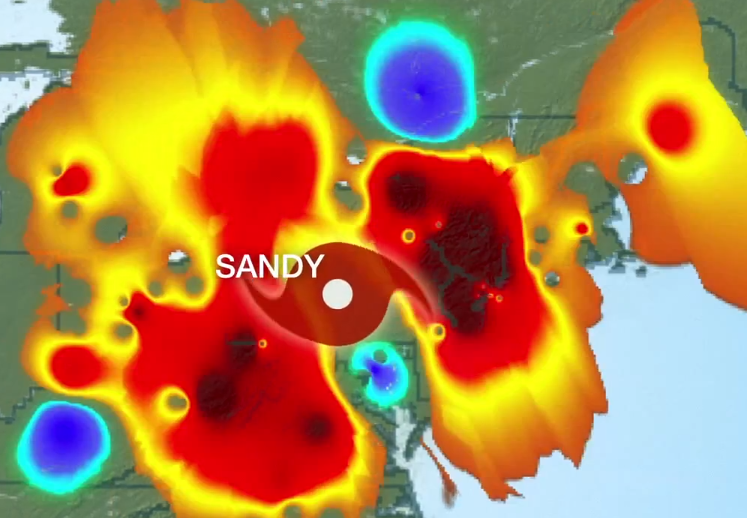
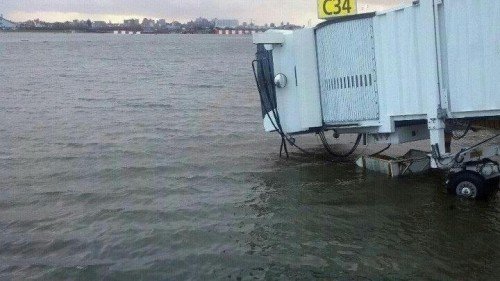
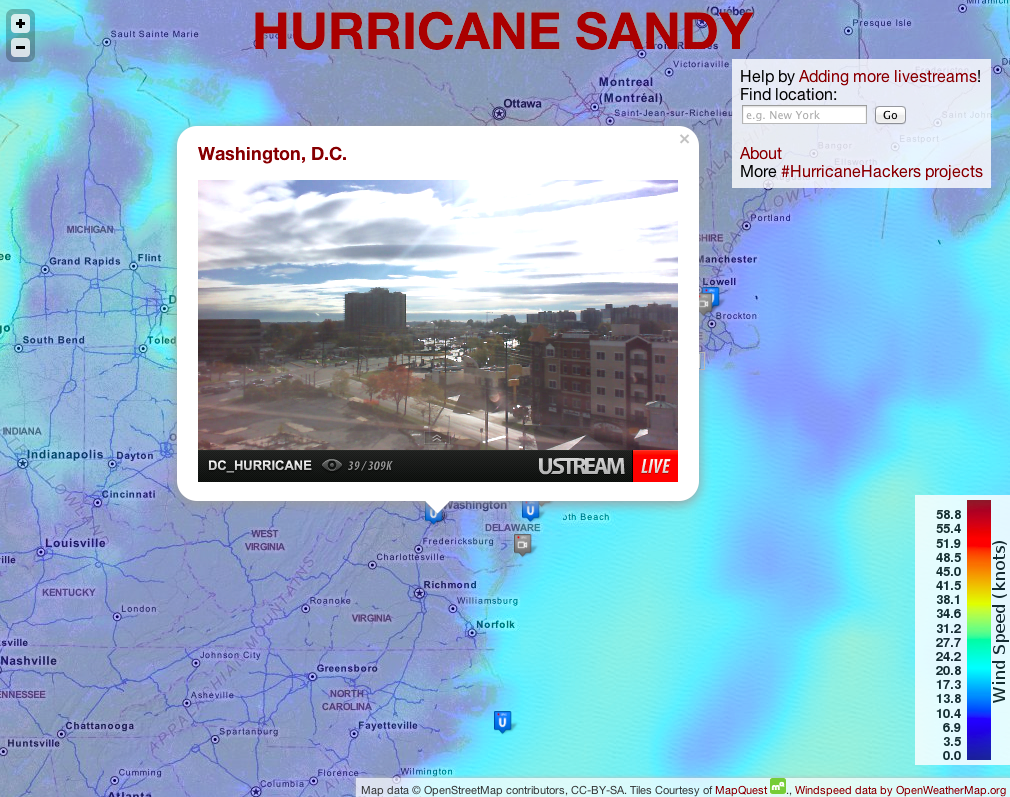
We saw the usual spikes in Twitter activity and the typical (reactive) launch of crowdsourced crisis maps. We also saw map mashups combining user-generated content with scientific weather data. Facebook was once again used to inform our social networks: “We are ok” became the most common status update on the site. In addition, thousands of pictures where shared on Instagram (600/minute), documenting both the impending danger & resulting impact of Hurricane Sandy. But was there anything really novel about the use of social media during this latest disaster?

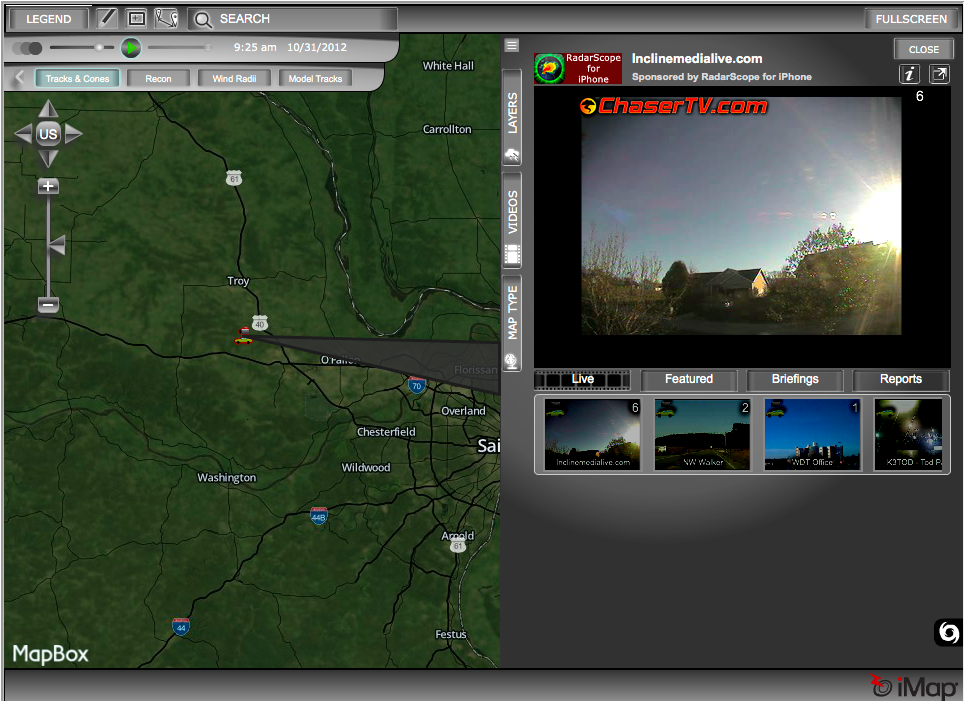
I’m asking not because I claim to know the answer but because I’m genuinely interested and curious. One possible “novelty” that caught my eye was this FrankenFlow experiment to “algorithmically curate” pictures shared on social media. Perhaps another “novelty” was the embedding of webcams within a number of crisis maps, such as those below launched by #HurricaneHacker and Team Rubicon respectively.

Another “novelty” that struck me was how much focus there was on debunking false information being circulated during the hurricane—particularly images. The speed of this debunking was also striking. As regular iRevolution readers will know, “information forensics” is a major interest of mine.

This Tumblr post was one of the first to emerge in response to the fake pictures (30+) of the hurricane swirling around the social media whirlwind. Snopes.com also got in on the action with this post. Within hours, The Atlantic Wire followed with this piece entitled “Think Before You Retweet: How to Spot a Fake Storm Photo.” Shortly after, Alexis Madrigal from The Atlantic published this piece on “Sorting the Real Sandy Photos from the Fakes,” like the one below.

These rapid rumor-bashing efforts led BuzzFeed’s John Herman to claim that Twitter acted as a truth machine: “Twitter’s capacity to spread false information is more than cancelled out by its savage self-correction.” This is not the first time that journalists or researchers have highlighted Twitter’s tendency for self-correction. This peer-reviewed, data-driven study of disaster tweets generated during the 2010 Chile Earthquake reports the same finding.

What other novelties did you come across? Are there other interesting, original and creative uses of social media that ought to be documented for future disaster response efforts? I’d love to hear from you via the comments section below. Thanks!