Category Archives: Big Data

State of the Art in Digital Disease Detection

Larry Brilliant’s TED Talk back in 2006 played an important role in catalyzing my own personal interest in humanitarian technology. Larry spoke about the use of natural language processing and computational linguistics for the early detection and early response to epidemics. So it was with tremendous honor and deep gratitude that I delivered the first keynote presentation at Harvard University’s Digital Disease Detection (DDD) conference earlier this year.

The field of digital disease detection has remained way ahead of the curve since 2006 in terms of leveraging natural language processing, computational linguistics and now crowdsourcing for the purposes of early detection of critical events. I thus highly, highly recommend watching the videos of the DDD Ignite Talks and panel presentations, which are all available here. Topics include “Participatory Surveillance,” “Monitoring Rumors,” “Twitter and Disease Detection,” “Search Query Surveillance,” “Open Source Surveillance,” “Mobile Disease Detection,” etc. The presentation on BioCaster is also well worth watching. I blogged about BioCaster here over three years ago and the platform is as impressive as ever.

These public health experts are really operating at the cutting-edge and their insights are proving important to the broader humanitarian technology community. To be sure, the potential added value of cross-fertilization between fields is tremendous. Just take this example of a public health data mining platform (HealthMap) being used by Syrian activists to detect evidence of killings and human rights violations.

Using Rayesna to Track the 2012 Egyptian Presidential Candidates on Twitter

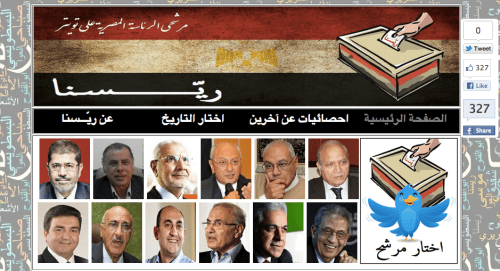
My (future) colleague at the Qatar Foundation’s Computing Research Institute (QCRI) have just launched a new platform that Al Jazeera is using to track the 2012 Egyptian Presidential Candidates on Twitter. Called Rayesna, which  means “our president” in colloquial Egyptian Arabic, this fully automated platform uses cutting-edge Arabic computational linguistics processing developed by the Arabic Language Technology (ALT) group at QCRI.

“Through Rayesna, you can find out how many times a candidate is mentioned, which other candidate he is likely to appear with, and the most popular tweets for a candidate, with a special category for the most retweeted jokes about the candidates. The site also has a time-series to explore and compares the mentions of the candidate day-by-day. Caveats: 1. The site reflects only the people who choose to tweet, and this group may not be representative of general society; 2. Tweets often contain foul language and we do not perform any filtering.”

I look forward to collaborating with the ALT group and exploring how their platform might also be used in the context of humanitarian response in the Arab World and beyond. There may also be important synergies with the work of the UN Global Pulse, particularly vis-a-vis their use of Twitter for real-time analysis of vulnerable communities.

Twitcident: Filtering Tweets in Real-Time for Crisis Response

The most recent newcomer to the “tweetsourcing” space comes to us from Delft University of Technology in the Netherlands. Twitcident is a web-based filtering system that extracts crisis information from Twitter in real-time to support emergency response efforts. Dutch emergency services have been testing the platform over the past 10 months and results “show the system to be far more useful than simple keyword searching of a twitter feed” (NewScientist).

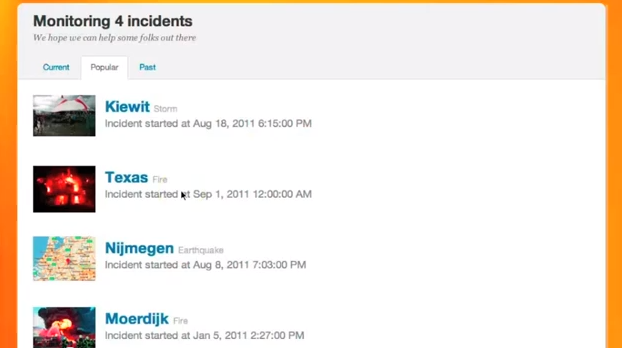
Here’s how it works. First the dashboard, which shows current events-of-interest being monitored.

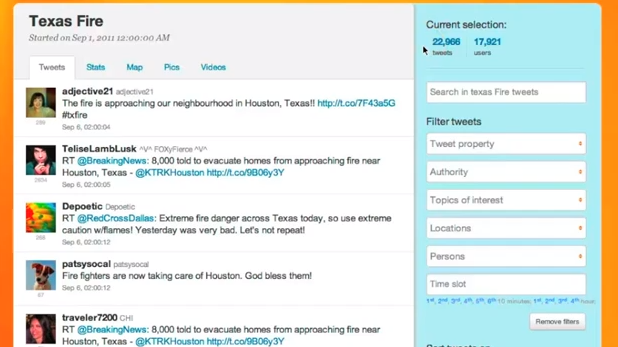
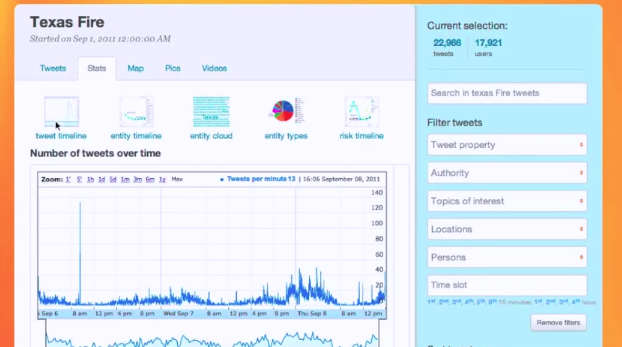
Lets click on “Texas”, which produces the following page. More than 22,000 tweets potentially relate to the actual fire of interest.

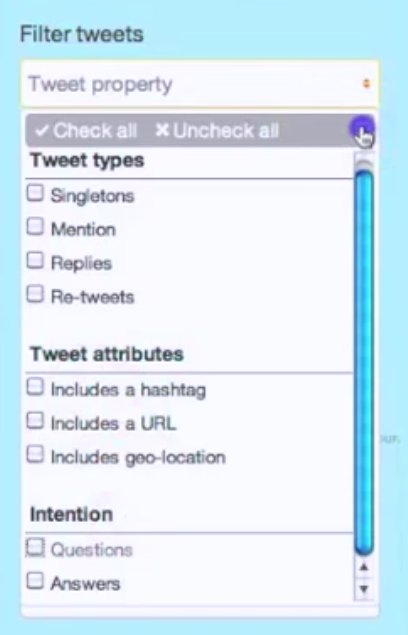
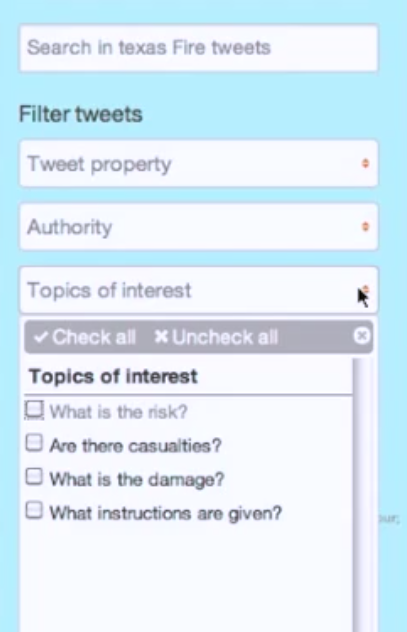
This is where the filtering comes in:

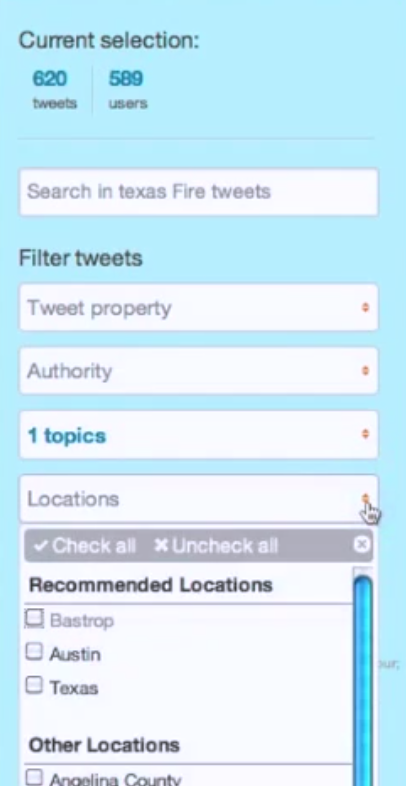
The number of relevant tweets is reduced with every applied filter.

Naturally, geo-location is also an optional filter.

Twitcident also allows for various visualization options, including timelines, word clouds and charts.

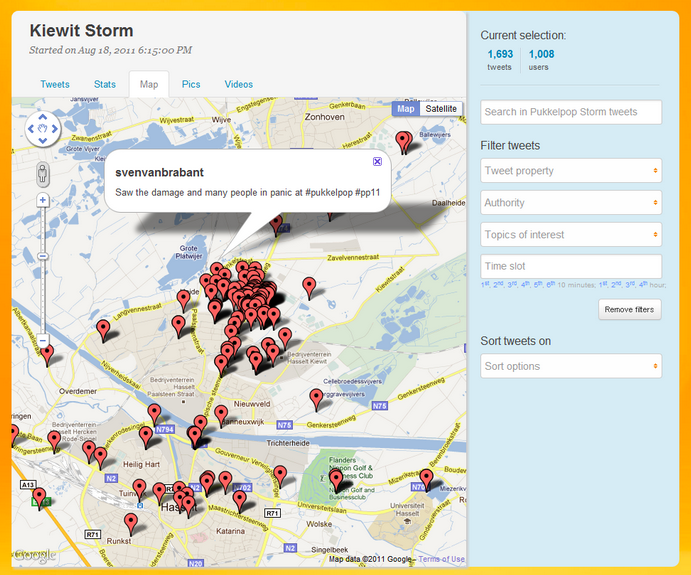
The system also allows the user to view the filtered tweets on a map. The pictures and videos shared via twitter are also aggregated and viewable on dedicated tabs.

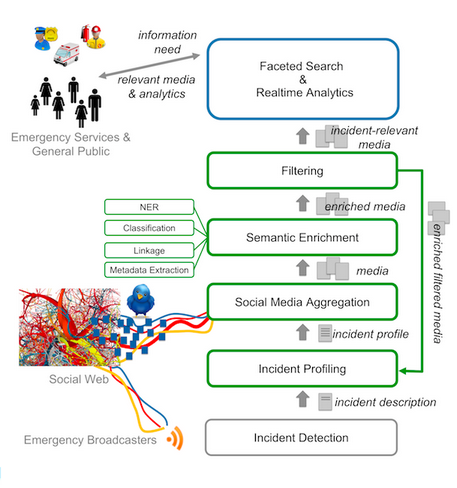
The developers of the platform have not revealed how their algorithms work but will demo the tool at the World Wide Web 2012 conference in France next week. In the meantime, here’s a graphic that summarizes the platform workflow.

I look forward to following Twitcident’s developments. I’d be particularly interested in learning more about how Dutch emergency services have been using the tool and what features they think would improve the platform’s added value.

Crisis Mapping Syria: Automated Data Mining and Crowdsourced Human Intelligence

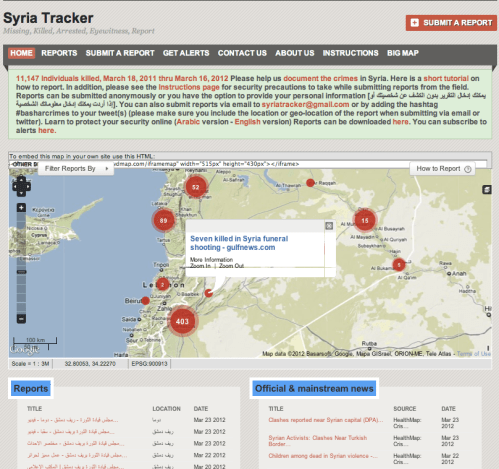
The Syria Tracker Crisis Map is without doubt one of the most impressive crisis mapping projects yet. Launched just a few weeks after the protests began one year ago, the crisis map is spearheaded by a just handful of US-based Syrian activists have meticulously and systematically documented 1,529 reports of human rights violations including a total of 11,147 killings. As recently reported in this NewScientist article, “Mapping the Human Cost of Syria’s Uprising,” the crisis map “could be the most accurate estimate yet of the death toll in Syria’s uprising […].” Their approach? “A combination of automated data mining and crowdsourced human intelligence,” which “could provide a powerful means to assess the human cost of wars and disasters.”

On the data-mining side, Syria Tracker has repurposed the HealthMap platform, which mines thousands of online sources for the purposes of disease detection and then maps the results, “giving public-health officials an easy way to monitor local disease conditions.” The customized version of this platform for Syria Tracker (ST), known as HealthMap Crisis, mines English information sources for evidence of human rights violations, such as killings, torture and detainment. As the ST Team notes, their data mining platform “draws from a broad range of sources to reduce reporting biases.” Between June 2011 and January 2012, for example, the platform collected over 43,o00 news articles and blog posts from almost 2,000 English-based sources from around the world (including some pro-regime sources).

Syria Tracker combines the results of this sophisticated data mining approach with crowdsourced human intelligence, i.e., field-based eye-witness reports shared via webform, email, Twitter, Facebook, YouTube and voicemail. This naturally presents several important security issues, which explains why the main ST website includes an instructions page detailing security precautions that need to be taken while sub-mitting reports from within Syria. They also link to this practical guide on how to protect your identity and security online and when using mobile phones. The guide is available in both English and Arabic.

Eye-witness reports are subsequently translated, geo-referenced, coded and verified by a group of volunteers who triangulate the information with other sources such as those provided by the HealthMap Crisis platform. They also filter the reports and remove dupli-cates. Reports that have a low con-fidence level vis-a-vis veracity are also removed. Volunteers use a dig-up or vote-up/vote-down feature to “score” the veracity of eye-witness reports. Using this approach, the ST Team and their volunteers have been able to verify almost 90% of the documented killings mapped on their platform thanks to video and/or photographic evidence. They have also been able to associate specific names to about 88% of those reported killed by Syrian forces since the uprising began.

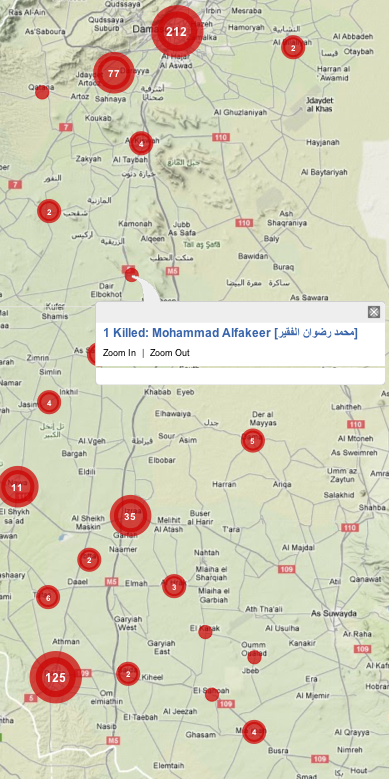
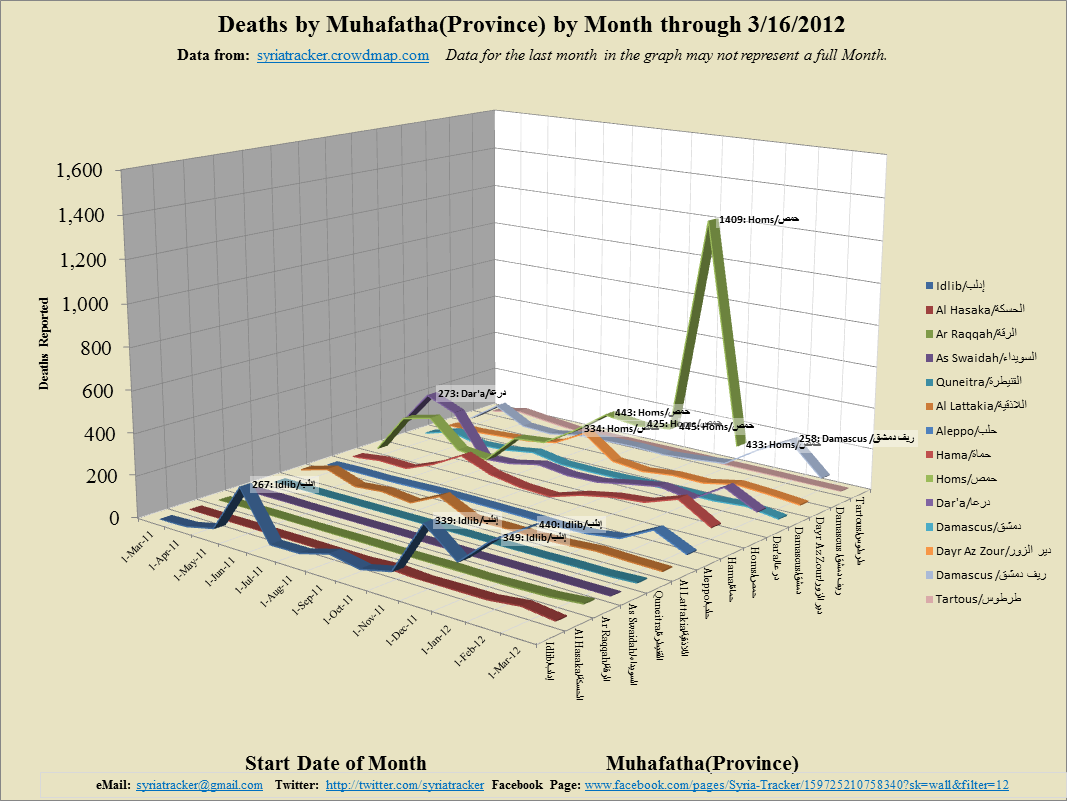
Depending on the levels of violence in Syria, the turn-around time for a report to be mapped on Syria Tracker is between 1-3 days. The team also produces weekly situation reports based on the data they’ve collected along with detailed graphical analysis. KML files that can be uploaded and viewed using Google Earth are also made available on a regular basis. These provide “a more precisely geo-located tally of deaths per location.”

In sum, Syria Tracker is very much breaking new ground vis-a-vis crisis mapping. They’re combining automated data mining technology with crowdsourced eye-witness reports from Syria. In addition, they’ve been doing this for a year, which makes the project the longest running crisis maps I’ve seen in a hostile environ-ment. Moreover, they’ve been able to sustain these import efforts with just a small team of volunteers. As for the veracity of the collected information, I know of no other public effort that has taken such a meticulous and rigorous approach to documenting the killings in Syria in near real-time. On February 24th, Al-Jazeera posted the following estimates:

Syrian Revolution Coordination Union: 9,073 deaths
Local Coordination Committees: 8,551 deaths
Syrian Observatory for Human Rights: 5,581 deaths

At the time, Syria Tracker had a total of 7,901 documented killings associated with specific names, dates and locations. While some duplicate reports may remain, the team argues that “missing records are a much bigger source of error.” Indeed, They believe that “the higher estimates are more likely, even if one chooses to disregard those reports that came in on some of the most violent days where names were not always recorded.”

The Syria Crisis Map itself has been viewed by visitors from 136 countries around the world and 2,018 cities—with the top 3 cities being Damascus, Washington DC and, interestingly, Riyadh, Saudia Arabia. The witnessing has thus been truly global and collective. When the Syrian regime falls, “the data may help sub-sequent governments hold him and other senior leaders to account,” writes the New Scientist. This was one of the principle motivations behind the launch of the Ushahidi platform in Kenya over four years ago. Syria Tracker is powered by Ushahidi’s cloud-based platform, Crowdmap. Finally, we know for a fact that the International Criminal Court (ICC) and Amnesty International (AI) closely followed the Libya Crisis Map last year.

Twitter, Crises and Early Detection: Why “Small Data” Still Matters

My colleagues John Brownstein and Rumi Chunara at Harvard Univer-sity’s HealthMap project are continuing to break new ground in the field of Digital Disease Detection. Using data obtained from tweets and online news, the team was able to identify a cholera outbreak in Haiti weeks before health officials acknowledged the problem publicly. Meanwhile, my colleagues from UN Global Pulse partnered with Crimson Hexagon to forecast food prices in Indonesia by carrying out sentiment analysis of tweets. I had actually written this blog post on Crimson Hexagon four years ago to explore how the platform could be used for early warning purposes, so I’m thrilled to see this potential realized.

There is a lot that intrigues me about the work that HealthMap and Global Pulse are doing. But one point that really struck me vis-a-vis the former is just how little data was necessary to identify the outbreak. To be sure, not many Haitians are on Twitter and my impression is that most humanitarians have not really taken to Twitter either (I’m not sure about the Haitian Diaspora). This would suggest that accurate, early detection is possible even without Big Data; even with “Small Data” that is neither representative or indeed verified. (Inter-estingly, Rumi notes that the Haiti dataset is actually larger than datasets typically used for this kind of study).

In related news, a recent peer-reviewed study by the European Commi-ssion found that the spatial distribution of crowdsourced text messages (SMS) following the earthquake in Haiti were strongly correlated with building damage. Again, the dataset of text messages was relatively small. And again, this data was neither collected using random sampling (i.e., it was crowdsourced) nor was it verified for accuracy. Yet the analysis of this small dataset still yielded some particularly interesting findings that have important implications for rapid damage detection in post-emergency contexts.

While I’m no expert in econometrics, what these studies suggests to me is that detecting change-over–time is ultimately more critical than having a large-N dataset, let alone one that is obtained via random sampling or even vetted for quality control purposes. That doesn’t mean that the latter factors are not important, it simply means that the outcome of the analysis is relatively less sensitive to these specific variables. Changes in the baseline volume/location of tweets on a given topic appears to be strongly correlated with offline dynamics.

What are the implications for crowdsourced crisis maps and disaster response? Could similar statistical analyses be carried out on Crowdmap data, for example? How small can a dataset be and still yield actionable findings like those mentioned in this blog post?

Truthiness as Probability: Moving Beyond the True or False Dichotomy when Verifying Social Media

I asked the following question at the Berkman Center’s recent Symposium on Truthiness in Digital Media: “Should we think of truthiness in terms of probabili-ties rather than use a True or False dichotomy?” The wording here is important. The word “truthiness” already suggests a subjective fuzziness around the term. Expressing truthiness as probabilities provides more contextual information than does a binary true or false answer.

When we set out to design the SwiftRiver platform some three years ago, it was already clear to me then that the veracity of crowdsourced information ought to be scored in terms of probabilities. For example, what is the probability that the content of a Tweet referring to the Russian elections is actually true? Why use probabilities? Because it is particularly challenging to instantaneously verify crowdsourced information in the real-time social media world we live in.

There is a common tendency to assume that all unverified information is false until proven otherwise. This is too simplistic, however. We need a fuzzy logic approach to truthiness:

“In contrast with traditional logic theory, where binary sets have two-valued logic: true or false, fuzzy logic variables may have a truth value that ranges in degree between 0 and 1. Fuzzy logic has been extended to handle the concept of partial truth, where the truth value may range between completely true and completely false.”

The majority of user-generated content is unverified at time of birth. (Does said data deserve the “original sin” of being labeled as false, unworthy, until prove otherwise? To digress further, unverified content could be said to have a distinct wave function that enables said data to be both true and false until observed. The act of observation starts the collapse of said wave function. To the astute observer, yes, I’m riffing off Shroedinger’s Cat, and was also pondering how to weave in Heisenberg’s uncertainty principle as an analogy; think of a piece of information characterized by a “probability cloud” of truthiness).

I believe the hard sciences have much to offer in this respect. Why don’t we have error margins for truthiness? Why not take a weather forecast approach to information truthiness in social media? What if we had a truthiness forecast understanding full well that weather forecasts are not always correct? The fact that a 70% chance of rain is forecasted doesn’t prevent us from acting and using that forecast to inform our decision-making. If we applied binary logic to weather forecasts, we’d be left with either a 100% chance of rain or 100% chance of sun. Such weather forecasts would be at best suspect if not wrong rather frequently.

In any case, instead of dismissing content generated in real-time because it is not immediately verifiable, we can draw on Information Forensics to begin assessing the potential validity of said content. Tactics from information forensics can help us create a score card of heuristics to express truthiness in terms of probabilities. (I call this advanced media literacy). There are indeed several factors that one can weigh, e.g., the identity of the messenger relaying the content, the source of the content, the wording of said content, the time of day the information was shared, the geographical proximity of the source to the event being reported, etc.

These weights need not be static as they are largely subjective and temporal; after all, truth is socially constructed and dynamic. So while a “wisdom of the crowds” approach alone may not always be well-suited to generating these weights, perhaps integrating the hunch of the expert coupled with machine learning algorithms (based on lessons learned in information forensics) could result more useful decision-support tools for truthiness forecasting (or rather “backcasting”).

In sum, thinking of truthiness strictly in terms of true and false prevents us from “complexifying” a scalar variable into a vector (a wave function), which in turn limits our ability to develop new intervention strategies. We need new conceptual frameworks to reflect the complexity and ambiguity of user-generated content:


Trails of Trustworthiness in Real-Time Streams

Real-time information channels like Twitter, Facebook and Google have created cascades of information that are becoming increasingly challenging to navigate. “Smart-filters” alone are not the solution since they won’t necessarily help us determine the quality and trustworthiness of the information we receive. I’ve been studying this challenge ever since the idea behind SwiftRiver first emerged several years ago now.

I was thus thrilled to come across a short paper on “Trails of Trustworthiness in Real-Time Streams” which describes a start-up project that aims to provide users with a “system that can maintain trails of trustworthiness propagated through real-time information channels,” which will “enable its educated users to evaluate its provenance, its credibility and the independence of the multiple sources that may provide this information.” The authors, Panagiotis Metaxas and Eni Mustafaraj, kindly cite my paper on “Information Forensics” and also reference SwiftRiver in their conclusion.

The paper argues that studying the tactics that propagandists employ in real life can provide insights and even predict the tricks employed by Web spammers.

“To prove the strength of this relationship between propagandistic and spamming techniques, […] we show that one can, in fact, use anti-propagandistic techniques to discover Web spamming networks. In particular, we demonstrate that when starting from an initial untrustworthy site, backwards propagation of distrust (looking at the graph defined by links pointing to to an untrustworthy site) is a successful approach to finding clusters of spamming, untrustworthy sites. This approach was inspired by the social behavior associated with distrust: in society, recognition of an untrustworthy entity (person, institution, idea, etc) is reason to question the trust- worthiness of those who recommend it. Other entities that are found to strongly support untrustworthy entities become less trustworthy themselves. As in society, distrust is also propagated backwards on the Web graph.”

The authors document that today’s Web spammers are using increasingly sophisticated tricks.

“In cases where there are high stakes, Web spammers’ influence may have important consequences for a whole country. For example, in the 2006 Congressional elections, activists using Google bombs orchestrated an effort to game search engines so that they present information in the search results that was unfavorable to 50 targeted candidates. While this was an operation conducted in the open, spammers prefer to work in secrecy so that their actions are not revealed. So,  revealed and documented the first Twitter bomb, which tried to influence the Massachusetts special elections, show- ing how an Iowa-based political group, hiding its affiliation and profile, was able to serve misinformation a day before the election to more than 60,000 Twitter users that were follow- ing the elections. Very recently we saw an increase in political cybersquatting, a phenomenon we reported in [28]. And even more recently, […] we discovered the existence of Pre-fabricated Twitter factories, an effort to provide collaborators pre-compiled tweets that will attack members of the Media while avoiding detection of automatic spam algorithms from Twitter.

The theoretical foundations for a trustworthiness system:

“Our concept of trustworthiness comes from the epistemology of knowledge. When we believe that some piece of information is trustworthy (e.g., true, or mostly true), we do so for intrinsic and/or extrinsic reasons. Intrinsic reasons are those that we acknowledge because they agree with our own prior experience or belief. Extrinsic reasons are those that we accept because we trust the conveyor of the information. If we have limited information about the conveyor of information, we look for a combination of independent sources that may support the information we receive (e.g., we employ “triangulation” of the information paths). In the design of our system we aim to automatize as much as possible the process of determining the reasons that support the information we receive.”

“We define as trustworthy, information that is deemed reliable enough (i.e., with some probability) to justify action by the receiver in the future. In other words, trustworthiness is observable through actions.”

“The overall trustworthiness of the information we receive is determined by a linear combination of (a) the reputation RZ of the original sender Z, (b) the credibility we associate with the contents of the message itself C(m), and (c) characteristics of the path that the message used to reach us.”

“To compute the trustworthiness of each message from scratch is clearly a huge task. But the research that has been done so far justifies optimism in creating a semi-automatic, personalized tool that will help its users make sense of the information they receive. Clearly, no such system exists right now, but components of our system do exist in some of the popular [real-time information channels]. For a testing and evaluation of our system we plan to use primarily Twitter, but also real-time Google results and Facebook.”

In order to provide trails of trustworthiness in real-time streams, the authors plan to address the following challenges:

•  “Establishment of new metrics that will help evaluate the trustworthiness of information people receive, especially from real-time sources, which may demand immediate attention and action. […] we show that coverage of a wider range of opinions, along with independence of results’ provenance, can enhance the quality of organic search results. We plan to extend this work in the area of real-time information so that it does not rely on post-processing procedures that evaluate quality, but on real-time algorithms that maintain a trail of trustworthiness for every piece of information the user receives.”

• “Monitor the evolving ways in which information reaches users, in particular citizens near election time.”

•  “Establish a personalizable model that captures the parameters involved in the determination of trustworthiness of in- formation in real-time information channels, such as Twitter, extending the work of measuring quality in more static information channels, and by applying machine learning and data mining algorithms. To implement this task, we will design online algorithms that support the determination of quality via the maintenance of trails of trustworthiness that each piece of information carries with it, either explicitly or implicitly. Of particular importance, is that these algorithms should help maintain privacy for the user’s trusting network.”

• “Design algorithms that can detect attacks on [real-time information channels]. For example we can automatically detect bursts of activity re- lated to a subject, source, or non-independent sources. We have already made progress in this area. Recently, we advised and provided data to a group of researchers at Indiana University to help them implement “truthy”, a site that monitors bursty activity on Twitter.  We plan to advance, fine-tune and automate this process. In particular, we will develop algorithms that calculate the trust in an information trail based on a score that is affected by the influence and trustworthiness of the informants.”

In conclusion, the authors “mention that in a month from this writing, Ushahidi […] plans to release SwiftRiver, a platform that ‘enables the filtering and verification of real-time data from channels like Twitter, SMS, Email and RSS feeds’. Several of the features of Swift River seem similar to what we propose, though a major difference appears to be that our design is personalization at the individual user level.”

Indeed, having been involved in SwiftRiver research since early 2009 and currently testing the private beta, there are important similarities and some differences. But one such difference is not personalization. Indeed, Swift allows full personalization at the individual user level.

Another is that we’re hoping to go beyond just text-based information with Swift, i.e., we hope to pull in pictures and video footage (in addition to Tweets, RSS feeds, email, SMS, etc) in order to cross-validate information across media, which we expect will make the falsification of crowdsourced information more challenging, as I argue here. In any case, I very much hope that the system being developed by the authors will be free and open source so that integration might be possible.

A copy of the paper is available here (PDF). I hope to meet the authors at the Berkman Center’s “Truth in Digital Media Symposium” and highly recommend the wiki they’ve put together with additional resources. I’ve added the majority of my research on verification of crowdsourced information to that wiki, such as my 20-page study on “Information Forensics: Five Case Studies on How to Verify Crowdsourced Information from Social Media.”


Mobile Technologies, Crisis Mapping & Disaster Response: My Talk at #MWC12

Many thanks to GSMA for their kind invitation to speak at the 2012 World Mobile Congress (MWC12) in Barcelona, Spain. GSMA is formally launching its Disaster Response Program at MWC12 with an inaugural working group. “The Disaster Response programme seeks to understand how mobile operators can most effectively support each other and improve resilience among networks in disaster scenarios, and identify how the mobile industry can best help citizens and humanitarian organisations on the ground following a crisis.” Below is the presentation I plan to give.

When disaster strikes, access to information is equally important as access to food and water. This link between information, disaster response and aid was officially recognized by the Secretary General of the International Federation of the Red Cross and Red Crescent Societies in the 2005 World Disasters Report. Since then, disaster-affected populations have become increasingly digital thanks to the widespread adoption of mobile technologies. Indeed, as a result of these mobile technologies, affected populations are increasingly able to source, share and generate a vast amount of information, which is completely transforming disaster response.

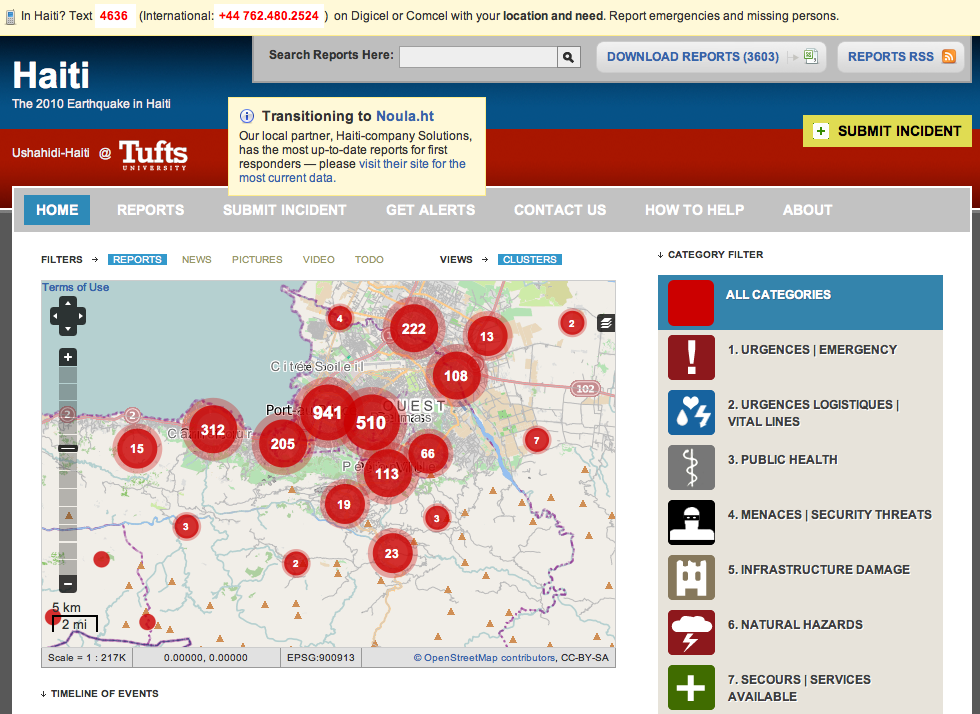
Take the case of Haiti, for example. Within 48 hours of the devastating earthquake that struck Port-au-Prince in 2010, a dedicated SMS short code was set up to crowdsource information on the urgent needs of the disaster-affected population. This would not have been possible without the partnership with Digicel Haiti since they’re the ones who provided the free SMS short code that enabled anyone in Haiti to text in their most urgent needs and location.

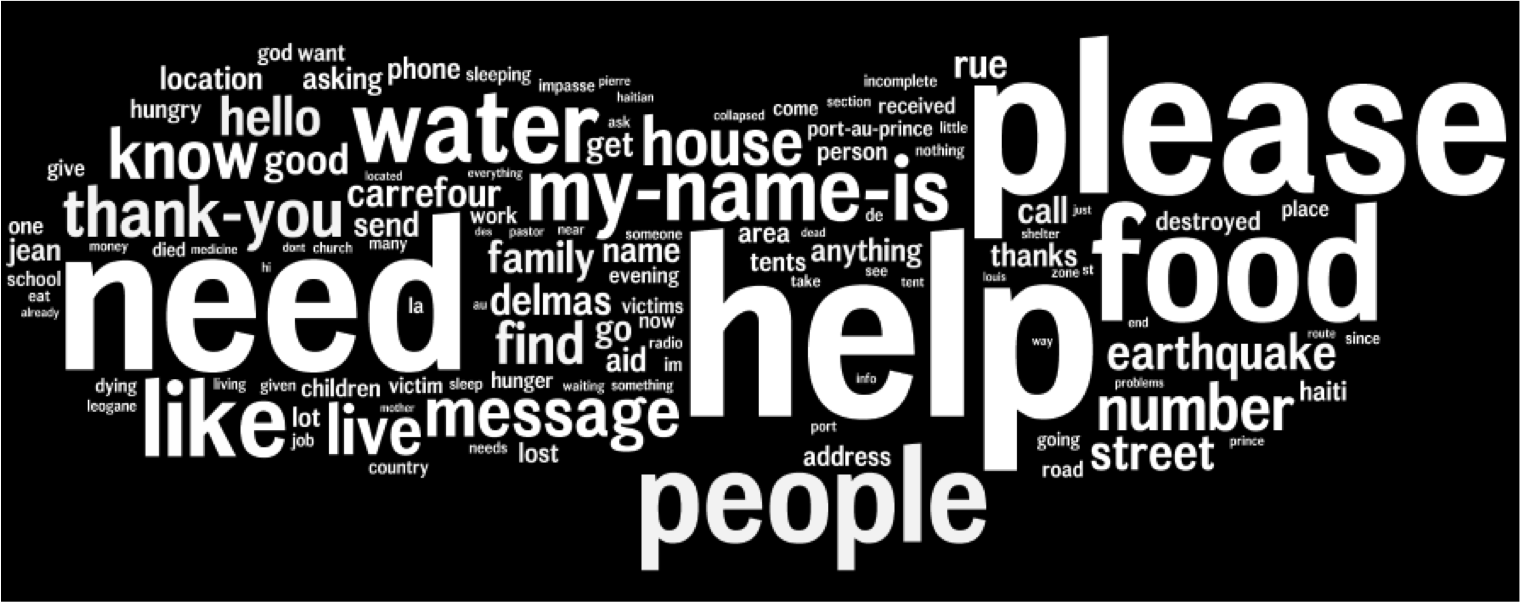
This graphic depicts the words that appeared most frequently in the text messages that were received during the first two weeks after the earthquake. Obviously, the original text messages were in Haitian Creole, so  volunteers from the Diaspora translated some 80,000 SMS’s during the entire 3-month operation. From these, the most urgent life-and-death text messages were identified and geo-located as quickly as possible.

The result was a live crisis map of Haiti, which became the most comprehensive and up-to-date information available to the humanitarian community. In fact, one first-responder noted that the live map helped them save hundreds of lives during their search and rescue operations.

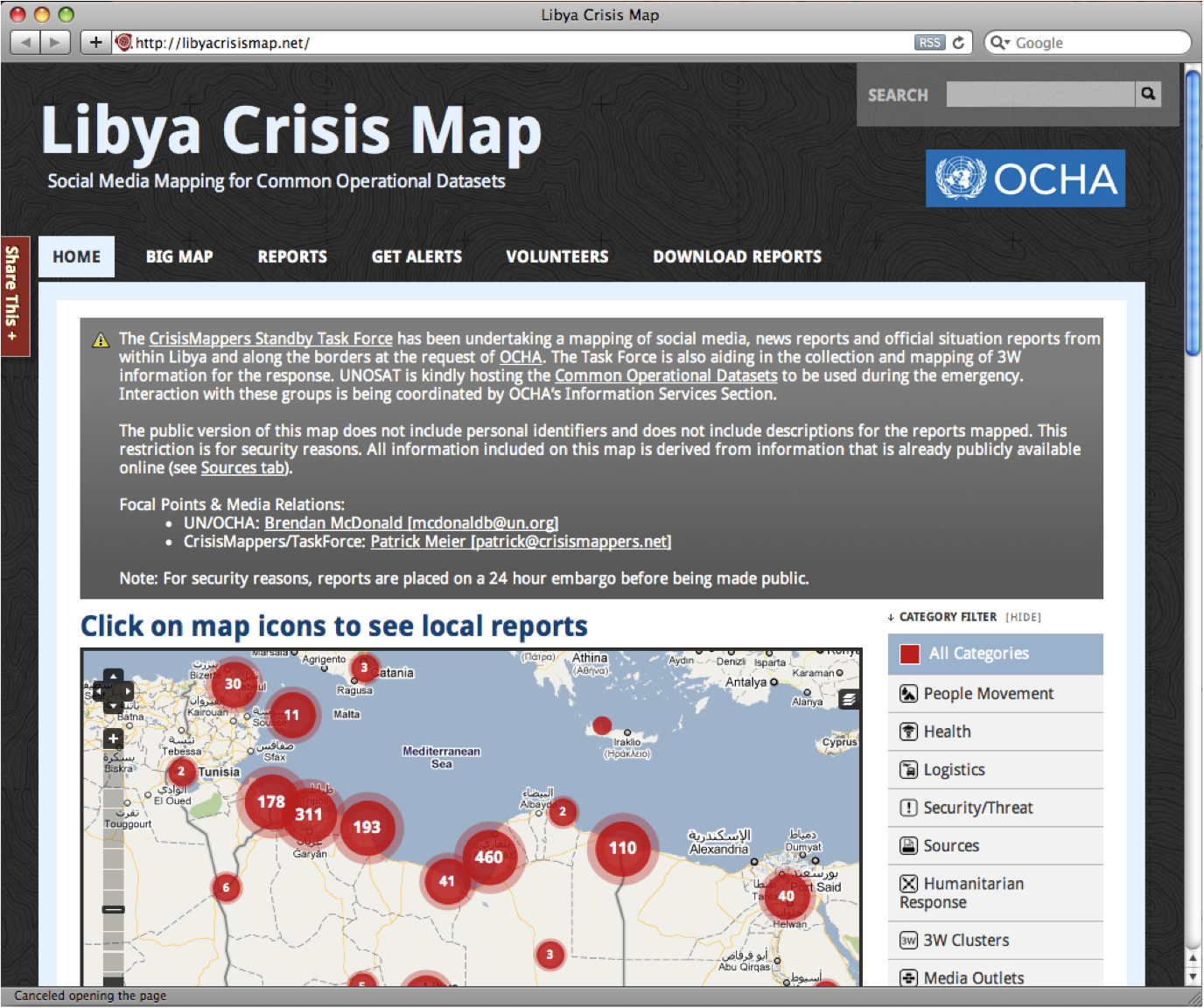
Live crisis maps are critical for disaster response because they can provide real-time situational awareness, like this official UN Crisis Map of Libya. Because the UN Office for the Coordination of Humanitarian Affairs (UN OCHA) did not have information management officers in-country when the crisis began to escalate, they turned to the crisis-affected population for real-time information on the rapidly changing situation. Indeed, a lot of local and relevant user-generated content was already being shared via Twitter, Flickr and YouTube.

The result was this crowdsourced social media map which was used not only by OCHA but also by the World Food Program and other humanitarian organiza-tions. Needless to say, the majority of the rich, multi-media content that populated this map was generated thanks to mobile technology.

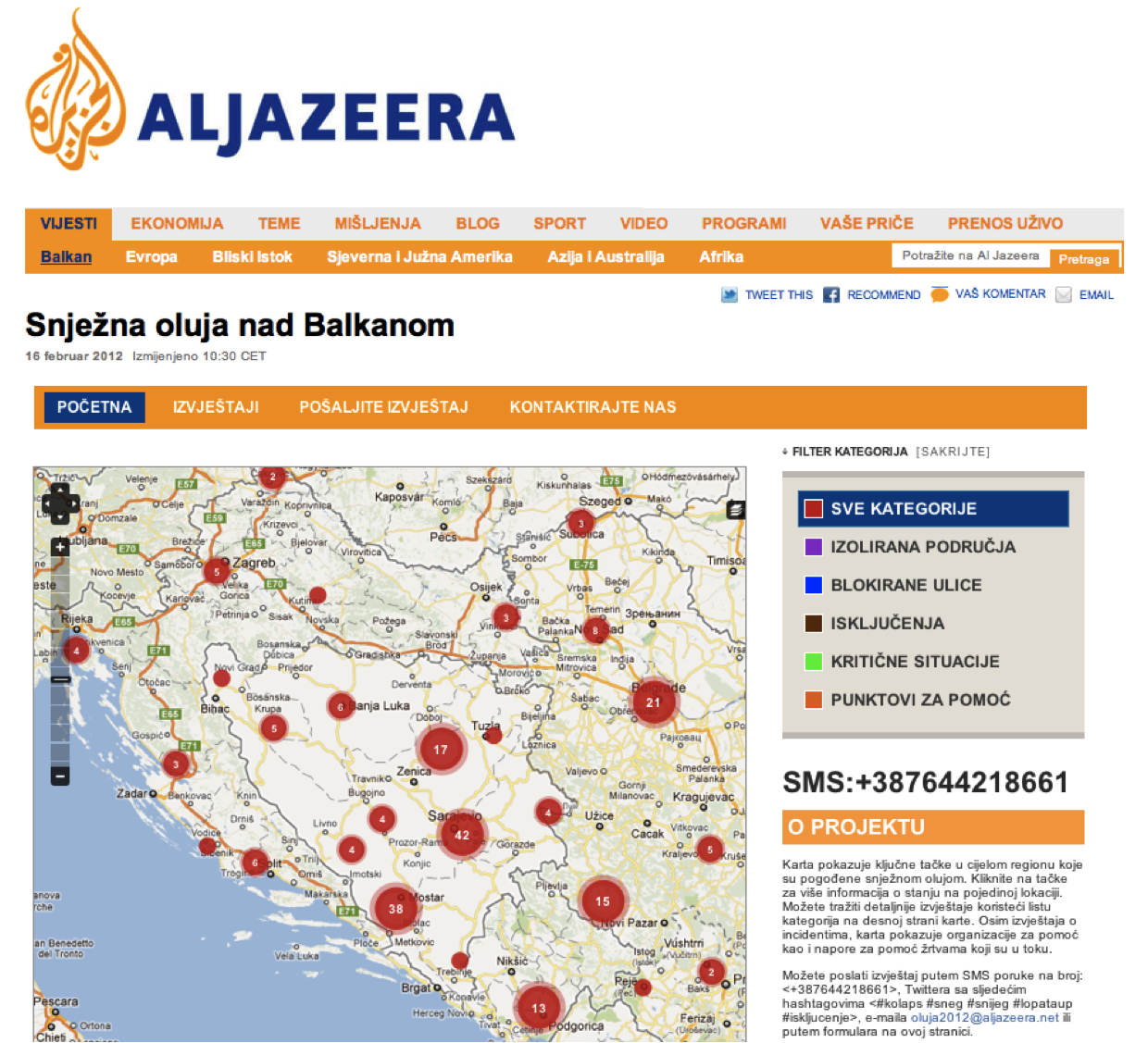
Humanitarian organizations are not the only groups using mobile technologies and crisis mapping platforms. Indeed, the mainstream media plays an instrumental role following a disaster. Their ability to widely and rapidly disseminate information to disaster affected populations is absolutely critical for disaster response. And they too are turning to live crisis maps to do this. Just a few weeks ago, Al-jazeera launched this live map to document the impact of the snowstorm emergency in the Balkans.

The map became the most viewed page on the Al-jazeera Balkans website for several weeks running, a clear testament to the demand for this type information and medium. This is actually the third time that Al-jazeera has leveraged mobile technologies for crisis mapping. Just two short months ago, we partnered with Al-jazeera to run a similar project in Somalia using an SMS short code.

There is no doubt that access to information is as important as access to food and water. In fact, sometimes information is the only help that can be made available, especially when isolated populations are cut off and beyond the reach of traditional aid. So while we talk of humanitarian aid and food relief, we also need to talk about “information aid” and “information relief”. Indeed, we have a “World Food Program” but we don’t have a “World Information Program” for communicating with disaster-affected populations.

This explains why I very much welcome and applaud the GSMA for launching their Disaster Response Program. It is perfectly clear that telecommunications companies are pivotal to the efforts just described. I thus look forward to collaborating with this new working group and hope that we’ll begin our conver-sations by addressing the pressing need and challenge to provide disaster-affected populations with free “information rations” (i.e., limited but free voice calls and SMS) in the immediate aftermath of a major disaster.

Some Thoughts on Real-Time Awareness for Tech@State

I’ve been invited to present at Tech@State in Washington DC to share some thoughts on the future of real-time awareness. So I thought I’d use my blog to brainstorm and invite feedback from iRevolution readers. The organizers of the event have shared the following questions with me as a way to guide the conver-sation: Where is all of this headed?  What will social media look like in five to ten years and what will we do with all of the data? Knowing that the data stream can only increase in size, what can we do now to prepare and prevent being over-whelmed by the sheer volume of data?

These are big, open-ended questions, and I will only have 5 minutes to share some preliminary thoughts. I shall thus focus on how time-critical crowdsourcing can yield real-time awareness and expand from there.

Two years ago, my good friend and colleague Riley Crane won DARPA’s $40,000 Red Balloon Competition. His team at MIT found the location of 10 weather balloons hidden across the continental US in under 9 hours. The US covers more than 3.7 million square miles and the balloons were barely 8 feet wide. This was truly a needle-in-the-haystack kind of challenge. So how did they do it? They used crowdsourcing and leveraged social media—Twitter in particular—by using a “recursive incentive mechanism” to recruit thousands of volunteers to the cause. This mechanism would basically reward individual participants financially based on how important their contributions were to the location of one or more balloons. The result? Real-time, networked awareness.

Around the same time that Riley and his team celebrated their victory at MIT, another novel crowdsourcing initiative was taking place just a few miles away at The Fletcher School. Hundreds of students were busy combing through social and mainstream media channels for actionable and mappable information on Haiti following the devastating earthquake that had struck Port-au-Prince. This content was then mapped on the Ushahidi-Haiti Crisis Map, providing real-time situational awareness to first responders like the US Coast Guard and US Marine Corps. At the same time, hundreds of volunteers from the Haitian Diaspora were busy translating and geo-coding tens of thousands of text messages from disaster-affected communities in Haiti who were texting in their location & most urgent needs to a dedicated SMS short code. Fletcher School students filtered and mapped the most urgent and actionable of these text messages as well.

One year after Haiti, the United Nation’s Office for the Coordination of Humanitarian Affairs (OCHA) asked the Standby Volunteer Task Force (SBTF) , a global network of 700+ volunteers, for a real-time map of crowdsourced social media information on Libya in order to improve their own situational awareness. Thus was born the Libya Crisis Map.

The result? The Head of OCHA’s Information Services Section at the time sent an email to SBTF volunteers to commend them for their novel efforts. In this email, he wrote:

“Your efforts at tackling a difficult problem have definitely reduced the information overload; sorting through the multitude of signals on the crisis is no easy task. The Task Force has given us an output that is manageable and digestible, which in turn contributes to better situational awareness and decision making.”

These three examples from the US, Haiti and Libya demonstrate what is already possible with time-critical crowdsourcing and social media. So where is all this headed? You may have noted from each of these examples that their success relied on the individual actions of hundreds and sometimes thousands of volunteers. This is primarily because automated solutions to filter and curate the data stream are not yet available (or rather accessible) to the wider public. Indeed, these solutions tend to be proprietary, expensive and/or classified. I thus expect to see free and open source solutions crop up in the near future; solutions that will radically democratize the tools needed to gain shared, real-time awareness.

But automated natural language processing (NLP) and machine learning alone are not likely to succeed, in my opinion. The data stream is actually not a stream, it is a massive torent of non-indexed information, a 24-hour global firehose of real-time, distributed multi-media data that continues to outpace our ability to produce actionable intelligence from this torrential downpour of 0’s and 1’s. To turn this data tsunami into real-time shared awareness will require that our filtering and curation platforms become more automated and collaborative. I believe the key is thus to combine automated solutions with real-time collabora-tive crowdsourcing tools—that is, platforms that enable crowds to collaboratively filter and curate real-time information, in real-time.

Right now, when we comb through Twitter, for example, we do so on our own, sitting behind our laptop, isolated from others who may be seeking to filter the exact same type of content. We need to develop free and open source platforms that allow for the distributed-but-networked, crowdsourced filtering and curation of information in order to democratize the sense-making of the firehose. Only then will the wider public be able to win the equivalent of Red Balloon competitions without needing $40,000 or a degree from MIT.

I’d love to get feedback from readers about what other compelling cases or arguments I should bring up in my presentation tomorrow. So feel free to post some suggestions in the comments section below. Thank you!

Information Forensics: Five Case Studies on How to Verify Crowdsourced Information from Social Media

My 20+ page study on verifying crowdsourced information is now publicly available here as a PDF and here as an open Google Doc for comments. I very much welcome constructive feedback from iRevolution readers so I can improve the piece before it gets published in an edited book next year.

Abstract

False information can cost lives. But no information can also cost lives, especially in a crisis zone. Indeed, information is perishable so the potential value of information must be weighed against the urgency of the situation. Correct information that arrives too late is useless. Crowdsourced information can provide rapid situational awareness, especially when added to a live crisis map. But information in the social media space may not be reliable or immediately verifiable. This may explain why humanitarian (and news) organizations are often reluctant to leverage crowdsourced crisis maps. Many believe that verifying crowdsourced information is either too challenging or impossible. The purpose of this paper is to demonstrate that concrete strategies do exist for the verification of geo-referenced crowdsourced social media information. The study first provides a brief introduction to crisis mapping and argues that crowdsourcing is simply non-probability sampling. Next, five case studies comprising various efforts to verify social media are analyzed to demonstrate how different verification strategies work. The five case studies are: Andy Carvin and Twitter; Kyrgyzstan and Skype; BBC’s User-Generated Content Hub; the Standby Volunteer Task Force (SBTF); and U-Shahid in Egypt. The final section concludes the study with specific recommendations.

Update: See also this link and my other posts on Information Forensics.